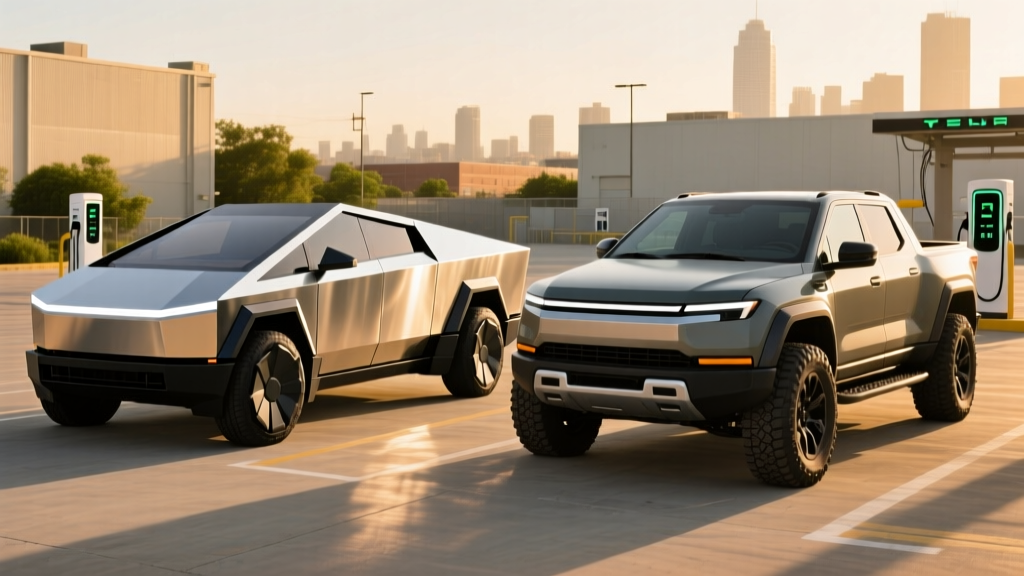
Two radically different philosophies define the electric pickup segment in 2026. Tesla's Cybertruck leans into stainless-steel brutalism, a 48-volt architecture, and steer-by-wire. Rivian's R1T (now in its Gen 2 refresh) takes a more traditional truck silhouette, packs a quad-motor option with over 1,000 horsepower, and targets the adventure-outdoor buyer. Both are compelling, but they solve different problems. Here is the data-driven breakdown you need before signing a purchase agreement.
Side-by-Side Specs: Cybertruck vs Rivian R1T at a Glance
The table below compares the most popular dual-motor configurations buyers actually cross-shop. Tri-motor and quad-motor variants are noted where relevant.
| Spec | 2026 Tesla Cybertruck (AWD) | 2026 Rivian R1T Dual-Motor (Standard Battery) |
|---|---|---|
| EPA Range | 340 mi | 270 mi (Standard) / 352 mi (Max) |
| Battery (usable) | ~123 kWh (NMC, 4680 cells) | ~95 kWh (Standard, LFP) / ~149 kWh (Max, NMC) |
| Peak DC Fast Charge | 250 kW | 220 kW (Gen 2) |
| 10-80% DC Charge Time | ~28 min | ~30 min |
| Level 2 AC Charge | 11.5 kW | 11.5 kW |
| 0-60 mph | 4.1 sec (AWD) | 4.5 sec (Dual) / 2.6 sec (Tri-Motor) |
| Horsepower | 600 hp (AWD) | 533 hp (Dual) / 850 hp (Tri) |
| Towing Capacity | 11,000 lbs | 11,000 lbs |
| Payload | 2,500 lbs | 1,760 lbs |
| Bed Length | 6 ft (vault-style) | 4.5 ft (Gear Tunnel adds 11 cu ft) |
| Cargo Volume (total) | 67 cu ft bed + 7 cu ft frunk | Bed + 11 cu ft Gear Tunnel + 11 cu ft frunk |
| Efficiency (MPGe) | ~70 MPGe combined | ~73 MPGe combined |
| Base MSRP | $79,990 (AWD) | $69,900 (Dual-Motor Standard) |
| Battery Warranty | 8 yr / 120,000 mi | 8 yr / 120,000 mi |
| Vehicle Warranty | 4 yr / 50,000 mi | 5 yr / 60,000 mi |
Sources: EPA fueleconomy.gov, Tesla and Rivian official spec sheets. Real-world range typically 10-15% below EPA at sustained highway speeds or in cold weather.
Range, Efficiency, and Real-World Charging
The Cybertruck AWD's 340-mile EPA rating looks strong on paper, but its 6,800-lb curb weight and un-aerodynamic angular profile work against it at highway speeds. In independent highway testing at 70 mph, expect closer to 270-290 miles before needing to plug in. Cold-weather highway driving can drop that to 230-250 miles despite the heat pump.
The R1T with the Standard Battery (LFP chemistry) posts a lower 270-mile EPA figure, but LFP cells handle cold somewhat better than NMC and tolerate repeated 100% charging without accelerated degradation. The R1T Max Pack (149 kWh, NMC) achieves 352 miles EPA, which is the segment leader—though at a significant price premium.
- Cybertruck AWD: EPA 340 mi → expect 270-290 mi highway, 230-250 mi cold
- R1T Dual-Motor Standard: EPA 270 mi → expect 220-240 mi highway, 190-210 mi cold
- R1T Max Pack: EPA 352 mi → expect 290-310 mi highway, 260-280 mi cold
Charging speed is close. The Cybertruck peaks at 250 kW on Tesla's V3 Superchargers, though the charge curve tapers sharply past 60% SoC. The R1T Gen 2 peaks at 220 kW and sustains that rate longer through the mid-range, making 10-80% times nearly identical (~28-30 minutes). The Cybertruck's NACS connector gives it native access to Tesla's Supercharger network (over 25,000 stalls in North America), which remains the most reliable DC fast-charging ecosystem. Rivian uses NACS as of 2025 model year vehicles, so both trucks now charge natively at Superchargers.
At 352 miles EPA and 73 MPGe, the R1T Max Pack edges out the Cybertruck. For the Standard Battery, however, the Cybertruck AWD wins on range per dollar.
Both use NACS natively. Both access Tesla Superchargers. Rivian also has its own Adventure Network (expanding), giving it a slight edge in destination-charging at outdoor locations.
Performance, Towing, and Capability
Both trucks tow 11,000 lbs—enough for most boat trailers, campers, and horse trailers. The Cybertruck's steer-by-wire system provides a tight 35-foot turning circle (better than many compact sedans), which is a genuine advantage on tight trails and in parking structures. However, steer-by-wire lacks traditional road feel, and some drivers find it disorienting at highway speeds during the first few weeks of ownership.
The Rivian R1T Tri-Motor variant (850 hp) is the performance king of this segment with a 2.6-second 0-60 time, making it one of the quickest production vehicles ever built. The standard Dual-Motor at 533 hp and 4.5 seconds is more than adequate for daily driving and merging.
Off-road, the R1T has a clear advantage. Its air suspension offers 14.9 inches of ground clearance in Max mode, a wading depth of 3+ feet, and approach/departure angles that outclass the Cybertruck. The Gear Tunnel (an 11-cu-ft pass-through storage compartment behind the cab) is a genuinely innovative feature for skis, fishing rods, or camping gear that the Cybertruck has no equivalent for. The Cybertruck's stainless-steel exoskeleton dents less easily than painted aluminum, but its sharp body lines create real pedestrian-safety concerns and limit aftermarket accessory options.
2.6-second 0-60, 850 hp. The Cybertruck Beast (tri-motor) runs 2.6 sec too, but at $99,990+ MSRP.
Air suspension, Gear Tunnel, better approach angles, and a traditional bed make the R1T more versatile for adventure use.
Pricing, Tax Credits, and Total Cost of Ownership
Price is where this comparison gets interesting—and where IRS §30D tax credit eligibility can flip the value verdict entirely.
| Cost Factor | Cybertruck AWD | R1T Dual-Motor Standard |
|---|---|---|
| Base MSRP | $79,990 | $69,900 |
| §30D Federal Tax Credit (est.) | $0 (exceeds $80K MSRP cap for trucks) | Up to $7,500 (if income/sourcing qualify) |
| Effective Price (best case) | $79,990 | ~$62,400 |
| Est. 5-Year Electricity Cost (15K mi/yr) | ~$6,400 | ~$6,100 |
| Est. 5-Year Insurance | ~$18,000-22,000 | ~$14,000-18,000 |
| Est. 5-Year Maintenance | ~$2,500 | ~$2,800 |
| Est. 5-Year Total Cost of Ownership | ~$106,000-110,000 | ~$85,000-89,000 |
Critical tax credit note: The §30D credit has an $80,000 MSRP cap for trucks and vans. The Cybertruck AWD at $79,990 technically squeaks under, but the Cyberbeast and any options that push MSRP above $80,000 disqualify it. Additionally, the buyer must meet income caps ($300K joint / $150K single), and the vehicle must satisfy critical-mineral and battery-component sourcing requirements that change annually. Always verify current-year eligibility on IRS.gov or with a tax professional. Point-of-sale transfer is available if eligible, reducing your dealer payment directly.
Insurance is notably higher on the Cybertruck due to its stainless-steel unibody construction (costly to repair), limited aftermarket body-shop familiarity, and Tesla's direct-repair model. Rivian insurance is also above average for the segment but generally 15-20% cheaper than Cybertruck premiums in most states.
Lower MSRP, tax-credit eligible, lower insurance. The effective price gap can exceed $17,000.
Superior UI responsiveness, OTA update cadence, and Supercharger network integration. Rivian's software is good but not Tesla-good.
Interior, Tech, and Driver-Assistance
The Cybertruck's interior is minimalist in the extreme: a single 18.5-inch touchscreen handles nearly all functions, including climate and mirror adjustments. There are no physical stalks (turn signals are steering-wheel buttons). This polarizes buyers—some love the clean aesthetic, others find it distracting during real driving. Build quality on 2025-2026 Cybertrucks has improved significantly over early 2024 units, but panel gaps and squeaks remain more common than on the R1T.
The R1T's cabin feels more like a premium midsize SUV, with physical buttons for climate, a 15.6-inch center display, a 12.3-inch driver cluster, and available wood/vegan-leather trim. It seats five comfortably. The R1T's software received a major Gen 2 overhaul with improved route planning, better regenerative-braking customization, and a more intuitive camp-mode feature.
Tesla's FSD (Supervised) offers more ambitious feature coverage (city-street navigation, traffic-light recognition), but it requires constant vigilance and has drawn NHTSA scrutiny. Rivian's Driver+ is more conservative, activating primarily on highways, but it is reliable and less prone to phantom-braking events. Both trucks offer adaptive cruise, lane-centering, and automatic emergency braking as standard.
Decision Framework: Which Truck Fits Your Life?
- You prioritize maximum Supercharger network convenience and Tesla's software ecosystem
- You want steer-by-wire maneuverability and a tight turning radius
- You prefer a stainless-steel body that resists dents and doesn't need paint
- You're a current Tesla owner already embedded in the Powerwall/Solar/charging ecosystem
- Budget flexibility allows the $80K+ entry without tax-credit reliance
- You need genuine off-road capability (air suspension, wading, approach angles)
- The Gear Tunnel and traditional bed shape serve your gear-hauling needs
- You want tax-credit eligibility and a lower total cost of ownership
- You prefer a more conventional driving feel (physical controls, traditional steering)
- You want the Tri-Motor option for supercar-level acceleration
- You value Rivian's Adventure Network at trailheads, national parks, and ski resorts
- 340-mile EPA range, 250 kW charging
- Best-in-class Supercharger access
- Stainless-steel durability
- 35-foot turning circle
- Strong OTA update cadence
- $79,990+ MSRP, limited tax-credit eligibility
- High insurance premiums
- Steer-by-wire learning curve
- Polarizing design limits resale appeal
- Limited aftermarket and accessory ecosystem
- $69,900 starting price, §30D eligible
- Best-in-class off-road capability
- Gear Tunnel is a genuine innovation
- Tri-Motor option: 2.6-sec 0-60
- More traditional driving feel
- Standard Battery range is only 270 mi EPA
- Smaller service-center network vs. Tesla
- Software still maturing vs. Tesla
- Max Pack is expensive ($90K+)
- Lower payload (1,760 lbs vs. 2,500)
Final Recommendation
There is no universal winner. The Rivian R1T is the better truck for most buyers: lower entry price, tax-credit eligibility, superior off-road chops, and a more practical bed-and-storage layout. It is the smarter financial choice, with 5-year total cost of ownership running $17,000-$21,000 lower than the Cybertruck AWD.
The Tesla Cybertruck wins for buyers who prioritize Tesla's software and Supercharger ecosystem, who value the stainless-steel body's durability, and who are comfortable paying a premium for a more unconventional driving experience. If you already own a Tesla and rely on Superchargers for road trips, the Cybertruck integrates seamlessly into that life.
Test-drive both. The steer-by-wire feel and the R1T's air-suspension ride quality are the two things spec sheets cannot convey—and they usually decide the purchase.
Frequently Asked Questions
Does the Cybertruck qualify for the $7,500 federal tax credit?
It depends. The AWD trim at $79,990 MSRP is under the $80,000 truck cap, but adding options can push it over. You must also meet income limits ($300K joint / $150K single) and the vehicle must satisfy evolving critical-mineral and battery-component sourcing rules. Verify current-year eligibility at IRS.gov.
Which truck tows better in real-world conditions?
Both are rated for 11,000 lbs. In practice, towing at maximum capacity reduces range by 40-50% on both trucks. The Cybertruck's larger battery (123 kWh) gives it a slight range buffer while towing, but the R1T's more aerodynamic profile partially offsets this at highway speeds.
Can I use Tesla Superchargers with a Rivian R1T?
Yes. Starting with the 2025 model year, Rivian switched to the NACS connector, giving R1T owners native access to Tesla's Supercharger network without an adapter.
Which truck handles cold weather better?
The R1T with the LFP Standard Battery handles cold-weather charging slightly better (LFP chemistry is more cold-tolerant), but the Cybertruck's larger NMC battery gives it more absolute range in cold conditions. Both trucks use heat pumps, which help preserve range in winter. Expect 20-30% range reduction in sub-freezing highway driving for either vehicle.
What is the real cost difference over 5 years?
Based on 15,000 miles/year, national-average electricity rates, and typical insurance premiums, the R1T Dual-Motor Standard costs roughly $85,000-$89,000 over 5 years (including purchase price minus estimated tax credit). The Cybertruck AWD runs $106,000-$110,000 over the same period, primarily due to higher purchase price, higher insurance, and no tax credit in many configurations.