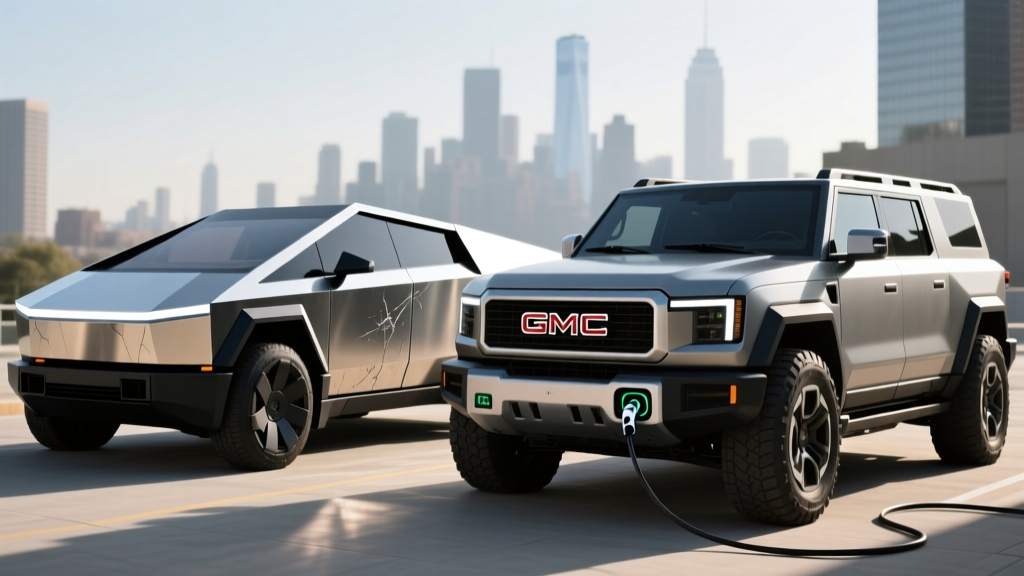
The Tesla Cybertruck and GMC Hummer EV are the two most polarizing electric pickups on the road. Both are heavy, angular, and loaded with enough battery capacity to power a small neighborhood. But beneath the polarizing sheet metal, they solve fundamentally different problems. One prioritizes efficiency-per-ton and charging infrastructure dominance; the other trades range for brute-force off-road capability and a party-trick CrabWalk. If you're cross-shopping these two in 2026, the decision comes down to how you'll actually use a 9,000-pound electric truck — and whether your daily driving involves a cul-de-sac or a rock crawl.
Side-by-Side: Cybertruck vs Hummer EV by the Numbers
Before we get into subjective impressions, here's the raw data. All figures reflect 2026 model-year specs for the dual-motor Cybertruck AWD and the Hummer EV 2X (dual-motor). Tri-motor variants are noted where relevant.
| Specification | Tesla Cybertruck (Dual Motor AWD) | GMC Hummer EV 2X (Dual Motor) |
|---|---|---|
| EPA Range | 340 mi | 314 mi |
| Battery Capacity (usable) | ~123 kWh (NMC) | ~212 kWh (NMC, Ultium) |
| Battery Chemistry | NMC (2170 cells, structural pack) | NMC (Ultium pouch cells, double-stacked) |
| Peak DC Fast Charge | ~250 kW (800V architecture) | ~350 kW (800V architecture) |
| 10–80% DC Charge Time | ~22 min (est.) | ~34 min (est.) |
| Level 2 Charge Rate | 11.5 kW (48A) | 11.5 kW (48A) |
| Horsepower | 600 hp | 625 hp |
| 0–60 mph | 3.9 sec | 4.5 sec |
| Curb Weight | ~6,603 lbs | ~9,063 lbs |
| Max Towing | 11,000 lbs | 8,500 lbs |
| Cargo (Bed + Frunk) | ~67 cu ft (bed) + 7 cu ft (frunk) | ~37 cu ft (bed) + 5.7 cu ft (eTrunk) |
| EPA Efficiency | ~58 MPGe (est. 2.0 kWh/mi) | ~47 MPGe (est. 2.6 kWh/mi) |
| Base MSRP | $79,990 | $98,545 |
| Federal §30D Tax Credit | Not eligible (MSRP cap + sourcing) | Not eligible (MSRP cap) |
| Battery / Powertrain Warranty | 8 yr / 120,000 mi | 8 yr / 100,000 mi |
Range and Efficiency: Physics Favors the Lighter Truck
The Cybertruck's 340-mile EPA rating beats the Hummer EV's 314 miles, but the real story is why. The Hummer lugs a 212 kWh Ultium battery — nearly double the Cybertruck's ~123 kWh pack — yet goes 26 fewer miles per charge. That's a massive efficiency gap driven by the Hummer's 9,063-pound curb weight (roughly 2,400 lbs heavier than the Cybertruck) and its boxy, barn-door aerodynamics.
Cybertruck: EPA 340 mi — expect ~270–295 mi sustained highway driving at 70+ mph; ~230–260 mi in sub-30°F cold weather with cabin heat.
Hummer EV: EPA 314 mi — expect ~245–270 mi highway; ~200–235 mi in cold conditions. The Hummer's massive battery gives it a buffer advantage, but its weight and drag compound losses at speed.
If you're a highway commuter covering 200+ miles between charges, the Cybertruck's efficiency advantage translates to fewer stops and lower electricity costs. If you mostly drive locally and charge overnight, the Hummer's range deficit matters less — but you'll still pay for every one of those 9,063 pounds at the charger.
340 mi EPA, ~2.0 kWh/mi. Lighter weight and better aero make it meaningfully cheaper to drive per mile.
Charging Speed and Network Access
Both trucks use 800V architectures, enabling fast DC charging. But raw peak kW only tells part of the story — battery size and charge-curve behavior determine how long you actually sit at a plug.
| Metric | Cybertruck | Hummer EV |
|---|---|---|
| Peak DC Rate | ~250 kW | ~350 kW |
| 10–80% Time | ~22 min | ~34 min |
| Miles Added in 15 min | ~170 mi (est.) | ~140 mi (est.) |
| Connector | NACS (native) | CCS1 (NACS adapter available) |
| Supercharger Access | Full native access | Requires NACS adapter; limited V4 stalls |
The Hummer's higher peak charge rate (350 kW vs. 250 kW) sounds impressive, but it's filling a 212 kWh battery versus the Cybertruck's 123 kWh. The result: the Cybertruck charges from 10–80% roughly 12 minutes faster. On a road trip, that's a meaningful difference — especially when the kids are restless.
Network access is another Cybertruck advantage. Tesla's native NACS connector plugs directly into the Supercharger network — the most reliable and widespread DC fast-charging system in North America. The Hummer uses CCS1 and requires an adapter to access Superchargers, and not all Supercharger V4 stalls are optimized for non-Tesla vehicles yet. For Electrify America or EVgo charging, both trucks work natively (CCS) or via adapter.
Preconditioning matters: Both trucks will precondition the battery when you navigate to a charger, but Tesla's integrated navigation-to-charger preconditioning is more seamless. On the Hummer, you'll want to manually activate preconditioning ~15 minutes before arrival at a DC fast charger to hit peak kW.
Faster 10–80% time, native NACS, and best-in-class Supercharger network access.
Performance, Capability, and Off-Road
The Cybertruck hits 60 mph in 3.9 seconds — half a second quicker than the Hummer EV 2X. The tri-motor Cybertruck Cyberbeast drops that to 2.6 seconds, while the tri-motor Hummer EV 3X manages a claimed 3.0 seconds. For a vehicle that weighs as much as two Honda Civics, the Cybertruck's acceleration is genuinely startling.
But straight-line speed isn't where the Hummer makes its case. The Hummer EV's party pieces are off-road: CrabWalk (four-wheel steering that moves diagonally), Extract Mode (adaptive air suspension that lifts the body ~6 inches for rock crawling), and 16 inches of ground clearance at max ride height. The Hummer also offers underbody armor, locking differentials, and a wade-depth rating for water crossings.
The Cybertruck's air suspension provides up to 17 inches of ground clearance and a reasonable approach/departure angle, but it lacks the Hummer's dedicated off-road hardware. Tesla's off-road mode is a software overlay, not a purpose-built trail system. If Moab weekends are on your calendar, the Hummer is the clear tool for the job.
Towing goes the other way: the Cybertruck's 11,000-lb rating beats the Hummer's 8,500 lbs. If you're pulling a boat or camper, the Cybertruck has the edge — though note that towing at max capacity will cut real-world range by 40–50% on either truck.
CrabWalk, Extract Mode, locking diffs, and purpose-built trail hardware.
11,000 lbs max tow rating, 2,500 lbs more than the Hummer.
Pricing, Tax Credits, and Total Cost of Ownership
Here's where the math gets interesting — and where most buyers get tripped up on incentives.
| Cost Factor | Cybertruck (Dual Motor AWD) | Hummer EV 2X |
|---|---|---|
| Base MSRP | $79,990 | $98,545 |
| Federal §30D Credit | $0 (exceeds $80K truck MSRP cap) | $0 (exceeds $80K truck MSRP cap) |
| Estimated Out-the-Door (base) | ~$83,000–$85,000 | ~$102,000–$106,000 |
| 5-Year Electricity Cost (15K mi/yr) | ~$4,500 (at $0.15/kWh) | ~$5,850 (at $0.15/kWh) |
| Estimated Annual Insurance | $2,800–$3,600 | $3,200–$4,200 |
| 5-Year Maintenance (est.) | ~$1,500 | ~$1,800 |
Neither truck qualifies for the federal §30D EV tax credit. Under current IRS rules, trucks must have an MSRP at or below $80,000 to be eligible. The base Cybertruck Dual Motor AWD at $79,990 squeaks under the cap — but destination fees and any option push it over. The Hummer EV is well above the threshold at any trim. Both trucks also face potential battery-sourcing and critical-mineral requirements that further complicate eligibility. Consult a tax professional before counting on any federal incentive for either vehicle.
Some states offer their own EV rebates or registration-fee reductions that may apply regardless of MSRP — check your state's energy office or fueleconomy.gov for local programs.
On the ownership-cost side, the Cybertruck's superior efficiency saves roughly $1,350 in electricity over five years at average residential rates. Insurance is notably expensive for both vehicles — the Cybertruck's stainless-steel body panels and specialized repair requirements drive premiums high, while the Hummer's $100K+ replacement cost and weight do the same. Budget $3,000–$4,000/year for insurance on either truck unless your carrier offers an EV-specific program.
~$18,500 lower base price, lower energy costs, and better Supercharger access reduce total cost of ownership.
Interior, Tech, and Daily Livability
The Cybertruck's cabin is aggressively minimalist: an 18.5-inch center touchscreen controls nearly everything, with a yoke-style steering wheel (a conventional round wheel is available). Material quality has improved since the 2024 launch, but the interior still reads as utilitarian — which is either refreshing or disappointing depending on your expectations at this price point. Rear-seat space is tight for adults on long trips, and the tonneau-covered bed limits vertical cargo.
The Hummer EV's interior is more conventionally luxurious, with available leather, a 13.4-inch infotainment screen plus a 12.3-inch driver display, and physical controls for off-road modes. The removable roof panels (stored in the frunk) give it an open-air experience the Cybertruck can't match. The Infinity Roof is a genuine differentiator for anyone who enjoys top-down trail driving. Rear seat room is generous, and the four-door crew-cab layout is more practical for families.
On the driver-assistance front, both trucks offer Level 2 systems — Tesla's Autopilot (with optional FSD Supervised) and GM's Super Cruise. Neither is self-driving. Super Cruise excels on pre-mapped divided highways with genuine hands-free capability (eyes-on required). Tesla's Autopilot is more versatile across road types but requires hands on the wheel. For long interstate commutes, Super Cruise is the more relaxing system.
Both Tesla Autopilot/FSD Supervised and GM Super Cruise are SAE Level 2 driver-assistance systems. You must remain engaged, monitor the road, and be prepared to take over at any moment. Neither system is autonomous (Level 4/5). Treat marketing names like "Full Self-Driving" as feature branding, not capability descriptions.
More conventional luxury, removable roof panels, better rear-seat space, and physical off-road controls.
OTA updates, integrated Supercharger routing, and Tesla's software ecosystem remain ahead.
Decision Framework: Which Truck Fits Your Life?
Choose the Tesla Cybertruck if:
- You prioritize range efficiency and want the most miles per kWh
- Road trips are frequent and Supercharger network reliability matters
- You need max towing capacity (11,000 lbs)
- You want a lower entry price (~$79,990 base)
- You prefer a minimalist, software-forward cabin
- Daily driving is your primary use case, with occasional light off-road
Choose the GMC Hummer EV if:
- Serious off-roading (rock crawling, trails, water crossings) is a priority
- You want an open-air experience with removable roof panels
- Interior luxury and rear-seat passenger comfort matter
- GM Super Cruise hands-free highway driving appeals to your commute
- You value CrabWalk and four-wheel steering for tight trails or parking
- Budget is flexible and $100K+ is acceptable
Frequently Asked Questions
Which has better real-world range, the Cybertruck or Hummer EV?
The Cybertruck. Its EPA rating is 340 miles versus the Hummer's 314 miles, and the gap widens in real-world highway and cold-weather driving due to the Cybertruck's lighter weight and better aerodynamics. Expect ~270–295 real-world highway miles from the Cybertruck and ~245–270 from the Hummer EV.
Can either truck qualify for the $7,500 federal EV tax credit?
Practically, no. Both exceed or effectively exceed the $80,000 MSRP cap for trucks under IRS §30D rules once destination and options are included. Battery-sourcing and critical-mineral requirements add further barriers. State-level incentives may still apply — check your local programs.
How long does it take to charge each truck at a DC fast charger?
The Cybertruck charges 10–80% in approximately 22 minutes at a 250 kW Supercharger. The Hummer EV takes roughly 34 minutes at a 350 kW-capable station due to its much larger 212 kWh battery. At Level 2 (11.5 kW), both trucks require an overnight session — roughly 10–11 hours for the Cybertruck and 18+ hours for the Hummer from empty.
Is the Hummer EV too heavy for daily driving?
At 9,063 lbs, the Hummer EV is one of the heaviest consumer vehicles ever sold. It drives surprisingly well on-road thanks to adaptive air suspension and rear-wheel steering, but tire wear is accelerated, braking distances are longer, and efficiency suffers. If 90% of your driving is commuting and errands, the weight penalty is noticeable. If you're towing, trail-driving, or making short local trips, it's less of an issue.
Which truck holds its value better?
Both trucks have experienced depreciation since launch as initial hype cooled and supply normalized. The Cybertruck's lower starting price gives it a smaller absolute depreciation hit, though early adopters paid significant markups that have not held. Long-term residual values for both are uncertain given the rapidly evolving EV truck segment. Lease or negotiate aggressively on price to mitigate depreciation risk.
What's the best home charging setup for either truck?
Both trucks accept 11.5 kW on Level 2, requiring a 60-amp dedicated circuit (NEMA 14-60 or hardwired wall connector). Expect $1,200–$2,500 for a professional Level 2 installation depending on panel proximity and local permitting. Given the Hummer's 212 kWh battery, you'll want to ensure your electrical panel can sustain an overnight full-charge cycle without overloading — consult a licensed electrician to verify your panel's capacity, especially if you already run a dryer or HVAC on the same service.