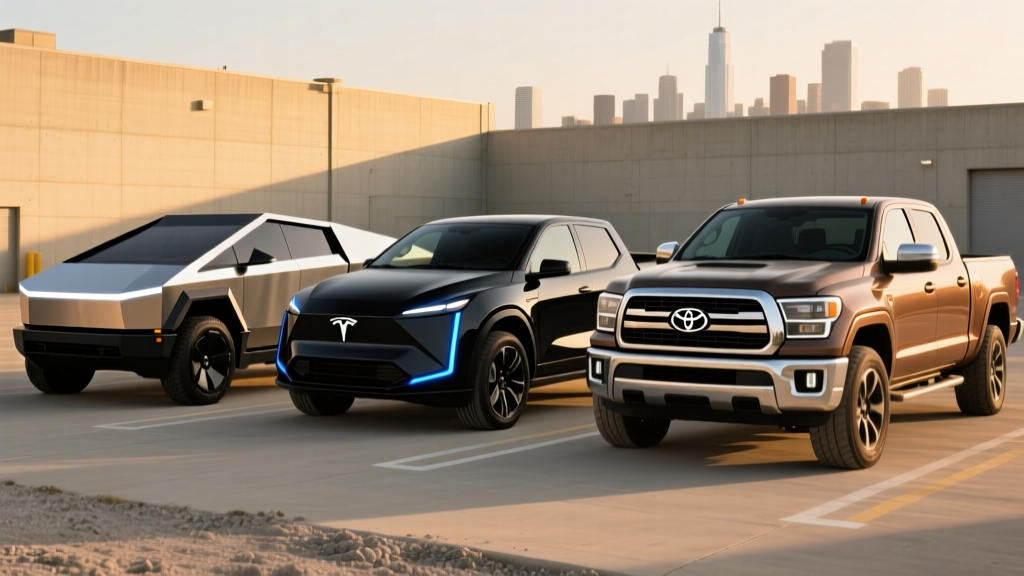
Truck buyers in 2026 face a three-way fork in the road: Tesla's polarizing stainless-steel Cybertruck, Ford's more conventional F-150 Lightning, and Toyota's hybrid-only Tundra i-FORCE MAX. Each takes a radically different approach to powertrain, efficiency, and daily usability. If you're researching Cybertruck vs F-150 Lightning vs Tundra driving dynamics, this comparison breaks down the exact numbers that matter — EPA range, battery chemistry, DC fast-charging curves, real-world highway efficiency, and total ownership cost — so you can match a truck to your actual needs rather than a marketing campaign.
Side-by-Side Spec Table: 2026 Model Year
The table below uses the most popular mid-tier trims: Cybertruck Long Range AWD, F-150 Lightning Lariat Extended Range, and Tundra i-FORCE MAX Limited (hybrid). All figures reflect 2026 model-year manufacturer data and EPA estimates where published.
| Spec | Tesla Cybertruck LR AWD | Ford F-150 Lightning Ext. Range | Toyota Tundra i-FORCE MAX |
|---|---|---|---|
| Powertrain | BEV (dual motor AWD) | BEV (dual motor AWD) | HEV (twin-turbo V6 hybrid) |
| EPA Range / MPG | 340 mi | 320 mi | 20 MPG combined (22 city / 24 hwy est.) |
| Battery / Tank | ~123 kWh usable (NMC) | 131 kWh usable (NMC) | 1.87 kWh hybrid + 32.6-gal tank |
| Peak DC Fast Charge | 250 kW (V3 Supercharger) | 150 kW peak | N/A (gasoline refuel) |
| 10–80% Charge Time | ~28 min | ~41 min (150 kW DC) | ~5 min (gas station) |
| Level 2 Charge Rate | 17.2 kW (80A) | 19.2 kW (80A) | N/A |
| Horsepower / Torque | 600 hp / 687 lb-ft | 580 hp / 775 lb-ft | 437 hp / 583 lb-ft |
| 0–60 mph | 3.9 sec | 4.0 sec | 5.7 sec |
| Max Towing | 11,000 lbs | 10,000 lbs | 12,000 lbs |
| Payload | 2,500 lbs | 2,235 lbs | 1,940 lbs |
| Bed Length / Volume | 6 ft / 67 cu ft | 5.5 ft / 52.8 cu ft | 5.5 ft / 52.8 cu ft (or 6.5 ft option) |
| Base MSRP (trim shown) | ~$79,990 | ~$71,990 | ~$62,500 |
| Federal Tax Credit (§30D) | Not eligible (MSRP cap exceeded) | Not eligible (MSRP cap exceeded for trucks: $80K, but sourcing may limit) | Not eligible (HEV, not PHEV/BEV) |
| Drivetrain Warranty | 8 yr / 120,000 mi (battery) | 8 yr / 100,000 mi (battery) | 10 yr / 100,000 mi (hybrid components) |
Note on §30D tax credits: The IRS clean vehicle credit caps new truck MSRP at $80,000. The Cybertruck Long Range at ~$79,990 sits right at the line, but must also meet battery-sourcing and critical-mineral requirements, buyer income caps ($300K MFJ / $150K single), and cannot exceed the threshold. The F-150 Lightning Extended Range Lariat often exceeds $80K with options. The Tundra hybrid does not qualify as it is not a plug-in vehicle. Always verify eligibility with a tax professional before purchase.
Range and Real-World Efficiency
EPA vs. Reality: The Cybertruck's 340-mile EPA sticker assumes mixed driving at moderate temperatures. In real-world highway testing at 70–75 mph, expect ~260–290 miles due to the truck's high drag coefficient and heavy curb weight (~6,670 lbs). In cold weather (below 30°F), plan for a further 15–25% reduction, dropping usable range to roughly 200–245 miles on winter road trips.
The F-150 Lightning Extended Range (320 mi EPA) typically delivers ~250–275 miles highway and ~190–230 miles in freezing conditions. Its boxier shape creates even more aero drag than the Cybertruck at speed.
The Tundra i-FORCE MAX hybrid gets 20 MPG combined EPA. On a 32.6-gallon tank, that's roughly 650 miles per fill-up — with zero charging anxiety and no cold-weather range penalty. Highway-only driving at 75 mph may drop this to 17–18 MPG (~550–580 miles).
Efficiency measured in cost-per-mile: At the national average electricity rate of ~$0.17/kWh (EIA 2025 data), the Cybertruck costs roughly $0.07–0.09 per mile to charge at home (using ~3.5–4.0 miles/kWh). The Lightning is slightly less efficient at ~3.0–3.5 mi/kWh, costing about $0.08–0.10/mi. The Tundra at 20 MPG and $3.40/gal gasoline costs approximately $0.17/mi — roughly double the EVs on fuel alone.
Charging Infrastructure and Road-Trip Reality
This is where the Cybertruck vs F-150 Lightning vs Tundra driving debate gets practical.
🏆 Charging Network Winner: Cybertruck
Tesla's Supercharger network in 2026 includes over 25,000 V3/V4 stalls across North America. The Cybertruck's NACS connector is now the industry standard, and the truck can peak at 250 kW on V3 stalls. Tesla's route-planning and battery preconditioning remain the most seamless in the industry. A 250-mile road trip typically requires one 20-minute stop.
Runner-Up: F-150 Lightning
Ford's F-150 Lightning now ships with the NACS port (2025+ models), giving it native access to Tesla Superchargers without an adapter. However, its peak charge rate of 150 kW means longer stops — roughly 41 minutes for a 10–80% session. Ford's BlueOval Charge Network aggregates Electrify America, EVgo, and others, but real-world public-charger reliability remains inconsistent compared to Tesla's proprietary network.
The Tundra sidesteps charging entirely. For buyers in rural areas, on long towing routes, or in extreme-cold climates where EV range collapses, the Tundra's gas-hybrid powertrain delivers predictable, fast refueling anywhere with a gas station — which is still virtually everywhere in rural America.
Performance, Towing, and Daily Driving
Both the Cybertruck and F-150 Lightning deliver supercar-level acceleration that redefines what a full-size truck can do. The Cybertruck Long Range AWD hits 0–60 in 3.9 seconds with 600 hp, while the Lightning Extended Range matches it closely at 4.0 seconds with 580 hp and a massive 775 lb-ft of torque. The Tundra i-FORCE MAX, at 437 hp and 583 lb-ft, reaches 60 mph in about 5.7 seconds — quick for a hybrid truck, but not in the same league.
Towing is where physics reasserts itself. The Tundra i-FORCE MAX leads with a 12,000-lb max tow rating, followed by the Cybertruck at 11,000 lbs and the Lightning at 10,000 lbs. More critically, towing with an EV dramatically reduces range — expect a 40–55% reduction when pulling a heavy trailer with either the Cybertruck or Lightning. That 340-mile Cybertruck range drops to roughly 150–190 miles while towing 8,000+ lbs, meaning frequent charging stops on any long haul. The Tundra's range while towing drops proportionally too (to roughly 350–400 miles), but refueling takes 5 minutes, not 30.
ADAS Reality Check: Tesla's Autopilot and FSD (Supervised) are SAE Level 2 driver-assistance systems — not self-driving. The driver must remain engaged at all times. Ford's BlueCruise (available on Lightning) is also Level 2, with hands-free capability on pre-mapped divided highways. Toyota Safety Sense 3.0 on the Tundra provides adaptive cruise and lane-centering but no hands-free capability. None of these systems replace an attentive driver.
Price, Tax Credits, and 5-Year Ownership Cost
| 5-Year Cost Factor | Cybertruck LR AWD | F-150 Lightning Ext. Range | Tundra i-FORCE MAX |
|---|---|---|---|
| Base MSRP | $79,990 | $71,990 | $62,500 |
| Federal Tax Credit (§30D) | $0 (MSRP/sourcing limits) | $0–$7,500 (trim-dependent) | $0 (not a plug-in) |
| Estimated Fuel/Energy (5 yr, 75K mi) | $5,500 (home charging) | $6,200 (home charging) | $12,750 (gasoline) |
| Maintenance (5 yr est.) | $1,500 | $1,800 | $4,000 |
| Insurance (5 yr avg.) | $14,000 | $10,500 | $8,500 |
| Estimated Depreciation (5 yr) | $32,000 | $28,000 | $22,000 |
| Estimated 5-Yr Total Cost | ~$69,000 | ~$63,500 | ~$65,750 |
Insurance note: Cybertruck insurance premiums are significantly higher than average for full-size trucks, driven by stainless-steel body repair costs, limited parts availability, and Tesla's proprietary collision network. Lightning and Tundra insurance track closer to segment norms. Get quotes before purchasing.
The F-150 Lightning emerges as the value leader when comparing similarly equipped trims, particularly if a buyer can secure the §30D credit on a sub-$80K configuration. The Tundra's lower purchase price and strong resale value make it competitive over 5 years despite higher fuel costs. The Cybertruck's premium pricing and steep insurance costs push its total ownership highest, though its fuel savings partially offset this.
Category Winners
🏆 Range: Cybertruck
340 mi EPA edges out the Lightning's 320 mi. The Tundra's 650+ mi gas range dominates overall if counting total distance between refuels.
🏆 Charging Speed: Cybertruck
250 kW peak, ~28 min 10–80%, plus the Supercharger network advantage.
🏆 Towing: Tundra
12,000-lb max rating and no range-collapse anxiety when pulling heavy loads long-distance.
🏆 Acceleration: Cybertruck
3.9 sec 0–60, barely edging the Lightning's 4.0 sec.
🏆 Value: F-150 Lightning
Lower MSRP, potential tax-credit eligibility, strong capability, and proven Ford dealer support.
🏆 Tech & Software: Cybertruck
Tesla's OTA updates, Supercharger integration, and route-planning remain best-in-class.
🏆 Off-Road / Rural Usability: Tundra
Gas-hybrid reliability, no charging dependency, and Toyota's proven truck durability in remote areas.
🏆 Payload: Cybertruck
2,500 lbs rated, with the stainless exoskeleton bed requiring no liner.
Decision Framework: Which Truck Fits You?
Choose the Tesla Cybertruck if:
- You want the fastest-charging electric truck with the best road-trip charging network
- You value acceleration, tech-forward design, and over-the-air updates
- Your daily driving is under 250 miles and you can charge at home (Level 2)
- You don't regularly tow over 7,000 lbs long-distance
- You're comfortable with higher insurance premiums and polarizing styling
Choose the Ford F-150 Lightning if:
- You want an electric truck that looks, feels, and works like a traditional F-150
- You need strong dealer support and a familiar service experience
- You want the best value proposition among electric trucks at a lower MSRP
- You need NACS Supercharger access (2025+ models) without an adapter
- You use your truck for worksite power (Pro Power Onboard up to 9.6 kW)
Choose the Toyota Tundra i-FORCE MAX if:
- You regularly tow heavy loads (8,000+ lbs) over long distances
- You live in a cold climate or rural area with limited charging infrastructure
- You want proven long-term reliability and strong resale value
- You prefer no charging dependency and 5-minute refueling anywhere
- You want the lowest purchase price and insurance cost in this comparison
Frequently Asked Questions
Can the Cybertruck or Lightning tow as far as the Tundra on a single trip?
Not without multiple charging stops. Towing 8,000+ lbs reduces EV range by 40–55%, meaning the Cybertruck delivers roughly 150–190 miles between charges while towing, and the Lightning about 140–175 miles. The Tundra can cover 350–400 miles towing the same load and refuels in 5 minutes. For frequent heavy towing on long routes, the Tundra remains the practical choice in 2026.
Does the Cybertruck qualify for the $7,500 federal tax credit?
It depends on the specific trim and your tax situation. The IRS §30D credit caps truck MSRP at $80,000. The Cybertruck Long Range AWD at ~$79,990 barely fits, but it must also meet critical-mineral and battery-component sourcing requirements, and the buyer must fall under income caps ($300K married filing jointly, $150K single). Many configurations with options push above the cap. Verify with a tax professional before assuming eligibility.
Is the Tundra hybrid worth it over the non-hybrid Tundra?
The i-FORCE MAX hybrid adds roughly $3,000–$4,000 over the standard twin-turbo V6 but delivers 20 MPG combined vs. approximately 17–18 MPG — a meaningful improvement in a truck this size. The hybrid also provides 437 hp and 583 lb-ft of torque with seamless low-end electric assist. For most buyers, the hybrid's efficiency and performance gains justify the premium, and Toyota's 10-year/100,000-mile hybrid warranty provides long-term peace of mind.
Which truck has the lowest cost per mile to operate?
The Cybertruck at approximately $0.07–0.09 per mile (home charging) is the cheapest to fuel, followed closely by the Lightning at $0.08–0.10/mi. The Tundra at 20 MPG and current gas prices costs roughly $0.17/mi. However, factor in the Cybertruck's higher insurance (~$2,800/yr vs. ~$1,700/yr for the Tundra) and the per-mile advantage narrows considerably.
Can I charge the Cybertruck or Lightning at home on a standard outlet?
Yes, but slowly. Level 1 charging on a standard 120V outlet delivers roughly 1.4 kW, adding about 3–5 miles of range per hour — adequate for overnight top-ups if you drive under 30 miles daily. For practical daily charging, a Level 2 home charger (240V, 48–80A) is strongly recommended, adding 25–40 miles per hour. Professional installation typically costs $800–$2,500 depending on your electrical panel capacity. Consult a licensed electrician to assess whether a panel upgrade is needed.
The right truck depends entirely on your driving patterns. If your world is paved, connected, and within 250 miles of home, either EV delivers extraordinary performance at lower fueling cost. If your world involves heavy trailers, dirt roads, sub-zero mornings, or stretches of highway far from any charger, the Tundra i-FORCE MAX hybrid remains the most dependable tool for the job.