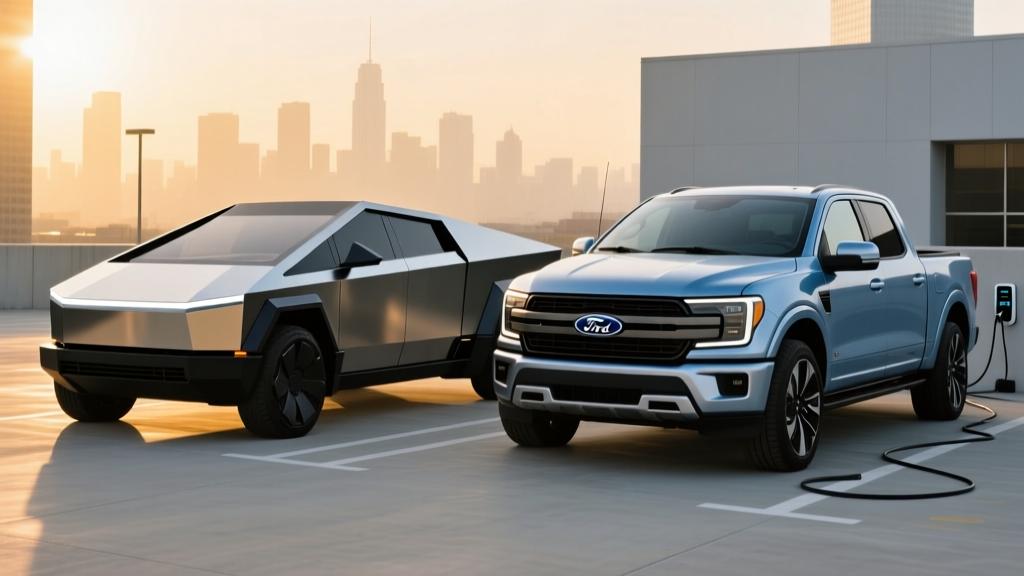
Buyers cross-shopping the Tesla Cybertruck and Ford F-150 Lightning are often deciding between radical innovation and proven truck DNA. But when the question shifts to Tesla Cybertruck vs Ford reliability, the comparison gets more nuanced than brand reputation alone. Both trucks have faced well-documented growing pains, yet their long-term durability profiles diverge sharply based on platform maturity, service infrastructure, and mechanical complexity.
This head-to-head breaks down every reliability-relevant dimension — from warranty coverage and build-quality track records to charging-network uptime, battery degradation expectations, and total cost of ownership — using 2026 model-year data and real-world owner feedback.
Side-by-Side Specs: Cybertruck vs F-150 Lightning (2026)
| Specification | Tesla Cybertruck (AWD Dual Motor) | Ford F-150 Lightning (Lariat Ext. Range) |
|---|---|---|
| EPA Range | 340 miles | 320 miles |
| Real-World Highway Range (est.) | ~270–290 mi | ~255–275 mi |
| Battery Capacity (usable) | ~123 kWh (NMC) | ~131 kWh (NMC) |
| Peak DC Fast Charge | 250 kW | 150 kW |
| 10–80% DC Charge Time | ~28 min | ~41 min |
| Level 2 Charge Rate | 11.5 kW (~44 mi/hr) | 19.2 kW (~77 mi/hr) w/ 80A charger |
| 0–60 mph | 4.1 seconds | 5.0 seconds |
| Horsepower | 600 hp | 580 hp |
| Towing Capacity | 11,000 lbs | 10,000 lbs |
| Payload Capacity | 2,500 lbs | 2,235 lbs |
| Cargo Bed Length | 6 ft (vault) | 5.5 ft (box) |
| Efficiency (MPGe combined) | ~70 MPGe | ~66 MPGe |
| Base MSRP (this trim equiv.) | $79,990 (AWD) | $69,995 (Lariat Ext.) |
| Federal Tax Credit (§30D) | Not eligible (MSRP cap exceeded) | Not eligible (MSRP cap exceeded for trucks: $80k, but sourcing rules may apply) |
| Battery Warranty | 8 yr / 120,000 mi (70% retention) | 8 yr / 100,000 mi (70% retention) |
| Bumper-to-Bumper Warranty | 4 yr / 50,000 mi | 3 yr / 36,000 mi |
Build Quality and Early Reliability Track Record
Tesla Cybertruck: Stainless Steel Ambition, Assembly Realities
The Cybertruck's exoskeleton-grade stainless steel body and 48-volt architecture are engineering firsts for a production truck. That ambition has come with predictable first-year friction. Owner forums and early service bulletins have flagged:
- Panel alignment inconsistencies (bed vault seams, frunk gaps)
- Steer-by-wire calibration software updates needed in early builds
- Tonneau cover mechanism failures on initial production units
- Wind noise at highway speeds from door-seal compression set
Tesla's track record with the Model X and original Model 3 shows a pattern: early production units carry disproportionate defect rates that improve substantially by year two or three. The Cybertruck, entering its third model year in 2026, has benefited from iterative manufacturing fixes at Giga Texas, but it remains a low-volume, high-complexity platform compared to Ford's body-on-frame truck line.
Ford F-150 Lightning: Proven Platform, Electrified
Ford's advantage is the F-150's 50-year platform lineage. The Lightning shares its fundamental chassis architecture, suspension geometry, and cab structure with the internal-combustion F-150 — meaning most mechanical failure modes are well-understood and parts are widely available. Documented issues have been more contained:
- Early 12V battery drain from parasitic software loads (addressed via OTA update)
- BlueCruise phantom braking events on certain highway overpasses
- Pro Power Onboard generator inverter faults on some 2022–2023 units
- Charge-port door latch freezing in sub-20°F conditions
Ford's dealer network — over 600 US locations with EV-certified service bays — gives Lightning owners a meaningful reliability-adjacent advantage: when something does break, getting it fixed is logistically easier than Tesla's more limited mobile-ranger and service-center footprint.
Charging Network Reliability: Supercharger vs. Open CCS Networks
Vehicle reliability means little if the charging ecosystem is unreliable. This is where the Cybertruck-vs-Lightning comparison reveals a structural difference.
| Factor | Tesla Cybertruck | Ford F-150 Lightning |
|---|---|---|
| Native Connector | NACS (Tesla proprietary, now open standard) | CCS1 (with NACS adapter available) |
| Tesla Supercharger Access | Native — full network, no adapter | Via Ford-provided NACS adapter (since 2024) |
| Supercharger Uptime (2025 data) | ~97% stall availability | ~97% (with adapter) |
| Non-Tesla DC Network Access | CCS adapter required (Tesla sells one) | Native CCS1 — Electrify America, EVgo, ChargePoint |
| Plug & Charge Reliability | Excellent on Superchargers | Variable on CCS networks; improving |
| Peak Charging Speed Realized | 250 kW on V3/V4 Superchargers | 150 kW (hardware-limited) |
Tesla's Supercharger network remains the gold standard for uptime, ease of use, and plug-and-charge seamlessness. The Cybertruck, as a native NACS vehicle, accesses this network without an adapter. Ford's 2024 integration of Supercharger access via adapter is functional but adds a point of failure — adapters can be lost, damaged, or occasionally cause communication handshake errors at the stall.
On the Lightning's native CCS1 connector, Electrify America and EVgo reliability has improved but still lags Supercharger consistency. Road-trip charging in the Lightning requires more contingency planning, particularly in rural corridors.
Ownership Cost Breakdown: Efficiency, Insurance, and Maintenance
Reliability extends beyond defect rates into the economic reliability of ownership — predictable costs, minimal surprise expenses, and long-term value retention.
| Cost Category | Tesla Cybertruck AWD | Ford F-150 Lightning Lariat Ext. |
|---|---|---|
| Purchase Price (MSRP) | $79,990 | $69,995 |
| Federal Tax Credit (§30D) | $0 (MSRP cap $80k for trucks, but AWD trim pricing and sourcing rules disqualify) | $0–$7,500 (trim-dependent; Lariat Ext. Range MSRP near cap — verify via IRS §30D guidelines) |
| Estimated Energy Cost (75k mi) | ~$5,400 (at $0.14/kWh avg) | ~$5,850 (at $0.14/kWh avg) |
| Insurance (5-yr avg) | ~$14,500 | ~$11,200 |
| Maintenance (5-yr est.) | ~$1,800 | ~$2,400 |
| Estimated Depreciation (5-yr) | ~$32,000 | ~$24,500 |
| 5-Year Total Cost (est.) | ~$133,690 | ~$113,945 |
The Cybertruck costs roughly $19,000–$20,000 more to own over five years, driven primarily by higher insurance premiums (stainless body repair costs and low parts availability), steeper projected depreciation, and a higher entry price. The Lightning's advantage here is substantial and compounds with every year of ownership.
Insurance note: Cybertruck insurance premiums average 35–50% higher than Lightning premiums in most states, driven by collision-repair complexity (stainless steel panels require specialized equipment) and low production volume. Always get quotes from your insurer before committing.
Battery Degradation and Long-Term Durability
Both trucks use NMC (nickel manganese cobalt) lithium-ion cells, which offer high energy density but are more sensitive to sustained high-state-of-charge storage and extreme heat than LFP chemistry. Neither manufacturer has published specific degradation curves for these packs, but industry data from Recurrent Auto and fueleconomy.gov provides useful benchmarks.
Expected 100,000-mile capacity retention:
- NMC packs with active thermal management (both trucks): ~88–92% SoH (State of Health)
- Warranty threshold: 70% retention at 8 years / 100k–120k miles — both manufacturers guarantee this floor
Tesla's battery management system (BMS) is widely regarded as industry-leading, with aggressive thermal preconditioning and calendar-degradation mitigation algorithms. Ford's BMS is competent but more conservative, occasionally limiting charge speed to protect the pack — a trade-off that favors longevity over convenience.
Replacement cost estimates (out of warranty, 2026 pricing):
- Cybertruck (~123 kWh): $18,000–$25,000
- Lightning (~131 kWh): $20,000–$28,000
These are worst-case scenarios. Most EV batteries outlast the vehicle's useful life, but buyers planning 200,000+ miles should factor this risk.
Technology and Driver-Assist Reliability
Tesla FSD (Supervised)
Tesla's vision-only FSD stack has improved substantially but remains polarizing. Its reliability as a driver-aid is high on well-marked highways but can exhibit unpredictable behavior in construction zones, unmapped roundabouts, and adverse weather. The Cybertruck's steer-by-wire system adds a layer of software-mediated complexity that has required multiple OTA patches.
Ford BlueCruise
BlueCruise operates on pre-mapped divided highways (over 130,000 miles of qualified roads in the US) and includes a driver-facing camera to monitor attention. It's more geofenced and conservative than FSD, which translates to more predictable — if less ambitious — behavior. Ford's approach prioritizes reliability-of-experience over capability breadth.
Category Verdicts: Where Each Truck Wins
250 kW peak vs 150 kW, 10–80% in ~28 min vs ~41 min. On road trips, this saves 10–15 minutes per stop.
340 mi EPA vs 320 mi. The gap widens with the Lightning's heavier curb weight under load.
~$10,000 lower MSRP, lower insurance, better depreciation trajectory. More truck for less money.
600+ EV-certified dealers vs Tesla's limited service centers and mobile rangers.
4yr/50k bumper-to-bumper and 8yr/120k battery vs Ford's 3yr/36k and 8yr/100k.
11,000 lbs towing and 2,500 lbs payload edge the Lightning's 10,000/2,235 lbs.
Native NACS on the most reliable network. Lightning requires an adapter for Superchargers.
Decades of F-150 engineering underpin the Lightning. The Cybertruck is a first-generation platform.
Decision Framework: Which Truck Fits Your Needs?
Choose the Tesla Cybertruck if:
- You prioritize charging speed and Supercharger seamlessness for frequent road trips
- You want maximum range per charge and can accept real-world highway reductions
- You value cutting-edge tech (steer-by-wire, 48V architecture, stainless exoskeleton) and accept first-gen platform risk
- You live near a Tesla Service Center and are comfortable with mobile-ranger repairs
- Towing capacity above 10,000 lbs is a regular requirement
Choose the Ford F-150 Lightning if:
- You want a proven truck platform with minimal learning curve from a gas F-150
- Dealer service accessibility matters — you live in a rural or underserved area
- Lower total cost of ownership (purchase price, insurance, depreciation) is a priority
- You need a conventional truck bed with standard 4x8 sheet-material compatibility
- You prefer predictable, conservative driver-assist (BlueCruise) over ambitious autonomy claims
- Pro Power Onboard (up to 9.6 kW V2L) is important for job-site or camping use
Final Recommendation
On the specific question of Tesla Cybertruck vs Ford reliability, the F-150 Lightning holds a measurable advantage in platform maturity, service accessibility, and ownership-cost predictability. Ford's decades of F-150 engineering translate into fewer unknowns, cheaper repairs when things go wrong, and a service network that reaches every corner of the country.
The Cybertruck counters with a longer warranty, faster charging, and access to the most reliable DC fast-charging network without adapters. Its reliability trajectory is improving — as Tesla's production volumes climb and manufacturing iterations resolve early-build issues — but it remains a higher-variance ownership proposition in 2026.
For risk-averse buyers who need a truck that simply works every day: the Lightning is the reliability play.
For tech-forward buyers who accept some friction in exchange for best-in-class charging and range: the Cybertruck's reliability arc is trending upward, and its warranty provides a meaningful safety net.
Before purchasing, verify current IRS §30D tax credit eligibility for your specific trim and delivery date, and check NHTSA for the latest recall and service-bulletin data on both vehicles.
Frequently Asked Questions
Is the Tesla Cybertruck more reliable than the Ford F-150 Lightning?
Based on 2026 data, the F-150 Lightning has a reliability edge due to its proven F-150 platform, broader service network, and fewer first-generation engineering risks. The Cybertruck's reliability has improved since its 2023 launch but remains less predictable as a newer, lower-volume platform with novel materials and systems.
Which truck has lower maintenance costs?
The Cybertruck has slightly lower estimated maintenance costs (~$1,800 over 5 years vs ~$2,400 for the Lightning) due to Tesla's minimal scheduled-maintenance approach. However, out-of-warranty collision repair on the Cybertruck's stainless steel body is significantly more expensive.
Does the Cybertruck qualify for the $7,500 federal tax credit?
As of 2026, the Cybertruck AWD at $79,990 sits right at the IRS truck MSRP cap of $80,000. However, battery-component and critical-mineral sourcing requirements under §30D may disqualify it. Always verify eligibility on the IRS qualified vehicles list before relying on the credit in your purchase decision.
How does cold weather affect range on both trucks?
Expect 15–25% range reduction at 20°F on both vehicles, with the Lightning slightly more affected due to its larger battery mass requiring more energy to thermally condition. Preconditioning while plugged in mitigates this loss substantially for both trucks.
Which truck charges faster on road trips?
The Cybertruck charges faster: 250 kW peak (10–80% in ~28 minutes) on Tesla V3/V4 Superchargers, compared to the Lightning's 150 kW peak (~41 minutes for 10–80%). Over a 600-mile trip with two charge stops, the Cybertruck saves roughly 25–30 minutes total.
Can I use the Ford F-150 Lightning on Tesla Superchargers?
Yes. Since 2024, Ford provides a NACS adapter that allows Lightning owners to access Tesla Supercharger stalls. The adapter works well but adds a physical component that can be lost or damaged, and occasional handshake communication errors have been reported.