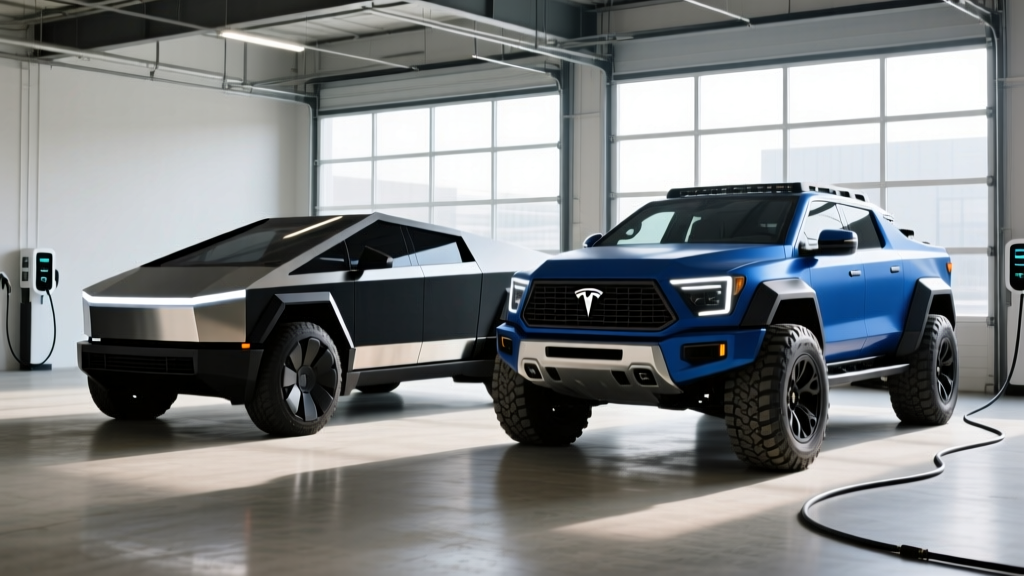
The Tesla Cybertruck lineup spans a $30,000+ price gap and a 200-horsepower performance gap, yet every variant shares the same stainless-steel exoskeleton and polarizing silhouette. For 2026, Tesla offers three configurations: the Long Range AWD (commonly just called "Cybertruck"), the mid-tier Dual Motor AWD, and the flagship tri-motor Cyberbeast. Each targets a fundamentally different buyer — from the efficiency-minded commuter to the track-day truck enthusiast.
This comparison zeroes in on the two bookends of the lineup: the Long Range AWD and the Cyberbeast. We'll break down every spec that matters to EV buyers — real-world range, charging curves, ownership costs, and tax-credit eligibility — so you can make a spec-driven decision rather than a marketing-driven one.
Cybertruck vs Cyberbeast: Full Spec Comparison
Before we dissect each category, here's the complete side-by-side spec table for the 2026 model year. All figures are sourced from Tesla's official spec sheets and fueleconomy.gov.
| Specification | Cybertruck Long Range AWD | Cyberbeast (Tri-Motor AWD) |
|---|---|---|
| Base MSRP | $79,990 | $99,990 |
| EPA Range | 340 miles | 320 miles |
| Real-World Highway Range (est.) | ~275–300 miles | ~255–280 miles |
| Usable Battery Capacity | ~123 kWh (NMC) | ~123 kWh (NMC) |
| EPA Efficiency (MPGe) | 71 MPGe (combined) | 68 MPGe (combined) |
| Peak DC Fast-Charge Rate | 250 kW | 250 kW |
| 10–80% DC Fast-Charge Time | ~30 minutes | ~30 minutes |
| Level 2 Charging (max) | 11.5 kW (48A) | 11.5 kW (48A) |
| Horsepower | 600 hp | 845 hp |
| 0–60 mph | 3.9 seconds | 2.6 seconds |
| Towing Capacity | 11,000 lbs | 11,000 lbs |
| Cargo Volume (bed + frunk) | ~67 cu ft total | ~67 cu ft total |
| Battery Warranty | 8 yr / 150,000 mi (70% min) | 8 yr / 150,000 mi (70% min) |
| Federal Tax Credit (§30D) | Up to $7,500 (eligibility varies) | Up to $7,500 (eligibility varies) |
Range & Efficiency: The Long Range Advantage Is Real
Both trucks share the same ~123 kWh NMC (nickel manganese cobalt) battery pack, but the Cyberbeast's tri-motor setup and higher performance calibration cost it 20 miles of EPA-rated range. The Long Range AWD earns 340 miles EPA versus the Cyberbeast's 320 miles EPA.
Cybertruck Long Range: Expect ~275–300 miles at sustained 70+ mph highway speeds. In cold weather (below 32°F), budget for 20–30% loss, putting realistic range around 220–255 miles.
Cyberbeast: Expect ~255–280 miles highway. Cold-weather range drops to roughly 200–240 miles. Aggressive driving or frequent launch-control use will push consumption higher.
Why the gap? The Cyberbeast's third motor adds weight and parasitic drag, and its performance-oriented torque mapping prioritizes acceleration over efficiency.
The Cybertruck's angular, stainless-steel body creates substantial aerodynamic drag compared to more sculpted EVs like the Rivian R1T or the Lucid Air. At highway speeds, that drag penalty is the single biggest range killer — and it affects both trims equally. Where the Long Range pulls ahead is its dual-motor simplicity: fewer motors means less rotating mass and less energy consumed per mile.
If you regularly tow, plan for a 40–50% range reduction regardless of trim. The 11,000-lb towing capacity is impressive on paper, but pulling even a 5,000-lb trailer at 65 mph will slash range to roughly 170–200 miles on the Long Range and 155–185 on the Cyberbeast.
Charging Speed: Identical Hardware, Identical Curves
This is where the comparison is straightforward: both trucks charge at the same rate because they share the same battery architecture and thermal management system.
| Charging Level | Power (kW) | Approx. Miles Added per Hour |
|---|---|---|
| Level 1 (120V household) | ~1.4 kW | ~3–4 mi/hr |
| Level 2 (240V home/public) | 11.5 kW max | ~30–34 mi/hr |
| DC Fast Charge (Tesla Supercharger) | 250 kW peak | ~600+ mi/hr at peak |
Both trucks peak at 250 kW on V3 Superchargers and achieve a 10–80% charge in approximately 30 minutes. However, peak rate is not sustained rate. The charge curve tapers significantly above 50% State of Charge (SoC), dropping below 100 kW past 60% and falling to roughly 40–50 kW by 80%. This is standard NMC chemistry behavior — the battery management system slows current to protect cell longevity.
For practical trip planning, expect to add about 180–200 miles of range in a 20-minute Supercharger stop (10–55% SoC). Pushing past 80% at a DC fast charger is painfully slow and rarely worth the wait unless you absolutely need those final miles.
Charging network advantage: Both trucks use the NACS (North American Charging Standard) connector natively, giving seamless access to the entire Tesla Supercharger network — the most reliable and extensive DC fast-charging network in North America. This is a meaningful ownership advantage over CCS-equipped competitors, though by 2026 most major networks have added NACS cables or adapters.
Performance: Where the Cyberbeast Earns Its Name
This is the category where the Cyberbeast justifies its $20,000 premium — at least for buyers who care about straight-line speed. The tri-motor setup produces 845 horsepower and rockets the truck to 60 mph in 2.6 seconds. That's supercar territory in a 6,800-lb stainless-steel wedge.
The Long Range AWD is no slouch: 600 hp and a 3.9-second 0–60 time would have been exotic-car numbers a decade ago. In daily driving, both trucks feel explosively quick. The difference emerges in rolling acceleration (50–90 mph highway passes) and launch control scenarios, where the Cyberbeast's third motor provides relentless shove.
The Cyberbeast's 2.6-second 0–60 requires a prepped surface, warm tires, and launch-control preconditioning. In real-world conditions (street tires, 50°F ambient), expect 2.9–3.2 seconds. Still blistering — but the gap to the Long Range narrows from 1.3 seconds to roughly 0.7 seconds in normal driving.
Neither truck is designed for off-road rock crawling. Despite the adaptive air suspension (12 inches of ground clearance in Extract Mode), the Cybertruck's approach/departure angles and the Cyberbeast's low-profile performance tires limit serious trail use. If off-road capability is a priority, the Rivian R1T or the Ford F-150 Lightning with the off-road package are more purpose-built alternatives.
Pricing, Tax Credits, and Total Cost of Ownership
The $20,000 MSRP gap between the Long Range ($79,990) and the Cyberbeast ($99,990) is substantial, but the full financial picture requires factoring in federal incentives, efficiency, insurance, and depreciation.
Federal Tax Credit (§30D) Eligibility
As of 2026, both Cybertruck trims qualify for the IRS §30D Clean Vehicle Credit of up to $7,500, subject to these requirements:
- MSRP cap: Trucks/vans/SUVs must have an MSRP of $80,000 or less. This means the Long Range AWD at $79,990 qualifies, but the Cyberbeast at $99,990 does NOT qualify for the new-vehicle credit.
- Buyer income limits: Modified AGI must not exceed $300,000 (joint), $225,000 (head of household), or $150,000 (single).
- Battery sourcing: Critical minerals and battery components must meet phased-in domestic-content thresholds. Tesla's US-built battery packs generally satisfy these requirements for 2026, but always verify at fueleconomy.gov before purchasing.
- Point-of-sale transfer: The credit can be applied at the dealer to reduce your purchase price directly, rather than waiting for a tax refund.
Cybertruck Long Range AWD: $79,990 – $7,500 = ~$72,490 (if eligible)
Cyberbeast: $99,990 – $0 = $99,990 (exceeds MSRP cap)
The effective gap widens to $27,500 when tax credits apply — a decisive factor for value-oriented buyers.
Ownership Cost Differences
| Annual Cost Factor | Long Range AWD | Cyberbeast |
|---|---|---|
| Electricity (12,000 mi/yr, $0.16/kWh) | ~$590 | ~$620 |
| Insurance (national avg.) | ~$3,200–$3,800 | ~$3,800–$4,500 |
| Tire Replacement (set of 4) | ~$1,200–$1,600 | ~$1,600–$2,200 |
| Scheduled Maintenance | ~$200/yr | ~$200/yr |
Insurance is a meaningful differentiator. The Cyberbeast's higher MSRP, 845-hp output, and tri-motor complexity push premiums $500–$700 higher annually than the Long Range. Over a 5-year ownership period, that's an additional $2,500–$3,500 in insurance costs alone.
Tire costs also differ. The Cyberbeast's wider, stickier performance tires wear faster and cost more to replace. Budget for a new set every 20,000–25,000 miles versus 30,000–35,000 on the Long Range's all-season rubber.
Technology, Interior, and Daily Usability
Both trims share the same 18.5-inch front touchscreen, 9.4-inch rear screen, yoke steering, and Tesla's latest infotainment software. The interior is minimalist to a fault — no physical buttons, no traditional instrument cluster, and all climate and mirror controls are touchscreen-driven.
What both trims include:
- Tesla Autopilot (SAE Level 2 driver assistance) — lane centering, adaptive cruise
- Over-the-air software updates
- Powered tonneau cover with lockable bed
- 120V/240V bed outlet (up to 9.6 kW for job-site or camping use)
- Adaptive air suspension with adjustable ride height
- HEPA air filtration (Bioweapon Defense Mode)
Tesla's Autopilot and optional Full Self-Driving (Supervised) are SAE Level 2 driver-assistance systems. You must keep your hands on the yoke and eyes on the road at all times. The system can assist with steering, acceleration, and braking on mapped highways, but it does not handle all driving scenarios. No consumer Tesla is autonomous. Only Level 4 services like Waymo operate without a human driver.
The Cyberbeast adds a few exclusive touches: a unique "Beast Mode" drive setting with enhanced torque vectoring, carbon-fiber interior trim accents, and a slightly different suspension calibration optimized for performance handling. But the core tech stack is identical.
Daily usability note: The Cybertruck's 6-foot-5 bed is shorter than a traditional full-size pickup, and the sloped tonneau limits vertical cargo height. The ~67 cu ft total cargo volume (bed + front trunk) is adequate for gear and groceries but falls short of an F-150 Lightning's 78 cu ft bed or the Rivian R1T's Gear Tunnel. Both trims share this limitation.
Category Verdicts: Who Wins Where
340 miles EPA vs. 320 — and the gap widens in real-world highway and cold-weather driving where efficiency matters most.
Identical 250 kW peak, ~30-min 10–80%, and 11.5 kW Level 2. Same battery, same hardware, same charge curve.
845 hp, 2.6-sec 0–60. It's not even close — the tri-motor Cyberbeast is one of the quickest production vehicles on the planet.
$20,000 cheaper at MSRP, qualifies for the $7,500 tax credit (Cyberbeast does not), and costs less to insure and maintain.
71 MPGe combined vs. 68 MPGe. Lower electricity costs and fewer charging stops on road trips.
Same screens, same Autopilot hardware, same software. Cyberbeast adds Beast Mode and cosmetic trim, not meaningful tech.
Both rated at 11,000 lbs towing with identical bed dimensions and 9.6 kW power export capability.
Cybertruck depreciation has been volatile. Early data suggests high-performance trims depreciate faster in absolute dollars, but percentage retention may be similar.
Decision Framework: Which Cybertruck Should You Buy?
- You want maximum range and the fewest charging stops on road trips
- You need to stay under the $80,000 MSRP cap to qualify for the $7,500 federal tax credit
- Your priority is daily commuting, towing, or utility — not quarter-mile times
- You want to minimize insurance premiums and tire replacement costs
- You view the truck primarily as a practical vehicle that happens to be quick
Choose the Cyberbeast if:
- Straight-line performance is a non-negotiable priority
- You're comfortable paying $99,990+ with no federal tax credit eligibility
- You want the halo-vehicle experience — 845 hp tri-motor, Beast Mode, exclusivity
- You already have a convenient home Level 2 charger and don't rely on public DC charging for daily use
- You accept higher insurance and tire costs as part of the performance premium
Final Recommendation
For the vast majority of Cybertruck buyers, the Long Range AWD is the rational choice. It delivers supercar-rivaling acceleration (3.9 seconds is genuinely fast), the longest range in the lineup, lower insurance, lower tire costs, and — critically — eligibility for the $7,500 federal tax credit that the Cyberbeast cannot access due to the $80,000 MSRP cap. The effective price gap balloons to $27,500, which buys a lot of home-charging infrastructure, Supercharger credits, or simply stays in your pocket.
The Cyberbeast exists for a narrow audience: buyers who want the fastest truck ever built, who have the budget to absorb a six-figure purchase with no federal incentive, and who view performance as the primary reason to own a Cybertruck. If that describes you, the Cyberbeast delivers an experience nothing else on four wheels can match. But understand that you're paying a $27,500+ premium over the Long Range for 245 additional horsepower, 1.3 seconds of 0–60 time, and 20 fewer miles of EPA range.
Either way, plan for home Level 2 charging as a near-requirement. With a 123 kWh battery, Level 1 (120V) charging adds only ~3–4 miles per hour — it would take over 30 hours to fully recharge a depleted pack. A 48-amp Level 2 home charger, professionally installed, will fully recharge overnight and costs roughly $800–$2,000 installed depending on your electrical panel's capacity.
Frequently Asked Questions
Does the Cyberbeast qualify for any federal EV tax credit?
No. The IRS §30D credit has an $80,000 MSRP cap for trucks, vans, and SUVs. The Cyberbeast's $99,990 base price exceeds this threshold, making it ineligible regardless of buyer income or battery sourcing. The Long Range AWD at $79,990 qualifies if all other requirements (income limits, battery sourcing) are met.
Can I add range to either Cybertruck after purchase?
Tesla announced a "Range Extender" battery pack option that fits in the bed, adding an estimated 100+ miles of range. As of early 2026, availability and pricing remain limited. This accessory, if released broadly, would benefit both trims equally.
Is the Cybertruck good for towing long distances?
It can tow 11,000 lbs, but expect range to drop by 40–50% when pulling a heavy trailer. A 5,000-lb load at highway speeds reduces real-world range to roughly 155–200 miles depending on trim, terrain, and temperature. Plan Supercharger stops accordingly, and note that not all Supercharger stalls accommodate truck-and-trailer configurations.
Which Cybertruck holds its value better?
Early depreciation data is still maturing. Historically, limited-production halo models (like the Cyberbeast) can retain value if supply remains constrained, but they also face steeper drops if demand softens. The Long Range AWD, as the volume trim, will have more predictable depreciation tied to overall EV market trends. Check Kelley Blue Book for the latest residual-value projections before purchasing.
Do both trims come with Full Self-Driving capability?
No. Both include basic Autopilot (SAE Level 2) as standard. Tesla's Full Self-Driving (Supervised) is an optional add-on that provides enhanced highway and city-street assist features — but it remains a Level 2 system requiring active driver supervision. It is not autonomous driving.
What's the real difference in daily driving between the two?
In normal driving — commuting, school runs, grocery trips — both trucks feel similarly responsive and refined. The Cyberbeast's extra motor and power are most noticeable during hard acceleration, highway overtaking, and launch-control scenarios. For 95% of daily driving, the Long Range AWD provides more than enough performance with better efficiency.