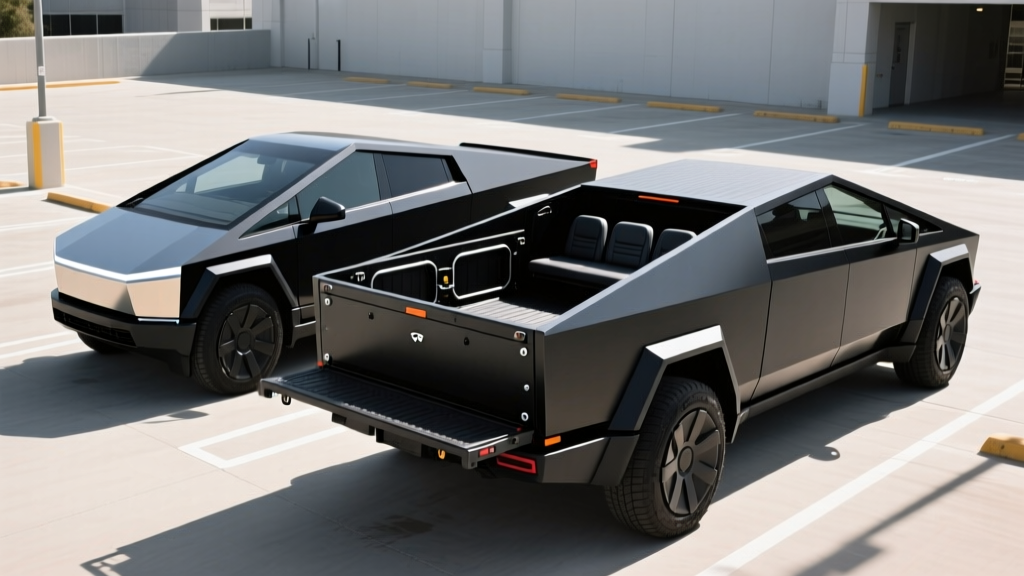
The Tesla Cybertruck's stainless-steel exoskeleton and angular vault dominate headlines, but for buyers actually planning to haul lumber, motorcycles, or camping gear, the practical question is far more specific: what are the exact bed dimensions, and do they change between the Long Range AWD and the tri-motor Cyberbeast? This Cybertruck bed size comparison breaks down every cargo measurement, payload limit, and towing figure across the 2026 lineup — then layers in the range, charging, and ownership data you need to choose the right configuration.
Cybertruck Bed Dimensions: The Core Numbers
Every 2026 Cybertruck shares the same structural vault, so bed size does not vary by powertrain. Whether you choose the dual-motor AWD or the tri-motor Cyberbeast, the cargo box dimensions are identical. What changes is how much weight you can carry, how far you can drive while carrying it, and how much you'll pay at the charger.
| Specification | Long Range AWD | Cyberbeast (Tri-Motor) |
|---|---|---|
| Bed Length (floor) | 78.0 in (6.5 ft) | 78.0 in (6.5 ft) |
| Bed Width (max / between wells) | 62.0 in / 50.0 in | 62.0 in / 50.0 in |
| Bed Depth (side wall height) | 27.0 in | 27.0 in |
| Cargo Box Volume | 67.0 cu ft | 67.0 cu ft |
| Frunk Volume | 7.1 cu ft | 7.1 cu ft |
| Total Cargo (bed + frunk + cabin) | ~121 cu ft | ~121 cu ft |
| Max Payload | 2,500 lb | 2,500 lb |
| Max Towing | 11,000 lb | 11,000 lb |
| Tonneau Cover | Power-retractable (std) | Power-retractable (std) |
| Bed 120V/240V Outlets | Yes (2× 120V, 1× 240V) | Yes (2× 120V, 1× 240V) |
A few details worth calling out. The 50-inch width between the wheel wells means a standard 4×8 sheet of plywood will not lie flat on the bed floor — it fits between the wells only if tilted slightly or placed on top of them. The power-retractable tonneau cover (Tesla calls it the "Vault" cover) supports up to 300 lb of distributed load, so you can stand on it or stack gear on top. The integrated 240V outlet (NEMA 14-50 style) enables job-site tool use or Level-1-style trickle charging of other EVs via the mobile connector.
Side-by-Side Spec Table: Range, Charging, Performance, and Price
Bed size may be identical, but the powertrain choice reshapes everything else. Here's the full comparison for the 2026 model year.
| Spec | Long Range AWD | Cyberbeast |
|---|---|---|
| EPA Range | 340 mi | 320 mi |
| Battery (usable / chemistry) | ~123 kWh / 4680 NMC | ~123 kWh / 4680 NMC |
| Efficiency (MPGe) | 70 MPGe | 65 MPGe |
| Peak DC Charge Rate | 250 kW | 250 kW |
| 10–80% DC Fast Charge | ~28 min | ~28 min |
| Level 2 Charge Rate | 11.5 kW (48A) | 11.5 kW (48A) |
| 0–60 mph | 3.9 sec | 2.6 sec |
| Horsepower | 600 hp | 845 hp |
| Top Speed | 130 mph | 130 mph |
| Base MSRP (before dest.) | $79,990 | $99,990 |
| Destination Fee | $1,995 | $1,995 |
| Federal §30D Tax Credit | Not eligible (MSRP cap) | Not eligible (MSRP cap) |
| Battery/Drive Unit Warranty | 8 yr / 120,000 mi | 8 yr / 120,000 mi |
Category-by-Category Verdict
🏆 Range & Efficiency Winner: Long Range AWD
With 340 EPA miles and 70 MPGe, the dual-motor AWD stretches each kWh further. If your workday involves long, unloaded highway stretches between job sites, the 20-mile EPA gap translates to fewer charging stops over a year of ownership.
🏆 Performance Winner: Cyberbeast
845 hp and a 2.6-second 0–60 time make the Cyberbeast one of the quickest production trucks ever built. The tri-motor layout also provides superior torque vectoring for off-road traction and heavy-towing stability — genuinely useful, not just a party trick.
🏆 Charging Winner: Tie
Both share the same 4680-cell battery pack, the same 250 kW peak DC charge rate, and the same ~28-minute 10–80% time on a V3 Supercharger or equivalent CCS/NACS station. The Cyberbeast's slightly larger energy consumption doesn't meaningfully slow its charge curve.
🏆 Cargo Utility Winner: Tie
Identical vault dimensions, identical payload, identical towing. The bed itself does not differentiate these trims. Choose based on what you're doing while carrying cargo, not what you're carrying.
🏆 Value Winner: Long Range AWD
$20,000 less at the register, nearly identical bed utility, and lower per-mile energy costs. Unless you specifically need tri-motor traction or sub-3-second acceleration, the AWD delivers more truck per dollar.
🏆 Tech & ADAS Winner: Tie
Both ship with Tesla's latest hardware suite, Autopilot standard, and Full Self-Driving (Supervised) available as a paid add-on. Note: FSD remains SAE Level 2 — the driver must remain engaged at all times. Neither trim offers hands-off or eyes-off autonomy.
Price, Tax Credits, and Total Cost of Ownership
Federal Tax Credit Alert
Under current IRS §30D rules, the Cybertruck does not qualify for the $7,500 federal EV tax credit. The credit applies a $80,000 MSRP cap for trucks, and both the Long Range AWD ($81,985 with destination) and Cyberbeast ($101,985 with destination) exceed it. No amount of trim or option selection changes this for 2026. Always verify current-year eligibility at irs.gov.
Beyond the purchase price, ownership costs diverge meaningfully:
| Cost Factor (5-Year Estimate) | Long Range AWD | Cyberbeast |
|---|---|---|
| Purchase Price (MSRP + dest.) | $81,985 | $101,985 |
| Federal Tax Credit | $0 | $0 |
| Estimated Electricity (5 yr / 75k mi) | ~$3,900 | ~$4,400 |
| Insurance (avg 5 yr) | ~$16,500 | ~$19,800 |
| Maintenance (tires, fluid, cabin filter) | ~$2,200 | ~$2,800 |
| Estimated 5-Year Total | ~$104,585 | ~$128,985 |
Insurance is the largest variable cost difference. Tri-motor Cyberbeast models command higher premiums due to their 845 hp output and higher repair-cost profile for the stainless-steel body panels. Get quotes from your provider before ordering — the $3,300 five-year insurance gap is substantial. Maintenance is minimal on both (no oil changes, no transmission fluid), but the Cyberbeast's heavier weight accelerates tire wear; budget for a set of replacement 35-inch all-terrains around year four.
Charging Network and Practical Considerations
Both Cybertrucks charge on Tesla's NACS connector natively and access the full Supercharger network — now the largest DC fast-charging network in North America with over 30,000 stalls. However, the Cybertruck's 8-foot width and 223.5-inch length create real-world friction at older Supercharger stalls designed for sedans. Plan to use pull-through stalls or newer V4 sites with wider spacing.
For home charging, both trucks accept 11.5 kW on Level 2 (48 amps on a 60-amp circuit). A full overnight charge from 20% to 100% takes roughly 9–10 hours — adequate for daily use but tight if you arrive home nearly empty and need a full battery for towing the next morning. Budget $800–$2,500 for a home Level 2 installation (Tesla Wall Connector + electrician + permit), and potentially $2,000–$5,000 more if your home needs a panel upgrade to support the 60-amp circuit.
Decision Framework: Which Cybertruck Configuration Is Right for You?
Choose the Long Range AWD if:
- You need maximum range for daily commuting or long highway drives between job sites
- Your payload is typically under 1,500 lb and you rarely tow over 7,000 lb
- You want to minimize purchase price and ongoing insurance costs
- Sub-4-second 0–60 is already more performance than you'll use
- You plan to keep the truck 5+ years and want the lowest total cost of ownership
Choose the Cyberbeast if:
- You regularly tow near the 11,000-lb max and want tri-motor traction for stability on grades
- You need maximum off-road capability (rear torque steering, higher ground-clearance modes)
- Performance is a non-negotiable priority and the $20,000 premium fits your budget
- You operate in snow/ice/mud where tri-motor torque vectoring provides a measurable traction advantage
- Resale desirability of the top trim matters for your ownership cycle
Key Differences Summary
Let's distill the comparison to what actually matters when you sign the order:
- Bed size: Identical. 78" × 62" × 27", 67 cu ft, 2,500 lb payload, 11,000 lb towing. No cargo advantage to either trim.
- Range: AWD wins by 20 EPA miles (340 vs 320). In real-world towing, both lose 40–55% of range.
- Charging: Identical. 250 kW peak, ~28 min 10–80%, 11.5 kW Level 2.
- Performance: Cyberbeast dominates (845 hp / 2.6s vs 600 hp / 3.9s).
- Price: $20,000 gap before options. Neither qualifies for the §30D credit.
- Insurance: Cyberbeast costs ~$3,300 more over 5 years on average.
- Warranty: Identical. 8 years / 120,000 miles on battery and drive units.
Frequently Asked Questions
Will a 4×8 sheet of plywood fit flat in the Cybertruck bed?
Not flat on the floor. The bed measures 62 inches wide at its widest point but only 50 inches between the wheel wells. A 48-inch-wide plywood sheet fits between the wells, but the 96-inch (8-foot) length exceeds the 78-inch bed floor. You'll need to lower the tailgate and let the sheet extend out, or angle it on top of the wheel wells. The power tonneau cover will not close over extended loads.
Does the Cybertruck bed rust or dent differently than a steel pickup?
The ultra-hard 30X cold-rolled stainless steel body resists dents far better than conventional aluminum or mild-steel truck beds. However, it can still scratch, and the brushed finish shows swirl marks. Unlike painted steel, it won't rust in the traditional sense, but surface discoloration from iron contamination (rail dust, brake dust from other vehicles) can occur — Tesla recommends periodic stainless-steel cleaner treatment.
How much range do I lose when towing with the Cybertruck?
Expect a 40–55% range reduction when towing a 7,000–10,000 lb enclosed trailer at highway speeds. That drops the Long Range AWD from 340 EPA miles to roughly 150–190 real-world miles. The Cyberbeast, starting at 320 EPA, drops to approximately 140–175 miles. Both require careful Supercharger route planning for towing trips over 200 miles. According to fueleconomy.gov, towing is the single largest efficiency penalty for any EV.
Can I use the Cybertruck bed outlets to power tools on a job site?
Yes. The bed includes two 120V outlets and one 240V outlet, capable of delivering up to 9.6 kW continuous power from the main traction battery. This is sufficient for most job-site tools — circular saws, compressors, welders — and effectively replaces a portable generator for many contractors. Monitor your battery level; running high-draw tools for extended periods will reduce your driving range.
Is the Cybertruck eligible for any state or local EV incentives?
While the Cybertruck is excluded from the federal §30D credit due to its MSRP exceeding the $80,000 truck cap, some states offer separate purchase rebates, HOV lane access, or reduced registration fees that apply regardless of price. These vary significantly by jurisdiction — check your state's energy office or DMV for current programs. A tax professional can confirm eligibility for any point-of-sale or filing-based incentives.
The Cybertruck's bed dimensions don't change between trims — your choice between the Long Range AWD and Cyberbeast is fundamentally a decision about powertrain, performance, and budget, not cargo capacity. For most buyers who need a daily-drivable electric work truck, the Long Range AWD delivers the same vault, the same payload, and the same towing at a $20,000 savings. The Cyberbeast justifies its premium only if tri-motor traction, extreme performance, or top-trim resale value are priorities in your ownership equation.