Why the Cost of Renewable Electricity Matters for EV Buyers
If you're weighing an electric vehicle purchase in 2026, the sticker price is only the beginning. The ongoing cost to fuel that vehicle — and whether your electricity comes from solar, wind, or a fossil-heavy grid — fundamentally shapes your total cost of ownership. The cost of renewable electricity has dropped dramatically over the past decade, and for EV owners who can access it (via rooftop solar, community solar, or green utility plans), the fuel-cost advantage over gasoline is substantial. But the full ownership picture includes insurance premiums, depreciation curves, maintenance savings, and a federal tax credit with more eligibility hurdles than most buyers realize.
This guide breaks down every major cost category with concrete numbers, so you can model your own 5-year ownership scenario before signing a purchase agreement.
Charging vs. Gas: The Per-Mile Cost Breakdown
Let's start with the cost category where EVs have the clearest structural advantage — fuel. The math depends on two variables: your local electricity rate (or solar cost) and your vehicle's efficiency in kWh per mile.
| Scenario | Rate / Price | Vehicle Efficiency | Cost Per Mile |
|---|---|---|---|
| Home Level 2 (national avg. utility rate) | $0.16/kWh | 3.5 mi/kWh (125 MPGe) | $0.046 |
| Home Level 2 (rooftop solar, amortized) | $0.08/kWh | 3.5 mi/kWh | $0.023 |
| Home Level 2 (California peak TOU) | $0.34/kWh | 3.5 mi/kWh | $0.097 |
| DC Fast Charging (public, avg.) | $0.38/kWh | 3.5 mi/kWh | $0.109 |
| Gasoline sedan (30 MPG combined) | $3.40/gal | 30 MPG | $0.113 |
| Gasoline truck/SUV (22 MPG combined) | $3.40/gal | 22 MPG | $0.155 |
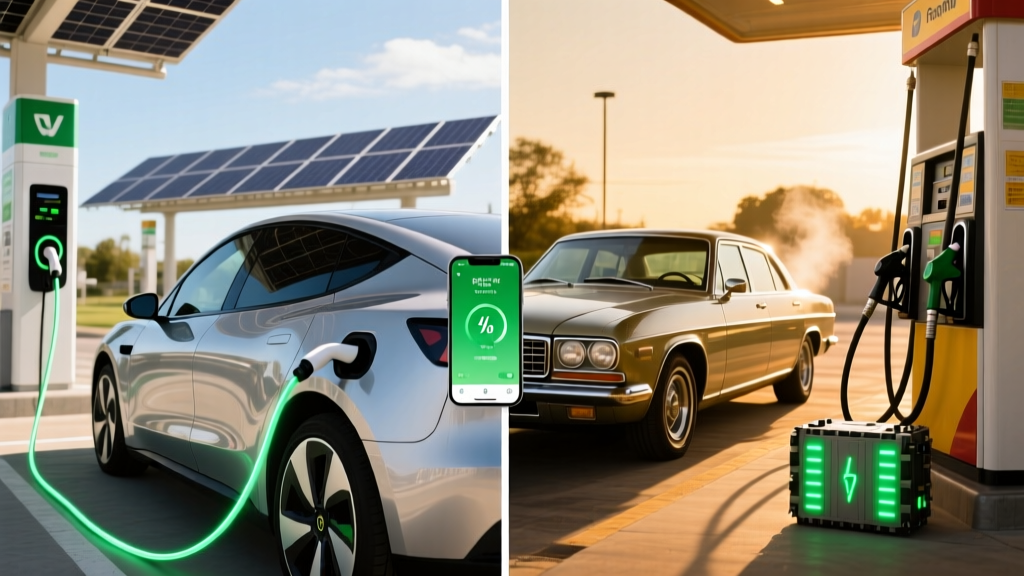
At the national average residential rate of roughly $0.16/kWh (per EIA data), a typical EV costs about 4.6 cents per mile to fuel. If you're charging from rooftop solar with an amortized cost around $0.08/kWh, that drops to 2.3 cents — roughly one-fifth the cost of a 30 MPG gas car.
But here's the nuance: if you rely heavily on public DC fast charging at $0.35–$0.45/kWh, your per-mile cost can approach or even exceed a fuel-efficient gas car. The cost-of-fuel advantage is maximized when you charge at home, especially with solar or a time-of-use plan that lets you charge overnight at off-peak rates.
Utility rebates and green-rate programs vary significantly by region. Many utilities offer EV-specific TOU plans (e.g., PG&E's EV2-A, ConEdison's EV rate) that drop overnight charging to $0.07–$0.10/kWh. Check your local utility's EV programs — some also offer $500–$1,500 rebates for Level 2 charger installation.
Federal Tax Credit: IRS §30D Eligibility in 2026
The federal EV tax credit under IRS §30D can reduce your effective purchase price by up to $7,500, but eligibility is far from universal. The rules have tightened considerably since the Inflation Reduction Act reshaped the credit, and they continue to evolve. Here's what applies for 2026 purchases:
§30D New Clean Vehicle Credit — 2026 Requirements:
- Credit amount: Up to $7,500 ($3,750 for meeting critical-minerals requirement + $3,750 for battery-component requirement)
- Buyer income caps (modified AGI): $300,000 joint / $225,000 head of household / $150,000 single
- MSRP caps: $80,000 for vans, SUVs, and pickups; $55,000 for sedans and other body styles
- Battery sourcing: Critical minerals and battery components must meet escalating domestic/free-trade-partner sourcing thresholds — many popular models lose partial or full credit as these thresholds tighten annually
- Final assembly: Vehicle must undergo final assembly in North America (verify at fueleconomy.gov)
- Point-of-sale transfer: As of 2024, buyers can transfer the credit to the dealer at purchase, receiving the benefit as a down-payment reduction rather than waiting for a tax refund — this applies in 2026
- Tax liability: Credit is non-refundable; if transferred at point of sale, the dealer handles the credit claim
Practical reality: Because battery-sourcing requirements tighten each year, the list of vehicles qualifying for the full $7,500 has shrunk. Several popular models that qualified for the full credit in 2023–2024 now receive only $3,750 or nothing at all. Always verify your specific vehicle's current eligibility on the DOE's fueleconomy.gov tax credit page before committing to a purchase.
5-Year Total Cost of Ownership: A Concrete Breakdown
Below is a modeled 5-year / 75,000-mile ownership scenario comparing a mainstream EV (similar to a 2026 Hyundai Ioniq 6 or Tesla Model 3 RWD) against a comparable gas sedan (similar to a Toyota Camry). The EV assumes mostly home charging at the national average rate with some DC fast charging on road trips.
| Cost Category | EV (Home Charging) | Gas Sedan (30 MPG) |
|---|---|---|
| Purchase price (base MSRP) | $42,000 | $30,000 |
| Federal tax credit (§30D) | −$7,500 | $0 |
| Effective purchase price | $34,500 | $30,000 |
| Fuel / energy (75k mi) | $3,800 | $8,500 |
| Maintenance (5 years) | $1,800 | $4,200 |
| Insurance (5 years) | $11,500 | $8,500 |
| Depreciation (est.) | $17,000 | $12,000 |
| Total 5-Year Cost | $68,600 | $63,200 |
In this scenario, the EV still costs roughly $5,400 more over five years, primarily due to higher insurance and steeper depreciation. But the gap narrows considerably — and can flip to EV savings — under these conditions:
- You charge primarily from rooftop solar (fuel cost drops to ~$2,000 over 5 years)
- Your state offers an additional $2,000–$5,000 rebate (California, Colorado, Massachusetts, etc.)
- You were previously driving a less-efficient gas vehicle (22 MPG truck/SUV: fuel cost jumps to ~$11,600)
- You keep the EV beyond 5 years, where maintenance savings compound and depreciation flattens
Maintenance Savings: Where EVs Quietly Win
EVs eliminate the largest recurring maintenance items on gas vehicles. There are no oil changes, no spark plugs, no timing belts, no exhaust systems, and no multi-speed transmissions to service. Regenerative braking dramatically reduces brake-pad wear — many EV owners report original brake pads at 80,000+ miles.
| Service Item | EV Cost (5 yr) | Gas Car Cost (5 yr) |
|---|---|---|
| Oil changes | $0 | $600–$1,000 |
| Brake pads / rotors | $0–$200 | $600–$1,200 |
| Transmission fluid | $0 | $200–$400 |
| Air / fuel filters | $50–$100 (cabin filter only) | $200–$400 |
| Coolant / spark plugs | $0 | $300–$600 |
| Tire rotation / replacement | $800–$1,200 (EVs wear tires faster due to weight/torque) | $600–$1,000 |
| Total estimate | $1,600–$2,000 | $3,500–$4,600 |
The one area where EVs cost more: tires. Heavier curb weights and instant torque accelerate tire wear by roughly 15–25%. Budget for a tire replacement around 35,000–45,000 miles. Even with this, total maintenance savings typically run $2,000–$3,000 over five years.
Insurance: The Cost Category That Catches Buyers Off Guard
EV insurance premiums are typically 15–25% higher than equivalent gas vehicles. The reasons are structural, not arbitrary:
- Higher repair costs: EV battery packs and power electronics are expensive to replace after collision damage. A minor underbody impact that would cost $500 to fix on a gas car can total an EV if the battery enclosure is compromised.
- Specialized labor: Fewer body shops have high-voltage-certified technicians, which drives up labor rates for EV repairs.
- Higher vehicle values: Higher MSRP means higher comprehensive/collision payouts.
- Tesla-specific premiums: Teslas historically carry the highest insurance surcharges in the EV segment due to parts costs and repair complexity. Tesla Insurance (available in select states) attempts to offset this with usage-based pricing.
What to do: Get insurance quotes for your specific EV model before purchasing. The spread varies enormously — a Hyundai Ioniq 5 might cost only 8–10% more to insure than a comparable gas crossover, while a Tesla Model Y can run 25–35% more. In 2026, as more EV-specific repair networks mature and parts availability improves, the insurance gap is narrowing for non-Tesla models.
Depreciation and Resale Value: The Evolving Picture
EV depreciation has been volatile. In 2022–2023, aggressive Tesla price cuts triggered a used-EV market correction that hit resale values across the segment. By 2025–2026, the market has largely stabilized, but EVs still depreciate faster than the best-resale gas vehicles (Toyota, Honda) for a few reasons:
- Battery health uncertainty: Used-EV buyers discount for unknown long-term battery degradation, even though most modern LFP and NMC packs retain 85–92% capacity at 100,000 miles.
- Rapid tech obsolescence: Newer models offer faster charging, longer range, and NACS ports, making 2–3-year-old EVs feel dated faster than gas cars.
- Price-cut ripple effects: When manufacturers cut new-EV prices, used values follow.
- Tax credit competition: The $7,500 credit on new EVs suppresses used-EV demand (though the used-EV credit under §25E offers up to $4,000 for qualifying pre-owned purchases).
Depreciation leaders: Teslas (Model 3, Model Y) have seen 45–55% depreciation over 3 years based on recent market data. Mainstream-brand EVs like the Hyundai Ioniq 5, Kia EV6, and Ford Mustang Mach-E have held somewhat better at 40–50%. For context, a Toyota Camry typically depreciates 35–40% over the same period.
If you plan to keep your EV 7–10 years, depreciation matters less — the vehicle is mostly amortized, and you benefit from years of lower fuel and maintenance costs. If you trade every 3 years, factor higher depreciation into your TCO honestly.
State, Local, and Utility Incentives
Beyond the federal §30D credit, many buyers can stack additional incentives:
- State rebates: California's Clean Fuel Reward (up to $1,000 at point of sale), Colorado's $5,000 EV tax credit, Massachusetts MOR-EV ($3,500), and others — these vary by state and change frequently; check your state energy office.
- Utility rebates: Many utilities offer $500–$1,500 for Level 2 home charger purchase and installation, plus discounted TOU electricity rates for EV owners.
- HOV lane access: Several states grant solo-carpool-lane access to EVs, a benefit worth real dollars in commute time (California, Colorado, Virginia, etc.).
- Used-EV credit (§25E): Up to $4,000 or 30% of the sale price (whichever is less) for qualifying used EVs purchased from a dealer, with income caps of $150,000 joint / $75,000 single.
Important: State and utility incentives change frequently and are subject to funding availability. Always verify current programs through your state energy office, local utility, and the DOE's AFDC state incentive database. Do not assume an incentive is available until you've confirmed it applies to your specific vehicle, purchase date, and income level.
The Renewable Electricity Advantage: Solar + EV Ownership
The cost of renewable electricity is the single biggest lever for maximizing EV savings. If you own or are considering rooftop solar, pairing it with an EV creates a compounding economic benefit:
- Solar amortized cost: $0.06–$0.10/kWh over the system's 25-year life, vs. $0.16/kWh national grid average — cutting your fuel cost roughly in half.
- Net metering / battery: With a home battery (e.g., Tesla Powerwall), you can store midday solar and charge your EV overnight without pulling from the grid, achieving near-zero marginal fuel cost.
- Rate-lock: Solar insulates you from utility rate increases. Grid electricity has risen roughly 3–5% annually; solar locks in your rate at installation.
- Combined payback: A solar system sized to cover home + EV usage often pays for itself in 6–9 years through combined electricity and fuel savings, after which the fuel cost is essentially zero.
For buyers without rooftop solar access (apartment dwellers, shaded roofs), community solar programs and green-energy utility plans still offer renewable electricity, often at a small premium ($0.01–$0.03/kWh above standard rates) — still far cheaper than gasoline per mile.
Frequently Asked Questions
How much does it really cost to own an EV over 5 years?
For a mainstream EV at ~$42,000 MSRP with the full $7,500 federal credit, expect a 5-year total cost of ownership around $63,000–$70,000 (75,000 miles), depending on your electricity rate, insurance market, and depreciation. This compares to $58,000–$65,000 for a comparable gas sedan. The gap narrows or reverses with solar charging, state rebates, and longer ownership horizons.
Do I qualify for the $7,500 federal EV tax credit?
You may qualify if your modified AGI is under $150,000 (single) or $300,000 (joint), the vehicle MSRP is under $55,000 (sedans) or $80,000 (SUVs/trucks), the vehicle was assembled in North America, and its battery meets 2026 critical-mineral and component-sourcing thresholds. The eligible vehicle list changes frequently. Verify at fueleconomy.gov before purchasing. You can transfer the credit to the dealer at point of sale for an immediate price reduction.
How much do I save on fuel and maintenance with an EV?
Fuel savings typically run $3,000–$6,000 over 5 years / 75,000 miles, depending on your electricity rate vs. local gas prices. With rooftop solar, savings can exceed $6,500. Maintenance savings add another $1,500–$2,500 by eliminating oil changes, reducing brake wear, and removing transmission/exhaust service. Combined: $4,500–$8,500 in operational savings over five years.
Are EVs more expensive to insure?
Yes, typically 15–25% higher premiums, driven by costlier collision repairs, specialized labor, and higher vehicle values. The spread varies significantly by model — non-Tesla EVs from mainstream brands are closer to gas-car insurance rates. Always get a quote before committing to a purchase.
How well do EVs hold their value?
EVs currently depreciate faster than top-resale gas vehicles, with 3-year depreciation of 40–55% depending on brand and market conditions. Battery health uncertainty and rapid tech advancement are primary drivers. If you plan to own your EV 7+ years, depreciation is less impactful. The used-EV market is maturing and stabilizing as the segment grows.