The EV Conversion Question: Retrofit or Buy New?
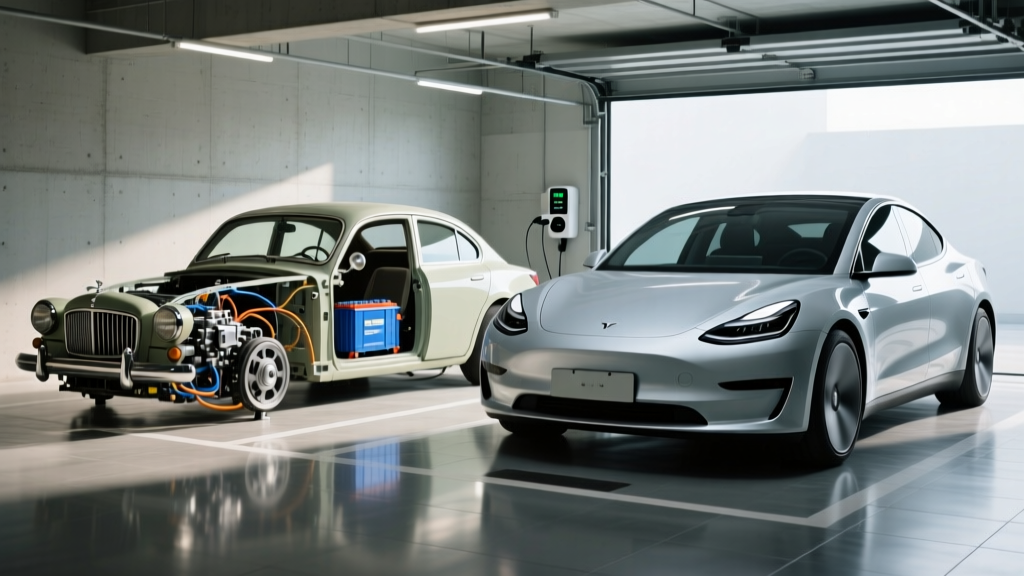
Search forums and YouTube and you'll find no shortage of enthusiasts dropping electric motors into classic Porsche 911s, VW buses, and Mazda Miatas. The appeal is real: keep a beloved chassis, ditch the gas engine, and drive emission-free. But when a prospective EV buyer asks about the cost of converting a car to electric, the honest answer requires separating passion projects from practical transportation.
A professional EV conversion in 2026 typically runs $15,000 to $40,000+ in parts and labor alone — before accounting for engineering, safety certification, or the donor vehicle. That's before you factor in what you don't get: no battery warranty, no federal tax credit eligibility, no modern thermal management, and no DC fast charging capability in most builds. For the vast majority of buyers, purchasing a new or used production EV delivers dramatically better economics, safety, and daily usability.
This guide breaks down the real numbers — conversion costs, new EV ownership over five years, federal and state incentives, fuel and maintenance savings, insurance realities, and depreciation — so you can make a data-driven decision.
What an EV Conversion Actually Costs in 2026
A typical battery-electric conversion replaces the internal combustion engine, fuel system, and exhaust with an electric motor, inverter, and lithium battery pack. Here's where the money goes:
| Component | Typical Cost Range |
|---|---|
| Battery pack (20–40 kWh, LFP or NMC modules) | $5,000 – $12,000 |
| Electric motor + inverter (75–150 kW) | $3,000 – $7,000 |
| BMS, wiring, contactors, chargers | $2,000 – $4,500 |
| Fabrication, mounts, adapters, cooling | $3,000 – $8,000 |
| Labor (specialty shop, 100–200+ hours) | $8,000 – $20,000 |
| Engineering / safety / registration | $1,000 – $3,000 |
| Total (professional conversion) | $22,000 – $54,500+ |
DIY builds can cut labor costs but demand serious electrical and mechanical expertise — and mistakes with high-voltage systems carry real safety risks. Critically, most conversions yield 60–120 miles of range (depending on pack size and vehicle weight), use air-cooled or rudimentary thermal management, and support only Level 1 or Level 2 AC charging — no DC fast charging. The result is a fun weekend car, not a practical daily driver for most commuters.
Buying a Production EV: 5-Year Total Cost of Ownership
Let's compare the conversion path against a representative new EV purchase. We'll use the 2026 Hyundai Ioniq 5 SE Standard Range as a baseline — a well-equipped crossover with EPA-estimated 290 miles of range, 84 kWh usable battery (NMC), 150 kW peak DC fast charging (10–80% in ~21 minutes on a capable charger), and a starting MSRP around $42,600.
| Cost Category (5 Years / 75,000 mi) | EV Conversion (est.) | New 2026 Ioniq 5 SE | Gas Baseline (2026 Tucson AWD) |
|---|---|---|---|
| Purchase / Build Price | $35,000 (donor + conversion) | $42,600 | $33,500 |
| Federal Tax Credit (§30D) | $0 (ineligible) | Up to $7,500* | $0 |
| Effective Purchase Price | $35,000 | ~$35,100 | $33,500 |
| Fuel / Energy (75k mi) | $3,750 ($0.15/kWh) | $4,500 ($0.15/kWh) | $9,375 ($3.50/gal, 28 MPG) |
| Maintenance | $1,500 (est.) | $2,200 | $4,800 |
| Insurance (5 yr avg.) | $12,000 (specialty) | $11,500 | $8,500 |
| Depreciation | $15,000 (niche market) | $18,500 | $14,000 |
| 5-Year Total Cost | $67,250 | $71,800 | $70,175 |
*§30D credit eligibility depends on income, MSRP, and battery sourcing — see eligibility checklist below. Source: IRS §30D guidelines.
The conversion and the new EV land in a similar total-cost neighborhood, but the production EV delivers a factory warranty, full safety certification, DC fast charging for road trips, modern ADAS (highway driving assist, automatic emergency braking, blind-spot monitoring), and vastly superior range. The conversion wins only if you place high personal value on the specific donor vehicle.
Federal Tax Credit: §30D Eligibility in 2026
The Inflation Reduction Act reshaped the federal clean vehicle credit with strict requirements. For 2026, the credit remains up to $7,500 for qualifying new EVs and up to $4,000 for qualifying used EVs (subject to different rules under §25E). A converted vehicle does not qualify — the credit applies only to new vehicles manufactured by an OEM and meeting all sourcing requirements.
New EV Credit (§30D) Requirements — 2026
- MSRP Caps: Vans, SUVs, and pickup trucks must have an MSRP ≤ $80,000. Sedans and other vehicles must be ≤ $55,000.
- Buyer Income Limits (MAGI): $300,000 joint filers / $225,000 head of household / $150,000 single filers.
- Battery Component Manufacturing: A percentage of battery components must be manufactured or assembled in North America (threshold increases yearly).
- Critical Minerals Sourcing: A percentage of critical minerals must be sourced from the U.S. or free-trade-agreement partners (threshold increases yearly).
- Final Assembly: Vehicle must undergo final assembly in North America.
- Point-of-Sale Transfer: Buyers can transfer the credit to the dealer at purchase, reducing the purchase price upfront rather than waiting for a tax refund.
- FEOC Restriction: Vehicles with battery components or critical minerals from a "foreign entity of concern" are disqualified.
Rules evolve annually. Verify current thresholds at fueleconomy.gov and consult a tax professional for your specific situation.
For the Ioniq 5 example above, eligibility depends on the buyer's income, the specific trim's MSRP, and whether Hyundai's battery supply chain meets the 2026 critical-mineral and component thresholds. Many trims qualify, but not all buyers will meet every requirement.
Charging vs. Gas: The Per-Mile Math
This is where EVs consistently win — but the savings depend on your electricity rate and driving patterns.
| Scenario | Cost per Mile | Annual Cost (15,000 mi) |
|---|---|---|
| Home charging at $0.15/kWh (Ioniq 5 at 3.5 mi/kWh) | $0.043 | $643 |
| Home charging at $0.10/kWh (low-rate utility) | $0.029 | $429 |
| Public DC fast charging at $0.40/kWh (road trips, 20% of miles) | $0.114 (blended) | $771 (blended annual) |
| Gas vehicle at 28 MPG, $3.50/gal | $0.125 | $1,875 |
| Gas vehicle at 22 MPG, $3.50/gal (truck/large SUV) | $0.159 | $2,386 |
At a national average residential rate of roughly $0.15–$0.17/kWh, an efficient EV like the Ioniq 5 costs about $0.04–$0.05 per mile to fuel at home — roughly one-third the cost of a 28 MPG gas car at $3.50/gallon. Even factoring in occasional DC fast charging at $0.35–$0.50/kWh for road trips, most owners save $800–$1,500 per year on energy compared to a comparable gas vehicle.
Conversion vehicles, typically less efficient due to older aerodynamics, added weight from steel-to-battery swaps, and lack of heat pumps, often achieve 2.5–3.0 mi/kWh — raising per-mile costs to $0.05–$0.06 at home. Still cheaper than gas, but the gap narrows.
Maintenance Savings: Where EVs Pull Ahead
Electric drivetrains have far fewer wear components than internal combustion engines. No oil changes, no spark plugs, no timing belts, no exhaust systems, and no multi-speed transmissions. Regenerative braking dramatically extends brake pad life — many EV owners report original brake pads at 80,000+ miles.
| Maintenance Item | Gas Vehicle (5 yr / 75k mi) | EV (5 yr / 75k mi) |
|---|---|---|
| Oil changes (5–7) | $350 – $700 | $0 |
| Transmission fluid / service | $200 – $500 | $0 – $150 |
| Brake pads (1–2 replacements) | $400 – $900 | $0 – $300 (regen extends life) |
| Spark plugs / ignition | $200 – $500 | $0 |
| Exhaust / emissions | $100 – $600 | $0 |
| Coolant / belts / misc. | $300 – $600 | $150 – $300 |
| Cabin air filter, wipers, tires | $800 – $1,200 | $800 – $1,200 (tires may wear faster on heavy EVs) |
| Estimated Total | $2,350 – $5,000 | $950 – $2,250 |
Over five years, expect to save $1,400 to $2,750 on routine maintenance with a production EV. Tire costs can be slightly higher on EVs due to increased vehicle weight and instant torque, but this is a minor offset against the broader savings.
For conversions, maintenance savings exist but are less predictable. Custom-fabricated components, non-standard battery modules, and one-off engineering can mean higher repair costs when something fails — and no dealership service department will work on them.
Insurance: The Cost EV Owners Often Underestimate
EV insurance premiums are typically 15–30% higher than equivalent gas vehicles. The reasons are structural, not arbitrary:
- Higher repair costs: EV battery packs are expensive ($10,000–$25,000+ to replace) and even minor collision damage near the battery enclosure can trigger total-loss decisions.
- Specialized labor: High-voltage system repairs require certified technicians, which are less common and more expensive.
- Higher vehicle MSRP: EVs still carry a price premium in many segments, and insurers price premiums partly on replacement cost.
- Parts availability: EV-specific body panels, battery modules, and power electronics can have longer lead times.
For our Ioniq 5 example, expect annual premiums around $2,100–$2,500 depending on state, driving record, and coverage level — compared to $1,600–$1,900 for a gas Tucson. Over five years, that's roughly $2,500–$3,500 more in insurance costs.
For conversions, insurance is even more complex. Many mainstream insurers won't cover modified vehicles, forcing owners to specialty classic-car or custom-vehicle insurers at higher rates — often $2,500–$4,000+ annually. Agreed-value policies may be required, and claims disputes over custom work are common.
Depreciation and Resale Value: The Evolving Picture
EV depreciation has been volatile. Early EVs suffered steep drops due to battery degradation fears and rapid technology improvements making older models obsolete. In 2023–2024, aggressive price cuts by Tesla and others caused used EV values to tumble faster than gas cars.
By 2026, the picture has stabilized for mainstream models. According to IIHS and industry resale data, popular EVs like the Hyundai Ioniq 5, Tesla Model Y, and Ford Mustang Mach-E now retain roughly 45–55% of MSRP after 5 years / 75,000 miles — competitive with many gas crossovers. Key factors:
- Battery warranties: Most OEMs provide 8-year/100,000-mile battery warranties (minimum 70% capacity retention), which supports resale confidence.
- Chemistry matters: LFP battery vehicles (e.g., Tesla Model 3 RWD, some Ford models) show slower degradation and may hold value better long-term.
- Charging standard convergence: The industry-wide shift to NACS (Tesla's connector) for 2025+ models reduces the "stranded asset" risk of CCS-only vehicles.
Conversion vehicles occupy a niche market. Resale depends entirely on finding a buyer who values the specific build — and that pool is small. Expect 40–60% depreciation with high variability, and sales that take months rather than weeks.
State, Local, and Utility Incentives
Incentive availability varies significantly by state, municipality, and utility provider. The following are examples — always verify current programs in your area:
- California: CVRP rebates up to $7,000 for income-qualified buyers (funding-dependent, application required).
- Colorado: State tax credit up to $5,000 for new EVs under $80,000 MSRP.
- New York: Drive Clean Rebate up to $2,000 (point-of-sale).
- Utility rebates: Many utilities offer $250–$1,500 for Level 2 home charger purchase/installation (e.g., PG&E, ConEdison, Xcel Energy).
- HOV lane access: Several states grant solo-carpool-lane access to EVs — a significant non-monetary incentive in congested metro areas.
- Time-of-use rates: Utility TOU plans can reduce home charging costs to $0.06–$0.09/kWh during off-peak hours.
Check AFDC's state law database and your local utility for current programs. None of these incentives apply to EV conversions.
The combined effect of federal, state, and utility incentives can reduce the effective purchase price of a new EV by $7,500 to $15,000+ in favorable jurisdictions — a gap no conversion can match.
Frequently Asked Questions
How much does it really cost to own an EV over 5 years?
For a mainstream EV like the 2026 Hyundai Ioniq 5 SE (MSRP ~$42,600), a realistic 5-year / 75,000-mile total cost of ownership is approximately $65,000–$75,000 including purchase (minus any applicable tax credit), home and public charging, insurance, maintenance, and depreciation. This is competitive with or slightly below a comparable gas crossover when the full §30D credit applies, and notably cheaper on a per-mile fuel basis.
Do I qualify for the federal EV tax credit?
Eligibility for the up-to-$7,500 §30D credit depends on your modified adjusted gross income (≤$150k single / ≤$300k joint), the vehicle's MSRP (≤$55k cars / ≤$80k SUVs/trucks/vans), North American final assembly, and battery component/critical-mineral sourcing thresholds. The credit can be transferred to the dealer at point of sale. Verify your specific vehicle's eligibility at fueleconomy.gov and consult a tax professional. EV conversions do not qualify.
How much do I save on fuel and maintenance with an EV?
Typical savings are $800–$1,500 per year on fuel (home charging at $0.10–$0.17/kWh vs. gas at $3.00–$4.00/gal) and $300–$550 per year on maintenance (no oil changes, extended brake life, fewer fluids). Over five years, combined fuel and maintenance savings usually total $5,500–$10,000 depending on mileage, local electricity rates, and gas prices.
Are EVs more expensive to insure?
Yes — typically 15–30% higher premiums than comparable gas vehicles due to higher repair costs (especially battery replacement), specialized labor requirements, and higher MSRP. Budget an extra $400–$800 per year. Conversion vehicles often cost even more to insure through specialty carriers.
How well do EVs hold their value?
Mainstream EVs in 2026 retain approximately 45–55% of MSRP after 5 years, comparable to many gas vehicles. LFP-battery models may depreciate more slowly due to superior longevity. Battery warranties (8 yr/100k mi, ≥70% capacity) provide buyer confidence. Conversion vehicles have unpredictable resale values in a very small buyer pool.
Is converting my gas car to electric ever worth it?
For a daily driver seeking reliable, practical, cost-effective transportation — almost never. A new or used production EV will deliver better range, safety, warranty, charging infrastructure access, tax incentives, and total cost of ownership. Conversions make sense as passion projects for classic or sentimental vehicles where the owner values the specific chassis and accepts the cost premium, limited range, and lack of modern amenities.