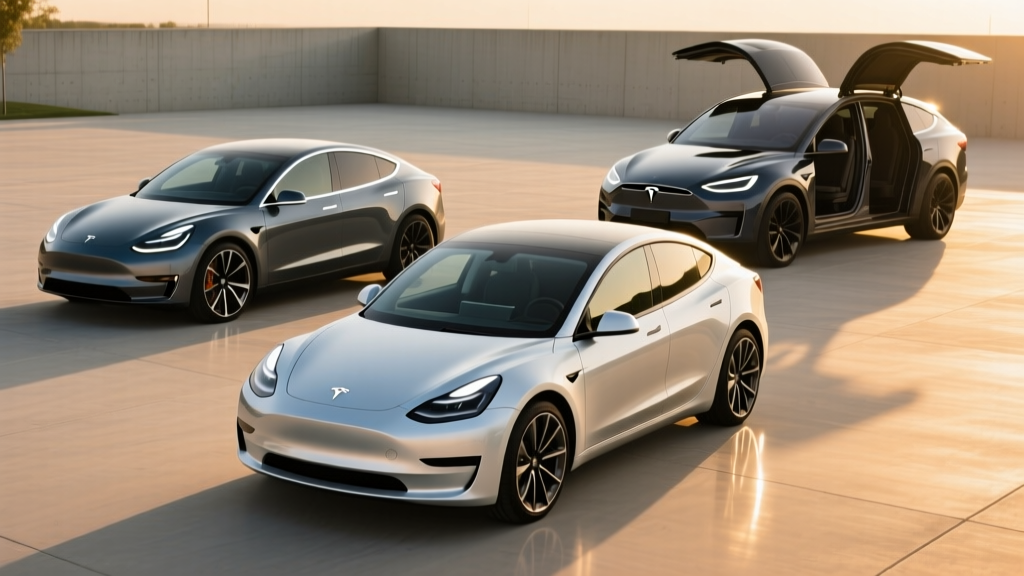
Tesla's 2026 lineup spans four distinct vehicles, from the $38,990 Model 3 sedan to the $79,990 Model X SUV. If you're trying to compare Tesla models to find the right fit, the differences go far beyond size. Battery chemistry, charging architecture, efficiency, and federal tax credit eligibility all shift depending on which model — and which trim — you select. This guide breaks down the exact numbers you need to make a data-driven decision.
Quick Verdict: The Model 3 Long Range AWD offers the best efficiency and value for most buyers. The Model Y is the practical family hauler. The Model S and X serve niche roles for performance enthusiasts and three-row households, respectively — but both sacrifice tax credit eligibility and charging efficiency.
2026 Tesla Lineup: Side-by-Side Specifications
The table below uses the most common Long Range (LR) and Standard trims across the lineup. Performance variants are noted where relevant. All EPA range figures are from fueleconomy.gov and Tesla's official specifications for the 2026 model year.
| Spec | Model 3 LR AWD | Model Y LR AWD | Model S LR | Model X LR |
|---|---|---|---|---|
| EPA Range | 363 mi | 320 mi | 402 mi | 348 mi |
| Battery (usable, kWh) | ~75 kWh (NMC) | ~75 kWh (NMC) | ~95 kWh (NMC) | ~95 kWh (NMC) |
| Efficiency (MPGe) | 132 MPGe | 119 MPGe | 124 MPGe | 109 MPGe |
| Peak DC Charge Rate | 250 kW | 250 kW | 250 kW | 250 kW |
| 10–80% DC Fast Charge | ~25 min | ~27 min | ~32 min | ~35 min |
| Level 2 Charge Rate | 11.5 kW (44 mi/hr) | 11.5 kW (44 mi/hr) | 11.5 kW (44 mi/hr) | 11.5 kW (44 mi/hr) |
| 0–60 mph | 4.2 sec | 4.8 sec | 3.1 sec | 3.8 sec |
| Horsepower | 346 hp | 384 hp | 670 hp | 670 hp |
| Cargo Volume (cu ft) | 23 (trunk+frunk) | 76 (rear seats up) | 28 (trunk+frunk) | 88 (5-seat, behind 2nd row) |
| Base MSRP | $47,740 | $48,990 | $79,990 | $84,990 |
| §30D Federal Tax Credit | $7,500 eligible* | $7,500 eligible* | Not eligible (MSRP cap) | Not eligible (MSRP cap) |
| Warranty (Battery) | 8 yr / 120,000 mi | 8 yr / 120,000 mi | 8 yr / 150,000 mi | 8 yr / 150,000 mi |
*§30D credit eligibility requires meeting income caps ($150K single / $300K joint), MSRP caps ($55K sedans / $80K SUVs), and battery sourcing rules. Verify current eligibility at IRS.gov. Point-of-sale transfer is available for qualified buyers.
Range and Efficiency: Real-World Expectations
The Model S Long Range claims the highest EPA range at 402 miles, but raw EPA numbers don't tell the full story. Efficiency — measured in MPGe or kWh per 100 miles — determines your actual electricity cost and how range holds up under real-world conditions.
Real-World Range Reality Check:
- Model 3 LR: EPA 363 mi → Expect ~310–330 mi highway, ~270–290 mi in cold weather (below 30°F)
- Model Y LR: EPA 320 mi → Expect ~275–290 mi highway, ~240–260 mi in cold weather
- Model S LR: EPA 402 mi → Expect ~340–360 mi highway, ~300–320 mi in cold weather
- Model X LR: EPA 348 mi → Expect ~295–315 mi highway, ~260–280 mi in cold weather
Highway speeds above 70 mph, headwinds, elevation gain, and cabin heating all reduce range. The Model 3's lighter weight and lower drag coefficient give it a meaningful efficiency edge.
The Model 3 Long Range achieves 132 MPGe combined, making it the most efficient vehicle Tesla sells. Over 15,000 miles annually, the Model 3 uses roughly 3,800 kWh compared to the Model X's ~4,600 kWh — a difference of about $100–$130 per year at the national average electricity rate of $0.17/kWh. Over five years, that efficiency gap compounds.
Charging Speed and Network Considerations
All 2026 Tesla models peak at 250 kW on V3 Superchargers, but sustained charging speed varies significantly due to battery size and thermal management. The charge curve — the rate at which charging speed tapers as the battery fills — matters more than peak kW.
| Charging Method | Model 3 / Y | Model S / X |
|---|---|---|
| Level 1 (120V, ~1.4 kW) | ~5 mi/hr | ~5 mi/hr |
| Level 2 (240V, 11.5 kW) | ~44 mi/hr | ~44 mi/hr |
| DC Fast (peak 250 kW) | 10–80% in ~25–27 min | 10–80% in ~32–35 min |
| DC Fast (sustained avg) | ~135 kW average | ~115 kW average |
The Model 3 and Y's smaller ~75 kWh battery charges from 10–80% roughly 5–8 minutes faster than the Model S/X's ~95 kWh pack. On a road trip, that's one fewer coffee stop per 600 miles. All Teslas support preconditioning — warming the battery before arriving at a Supercharger — which is essential for achieving advertised charge speeds in cold weather. Without preconditioning, winter DC fast charging can slow by 30–50%.
Tesla's Supercharger network remains the most reliable public charging infrastructure in the U.S., with over 25,000 V3 (250 kW) and growing V4 stalls. All 2026 Teslas use the NACS connector natively. If you frequently drive in areas with only CCS-equipped networks (Electrify America, etc.), you'll need a NACS-to-CCS adapter — though Tesla's network coverage now makes this largely unnecessary for most owners.
Performance and Driving Dynamics
Every 2026 Tesla is quick by any reasonable standard, but the performance spread is substantial.
🏆 Performance Winner: Model S Plaid
At 1,020 hp and a 1.99-second 0–60 time (with rollout), the Model S Plaid is one of the fastest production cars ever built. The standard Model S LR's 3.1-second 0–60 and 670 hp are still supercar territory.
🏆 Driving Dynamics Winner: Model 3
The Model 3's lower weight (~3,900 lbs vs. the Model X's ~5,200 lbs), lower center of gravity, and sharper steering make it the most engaging Tesla to drive on twisty roads. It feels like a sports sedan; the Model Y feels like a competent crossover.
The Model Y and Model X, as crossovers/SUVs, offer higher seating positions, more ground clearance, and available all-wheel drive with better traction in snow — practical trade-offs for the performance gap. The Model X's falcon-wing rear doors add drama but also complexity; owners report occasional sensor and seal issues in extreme cold.
Pricing, Tax Credits, and True Cost to Buy
The price gap between Tesla's lineup is wider than it first appears once you factor in the federal §30D tax credit. Under current IRS rules, the credit is available only for vehicles under the MSRP cap: $55,000 for sedans and $80,000 for SUVs/vans/pickups. Buyer income caps also apply ($150,000 single / $225,000 head of household / $300,000 joint AGI).
| Model | Base MSRP | §30D Credit | Effective Price* |
|---|---|---|---|
| Model 3 LR AWD | $47,740 | $7,500 | $40,240 |
| Model 3 Performance | $52,990 | $7,500 | $45,490 |
| Model Y LR AWD | $48,990 | $7,500 | $41,490 |
| Model Y Performance | $52,490 | $7,500 | $44,990 |
| Model S LR | $79,990 | $0 | $79,990 |
| Model X LR | $84,990 | $0 | $84,990 |
*Effective price assumes full §30D eligibility. The Model 3 Performance exceeds the $55K sedan MSRP cap and is NOT eligible. The Model Y qualifies under the $80K SUV cap. Always verify current rules at IRS.gov — battery sourcing and critical mineral requirements change annually.
The §30D credit can now be transferred to the dealer at point of sale as an instant discount, effectively reducing your out-of-pocket cost at purchase rather than waiting for a tax refund. This is a significant advantage for the Model 3 and Y, which become meaningfully more affordable than their sticker prices suggest.
Five-Year Ownership Cost Breakdown
Purchase price is only part of the equation. Here's how the four models compare over five years and 75,000 miles of ownership, assuming home Level 2 charging at $0.17/kWh and national average insurance rates.
| Cost Factor | Model 3 LR | Model Y LR | Model S LR | Model X LR |
|---|---|---|---|---|
| Purchase (after credit) | $40,240 | $41,490 | $79,990 | $84,990 |
| Electricity (75K mi) | $2,170 | $2,410 | $2,480 | $2,900 |
| Insurance (5-yr est.) | $9,500 | $10,200 | $14,000 | $15,000 |
| Maintenance (5-yr est.) | $1,500 | $1,700 | $2,000 | $2,500 |
| Est. Depreciation (5-yr) | $16,000 | $17,500 | $30,000 | $34,000 |
| 5-Year Total Cost | $69,410 | $73,300 | $128,470 | $139,390 |
The Model 3's combination of lower purchase price, superior efficiency, lower insurance premiums, and slower depreciation makes it the clear value leader. The Model Y costs roughly $4,000 more over five years — a reasonable premium for the extra cargo space and ride height. The Model S and X carry substantially higher ownership costs driven by depreciation and insurance, which are proportionally much steeper on six-figure vehicles even after accounting for their higher build quality and performance.
Insurance note: Tesla insurance premiums run 15–30% higher than comparable non-Tesla EVs due to higher repair costs (aluminum body panels, integrated sensor suites, and proprietary parts). Tesla's own insurance product is available in many states and may offer savings for safe drivers via real-time driving score data.
Autopilot, FSD, and Technology
SAE Automation Level: Level 2
All Tesla driver-assistance features — including Basic Autopilot, Enhanced Autopilot, and FSD (Supervised) — are SAE Level 2 systems. This means the driver must remain fully engaged, with hands on the wheel and eyes on the road, at all times. These are NOT self-driving systems. Only Level 4 services like Waymo operate without a driver.
All 2026 Teslas ship with Basic Autopilot (traffic-aware cruise control and lane centering) at no extra cost. Enhanced Autopilot ($6,000) adds auto lane change, navigate on Autopilot, auto park, and Summon. FSD (Supervised) at $8,000 (or $99/month subscription) adds traffic light and stop sign recognition and city-street autosteer.
The hardware and software experience is identical across all four models — Tesla's latest HW4 computer, 15.4-inch center touchscreen (Model 3/Y) or 17-inch (Model S/X), and the same over-the-air update pipeline. The Model S and X add a rear-seat 8-inch touchscreen for passengers and a more premium audio system (22 speakers vs. 17 in the Model 3/Y).
FSD (Supervised) Limitations: FSD does not eliminate the need for driver attention. It can make errors at construction zones, unmapped intersections, and in adverse weather. NHTSA continues to investigate Tesla's Autopilot/FSD in certain crash scenarios. Treat it as an advanced cruise control system, not a chauffeur.
🏆 Tech Winner: Tie (All Models)
Software, infotainment, and ADAS hardware are functionally identical. The Model S/X offer slightly larger screens and better audio, but the core experience is the same across the lineup.
🏆 Value Winner: Model 3 LR AWD
At an effective ~$40,240 after the tax credit, with the lowest operating costs and best efficiency, the Model 3 delivers the most car per dollar in Tesla's lineup.
Interior, Cargo, and Practicality
The Model 3 and Y share Tesla's minimalist interior architecture — clean surfaces, no physical buttons, and all controls routed through the center touchscreen. The 2026 Model 3 ("Highland" refresh) added ventilated front seats, ambient lighting, rear-seat ventilation controls, and improved sound insulation. The Model Y received a similar "Juniper" update for 2026 with comparable refinements.
The Model S and X occupy a different tier: real wood and aluminum trim, a yoke or round steering wheel option, a powered rear sunshade, and more rear legroom. The Model X offers an optional third row (seating up to 7), though the third row is best suited for children. With the second row folded, the Model X provides 88 cubic feet of cargo space — enough for a full apartment move.
For daily commuting and weekend trips, the Model Y's 76 cu ft of cargo (with rear seats up, measured behind the front row including under-floor storage) hits a sweet spot. The Model 3's 23 cu ft trunk-and-frunk combination handles groceries and luggage for two but falls short for families.
Decision Framework: Which Tesla Is Right for You?
Choose the Model 3 LR AWD if:
- You prioritize efficiency and lowest total cost of ownership
- You commute solo or with one passenger most days
- You want the best driving dynamics in the lineup
- You want to maximize the §30D federal tax credit
- Your budget is under $50,000 effective
Choose the Model Y LR AWD if:
- You need family-friendly cargo space and easy car-seat installation
- You prefer a higher seating position and crossover ride height
- You still want strong range (320 mi EPA) and tax credit eligibility
- You frequently haul bulky items (strollers, bikes, dogs)
Choose the Model S LR if:
- You want maximum range (402 mi EPA) for long-distance driving
- Performance is a priority (3.1-sec 0–60, 670 hp)
- You prefer a premium sedan experience over a crossover
- Tax credit eligibility and total cost of ownership are secondary concerns
Choose the Model X LR if:
- You need three rows of seating for up to 7 passengers
- You want falcon-wing doors for tight parking-space access to rear seats
- You need 88 cu ft of cargo volume and 5,000-lb towing capacity
- Budget is flexible above $80,000
Pros and Cons at a Glance
Model 3 LR AWD
✅ 363 mi EPA range, best-in-class efficiency (132 MPGe)
✅ Lowest effective price after $7,500 credit (~$40,240)
✅ Sharpest handling and lightest weight in the lineup
❌ Limited cargo space (23 cu ft)
❌ Rear-seat space tight for tall passengers
Model Y LR AWD
✅ 76 cu ft cargo, family-friendly with hatchback utility
✅ Tax credit eligible, effective price ~$41,490
✅ Comfortable ride height, good visibility
❌ Heavier and less efficient than Model 3
❌ Road noise still noticeable at highway speeds
Model S LR
✅ 402 mi EPA range — longest of any Tesla
✅ 3.1-sec 0–60, 670 hp, premium interior
✅ Adaptive air suspension, superior ride quality
❌ No federal tax credit (exceeds MSRP cap)
❌ Higher insurance, faster depreciation
Model X LR
✅ Optional 3-row seating (up to 7 passengers)
✅ 88 cu ft cargo, 5,000-lb towing
✅ Falcon-wing doors for easy rear-seat access
❌ Most expensive, no federal tax credit
❌ Falcon-wing door sensors can be finicky in cold/ice
Frequently Asked Questions
Which Tesla model has the best range in 2026?
The Model S Long Range leads at 402 miles EPA, followed by the Model 3 LR at 363 miles. However, the Model 3 achieves its range with a smaller, lighter battery, making it more efficient per mile and cheaper to charge. In real-world highway driving at 75 mph, expect roughly 340–360 miles from the Model S and 310–330 from the Model 3.
Is the Model 3 or Model Y better value after tax credits?
Both qualify for the full $7,500 §30D federal tax credit (subject to buyer income and sourcing rules), bringing the Model 3 LR to an effective ~$40,240 and the Model Y LR to ~$41,490. The Model 3 is ~$1,250 cheaper and more efficient, but the Model Y offers substantially more cargo space. For a single commuter, the Model 3 wins on pure economics. For a family, the Model Y's utility justifies the small premium.
Do the Model S and Model X qualify for any federal tax credits?
No. Under current IRS §30D rules, sedans with an MSRP above $55,000 and SUVs above $80,000 are ineligible. The Model S ($79,990) exceeds the sedan cap, and the Model X ($84,990) exceeds the SUV cap. Some states offer separate incentives that may apply — check your state's energy office for details.
How long do Tesla batteries last, and what does replacement cost?
Tesla warranties its batteries for 8 years/120,000 miles (Model 3/Y) or 8 years/150,000 miles (Model S/X), guaranteeing at least 70% capacity retention. Real-world data from Tesla's fleet shows average degradation of roughly 12–15% at 150,000 miles for NMC batteries. A full battery replacement out of warranty costs approximately $12,000–$16,000 for Model 3/Y and $18,000–$22,000 for Model S/X, based on current service center estimates.
Can I charge a Tesla on non-Tesla charging networks?
All 2026 Teslas use the NACS (North American Charging Standard) connector natively. Tesla's Supercharger network is the largest and most reliable in the U.S. For CCS-equipped networks like Electrify America, you'll need a NACS-to-CCS adapter (sold separately, ~$200–$250). Tesla has also begun opening select Superchargers to non-Tesla EVs, but Tesla owners retain priority access and native integration (automatic routing, preconditioning, and billing).
Is Tesla's Autopilot or FSD worth the extra cost?
Basic Autopilot (included) handles highway cruising well and satisfies most commuters. Enhanced Autopilot ($6,000) adds useful features like auto lane change. FSD (Supervised) at $8,000 or $99/month is a more speculative purchase — it works impressively in many scenarios but still requires constant supervision and can make unexpected errors. We recommend starting with the included Basic Autopilot and subscribing to FSD monthly ($99/mo) to evaluate it on your typical routes before committing to a purchase. Remember: all current Tesla driver-assist features are SAE Level 2 — you are always the driver.