Why the Chinese Electric Car Price Headline Is Misleading for US Buyers
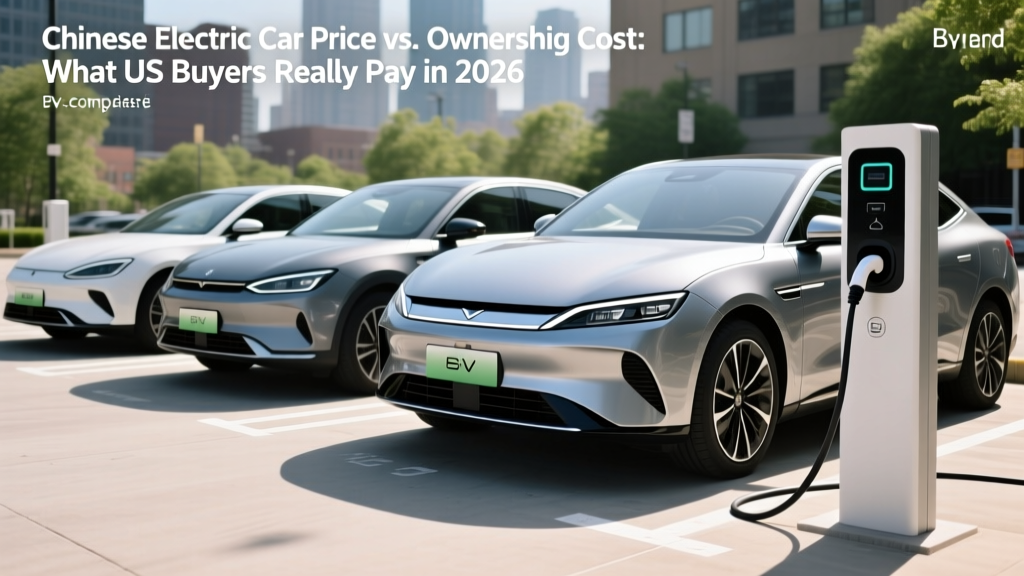
Scroll through global EV news and you'll see eye-popping figures: a BYD Seagull starting under $10,000 in China, a Changan Lumin for less than a used Civic. These numbers fuel a persistent search trend around chinese electric car price — but for US-based shoppers, the sticker you see in Shanghai isn't the sticker you'd pay in Sacramento.
Between 100%+ combined tariffs, federal tax-credit ineligibility due to battery-sourcing rules, and the reality that most Chinese brands still don't sell passenger vehicles in the United States as of the 2026 model year, the true cost picture is far more complex. This guide breaks down what a Chinese-made EV would actually cost a US buyer over five years — and why the math rarely works in your favor compared to domestically assembled alternatives.
5-Year Total Cost of Ownership: Chinese-Made EV vs. US-Assembled EV (Illustrative)
| Cost Category | Chinese-Made EV (e.g., BYD Atto 3 equivalent, if imported) | US-Assembled EV (e.g., Tesla Model Y RWD) |
|---|---|---|
| Base MSRP | ~$30,000 (China) | $44,990 |
| Tariffs & import duties (100%+ combined) | +$30,000–$35,000 | $0 |
| Landed US price | ~$60,000–$65,000 | $44,990 |
| Federal tax credit (§30D) | $0 (FEOC battery sourcing fail) | Up to $7,500 (point-of-sale) |
| Effective purchase price | ~$60,000–$65,000 | ~$37,490 |
| Charging (5 yr, 12k mi/yr, $0.14/kWh avg) | ~$3,360 | ~$3,360 |
| Insurance (5 yr avg) | ~$12,500 (limited parts network) | ~$9,500 |
| Maintenance (5 yr) | ~$1,800 | ~$1,500 |
| Depreciation (5 yr) | ~$35,000 (no resale market) | ~$18,000 |
| 5-Year Total Cost | ~$112,660–$117,660 | ~$70,350 |
Sources: Manufacturer MSRP data, IRS §30D guidelines, industry depreciation estimates. Tariff rates reflect 2025–2026 US trade policy on Chinese-origin EVs.
The Tariff Wall: Why Chinese EV Prices Double at the US Border
The single biggest factor distorting the chinese electric car price for American buyers is the US tariff structure. As of 2026, Chinese-manufactured battery electric vehicles face a combined duty rate that can exceed 100% of the vehicle's declared value. This includes the baseline Section 301 tariff (raised to 100% on Chinese EVs in late 2024) plus standard auto import duties.
What does this mean in practice? A BYD Atto 3 (known as the Yuan Plus in China) that sells for roughly 140,000 RMB (~$19,500) in its home market would land in the US at close to $40,000–$45,000 before dealer markup, destination, or any compliance modifications — and that's before you discover it doesn't qualify for the federal tax credit.
The tariff structure exists partly because of US trade policy aimed at protecting domestic auto manufacturing, and partly because Chinese EVs rely heavily on battery supply chains that the US government has designated as Foreign Entities of Concern (FEOC). This dual barrier — tariff plus credit disqualification — effectively prices most Chinese EVs out of the US market.
Federal Tax Credit Eligibility: Why Chinese-Made EVs Don't Qualify
The IRS §30D Clean Vehicle Credit offers up to $7,500 for qualifying new EVs, but the eligibility requirements are specifically designed to exclude vehicles with Chinese-sourced battery components. Here's the checklist as of the 2026 tax year:
§30D Federal Tax Credit Requirements (2026)
- Final assembly in North America: Vehicle must be assembled in the US, Canada, or Mexico. Most Chinese-brand EVs fail this requirement outright.
- MSRP caps: Vans, SUVs, and trucks ≤ $80,000; sedans and other body styles ≤ $55,000.
- Buyer income limits: Modified AGI ≤ $300,000 (joint), $225,000 (head of household), $150,000 (single).
- Battery critical minerals (up to $3,750): Must be sourced from the US or a free-trade-agreement partner. Chinese-mined or -processed minerals disqualify this half.
- Battery components (up to $3,750): Cannot be manufactured or assembled by a Foreign Entity of Concern (FEOC). Any Chinese-made cell or module eliminates this half — and from 2025 onward, FEOC-sourced critical minerals also disqualify the vehicle entirely.
- Point-of-sale transfer: Eligible buyers can apply the credit as an immediate dealer discount rather than waiting for tax filing.
Source: IRS Clean Vehicle Credits. Rules are subject to change — verify current-year eligibility at irs.gov or with a tax professional.
Even if a Chinese automaker established North American assembly (which none have done for passenger vehicles as of 2026), the battery-sourcing rules would still likely disqualify the vehicle. CATL and BYD's FinDreams — the two dominant Chinese battery suppliers — are classified as FEOCs. This is a structural exclusion, not a temporary one.
Charging vs. Gas: The Per-Mile Math That Applies to Any EV
Regardless of origin, any battery electric vehicle delivers the same fundamental fuel-cost advantage. Here's the real math using 2026 national averages:
Cost Per Mile: EV vs. Gas Vehicle
| Metric | EV (home charging) | Gas vehicle (30 MPG combined) |
|---|---|---|
| Energy cost | $0.14/kWh (national avg residential) | $3.30/gallon (national avg regular) |
| Efficiency | 3.5 mi/kWh (~120 MPGe) | 30 MPG combined |
| Cost per mile | $0.040/mile | $0.110/mile |
| Annual cost (12,000 mi) | $480 | $1,320 |
| 5-year fuel cost | $2,400 | $6,600 |
| 5-year savings (EV) | $4,200 | |
Assumes 85% home Level 2 charging at $0.14/kWh, 15% public DC fast charging at $0.35/kWh blended to ~$0.17/kWh effective. Gas price reflects EIA 2026 projections. Your actual rate varies by utility and state.
This savings holds whether you're charging a Tesla, a Hyundai Ioniq 5, or a hypothetical imported BYD. The problem isn't the per-mile cost — it's that the tariff-inflated purchase price of a Chinese EV erases years of fuel savings before you drive off the lot.
Maintenance Savings: Real but Modest
EVs genuinely cost less to maintain than internal-combustion vehicles, but the savings aren't as dramatic as some headlines suggest. Here's a realistic breakdown:
| Maintenance Item | Gas Vehicle (5 yr / 60k mi) | EV (5 yr / 60k mi) |
|---|---|---|
| Oil changes | $600–$900 | $0 |
| Brake pads/rotors | $800–$1,500 | $200–$400 (regen extends life 2–3×) |
| Transmission fluid | $200–$400 | $0 (most EVs use single-speed reduction gear) |
| Cabin air filter | $150–$250 | $150–$250 |
| Tire rotation/replacement | $1,200–$1,800 | $1,400–$2,200 (heavier vehicle, instant torque wears tires faster) |
| Coolant flush | $200–$300 | $150–$250 (battery thermal management loop) |
| Spark plugs | $300–$500 | $0 |
| Total (5 yr) | $3,450–$5,650 | $1,900–$3,100 |
The net maintenance savings for an EV is roughly $1,500–$2,500 over five years. That's meaningful, but it doesn't offset a $20,000+ tariff penalty on a Chinese import. Note that tire costs can actually be higher on EVs due to greater curb weight and instant torque — a factor many ownership calculators conveniently omit.
Insurance Reality: EVs Cost More to Insure, and Chinese Imports Would Cost Even More
Electric vehicles typically carry insurance premiums 15–25% higher than comparable gas vehicles. The reasons are straightforward:
- Higher repair costs: Battery packs are expensive to replace after collision damage, and insurers price in worst-case scenarios.
- Specialized labor: High-voltage system repairs require certified technicians, which limits shop availability and raises labor rates.
- Higher vehicle values: Even after depreciation, EVs tend to have higher insured values than equivalent-age gas cars.
- Total-loss thresholds: Minor battery-case damage can trigger a total-loss declaration, increasing insurer payout exposure.
For a Chinese-made EV sold in the US (hypothetically), insurance costs would likely be even higher due to:
- Limited or nonexistent parts distribution networks in the US
- Fewer certified collision repair facilities familiar with the brand
- Longer repair wait times (parts shipped from overseas)
- Uncertain salvage/resale values for insurers to model
Based on current EV insurance averages, expect to pay $1,800–$2,800/year for a mid-range EV from an established brand. A hypothetical Chinese import with no US dealer network could push that to $2,500–$3,500/year — adding $3,500–$5,000 in extra insurance cost over five years compared to a mainstream EV.
Depreciation and Resale: The Hidden Cost That Destroys the Value Proposition
Depreciation is the single largest ownership cost for any vehicle, and it's where Chinese EVs in the US market face their steepest disadvantage.
Mainstream EVs from Tesla, Hyundai, and BMW have established resale markets with predictable depreciation curves. According to industry data, the average EV retains roughly 40–50% of its value after five years (varies heavily by brand and market conditions). A Tesla Model Y, for example, might depreciate $18,000–$22,000 over five years from a ~$45,000 purchase.
A Chinese-brand EV with no established US dealer network, no proven long-term reliability data, no IIHS safety rating, and uncertain parts availability would face catastrophic depreciation — potentially 60–75% over five years. On a $60,000 tariff-inflated purchase, that's $36,000–$45,000 in lost value. You'd be underwater on any reasonable loan within 18 months.
State, Local, and Utility Incentives
Beyond the federal §30D credit, many states and utilities offer additional EV incentives — but they typically apply to all qualifying EVs, not specifically Chinese-made ones. Examples include:
- California: Up to $7,000 via the Clean Vehicle Rebate Project (CVRP) for income-eligible buyers; additional $1,500–$4,500 through Clean Fuel Reward at participating dealers.
- Colorado: Up to $5,000 state tax credit for new EVs (income and price caps apply).
- Utility rebates: Many utilities offer $250–$1,500 for home Level 2 charger installation, and some offer off-peak charging credits worth $100–$300/year.
- HVAC/utility integration: A growing number of utilities offer V2H (vehicle-to-home) incentives for bidirectional-capable EVs.
Incentive amounts, eligibility, and availability vary by jurisdiction and change frequently. Check your state energy office and local utility for current programs. These incentives generally require the vehicle to meet the same battery-sourcing and assembly requirements as the federal credit.
The Bottom Line: When Does a Chinese EV Make Financial Sense in the US?
Under current 2026 trade policy and tax-credit rules, the answer is almost never — at least not for a new vehicle imported directly from China. The tariff structure alone doubles the effective price, and the FEOC battery-sourcing exclusion eliminates the $7,500 federal credit. Combined with higher insurance, uncertain resale values, and no dealer support network, the 5-year total cost of ownership for a Chinese-made EV in the US can exceed that of a domestically assembled Tesla or Hyundai by $30,000–$50,000.
There are two scenarios where this could change:
- Chinese automakers build North American factories: BYD has explored manufacturing in Mexico, and others have announced plans for Southeast Asian plants. If a Chinese brand assembles vehicles in a USMCA country with non-FEOC battery sourcing, the tariff and credit barriers could partially lift. As of early 2026, no such facility is producing passenger vehicles for the US market.
- Trade policy shifts: Tariff rates and FEOC designations are policy decisions that could change with future administrations or trade negotiations. However, bipartisan support for domestic EV supply-chain development makes near-term reversal unlikely.
For US buyers researching the chinese electric car price out of curiosity or future-planning: the vehicles are genuinely impressive on their home turf. BYD's e-Platform 3.0, CATL's Shenxing LFP cells with 4C charging, and competitive pricing make Chinese EVs formidable globally. But the US market's regulatory and trade barriers mean those prices don't translate across the Pacific.
Can I personally import a Chinese EV to the United States?
Technically, you can attempt to import a vehicle under the "show or display" exemption or by bringing it into compliance with FMVSS (Federal Motor Vehicle Safety Standards). In practice, Chinese-market EVs are not certified to US safety standards, lack DOT-compliant lighting and crash structures, and would require hundreds of thousands of dollars in modification and testing. It's not a viable path for consumer purchase.
Are any Chinese-brand EVs sold in the US in 2026?
As of the 2026 model year, no Chinese-headquartered automaker sells passenger battery electric vehicles through US dealerships. Volvo (owned by China's Geely) sells US-market EVs like the EX30 and EX90, but these are manufactured in Belgium, China, or South Carolina with supply chains that can qualify for tax credits. Polestar (also Geely-backed) similarly manufactures in China and South Korea for the US market, though its tax-credit eligibility varies by model and model year based on battery sourcing.
What about the used EV tax credit for a Chinese-made vehicle?
The §25E used clean vehicle credit (up to $4,000 or 30% of sale price, whichever is less) has its own battery-sourcing and MSRP requirements (≤$25,000 sale price). Given that Chinese EVs can't be legally imported in volume and have no US resale market, this credit is effectively irrelevant for Chinese-made vehicles. The used credit is best applied to domestically available models like a used Tesla Model 3, Chevrolet Bolt EV, or Nissan Leaf.
How much does it cost to charge an EV per month in the US?
At the national average residential electricity rate of ~$0.14/kWh and an average EV efficiency of 3.5 miles per kWh, driving 1,000 miles per month costs approximately $40 in electricity. Compare that to ~$110/month in gasoline for a 30 MPG vehicle at $3.30/gallon. Your actual cost depends on your utility rate, whether you have access to free workplace or destination charging, and how much DC fast charging you use (typically $0.30–$0.50/kWh at public stations).
Do EVs really save money over 5 years compared to gas cars?
Yes — but only when you compare vehicles in the same price class and factor in the tax credit. A $37,500 Tesla Model Y (after $7,500 credit) will almost certainly cost less over 5 years than a $38,000 gas-powered SUV when you account for $4,200 in fuel savings, $1,500–$2,500 in maintenance savings, and comparable depreciation. The savings disappear if you're comparing a tariff-inflated $65,000 Chinese import against a $35,000 gas car. The purchase price and credit eligibility drive the equation more than operating costs.