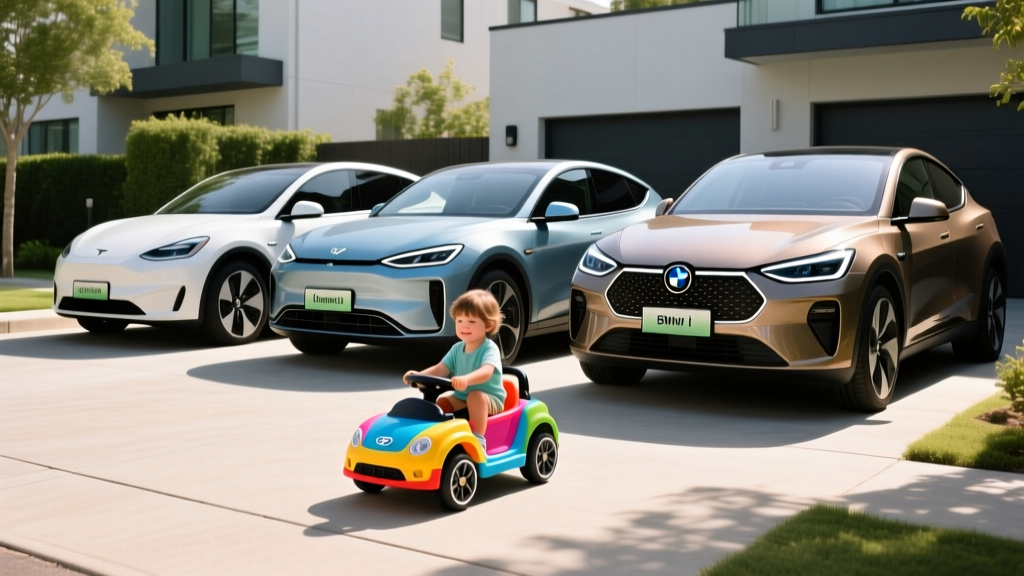
If you're shopping for a child's ride-in electric car, you're likely weighing options like Power Wheels, licensed mini-EVs (think kid-sized Tesla Model S or Mercedes G-Wagon replicas), or generic 12V/24V battery-powered ride-ons. These toys typically cost $150–$600, run on sealed lead-acid or lithium-ion batteries (12V or 24V), reach speeds of 2–6 mph, and offer 45–90 minutes of runtime per charge. While they're fantastic for driveway fun, they share almost no technology with real electric vehicles — and understanding the difference helps you make smarter decisions both as a toy buyer today and as a potential EV owner tomorrow.
Quick Answer: Ride-In Electric Cars for Kids
Kids' ride-in electric cars are low-speed toys (2–6 mph) powered by 12V or 24V lead-acid or lithium batteries with 45–90 minutes of runtime. They cost $150–$600 and share no meaningful technology with real EVs, which use 400V–800V lithium-ion packs (50–120 kWh) delivering 250–400+ miles of EPA range. Think of them as fun introductions to the concept of electric mobility — not training for real EV ownership.
What Exactly Is a Child's Ride-In Electric Car?
The term "child's ride-in electric car" covers a broad category of battery-powered toy vehicles designed for kids ages 2–8. These range from basic plastic-bodied ride-ons to licensed replicas of real cars (Tesla, Mercedes, BMW, Land Rover) with working headlights, Bluetooth speakers, and parental remote controls.
Here's what you're actually getting under the hood:
- Battery: 12V sealed lead-acid (SLA) in budget models ($150–$300); 24V SLA or lithium-ion in premium models ($350–$600+)
- Motor: 25W–120W brushed DC motors (typically one per driven wheel)
- Top Speed: 2–3 mph on 12V models; 4–6 mph on 24V models
- Runtime: 45–90 minutes continuous use (varies by terrain, weight, battery age)
- Charge Time: 8–14 hours (overnight charging required)
- Weight Capacity: 55–110 lbs depending on model
- Price Range: $150 (generic 12V) to $600+ (licensed 24V with extras)
For context, a real 2026 EV like the Tesla Model Y uses a ~75 kWh (usable) lithium-ion battery pack operating at 400V, delivering 310+ miles of EPA range, 0–60 mph in 5.0 seconds, and DC fast charging at up to 250 kW. The technology gap is enormous — and intentional. Kids' ride-ons prioritize safety, simplicity, and cost over performance.
Kid's Ride-In Electric Car vs Real EV: A Reality Check
It's tempting to think that buying your child a miniature Tesla is somehow "preparing them" for an electric future. Let's be direct: these toys share only the broadest concept (electric motors powered by batteries) with real EVs. Here's a side-by-side comparison to make that concrete:
| Specification | Kid's Ride-In (24V Premium) | 2026 Tesla Model Y |
|---|---|---|
| Battery Voltage | 24V | ~400V |
| Battery Capacity | ~0.3 kWh (12Ah × 24V) | ~75 kWh usable |
| Battery Chemistry | Sealed lead-acid or basic Li-ion | NMC or LFP lithium-ion |
| Motor Power | ~120W (0.16 hp) | ~346 hp (258 kW) |
| Top Speed | 5–6 mph | 135 mph (electronically limited) |
| Range / Runtime | 45–90 minutes (~1–3 miles) | 310 miles EPA |
| Charge Time (full) | 8–14 hours (wall outlet) | ~8 hrs (Level 2, 11.5 kW); ~25 min 10–80% (DC fast charge, 250 kW peak) |
| Price | $350–$600 | ~$44,990 MSRP (before incentives) |
| Thermal Management | None | Active liquid cooling/heating |
| Regenerative Braking | No | Yes (one-pedal driving capable) |
The takeaway? A child's ride-in electric car is closer to a motorized toy train than to any real EV on the road. That's not a criticism — it's exactly what it should be for a 4-year-old.
Real Costs: Kid's Electric Ride-On Ownership Over 3 Years
Parents often assume a $400 ride-on car is a one-time purchase. In reality, battery replacement and wear items add up. Here's a realistic 3-year ownership cost breakdown for a mid-range 24V ride-in electric car:
| Cost Item | Year 1 | Year 2 | Year 3 | 3-Year Total |
|---|---|---|---|---|
| Vehicle Purchase | $450 | — | — | $450 |
| Battery Replacement (SLA, every 1–2 years) | — | $60 | $60 | $120 |
| Electricity (charging ~3x/week, ~0.05 kWh per charge) | $3 | $3 | $3 | $9 |
| Tire/Wheel Replacement | — | — | $30 | $30 |
| Charger Replacement (if lost/broken) | — | $25 | — | $25 |
| Total | $453 | $88 | $93 | $634 |
The electricity cost is negligible — roughly $3/year at the US average of ~$0.17/kWh (source: EIA). The real expense is battery replacement: sealed lead-acid batteries in ride-ons typically last 200–400 charge cycles before capacity drops noticeably, meaning most families replace at least one battery over 2–3 years.
Common Misconceptions About Kids' Electric Ride-On Cars
Marketing for these toys often borrows language from the real EV world, creating confusion. Let's separate myth from fact:
| Myth | Fact |
|---|---|
| "It has a lithium battery, just like a Tesla!" | Even if lithium-ion, kid's ride-on batteries are basic cells with no battery management system (BMS), thermal management, or degradation protection. A Tesla's battery pack has thousands of individually monitored cells with active liquid cooling. |
| "My kid is learning to drive an EV!" | Ride-ons have no steering geometry, suspension tuning, or braking dynamics that transfer to real driving. They're toys, not simulators. |
| "The battery will last for years." | SLA batteries in ride-ons typically last 1–2 years with regular use. Leaving them uncharged for months (common between seasons) can permanently damage them. |
| "24V is twice as fast as 12V." | Not necessarily. Speed depends on motor wattage, gearing, and weight. A well-geared 12V can outperform a poorly designed 24V. |
| "It's eco-friendly because it's electric." | While tailpipe-emissions-free, the SLA batteries contain lead and sulfuric acid requiring proper recycling. The electricity source also matters — grid mix varies by region. |
What Parents Should Know Before Buying
Whether you're buying a ride-on for a toddler or considering your family's first real EV, here's what actually matters:
For the Kid's Ride-In Electric Car
- Safety first: Look for models with parental remote override, seat belts, and speed limiters. The CPSC has issued recalls on ride-ons with fire risks from battery/charger faults — always check for active recalls before purchasing.
- Battery care: Never let a lead-acid battery sit fully discharged. Charge it fully before off-season storage, and top up every 4–6 weeks. This single habit doubles battery life.
- Surface matters: Runtime claims assume flat, paved surfaces. Grass, gravel, and inclines can cut runtime by 30–50%.
- Weight limits are real: Exceeding the rated capacity strains motors and dramatically shortens battery life. If your child is near the limit, size up to a 24V model.
For Your Own EV Purchase (When You're Ready)
If your child's ride-on has sparked your own interest in electric vehicles, here are the real-world numbers that matter for a 2026 EV purchase:
- Home charging: A Level 2 home charger (240V, 32–48A, 7.7–11.5 kW) adds 25–40 miles of range per hour and costs $500–$2,000 installed, depending on your electrical panel. Most EV owners do 80%+ of their charging at home.
- Federal tax credit: The IRS §30D credit offers up to $7,500 for qualifying new EVs, but eligibility depends on vehicle MSRP caps ($55,000 for sedans, $80,000 for SUVs/trucks), buyer income limits ($150K single / $300K joint), and battery sourcing requirements that change annually. Always verify current-year rules.
- Real-world range: EPA estimates are a starting point. Expect 15–25% range loss at sustained highway speeds (70+ mph) and 20–40% loss in freezing temperatures. A 310-mile EPA rating might deliver 230–260 miles on a winter road trip.
- Charging speed reality: A "250 kW peak" DC fast charger doesn't sustain that rate. Real-world 10–80% charges typically take 18–30 minutes, with significant tapering above 80% state of charge.
Decision Framework: Ride-On, Real EV, or Something In Between?
What Should You Buy?
Choose a kid's ride-in electric car if:
- Your child is 2–7 years old and wants driveway/yard fun
- Your budget is $150–$600
- You have flat, paved outdoor space for safe use
- You're okay with 45–90 minute runtime and overnight charging
Choose a real EV for your family if:
- You have reliable home charging access (garage or driveway with 240V outlet)
- Your daily driving is under 60 miles round-trip (covers 90%+ of US commutes)
- You want to reduce fuel costs (electricity at $0.17/kWh ≈ $0.04–$0.06/mile vs. gas at $3.50/gal ≈ $0.12–$0.18/mile for a 25–30 MPG vehicle)
- You qualify for federal/state incentives that offset the higher upfront cost
Choose a plug-in hybrid (PHEV) if:
- You want electric-only commuting (25–45 miles) but need gas-engine range for road trips
- You lack reliable home charging but can plug in occasionally
- Range anxiety is a genuine concern for your driving patterns
- Models like the Toyota RAV4 Prime (42 miles electric, 38 MPG combined after depletion) offer a practical bridge
Stick with gas or hybrid for now if:
- You live in an apartment with no charging access and no nearby public chargers
- You regularly tow heavy loads or drive 300+ miles in remote areas
- Your budget is under $30,000 and you can't find a qualifying used EV with the $4,000 used-vehicle credit
Battery Care Tips That Apply to Both (Sort Of)
While the technology is worlds apart, some battery care principles are universal:
- Don't store at 0% or 100%: Real EVs benefit from storing at 50–80% state of charge for extended periods. Kid's ride-ons with SLA batteries should be stored fully charged (SLA chemistry is the opposite of lithium-ion here — another reason these are different technologies).
- Temperature matters: Both SLA and lithium-ion batteries lose capacity in extreme cold and degrade faster in extreme heat. Store ride-ons indoors during winter; park real EVs in shade or garages when possible.
- Use the correct charger: Mixing chargers between ride-on models can cause overcharging and fire risk. For real EVs, always use UL-listed Level 2 equipment (ChargePoint, Emporia, Wallbox) installed by a licensed electrician.
- Replace when degraded: A ride-on that runs for 15 minutes instead of 60 needs a new battery ($40–$80). A real EV showing significant range loss (below 70% capacity) within the warranty period (typically 8 years / 100,000 miles) may qualify for a battery replacement under federal mandate.
Frequently Asked Questions
Are kid's ride-in electric cars safe for toddlers?
Most are rated for ages 3+ with parental supervision. Look for models with adjustable speed limiters (2 mph for beginners), parental remote control override, and 3-point seat belts. Always check CPSC recall listings before purchasing, as battery and charger defects have triggered recalls on several popular models.
How long do ride-in electric car batteries last?
Sealed lead-acid (SLA) batteries — the most common type — last 200–400 charge cycles, typically 1–2 years with regular use. Lithium-ion versions (found in premium $400+ models) can last 500–800 cycles, or 2–4 years. Proper storage (fully charged, topped up monthly) significantly extends life.
Can I upgrade a 12V ride-on to 24V for more speed?
Technically possible, but not recommended without replacing the motors, controller, and wiring. Doubling voltage through stock components will overheat motors and can cause electrical fires. If you want more speed, buy a factory 24V model designed for it.
Do ride-in electric cars qualify for any tax credits?
No. The IRS §30D federal clean vehicle credit applies only to highway-capable vehicles with a gross vehicle weight rating under 14,000 lbs and specific battery sourcing requirements. Toy ride-ons don't qualify. The credit applies to real EVs meeting MSRP caps ($55,000 sedans / $80,000 SUVs and trucks), buyer income limits, and critical mineral sourcing rules.
What's the best ride-in electric car brand for kids?
Power Wheels (Fisher-Price) dominates the budget segment ($150–$300) with wide parts availability. For licensed replicas, brands like Best Choice Products, Costzon, and Tobbi offer 24V models ($300–$600) with parental remote controls. Prioritize models with replaceable batteries and available spare parts over flashy features.
At what age should my child transition from a ride-on to learning about real EVs?
Most kids outgrow ride-ons by age 7–8. That's a natural time to introduce real EV concepts — how regenerative braking works, why charging takes longer than filling a gas tank, and how batteries degrade over time. If your family is considering an EV purchase, involving kids in the research (range calculators, charging maps, cost comparisons) builds genuine understanding far beyond what a toy can teach.