Quick Answer: The Chevrolet Bolt EV is the clear winner for most used-EV buyers in 2026. With an EPA range of 259 miles (2017–2022 models) and a 60–66 kWh battery, it offers nearly triple the range of the Spark EV's 82 miles on a 19 kWh pack. The Spark EV (2014–2016) is viable only as a low-cost, city-only second car with reliable home charging. Expect to pay $7,000–$12,000 for a used Bolt EV and $4,000–$7,000 for a Spark EV. Neither qualifies for the federal used-EV tax credit in 2026 because GM's original battery sourcing does not meet current critical-mineral requirements under IRS §25E rules.
Why Compare These Two Discontinued Chevy EVs?
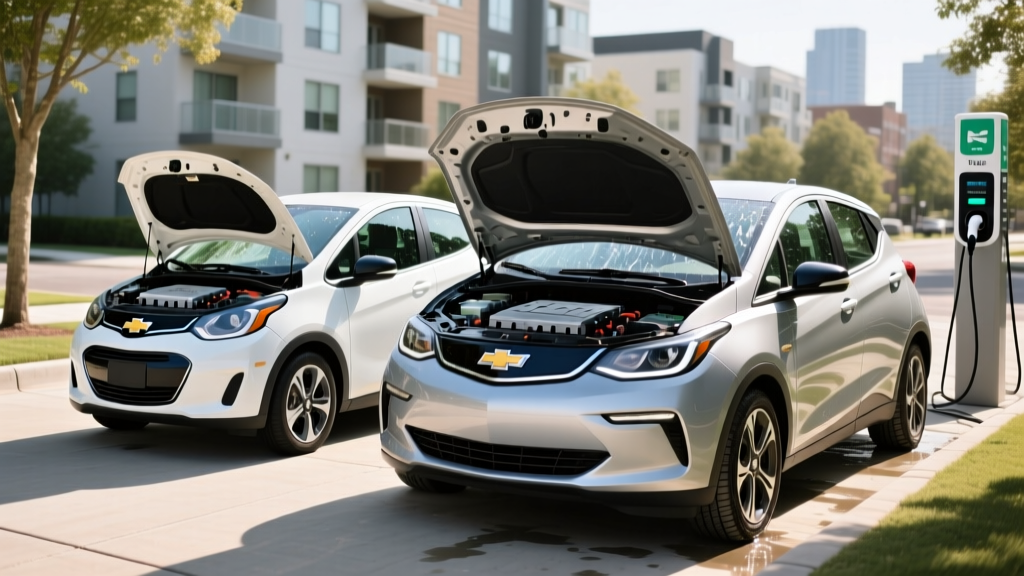
Chevrolet built two very different electric cars before the modern Equinox EV and Blazer EV arrived. The Spark EV (2014–2016) was a compliance car — a tiny hatchback converted to electric power to meet California's zero-emission mandate. The Bolt EV (2017–2023) was a ground-up electric platform that became one of the most affordable long-range EVs ever sold in the U.S. Both are now available only on the used market, and they attract budget-conscious shoppers searching for an entry point into electric driving.
Understanding the gap between these two vehicles is essential. One is a 3,200-pound city runabout with an 82-mile range. The other is a practical hatchback that can handle highway road trips. The right choice depends entirely on your commute length, charging access, and climate.
Side-by-Side Specifications: Spark EV vs Bolt EV
| Specification | Chevy Spark EV (2014–2016) | Chevy Bolt EV (2020–2022) |
|---|---|---|
| EPA Range | 82 miles | 259 miles |
| Battery Capacity (usable) | ~19 kWh | ~65 kWh (NMC) |
| Battery Chemistry | NMC (LG Chem) | NMC (LG Chem) |
| Motor Output | 140 hp / 327 lb-ft torque | 200 hp / 266 lb-ft torque |
| 0–60 mph | ~7.2 seconds | ~6.5 seconds |
| DC Fast Charge (peak) | 50 kW (CCS) | 55 kW (CCS) |
| 10–80% DCFC Time | ~30 minutes | ~60 minutes |
| Level 2 Charge Rate | 3.3 kW | 7.2 kW (11.5 kW on 2022+) |
| EPA Efficiency (MPGe) | 119 MPGe combined | 120 MPGe combined |
| Cargo Volume | 9.6 cu ft (23.5 with seats down) | 56.6 cu ft (seats folded) |
| Original MSRP (base) | ~$26,685 (before incentives) | ~$36,500 (before incentives) |
| 2026 Used Price Range | $4,000–$7,000 | $7,000–$12,000 |
| Battery/Powertrain Warranty | 8 yr / 100,000 mi (likely expired) | 8 yr / 100,000 mi (may have residual) |
Sources: EPA fueleconomy.gov, Chevrolet archived spec sheets.
Real-World Range: What You'll Actually Get
Bolt EV: EPA 259 miles. Real-world highway driving at 70 mph yields approximately 220–240 miles. In freezing temperatures (below 32°F), expect 170–200 miles due to battery resistance and cabin heating draw. The Bolt EV has no heat pump — it uses resistive heating, which is energy-intensive.
Spark EV: EPA 82 miles. Real-world city driving in mild weather: 75–85 miles. Highway at 65 mph: 60–70 miles. Cold weather (below 32°F): 50–65 miles. This car demands daily charging for most commuters.
The Spark EV's range limitation is its defining ownership constraint. A 40-mile round-trip commute leaves roughly 20–40 miles of buffer in mild weather — and that buffer shrinks dangerously in winter or with air conditioning. The Bolt EV, by contrast, can handle a 100-mile round trip with room to spare, even in moderate cold.
Charging Realities for Both Models
Neither the Spark EV nor the Bolt EV are fast-charging champions by 2026 standards. Modern EVs like the Hyundai Ioniq 5 peak at 240 kW and charge 10–80% in 18 minutes. These older Chevys charge at a fraction of that speed.
| Charging Level | Spark EV | Bolt EV (2020–2021) | Bolt EV (2022–2023) |
|---|---|---|---|
| Level 1 (120V, 1.4 kW) | ~4 mi/hr added | ~4 mi/hr added | ~4 mi/hr added |
| Level 2 (240V, standard) | 3.3 kW / ~13 mi/hr | 7.2 kW / ~28 mi/hr | 11.5 kW / ~45 mi/hr |
| DC Fast Charge (peak) | 50 kW | 55 kW | 55 kW |
| Full Charge Time (Level 2) | ~6–7 hours | ~9–10 hours | ~6–7 hours |
The Bolt EV's sluggish DC fast charging is a known pain point. Its 55 kW peak means a 10–80% charge takes roughly 60 minutes — far longer than the 18–25 minutes offered by 800V-architecture vehicles. For road trips, plan extended stops. For daily driving with home Level 2 charging, the Bolt's overnight replenishment is perfectly adequate.
Home charging access is non-negotiable for these cars. Neither supports the rapid DC charging speeds needed to rely on public infrastructure alone. If you cannot install a Level 2 charger at home (240V, 30–50 amp circuit), these vehicles become impractical for daily use.
Cost Breakdown: Purchase, Charging, and Maintenance
Buying a used Spark EV or Bolt EV is one of the cheapest ways into EV ownership. But the total cost picture extends beyond the purchase price.
| Cost Factor | Spark EV (Used) | Bolt EV (Used) | Comparable Gas Car (Used Chevy Sonic) |
|---|---|---|---|
| Purchase Price (2026 avg) | $5,500 | $9,500 | $8,000 |
| Annual Fuel/Energy (12,000 mi/yr) | $430 (electricity at $0.14/kWh) | $440 (electricity at $0.14/kWh) | $1,440 (gas at $3.60/gal, 28 MPG) |
| Annual Maintenance | $200–$350 | $250–$400 | $600–$900 |
| Annual Insurance (avg) | $900–$1,200 | $1,100–$1,500 | $900–$1,200 |
| 5-Year Total Operating Cost | $7,650–$9,750 | $8,200–$11,700 | $14,700–$19,500 |
The energy savings are substantial. At the U.S. average residential electricity rate of roughly $0.14/kWh (per EIA data), both EVs cost about 3.5–4 cents per mile to fuel. A comparable gas car at 28 MPG combined with gas at $3.60/gallon costs roughly 12–13 cents per mile. Over five years and 60,000 miles, that's a fuel savings of $5,000–$6,000.
Maintenance is minimal on both EVs — no oil changes, no transmission fluid, no spark plugs, no exhaust system. Brake pad life is extended significantly by regenerative braking. The primary maintenance items are tire rotation, cabin air filter, wiper fluid, and the 12V auxiliary battery (which should be checked annually).
Battery Health and Degradation: What to Check Before Buying
Both vehicles use LG Chem NMC (nickel-manganese-cobalt) battery packs. NMC chemistry offers strong energy density but is more sensitive to sustained high-state-of-charge storage and extreme heat than LFP (lithium iron phosphate) chemistry used in some newer EVs.
Expected degradation: Data from owner communities and fleet analyses suggest the Bolt EV battery loses approximately 8–12% of its original capacity over the first 100,000 miles or 6–8 years. A 2017 Bolt EV with 80,000 miles might show 220–235 miles of range instead of the original 238 (the 2017–2019 EPA rating). A 2020–2022 model with the larger 65 kWh pack should still deliver 230+ miles when new and 210+ with moderate degradation.
The Spark EV, being older (2014–2016), will show more degradation. A pack that started at 82 miles might now deliver 65–75 miles. This makes the Spark EV even more constrained for anything beyond short city errands.
Before purchasing either vehicle used, take these steps:
- Request a battery state-of-health (SoH) reading from a Chevy dealer using the GDS2 diagnostic tool.
- Check for recall completion — the Bolt EV had a major battery recall (2021) for fire risk related to manufacturing defects in certain LG Chem cells. Verify the recall repair was completed, which included a battery replacement on many vehicles.
- Review the remaining 8-year/100,000-mile battery warranty. A 2020 Bolt EV with 45,000 miles still has warranty coverage through 2028 or 100,000 miles.
The Bolt EV battery recall is a critical ownership fact. General Motors recalled 2017–2019 Bolt EVs and replaced defective battery modules. Vehicles that received the recall fix often have newer, healthier battery packs than their age would suggest. Always verify recall status via NHTSA's VIN lookup tool.
Federal Tax Credit Reality for Used EVs in 2026
| Myth | Fact |
|---|---|
| "I'll get $4,000 off a used Bolt EV from the federal tax credit." | The §25E used-EV credit requires the vehicle's battery to meet critical-mineral and component sourcing thresholds that neither the Spark EV nor Bolt EV satisfy. As of 2026, very few used EVs qualify. Verify current rules at IRS.gov. |
| "The Spark EV qualifies because it's so cheap." | Price alone doesn't determine eligibility. Battery sourcing rules apply regardless of sale price. |
| "State incentives will cover the difference." | Some states offer used-EV rebates (e.g., California, Colorado, Massachusetts), but amounts and eligibility vary widely. Check your state's energy office or DMV for current programs. |
Do not budget for a federal tax credit when purchasing either of these vehicles used. Price them at full cost and treat any state or utility incentive as a bonus.
Decision Framework: Which One Fits Your Situation?
Choose the Bolt EV if:
- Your daily round-trip commute exceeds 50 miles
- You take occasional highway trips of 100+ miles
- You live in a cold-winter climate where range loss of 25–35% is expected
- You need cargo space for groceries, gear, or child seats
- You want a vehicle that can serve as your primary car
- You value a battery recall repair that may have installed newer cells
Choose the Spark EV if:
- Your daily driving is under 30 miles round trip, reliably
- You already have a primary vehicle and need a cheap second car for errands
- You live in a mild climate (Southern California, Florida, Arizona)
- Your budget is strictly under $6,000
- You have Level 2 home charging and can top off nightly without inconvenience
- You accept that this car cannot handle road trips or cold-weather driving confidently
Choose neither (and look at a used PHEV like the Chevy Volt or a newer Bolt EUV) if:
- You lack home charging access
- You regularly drive in areas with sparse public charging infrastructure
- You need 200+ miles of range with fast-charging capability for road trips
Common Misconceptions About These Budget EVs
| Misconception | Reality |
|---|---|
| "The Spark EV's 327 lb-ft of torque makes it a hot hatch." | It's quick to 30 mph but tops out at 90 mph. The 140 hp motor runs out of breath on highway merges. It's a city car, not a performance vehicle. |
| "The Bolt EV charges fast enough for road trips." | At 55 kW peak, a 10–80% charge takes ~60 minutes. Plan accordingly. Modern EVs charge 3–4x faster. |
| "These batteries will need replacement soon." | NMC batteries in these models have shown 8–12% degradation over 8 years. Replacement is rare and covered under the 8-year/100,000-mile warranty if within the window. A full Bolt EV battery replacement costs $14,000–$16,000 out of warranty — but most packs outlast the car's economic value. |
| "I can charge these at Tesla Superchargers." | No. Both use CCS1 connectors. Tesla's NACS network does not support CCS1 vehicles without an adapter, and as of 2026, GM has not released an official NACS adapter for the Bolt EV or Spark EV. |
| "The Spark EV has DC fast charging." | Only 2015–2016 models with the SAE Combo (CCS) option. The 2014 model and some 2015s have CHAdeMO. Verify the connector type before purchase. |
Frequently Asked Questions
Is the Chevy Bolt EV still a good buy in 2026?
Yes, as a used EV. The 259-mile EPA range remains competitive with many new EVs selling for $40,000+. The main drawbacks are slow DC fast charging (55 kW), no heat pump, and the age of infotainment hardware. If you find a 2020–2022 model with the recall repair completed, under 60,000 miles, and a clean battery health report, it's one of the best value propositions in the used EV market.
Can I daily-drive the Spark EV?
Only if your commute is short (under 30 miles round trip), you live in a mild climate, and you have reliable home charging. In cold weather, the Spark EV's real-world range drops to 50–65 miles, which eliminates any margin for detours or errands. It works best as a dedicated city errand car, not a primary vehicle.
What's the difference between the Bolt EV and Bolt EUV?
The Bolt EUV (2022–2023) is a slightly longer version with a 247-mile EPA range, more rear legroom, and available Super Cruise (Level 2 driver assistance on compatible highways). The EUV uses the same 65 kWh battery and 55 kW DC charging as the standard Bolt EV. Used EUV prices in 2026 typically run $12,000–$16,000.
How much does it cost to charge a Bolt EV at home?
A full charge from empty to 100% uses roughly 65 kWh. At the U.S. average of $0.14/kWh, that's about $9.10 for 259 miles of range — or roughly 3.5 cents per mile. If you drive 12,000 miles per year, annual home charging costs approximately $420–$450, compared to $1,400–$1,500 for a gas car at 28 MPG.
Do I need to worry about the Bolt EV battery fire recall?
The recall was serious but has been addressed. GM identified specific LG Chem battery cells with manufacturing defects that could cause fires, primarily when charging to 100% and parking indoors. Affected vehicles received replacement battery modules. If the VIN shows the recall repair was completed, the vehicle received newer, safer cells. Always verify at nhtsa.gov/recalls before purchasing.
What home charging equipment do I need?
For the Bolt EV (2022–2023 with 11.5 kW onboard charger), a 48-amp Level 2 charger on a 60-amp 240V circuit maximizes charging speed. For earlier Bolt EVs (7.2 kW) and the Spark EV (3.3 kW), a 32-amp charger on a 40-amp circuit is sufficient. Expect $500–$1,200 for the charger hardware and $800–$2,500 for electrician installation, depending on panel capacity and run length. A panel upgrade (to 200 amps) adds $1,500–$3,000 if needed.