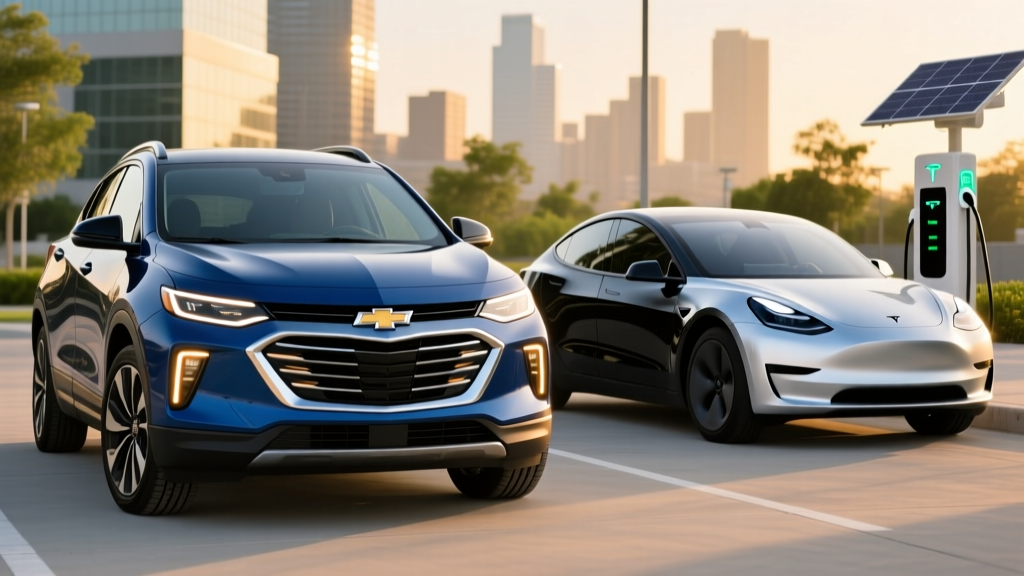
The compact electric SUV and the electric sedan represent two fundamentally different philosophies in the 2026 EV market. The 2026 Chevrolet Equinox EV prioritizes interior space, comfort, and mainstream accessibility in a crossover body. The 2026 Tesla Model 3 (the refreshed "Highland" generation) doubles down on efficiency, performance, and the Supercharger network. Both are compelling, but they serve different drivers.
This head-to-head breaks down every spec that matters — from real-world range and charging curves to total cost of ownership — so you can match the right EV to your actual needs rather than marketing narratives.
Side-by-Side Specifications: Equinox EV vs Model 3
Before we get into subjective driving impressions, let's ground this comparison in hard numbers. The table below uses the most comparable trims: the Equinox EV 3RS (AWD, the volume seller) and the Model 3 Long Range AWD.
| Specification | Chevrolet Equinox EV 3RS AWD | Tesla Model 3 Long Range AWD |
|---|---|---|
| EPA Range | 319 miles | 363 miles |
| Battery (usable) | 85 kWh (NMC) | 75 kWh (NMC) |
| Efficiency (MPGe) | 109 MPGe combined | 132 MPGe combined |
| Efficiency (kWh/100 mi) | 31 kWh/100 mi | 25 kWh/100 mi |
| Peak DC Fast Charge | 150 kW | 250 kW |
| 10–80% DC Charge Time | ~30 minutes | ~25 minutes |
| Level 2 AC Charge Rate | 11.5 kW (19.2 kW optional) | 11.5 kW |
| Horsepower | 288 hp | 384 hp |
| 0–60 mph | ~7.3 seconds | 4.2 seconds |
| Cargo Volume (behind 2nd row / total) | 26.4 / 57.2 cu ft | 21.0 / 64.9 cu ft (trunk + frunk) |
| Seating | 5 passengers | 5 passengers |
| Base MSRP (comparable AWD trim) | $44,900 | $47,740 |
| Battery/Powertrain Warranty | 8 years / 100,000 miles | 8 years / 120,000 miles |
Sources: fueleconomy.gov, Chevrolet and Tesla official spec sheets. Real-world results vary with temperature, terrain, and driving style.
Range and Efficiency: The Model 3's Physics Advantage
The Model 3 Long Range achieves 363 miles of EPA range from a smaller 75 kWh battery, while the Equinox EV squeezes 319 miles from a larger 85 kWh pack. That gap reveals a fundamental efficiency difference: the Model 3 consumes roughly 25 kWh per 100 miles versus the Equinox EV's 31 kWh/100 mi.
Equinox EV 3RS AWD: EPA 319 mi. Expect ~260–280 mi on sustained highway driving at 70+ mph, and ~210–230 mi in sub-freezing winter conditions (LFP/NMC batteries lose 15–30% range in cold weather, and the boxier SUV shape increases aerodynamic drag at speed).
Model 3 Long Range AWD: EPA 363 mi. Expect ~300–320 mi highway, and ~260–280 mi in cold weather. The sedan's lower drag coefficient (Cd ~0.219 vs the Equinox's estimated ~0.30) pays compounding dividends at highway speeds.
If range-per-charge is your top priority — say, for frequent 300-mile road trips without stopping — the Model 3 wins decisively. The Equinox EV's range is adequate for daily commuting and moderate road trips, but you'll plan charging stops sooner on long hauls.
Charging Speed and Network Access
Charging is where two separate stories collide: how fast each vehicle can accept power, and where you can plug in.
DC Fast Charging Hardware
The Model 3 peaks at 250 kW on V3 Superchargers and compatible CCS/NACS stations, achieving a 10–80% charge in roughly 25 minutes. The Equinox EV peaks at 150 kW, taking about 30 minutes for the same 10–80% session.
Five minutes doesn't sound dramatic on paper, but it compounds on road trips. More importantly, the Model 3 sustains higher charge rates deeper into the session. The Equinox EV's charge curve tapers more aggressively above 60% State of Charge (SoC), meaning the gap widens in practice. On a 200-mile highway trip requiring a mid-charge top-up, you might spend 15 minutes in the Model 3 versus 20–22 minutes in the Equinox EV.
Charging Network: The NACS Convergence
As of 2026, both vehicles use the NACS (North American Charging Standard) connector natively. Chevrolet's adoption of NACS means the Equinox EV can access Tesla Superchargers directly without an adapter — a significant shift from 2024, when CCS-to-NACS adapters were required.
However, the Tesla Supercharger network still leads in reliability. J.D. Power EV Experience Index studies consistently rank Tesla's network highest for uptime and plug-and-charge seamlessness. The Equinox EV benefits from this access, but Tesla's integrated navigation-to-preconditioning-to-payment pipeline remains more polished than GM's Ultium Charge integration.
Performance and Driving Dynamics
This category isn't close, and that's by design. The Model 3 Long Range AWD produces 384 hp and hits 60 mph in 4.2 seconds — sports-sedan territory. The Equinox EV 3RS makes 288 hp and reaches 60 mph in approximately 7.3 seconds, which is perfectly adequate for merging and passing but never thrilling.
Beyond straight-line speed, the Model 3's lower center of gravity, quicker steering ratio, and sport-tuned suspension deliver genuinely engaging handling. The Equinox EV drives like a competent crossover: comfortable, compliant over rough pavement, and quiet at highway speeds, but with noticeable body roll in corners and a softer, more isolated feel.
If you value a smooth, relaxed ride over canyon-carving dynamics, the Equinox EV's tuning may actually suit you better. If you enjoy driving and want an EV that rewards aggressive inputs, the Model 3 is in a different league.
Interior Space, Cargo, and Daily Practicality
Here the Equinox EV fights back hard. Its crossover proportions deliver a higher seating position, easier ingress/egress (important for older adults or parents loading child seats), and a more traditional cabin layout with physical controls for climate and volume.
Cargo space behind the second row is 26.4 cubic feet in the Equinox EV versus roughly 21 cubic feet in the Model 3's trunk (the Model 3 does have a front trunk, or "frunk," adding usable volume). Fold the rear seats and the Equinox offers 57.2 cu ft of flat load space, ideal for furniture-store runs or camping gear. The Model 3's total enclosed volume (trunk + frunk) is competitive at roughly 64.9 cu ft, but the trunk opening is narrower and the load floor less practical for bulky items.
The Model 3's minimalist interior — no instrument cluster, all functions routed through a 15.4-inch center touchscreen — continues to polarize. Some owners love the clean aesthetic; others find it distracting. The Equinox EV uses a more conventional layout with an 11.3-inch touchscreen and an 11-inch digital driver display, plus physical buttons for core functions.
Technology, ADAS, and Driver Assistance
Both vehicles offer advanced driver-assistance systems, but they differ sharply in approach and capability.
Tesla Autopilot and FSD (Supervised): Standard Autopilot includes adaptive cruise and lane-keeping. The optional FSD (Supervised) package ($8,000 or $99/month) adds automated lane changes, navigation-guided on/off-ramp transitions, and traffic-light recognition. FSD operates on virtually any road but requires continuous driver supervision. Tesla's vision-only approach (no LiDAR or radar) remains controversial among safety researchers.
Chevrolet Super Cruise: Available on higher Equinox EV trims, Super Cruise enables hands-free driving on over 750,000 miles of mapped divided highways in the US and Canada. It uses a driver-facing camera to monitor attention and LiDAR-mapped road data for precision. It's more geographically limited than FSD but offers a genuinely hands-free experience on compatible roads — a tangible advantage for frequent interstate commuters.
For infotainment, the Model 3's system is faster and more responsive, with an excellent navigation system and over-the-air (OTA) updates that meaningfully improve the car over time. The Equinox EV runs Google Built-In (Google Maps, Assistant, and Play Store), which is solid but receives less ambitious OTA enhancements.
Price, Tax Credits, and Total Cost of Ownership
The purchase price gap narrows considerably once you factor in federal incentives and running costs.
MSRP and Federal Tax Credit (§30D)
| Factor | Chevrolet Equinox EV 3RS AWD | Tesla Model 3 Long Range AWD |
|---|---|---|
| Base MSRP | $44,900 | $47,740 |
| §30D Federal Tax Credit (max) | Up to $7,500 | Up to $7,500 |
| MSRP Cap (§30D SUV limit: $80,000) | ✅ Well under | ✅ Well under (sedan limit: $55,000) |
| Point-of-Sale Transfer Available | Yes (reduces dealer price) | Yes (reduces dealer price) |
| Effective Price After Max Credit | ~$37,400 | ~$40,240 |
Critical caveat: The §30D credit has buyer income caps ($150,000 single / $300,000 joint modified AGI), battery critical-mineral and component sourcing requirements, and the vehicle must be assembled in North America. Both vehicles are US-assembled, but the exact credit amount ($0, $3,750, or $7,500) depends on the current battery-sourcing compliance for each model's supply chain, which shifts periodically. Always verify current eligibility at fueleconomy.gov and consult a tax professional. As of early 2026, both vehicles have qualified for the full $7,500, but this is subject to change.
Five-Year Ownership Cost Estimate
| Cost Category | Equinox EV 3RS AWD | Model 3 Long Range AWD |
|---|---|---|
| Purchase (after $7,500 credit) | $37,400 | $40,240 |
| Electricity (home charging, $0.16/kWh avg) | $3,488 | $2,813 |
| Insurance (5-year total, national avg) | $9,200 | $10,800 |
| Maintenance (tires, cabin filter, wipers) | $1,500 | $1,400 |
| Estimated Depreciation (5-year) | ~$16,800 | ~$18,100 |
| Estimated 5-Year Total | ~$68,388 | ~$73,353 |
The Equinox EV's lower purchase price, cheaper insurance premiums (Teslas carry higher insurance costs in most states due to repair complexity and parts pricing), and competitive depreciation give it a roughly $5,000 advantage over five years. The Model 3 partially offsets this with lower electricity costs thanks to its superior efficiency — about $675 less in charging over 75,000 miles.
Your actual numbers will vary based on local electricity rates, insurance profile, and whether you charge primarily at home (cheap) or on DC fast chargers (2–4× more expensive per kWh).
Decision Framework: Which Should You Choose?
Choose the Chevrolet Equinox EV if:
- You need a higher seating position and easier entry/exit for family members
- Cargo versatility matters — hauling strollers, furniture, or camping gear regularly
- You prefer physical climate/volume controls and a conventional instrument cluster
- Your budget is firm around $37,000–$42,000 after incentives
- You commute on Super Cruise-mapped highways and want hands-free driving
- You prioritize lower insurance costs and a lower total cost of ownership
Choose the Tesla Model 3 if:
- Maximum range per charge is a top priority (363 mi EPA, 300+ mi real-world highway)
- You take frequent road trips and value the fastest DC charging in this price range
- Performance and handling engagement matter to you (4.2-second 0–60, sport-sedan dynamics)
- You want the most mature OTA update pipeline and infotainment system
- You value FSD (Supervised) for varied-road automated driving (with supervision)
- You don't mind the minimalist, touchscreen-centric interior
Final Recommendation
There is no universal winner between the 2026 Chevrolet Equinox EV and the 2026 Tesla Model 3 — they excel in different dimensions. The Model 3 is the more impressive engineering achievement: more range from a smaller battery, faster charging, sharper performance, and a tech-forward experience. It's the better EV for road-trippers, driving enthusiasts, and efficiency obsessives.
The Equinox EV is the more practical daily vehicle for families and crossover shoppers who value space, comfort, straightforward controls, and a lower bottom-line cost. It's the better EV for school runs, grocery hauls, and budget-conscious buyers who want a comfortable, roomy electric vehicle without paying a premium for performance they won't use.
Test-drive both. Pay attention to how you feel getting in and out, how the visibility and seating position work for your body, and whether the touchscreen-heavy or button-friendly interface suits your habits. The spec sheet gets you to a shortlist; the driver's seat makes the final call.
Frequently Asked Questions
Can the Equinox EV use Tesla Superchargers?
Yes. As of the 2025 model year, Chevrolet adopted the NACS charging port natively. The 2026 Equinox EV can plug directly into any Tesla Supercharger V3/V4 stall without an adapter. The Tesla app or in-car navigation handles routing and payment seamlessly.
Which is cheaper to insure?
The Equinox EV. Tesla vehicles carry higher insurance premiums in most US states due to higher repair costs, specialized parts, and elevated claim severity. Expect to pay roughly $200–$350 more per year insuring a Model 3 versus an Equinox EV, though your personal profile (age, location, driving record) matters more than the vehicle alone.
Does the Equinox EV qualify for the full $7,500 federal tax credit?
As of early 2026, the Equinox EV has qualified for the full $7,500 §30D credit when purchased by eligible buyers (income under $150K single / $300K joint, and meeting battery-sourcing requirements). The credit can be transferred to the dealer at point of sale, reducing your purchase price directly. Verify current status at fueleconomy.gov before purchasing, as sourcing compliance can shift.
How does cold weather affect each vehicle's range?
Both use NMC lithium-ion chemistry with liquid thermal management, but cold weather (below 32°F) reduces range by 15–30% in any EV. The Equinox EV, with its larger frontal area and higher consumption baseline, tends to lose slightly more usable range in winter than the Model 3. Preconditioning the battery while plugged in (both vehicles support scheduled preconditioning) mitigates this loss significantly.
Which has better long-term battery warranty coverage?
The Model 3 edges ahead with 8 years / 120,000 miles of battery and drive-unit coverage versus the Equinox EV's 8 years / 100,000 miles. Both warranties guarantee a minimum battery capacity retention (typically 70% of original capacity) over the warranty period. Neither manufacturer has published 2026-specific degradation data yet, but historical Tesla NMC packs have shown approximately 10–12% degradation at 100,000 miles based on fleet data.
Is FSD (Supervised) worth the $8,000 cost on the Model 3?
For most buyers, no. FSD (Supervised) remains an SAE Level 2 system requiring constant driver attention. Its value depends heavily on your commute: if you drive complex urban/suburban routes daily, the automated lane changes and intersection handling reduce fatigue. If you primarily drive mapped highways, Super Cruise on the Equinox EV (included in higher trims, no extra subscription) provides a more relaxed hands-free experience. Consider the $99/month subscription option before committing to the full purchase.