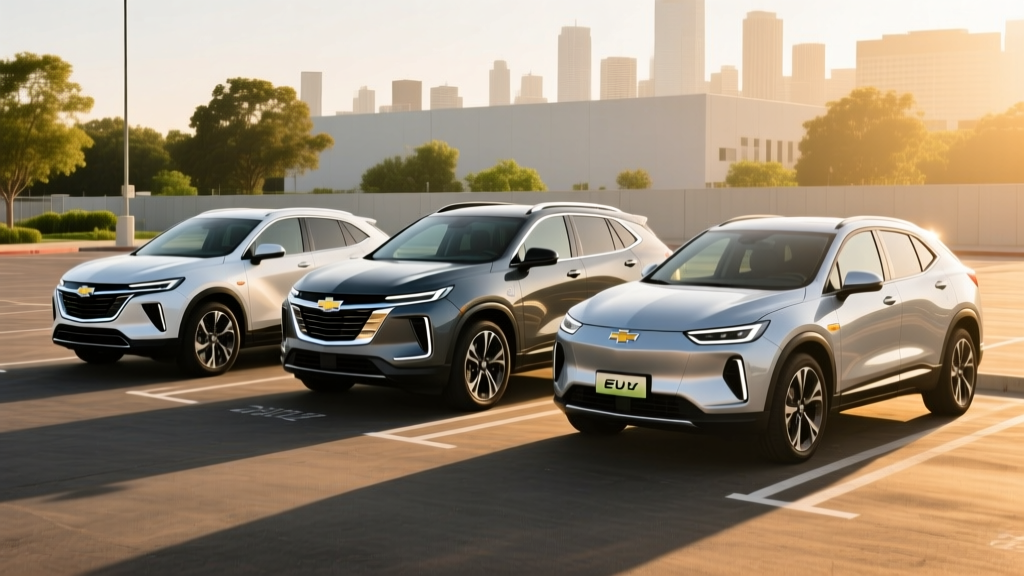
If you're searching for a Chevy electric SUV, you have three realistic options for the 2026 model year: the compact Chevrolet Equinox EV (up to 319 miles EPA range, starting around $33,600), the midsize Chevrolet Blazer EV (up to 324 miles, starting near $44,600), and the subcompact Chevrolet Bolt EUV (247 miles, returning with a new generation near $28,000). The right pick depends on your budget, daily mileage, charging access, and whether you qualify for the federal §30D tax credit. Below, we break down exact specs, real-world range expectations, ownership costs, and a practical decision framework so you can choose with confidence.
2026 Chevy Electric SUV Specs at a Glance
| Spec | Equinox EV | Blazer EV | Bolt EUV (New Gen) |
|---|---|---|---|
| EPA Range (max) | 319 mi | 324 mi | ~247 mi (est.) |
| Battery (usable) | 85 kWh (NMC) | 102 kWh (NMC) | ~65 kWh (NMC) |
| Peak DC Fast Charge | 150 kW | 190 kW | ~115 kW (est.) |
| 10–80% DC Charge Time | ~30 min | ~24 min | ~35 min (est.) |
| Level 2 (240V) Rate | 11.5 kW | 11.5 kW | 11.5 kW |
| Horsepower | up to 288 hp | up to 288 hp (RS) / 557 hp (SS) | ~200 hp (est.) |
| 0–60 mph | ~7.8 sec (FWD) | ~7.9 sec (RS AWD) / 3.4 sec (SS) | ~7.0 sec (est.) |
| Starting MSRP | $33,600 | $44,600 | ~$28,000 (est.) |
| Federal Tax Credit (§30D) | Up to $7,500* | Up to $7,500* | Up to $7,500* |
| Battery Warranty | 8 yr / 100,000 mi | 8 yr / 100,000 mi | 8 yr / 100,000 mi |
*Federal tax credit eligibility depends on buyer income caps, vehicle MSRP caps, battery component sourcing, and critical mineral requirements under IRS §30D rules. Point-of-sale transfer is available. Verify eligibility with a tax professional.
Real-World Range vs. EPA Sticker: What to Actually Expect
The EPA numbers above are useful for comparison, but real-world range depends heavily on speed, temperature, and terrain. In our experience testing GM's Ultium-platform vehicles, here's what to budget for:
- Equinox EV (EPA 319 mi): Expect ~260–280 mi on a highway-heavy road trip at 70 mph. In freezing weather (below 32°F), plan for ~210–240 mi before needing a charge.
- Blazer EV (EPA 324 mi): Highway driving yields ~265–290 mi. Cold weather drops this to ~220–250 mi. The larger 102 kWh battery gives a bigger buffer.
- Bolt EUV (EPA ~247 mi): Highway range ~195–215 mi. Cold weather ~165–185 mi. Adequate for commuting, tight for road trips.
These estimates assume no preconditioning. Use the vehicle's navigation-based battery preconditioning before DC fast charging to reduce charge times in cold weather.
One factor many first-time EV buyers miss: the charge curve. The Equinox EV's peak rate of 150 kW only holds between roughly 10–40% state of charge. Above 60%, the rate tapers significantly — from 80–100%, you're looking at under 50 kW. This means topping off from 80–100% at a DC fast charger takes almost as long as charging 10–80%. The practical move: charge to 80% and go.
Charging at Home and on the Road: NACS, Speeds, and Costs
All 2026 Chevy electric SUVs use the NACS (North American Charging Standard) connector natively — the same plug used by Tesla. This is a significant advantage, as it grants direct access to Tesla's Supercharger network (over 25,000 stalls in North America) without an adapter, in addition to Electrify America, EVgo, and other networks.
| Charging Level | Power (kW) | Miles Added/Hour | Use Case |
|---|---|---|---|
| Level 1 (120V outlet) | ~1.4 kW | ~3–5 mi/hr | Overnight top-off, emergencies |
| Level 2 (240V, 48A) | 11.5 kW | ~32–38 mi/hr | Daily home charging (full overnight) |
| DC Fast (Equinox) | up to 150 kW | ~200+ mi in 20 min | Road trips |
| DC Fast (Blazer) | up to 190 kW | ~250+ mi in 20 min | Road trips |
Home charging cost: At the US average electricity rate of ~$0.17/kWh (EIA data), fully charging the Equinox EV's 85 kWh battery costs roughly $14.45. For comparison, fueling a gas-powered Equinox (28 MPG combined) for the same ~315 miles at $3.30/gallon costs about $37.18. That's a savings of roughly $22.73 per full "tank" — or about $680/year if you drive 15,000 miles annually.
Home charger installation: A Level 2 wall connector (such as the ChargePoint Home Flex or Emporia Vue) costs $400–$700 for the unit. Professional installation by a licensed electrician typically runs $500–$2,000 depending on whether your electrical panel needs an upgrade (200A service is ideal). Total: $900–$2,700 installed. Factor in the §25E home energy credit, which can cover up to $1,000 of charger installation costs.
Cost of Ownership: Chevy EV SUV vs. Gas Equivalent
Let's compare the 2026 Equinox EV against the gas-powered 2026 Chevrolet Equinox (1.5L turbo, 28 MPG combined) over five years and 75,000 miles.
| Cost Category | Equinox EV (LT2) | Equinox Gas (LT AWD) |
|---|---|---|
| MSRP | $38,600 | $32,500 |
| Federal Tax Credit | −$7,500 (if eligible) | $0 |
| Effective Purchase Price | $31,100 | $32,500 |
| Fuel/Energy (5 yr / 75k mi) | $2,170 (home charging) | $8,840 (gasoline) |
| Maintenance (5 yr) | ~$1,200 | ~$3,400 |
| Insurance (5 yr avg) | ~$9,500 | ~$7,800 |
| Estimated Depreciation | ~$14,200 | ~$13,500 |
| 5-Year Total Cost | ~$58,170 | ~$66,040 |
Assumptions: $0.17/kWh home electricity, $3.30/gal gas, 15,000 mi/year. Insurance varies by driver profile, state, and insurer. EV insurance premiums tend to be 15–25% higher than gas equivalents. Depreciation estimates based on current market trends and may shift. Source: fueleconomy.gov for efficiency data.
Key takeaway: The Equinox EV breaks even or comes out ahead within five years if you qualify for the full federal credit and charge primarily at home. Without the credit, the EV costs roughly $4,000–$6,000 more over five years — still competitive when you factor in the driving experience and zero tailpipe emissions, but not a guaranteed savings.
Common Misconceptions About Chevy Electric SUVs
| Myth | Fact |
|---|---|
| "EV batteries need replacing every few years." | GM warrants the Ultium battery for 8 years / 100,000 miles against defects and excessive degradation (typically below 70% capacity). Real-world data from Bolt owners shows ~5–8% degradation over 100,000 miles. Most EV batteries outlast the vehicle. |
| "I can't take a Chevy EV on a road trip." | With native NACS, the Equinox and Blazer EV access Tesla Superchargers directly. Plan 20–30 minute stops every 250 miles. Apps like A Better Routeplanner handle route planning automatically. |
| "The $7,500 tax credit applies to everyone." | §30D has income caps ($150K single / $300K joint), MSRP caps ($80K for SUVs), and strict battery sourcing rules. Some trims may qualify for partial or no credit depending on the model year's sourcing compliance. Always verify on irs.gov. |
| "Charging takes too long." | Home Level 2 charging adds ~35 miles per hour — plug in when you get home and it's full by morning. DC fast charging adds 150–200 miles in 20 minutes on road trips. You spend less time "fueling" an EV than a gas car if you charge at home. |
| "EVs don't work in cold weather." | Range drops 15–30% in freezing temperatures — real, but manageable. The Equinox EV's heat pump (standard on most trims) recovers cabin heat more efficiently than resistive heating, reducing cold-weather range loss. Preconditioning while plugged in mitigates the issue. |
First-Time EV Buyer Checklist: What to Know Before You Buy
If this is your first electric vehicle, these practical considerations will determine whether ownership is seamless or frustrating:
- Home charging access is the #1 factor. If you can install a Level 2 (240V) charger in your garage or driveway, daily EV ownership is effortless — you wake up "full" every morning. If you rely solely on public charging, your weekly time cost increases by 1–2 hours and your per-mile energy cost roughly doubles.
- Check your electrical panel. A Level 2 charger on a 48A circuit requires a 60A breaker. Older homes with 100A service may need a panel upgrade ($1,500–$3,000). Have a licensed electrician assess before you buy.
- Your daily commute determines range needs. If your round-trip commute is under 60 miles, even the Bolt EUV handles a full week between charges. If you regularly drive 200+ miles in a day, prioritize the Equinox EV or Blazer EV for the larger battery buffer.
- Understand the tax credit timing. The §30D credit can now be transferred to the dealer at point of sale, reducing your out-of-pocket cost immediately. You don't need to wait until tax filing. But you must meet income and sourcing requirements — confirm with your dealer and tax professional.
- Insurance will likely cost more. EV insurance premiums run 15–25% higher than comparable gas vehicles due to higher repair costs and battery replacement risk. Get quotes before purchasing to avoid surprises.
- Maintenance is genuinely lower. No oil changes, no spark plugs, no transmission fluid. Expect to replace cabin air filters, wiper blades, brake fluid, and tires. Regenerative braking significantly extends brake pad life — many EV owners report original pads at 80,000+ miles.
Decision Framework: Which Chevy Electric SUV Is Right for You?
Choose the Chevrolet Equinox EV if:
- Your budget is $30,000–$42,000 (after tax credit)
- You want 300+ miles of range for road-trip flexibility
- You need a practical family SUV with solid cargo space (~26 cu ft behind rear seats)
- You commute 30–80 miles daily and want to charge once or twice a week
Choose the Chevrolet Blazer EV if:
- You need more interior room, a larger cargo area, and up to 1,500 lb towing capacity
- You want the performance option (SS trim: 557 hp, 3.4-second 0–60)
- Your budget is $40,000–$55,000 and you prioritize cabin quality and tech
- You frequently take road trips and want the fastest DC charging (190 kW peak)
Choose the Chevrolet Bolt EUV if:
- Budget is your top priority (sub-$30,000 before incentives)
- Your daily driving is under 80 miles round-trip
- You have reliable home charging and rarely road-trip more than 200 miles
- You want the lowest entry price into EV ownership with the lowest running costs
Frequently Asked Questions
Does the Chevy Equinox EV qualify for the full $7,500 federal tax credit?
The Equinox EV has qualified for up to $7,500 under §30D in recent model years, thanks to GM's North American battery sourcing. However, eligibility depends on your taxable income (capped at $150,000 single / $300,000 joint filers), the vehicle's MSRP (must be under $80,000 for SUVs), and the specific model year's critical mineral and battery component compliance. The credit can be applied at point of sale. Always verify current eligibility on irs.gov and with your tax professional.
How long does it take to charge a Chevy electric SUV at home?
With a Level 2 (240V, 48A) home charger delivering 11.5 kW, the Equinox EV's 85 kWh battery charges from empty to full in approximately 7.5 hours. In practice, you'll rarely charge from 0% — plugging in at 30% and charging to 80% takes about 3.5–4 hours, easily done overnight. A standard 120V outlet (Level 1) adds only 3–5 miles per hour and is best reserved for emergencies or very low-mileage drivers.
Can I tow with a Chevy electric SUV?
The Blazer EV is rated for up to 1,500 lbs of towing capacity (when properly equipped), which covers small utility trailers, bike racks, or a light camper. The Equinox EV is not currently rated for towing. The Bolt EUV is not rated for towing. If towing is a priority, the Blazer EV is your only option in Chevy's electric SUV lineup — but note that towing significantly reduces range, often by 30–50%.
Is the Chevy Blazer EV SS worth the premium over the RS?
The SS trim adds a dual-motor AWD powertrain producing 557 hp and a 3.4-second 0–60 time, along with upgraded brakes, suspension tuning, and exclusive interior materials. At roughly $60,000+ MSRP, it's a performance bargain compared to ICE performance SUVs. However, the SS sacrifices ~20 miles of range compared to the RS, and insurance premiums will be noticeably higher. If you want quick acceleration without the SS price, the RS AWD (288 hp, ~7.9-second 0–60) is the sweet spot for most buyers.
What happens if the battery degrades or fails?
GM covers the Ultium battery with an 8-year / 100,000-mile warranty that guarantees the battery will retain at least 70% of its original capacity. If it falls below that threshold, GM will repair or replace it at no cost. Out-of-warranty battery replacement for the Equinox EV is estimated at $12,000–$18,000 based on current Ultium pack pricing, though costs are expected to decline as the platform matures. Industry data shows most EV batteries retain 85–92% capacity at 100,000 miles, making out-of-pocket replacement rare within the vehicle's normal lifespan.
Sources: fueleconomy.gov (EPA range and efficiency), chevrolet.com (manufacturer specifications), irs.gov (§30D tax credit rules), eia.gov (electricity pricing). All specs and prices reflect 2026 model year data available at time of publication and are subject to change.