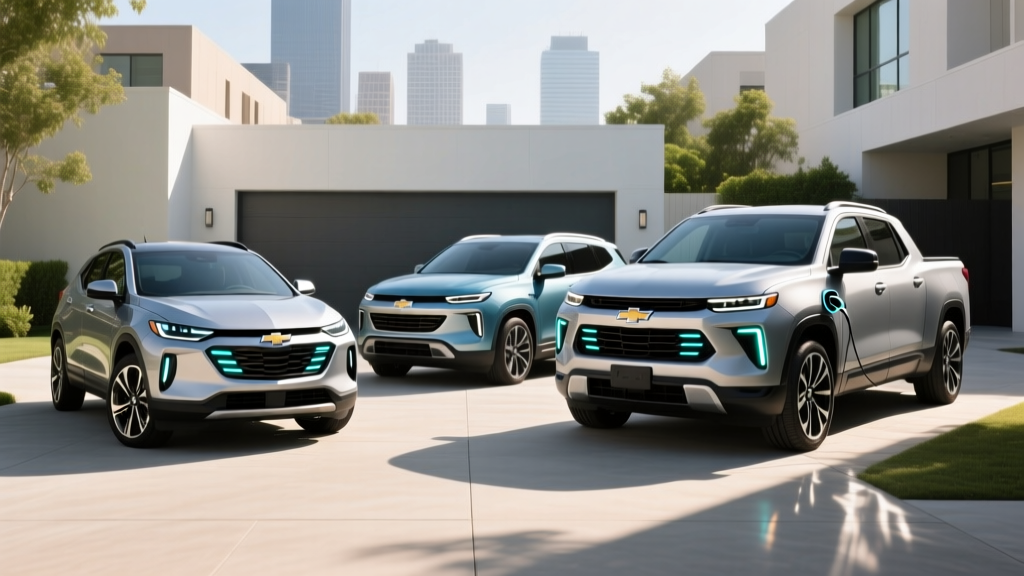
Quick Answer: Chevrolet's 2026 electric lineup spans three Ultium-platform vehicles: the Equinox EV (compact crossover, ~319 mi EPA range, starting ~$33,600), the Blazer EV (midsize crossover, ~324 mi EPA range, starting ~$44,600), and the Silverado EV (full-size pickup, ~440 mi EPA range on 4WT trims, starting ~$57,900). All three use GM's Ultium battery architecture with NMC chemistry, support DC fast charging up to 190 kW (Equinox) or 200+ kW (Blazer/Silverado), and qualify for varying levels of the federal §30D tax credit depending on trim, MSRP caps, and buyer income. The Equinox EV is the value pick; the Blazer EV suits families needing more room and power; the Silverado EV targets truck buyers who need towing plus daily range.
The 2026 Chevy Electric Car Lineup at a Glance
Chevrolet has committed fully to GM's Ultium platform, and by the 2026 model year the lineup is mature. The Bolt EV and Bolt EUV were discontinued after 2023, replaced in spirit by the Equinox EV as the affordable entry point. Here's how the three current models stack up on paper before we dig into real-world ownership.
| Spec | 2026 Equinox EV | 2026 Blazer EV | 2026 Silverado EV |
|---|---|---|---|
| Body Style | Compact Crossover | Midsize Crossover | Full-Size Pickup |
| EPA Range (max trim) | ~319 mi (RS/LTZ FWD) | ~324 mi (RS AWD) | ~440 mi (4WT) |
| Battery (usable) | ~85 kWh (NMC) | ~102 kWh (NMC) | ~200 kWh (NMC, 4WT) |
| Peak DC Fast Charge | ~190 kW | ~190 kW | ~200+ kW |
| 10–80% DC Charge | ~28 min | ~30 min | ~40 min |
| Level 2 Charge Rate | 11.5 kW | 11.5 kW | 11.5 kW (19.2 kW opt.) |
| Horsepower | 213 hp (FWD) / 288 hp (AWD) | 288 hp (AWD) / 557 hp (SS) | 510 hp (RST) / 664 hp (4WT) |
| 0–60 mph | ~7.8s (FWD) | ~5.9s (AWD) / ~3.4s (SS) | ~4.5s (4WT) |
| Starting MSRP | ~$33,600 | ~$44,600 | ~$57,900 |
| Battery Warranty | 8 yr / 100,000 mi | 8 yr / 100,000 mi | 8 yr / 100,000 mi |
Sources: fueleconomy.gov (EPA estimates), Chevrolet.com configurator. Real-world range and charge times vary by temperature, driving style, and charger availability.
Real-World Range: What the EPA Sticker Doesn't Tell You
EPA vs. Reality: The Equinox EV's 319-mile EPA estimate assumes a mix of city and moderate-speed driving at ~70°F. On a sustained 75 mph highway run, expect ~250–275 miles. In freezing temperatures (below 32°F), range drops another 15–25%, putting a realistic winter highway figure closer to ~200–230 miles. The Blazer EV and Silverado EV follow similar patterns — subtract roughly 20% for highway and 30–35% for cold-weather highway driving.
The Ultium platform uses NMC (nickel manganese cobalt) chemistry across the lineup. NMC offers higher energy density than LFP, which is why the Silverado EV can pack ~200 kWh usable into a truck bed-length pack — but NMC cells are more sensitive to sustained high State of Charge. For daily driving, GM recommends charging to 80–90% and only topping to 100% before long trips. This preserves long-term State of Health (SoH).
One thing the spec sheet won't show you: the charge curve taper. The Equinox EV peaks at ~190 kW, but that rate only holds between roughly 10–40% State of Charge. From 40–60%, it drops to ~140 kW; from 60–80%, it falls to ~90 kW. The 10–80% time of ~28 minutes reflects this curve — the last 20% takes nearly as long as the first 50%. On a road trip, plan stops around the 60–70% mark and get back on the road rather than waiting to fill up.
Charging at Home vs. Public Networks: The Cost Reality
Home charging is where EV ownership economics work. Public DC fast charging is convenient for road trips but costs significantly more per mile. Here's what the math looks like for the Equinox EV (85 kWh battery) in a typical US market:
| Charging Method | Rate | Cost for 10–80% (≈60 kWh) | Cost per Mile (≈265 mi) |
|---|---|---|---|
| Home Level 1 (120V) | ~$0.16/kWh (avg US residential) | $9.60 | $0.036/mi |
| Home Level 2 (240V) | ~$0.16/kWh | $9.60 | $0.036/mi |
| Public Level 2 (workplace/retail) | ~$0.25–$0.35/kWh | $15–$21 | $0.057–$0.079/mi |
| DC Fast Charger (EA, EVgo) | ~$0.40–$0.55/kWh | $24–$33 | $0.091–$0.125/mi |
| Gas equivalent (25 MPG, $3.40/gal) | — | — | $0.136/mi |
At home electricity rates, the Equinox EV costs roughly 3.6 cents per mile to fuel — about a quarter of what a comparable 25 MPG gas crossover costs. But if you rely exclusively on DC fast charging, that advantage shrinks to near parity with gasoline. This is why home charging access is the single most important factor in whether a Chevy electric car saves you money.
Home Level 2 Installation: What to Budget
Every Chevy EV ships with a dual-level charge cord (120V/240V), but for practical daily use, a dedicated 240V Level 2 station delivering 11.5 kW is the standard. A full overnight charge from 10–100% takes about 7.5 hours for the Equinox EV at that rate — perfect for a standard sleep cycle.
| Item | Typical Cost Range | Notes |
|---|---|---|
| Level 2 Charger (hardwired, 48A) | $400–$700 | ChargePoint Home Flex, Emporia, Wallbox |
| Electrician labor (240V/50A circuit) | $500–$2,000 | Depends on panel proximity, conduit run |
| Permit & inspection | $50–$300 | Varies by jurisdiction |
| Electrical panel upgrade (if needed) | $1,500–$3,500 | Required if existing panel is 100A or maxed out |
| Total (no panel upgrade) | $950–$3,000 | Most homes with 200A service |
| Total (with panel upgrade) | $2,450–$6,500 | Older homes, 100A panels |
Always get a licensed electrician to evaluate your panel capacity before purchasing equipment. A 200-amp panel with available breaker slots is ideal; older homes with 100-amp service often need an upgrade. The federal Residential Clean Energy Credit covers 30% of charger equipment and installation costs (up to $1,000) through 2032 — check IRS.gov for current eligibility.
Federal Tax Credit: Which Chevy EVs Qualify in 2026?
The §30D Clean Vehicle Credit offers up to $7,500 for qualifying new EVs, but eligibility depends on a matrix of requirements that change yearly. As of the 2026 tax year, the key rules include:
- MSRP caps: Vans, SUVs, and pickups must be under $80,000; sedans and other vehicles under $55,000. All three Chevy EVs fall under their respective caps.
- Buyer income limits: AGI must not exceed $150,000 (single), $225,000 (head of household), or $300,000 (joint).
- Battery sourcing: Critical minerals and battery components must meet escalating domestic/free-trade-partner thresholds. GM has worked to shift Ultium cell sourcing (LG Energy Solution joint venture, US-assembled), but exact credit amounts vary by model year and build date.
- Point-of-sale transfer: Buyers can transfer the credit to the dealer at purchase, reducing the out-of-pocket price immediately — no need to wait for tax filing.
- Final assembly: Vehicle must be assembled in North America (all three qualify — assembled in Tennessee, Ontario, and Michigan respectively).
Current status (2026): The Equinox EV and Blazer EV have historically qualified for the full or partial credit, but critical-mineral sourcing rules tighten each year. The Silverado EV's eligibility depends on specific trim and build date. Always verify on the DOE's qualifying vehicle list and consult a tax professional before relying on credit estimates.
Chevy EV vs. Gas and Hybrid: Total Cost of Ownership
The purchase price of an EV is higher, but operating costs are lower. Here's a 5-year / 75,000-mile ownership comparison between the Equinox EV RS (FWD), a comparably equipped gas Equinox (1.5L turbo AWD), and the Equinox hybrid (if available in your market):
| Cost Factor | Equinox EV (~$38K) | Gas Equinox (~$32K) | Difference (EV vs Gas) |
|---|---|---|---|
| Purchase price (after $7,500 credit) | $30,500 | $32,000 | EV saves $1,500 |
| Fuel/Energy (75K mi, home charging) | $2,700 | $10,200 | EV saves $7,500 |
| Maintenance (5 yr) | $1,200 | $3,500 | EV saves $2,300 |
| Insurance (5 yr avg) | $9,500 | $7,800 | EV costs $1,700 more |
| Depreciation (est. 5 yr) | $18,000 | $14,500 | EV costs $3,500 more |
| Net 5-Year Cost | $61,900 | $68,000 | EV saves ~$6,100 |
The EV wins on fuel and maintenance — no oil changes, fewer brake replacements (regen braking saves pads), no transmission fluid. But insurance premiums run 15–25% higher for EVs (costlier collision repairs, battery replacement risk), and depreciation remains steeper for EVs as the used market adjusts to rapid tech obsolescence and battery health concerns. If you qualify for the full tax credit and charge primarily at home, the Equinox EV breaks even or beats the gas version within 3–4 years.
What About Hybrids?
A plug-in hybrid (PHEV) like the Toyota RAV4 Prime offers ~42 miles of electric range plus a gas engine for longer trips — no range anxiety, no charging infrastructure dependence. If you drive under 40 miles daily and can charge at home, a PHEV delivers EV-like daily costs with gas-car flexibility. The tradeoff: higher complexity (two powertrains to maintain), lower electric-only efficiency, and a smaller tax credit (typically $3,750–$7,500 depending on battery capacity). For pure-commute drivers with home charging, the Chevy EV is simpler and cheaper per mile. For one-car households that road-trip frequently without reliable DC fast charging along their routes, a PHEV may be the pragmatic middle ground.
Common EV Misconceptions — Fact-Checked
| Myth | Fact |
|---|---|
| "EV batteries need replacing every few years." | GM warranties the Ultium pack for 8 years/100,000 miles against degradation below 70% capacity. Real-world data from early Ultium vehicles shows <10% degradation at 100K miles with normal charging habits. Full pack replacement (if ever needed out of warranty) runs $12,000–$18,000, but most packs outlast the vehicle. |
| "Charging takes too long for road trips." | A 10–80% DC fast charge in ~28–30 minutes aligns with a rest stop, meal, or bathroom break. The key is route planning: apps like A Better Routeplanner and the myChevrolet app pre-condition the battery and identify chargers along your route. |
| "EVs don't work in cold climates." | Range drops 15–25% in freezing temps — real, but manageable. The Equinox EV's heat pump (standard on most trims) reduces cabin-heating energy draw by ~30% compared to resistive heaters. Pre-conditioning while plugged in preserves range. Owners in Minnesota and Maine drive Ultium EVs year-round. |
| "The grid can't handle everyone switching to EVs." | Most EV charging happens overnight during off-peak hours when grid capacity is underutilized. A single Level 2 charger draws ~11.5 kW — comparable to running an electric dryer. Utilities are upgrading distribution, and managed/V2G charging programs are expanding. |
| "EVs are worse for the environment because of battery mining." | Lifecycle analyses (including from Argonne National Laboratory) consistently show EVs produce fewer total emissions than gas cars over their lifetime, even accounting for battery manufacturing. As the grid decarbonizes, that gap widens further. |
Which Chevy Electric Car Should You Buy?
Choose the Equinox EV if:
- Your budget is $33K–$45K and you want maximum value per mile of range
- You commute under 60 miles daily and road-trip 2–4 times per year
- You qualify for the §30D credit and have home Level 2 charging
- You don't need more than ~64 cu-ft of cargo space
Choose the Blazer EV if:
- You need a midsize crossover with more rear legroom and ~78 cu-ft cargo volume
- You want available AWD with 288 hp for snow-belt driving or the SS trim with 557 hp for performance
- Your budget is $45K–$60K and you value a premium interior over maximum efficiency
- You tow occasionally (up to 1,500 lb on some trims)
Choose the Silverado EV if:
- You need a full-size truck bed, up to 10,000 lb towing capacity, and over 400 miles of range
- You use a truck for work (job-site power via ProGrade Power, V2L capability)
- Your budget is $58K–$90K+ and the commercial/work tax write-offs apply
- You accept that the 4WT's ~200 kWh battery means longer Level 2 charge times (~17 hours from 10–100% at 11.5 kW — plan for overnight charging or opt for the 19.2 kW onboard charger)
Don't buy a Chevy EV yet if:
- You live in an apartment or condo without charging access and your area lacks reliable public Level 2 or DC infrastructure
- You regularly drive 300+ miles in a single day through DC-charging-desert regions (rural Mountain West, parts of the Dakotas)
- Your AGI exceeds the §30D income caps and the effective price premium doesn't pencil out against your annual mileage
First-Time EV Buyer Checklist
If this is your first Chevy electric car, here's what to sort out before signing:
- Verify home charging feasibility. Check your electrical panel (200A service preferred), identify a 240V outlet or plan for a new circuit. Get an electrician quote before purchase.
- Confirm tax credit eligibility. Use the IRS's seller-reporting tool and the DOE's qualifying vehicle list. Ask the dealer about point-of-sale transfer.
- Download the myChevrolet app. It handles route planning, preconditioning, charge scheduling, and battery health monitoring. Set it up before delivery.
- Understand your rate plan. Many utilities offer time-of-use (TOU) rates that make overnight charging 30–50% cheaper than peak hours. Enroll before your first bill.
- Plan your first road trip. Use A Better Routeplanner or the in-dash navigation to identify DC fast chargers along your most common long-distance route. Note which networks (Electrify America, EVgo, Pilot/Flying J) have chargers where you'll need them.
- Set a charge limit. Configure the vehicle to charge to 80–90% daily. Only set 100% when departing on a trip.
- Check insurance quotes. Get EV-specific quotes from 3+ carriers before purchase. Some insurers offer EV discounts; others charge premiums 20% higher than gas equivalents.
Frequently Asked Questions
Is the Chevy Bolt EV still available in 2026?
No. The Bolt EV and Bolt EUV were discontinued after the 2023 model year. The Equinox EV effectively replaces the Bolt as Chevrolet's most affordable electric vehicle, starting around $33,600 — roughly $7,000 more than the last Bolt, but with 60+ more miles of range, DC fast charging (the Bolt was limited to ~55 kW), and a significantly larger cabin.
Do Chevy EVs use Tesla's NACS connector or CCS?
GM adopted the Tesla North American Charging Standard (NACS) for its EVs. The 2026 Equinox EV, Blazer EV, and Silverado EV all come with a native NACS charge port, giving them direct access to Tesla Supercharger stalls (15,000+ locations in North America) without an adapter. This is a major advantage over CCS-equipped vehicles, which require a NACS adapter for Supercharger access.
How long does the Ultium battery last?
GM warrants the Ultium battery for 8 years or 100,000 miles against capacity loss below 70% of original. In practice, NMC Ultium packs are showing degradation rates of roughly 1.5–2.5% per year under normal use (80% daily charge limit, occasional DC fast charging, preconditioning in cold weather). At that rate, a 10-year-old pack should retain 80–85% of original capacity — well above the warranty threshold. Full replacement cost (out of warranty) is estimated at $12,000–$18,000 depending on pack size, but most EV batteries outlast the vehicle's useful life.
Can I tow with a Chevy electric car?
The Silverado EV is rated for up to 10,000 lb of towing on properly equipped Work Truck and RST trims. The Blazer EV is rated up to 1,500 lb on select trims. The Equinox EV is rated up to 1,500 lb with the trailering package. Critical caveat: towing at maximum capacity cuts range by 35–50%. A Silverado EV rated at 440 miles EPA may deliver only ~220–280 miles while towing 8,000 lb at highway speeds. Plan charging stops accordingly.
Is Super Cruise available on Chevy EVs?
Yes, GM's Super Cruise — a hands-off, eyes-on Level 2 driver-assistance system — is available on the Blazer EV and Silverado EV (standard or optional depending on trim). It operates on over 750,000 miles of mapped divided highways in the US and Canada. Super Cruise is not self-driving: the driver must remain attentive, and the system uses a camera to monitor eye position. It disengages on unmapped roads, in construction zones, and in severe weather. The Equinox EV does not currently offer Super Cruise but includes Chevy's standard driver-assistance suite (automatic emergency braking, lane-keep assist, adaptive cruise).