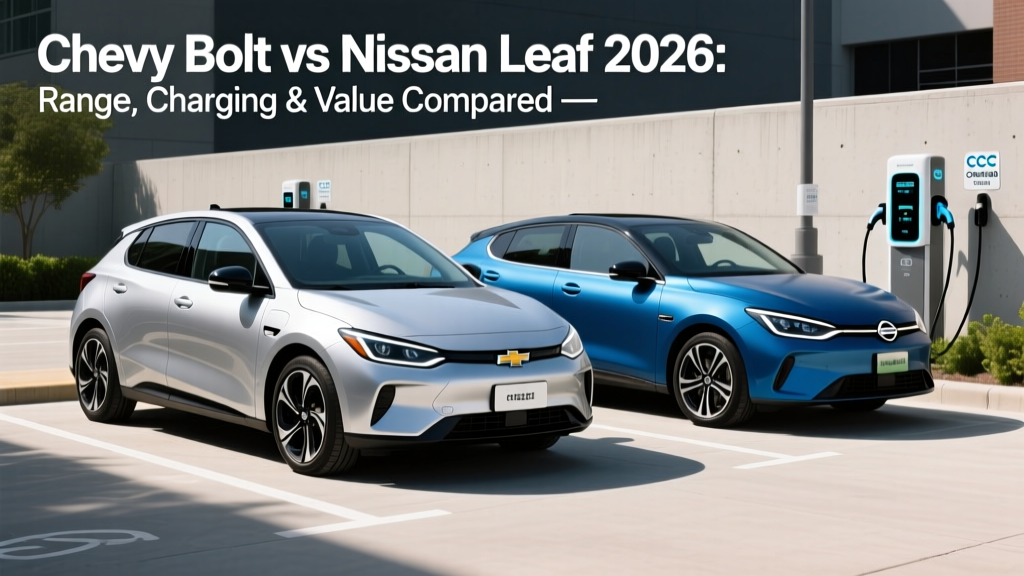
If you're shopping for an affordable electric vehicle in 2026, the Chevrolet Bolt EV and Nissan Leaf remain two of the most talked-about nameplates in the sub-$40,000 segment. Both deliver practical daily range, compact packaging, and low running costs. But beneath the surface, they diverge sharply — particularly on charging hardware, battery chemistry, and federal incentive eligibility. This Chevy Bolt vs Nissan Leaf comparison breaks down every spec that matters, from real-world highway range to DC fast-charging curves, so you can pick the right one for your actual driving life.
Quick Verdict: Two Budget EVs, Very Different Strengths
The Bolt is the range-and-road-trip play. The Leaf is the commuter-and-city play. Neither is universally better — the right pick depends on whether you prioritize maximum miles per charge or a lower entry price with adequate daily usability. Both qualify for at least partial federal tax credits under current IRS §30D rules, but sourcing requirements and buyer income caps mean your personal eligibility may differ. Let's get into the numbers.
Side-by-Side Spec Table: 2026 Chevy Bolt EV vs 2026 Nissan Leaf
| Specification | 2026 Chevrolet Bolt EV (2LT) | 2026 Nissan Leaf (SV Plus) |
|---|---|---|
| EPA Range | 259 miles | 212 miles |
| Battery (usable) | 65 kWh (NMC) | 60 kWh (NMC) |
| Motor Output | 200 hp / 266 lb-ft | 214 hp / 250 lb-ft |
| 0–60 mph | ~6.5 sec | ~6.9 sec |
| DC Fast Charge (peak) | 115 kW (CCS) | 100 kW (CHAdeMO) |
| 10–80% DC Charge Time | ~30 min | ~40 min |
| Level 2 Charge Rate | 11.5 kW | 7.2 kW |
| Efficiency (combined MPGe) | 120 MPGe | 111 MPGe |
| Cargo Volume (rear seats up) | 22.1 cu ft | 23.6 cu ft |
| Starting MSRP | ~$28,900 | ~$29,990 |
| Battery Warranty | 8 yr / 100,000 mi | 8 yr / 100,000 mi |
Sources: fueleconomy.gov, Chevrolet and Nissan official spec sheets. Real-world results vary with temperature, terrain, and driving style.
Range and Efficiency: The Bolt Goes Further, But Real-World Matters
EPA Sticker vs. Reality: The Bolt's 259-mile EPA rating is excellent for the price. On flat, moderate-temperature suburban routes, owners commonly report 240–265 miles. However, at sustained 75 mph highway speeds, expect roughly 210–225 miles. In freezing weather (below 30°F), plan for 170–195 miles — the Bolt lacks a heat pump, so cabin heating draws heavily from the traction battery.
The Leaf SV Plus at 212 miles EPA delivers around 190–205 miles in mixed real-world driving and drops to approximately 150–170 miles in winter cold. Like the Bolt, the Leaf uses resistive cabin heating rather than a heat pump, which amplifies cold-weather range loss.
For a 40-mile round-trip commute with errands, either car works effortlessly. The gap opens on weekend road trips: the Bolt's extra ~47 miles of EPA range translates to roughly one fewer charging stop on a 400-mile drive.
Charging Speed and Network Access: Bolt Wins on Infrastructure
This is where the comparison tilts decisively. The Bolt uses the CCS1 connector, which is supported at virtually every public DC fast-charging network in the U.S. — Electrify America, EVgo, ChargePoint, and the growing number of Tesla Superchargers now open to CCS vehicles via adapter.
The Leaf uses CHAdeMO, a connector standard that has been in steady decline in North America. While Electrify America still maintains some CHAdeMO stalls, new installations overwhelmingly favor CCS and NACS. If you rely on public fast charging, the Leaf's connector limits your options and may leave you hunting for compatible stations on road trips.
| Charging Level | Bolt EV | Nissan Leaf |
|---|---|---|
| Level 1 (120V, 1.4 kW) | ~4 mi/hr | ~3.5 mi/hr |
| Level 2 (240V) | 11.5 kW / ~39 mi/hr | 7.2 kW / ~25 mi/hr |
| DC Fast Charge (peak) | 115 kW / ~160 mi in 30 min | 100 kW / ~120 mi in 30 min |
Charging curve reality: Neither vehicle sustains peak kW for the full session. The Bolt peaks near 115 kW up to roughly 55% state of charge, then tapers to 55–70 kW through 80%. The Leaf peaks near 100 kW but tapers earlier, around 45% SoC. Both slow significantly above 80%, which is typical for NMC chemistry — charging from 80–100% can add another 25–35 minutes.
Price, Tax Credits, and Total Cost of Ownership
2026 Pricing After Federal Incentives
| Chevy Bolt EV (2LT) | Nissan Leaf SV Plus | |
|---|---|---|
| Base MSRP | $28,900 | $29,990 |
| Federal §30D Credit (max) | Up to $7,500 | Up to $3,750–$7,500* |
| Est. Effective Price | ~$21,400 | ~$22,490–$26,240 |
| Destination Charge | $1,395 | $1,195 |
*Nissan Leaf credit eligibility depends on battery-component and critical-mineral sourcing requirements under IRS §30D rules. The Leaf's battery sourcing has historically met partial requirements, yielding $3,750 in some model years. Confirm current-year eligibility with your tax professional or dealer at point of sale.
Key §30D caveats for both vehicles: The buyer's modified adjusted gross income must not exceed $150,000 (single) or $300,000 (joint). The vehicle MSRP must be under $55,000 for sedans/hatchbacks — both qualify comfortably. The credit can now be transferred to the dealer at point of sale as a purchase-price reduction, which is a significant cash-flow advantage over waiting for a tax refund. Always verify eligibility on the IRS Clean Vehicle credit page before signing.
5-Year Ownership Cost Comparison
| Cost Category (5 yr) | Bolt EV | Nissan Leaf |
|---|---|---|
| Electricity (home charging, 15k mi/yr) | ~$3,400 | ~$3,700 |
| Insurance (avg) | ~$7,200 | ~$6,800 |
| Maintenance | ~$1,200 | ~$1,200 |
| Tires (1 set replacement) | ~$700 | ~$700 |
| Est. Depreciation | ~$9,500 | ~$10,200 |
| Total 5-Year Cost (est.) | ~$22,000 | ~$22,600 |
The Bolt's superior efficiency (120 vs. 111 MPGe combined) saves roughly $300 in electricity over five years. Insurance for the Bolt tends to run slightly higher due to its stronger performance profile and GM's repair-cost data. Depreciation favors the Bolt modestly, as its CCS connector and longer range give it broader appeal in the used market. These figures assume predominantly home Level 2 charging at $0.14/kWh national average — public DC fast charging at $0.35–$0.50/kWh would raise costs substantially for either car.
Category Winners: Where Each EV Excels
🏆 Range & Efficiency: Chevy Bolt EV
259 miles EPA and 120 MPGe combined gives the Bolt a clear edge for drivers who regularly exceed 100 miles per day or take occasional road trips.
🏆 Charging Infrastructure: Chevy Bolt EV
CCS compatibility opens virtually every U.S. public fast-charging network. The Leaf's CHAdeMO connector is a growing liability outside major metro areas.
🏆 Cargo Practicality: Nissan Leaf
23.6 cu ft behind the rear seats edges out the Bolt's 22.1 cu ft. The Leaf's hatch opening is also slightly wider, making bulkier items easier to load.
🏆 Entry Price (Before Credit): Nissan Leaf
The Leaf S trim starts below $28,000 with the smaller 40 kWh battery and 149-mile range — the cheapest new EV available if your commute is short. The Bolt has no comparable low-range trim.
🏆 Level 2 Home Charging Speed: Chevy Bolt EV
11.5 kW onboard charger vs. the Leaf's 7.2 kW means the Bolt recovers a full charge overnight in roughly 7 hours vs. 9.5 hours — a meaningful difference if you charge opportunistically during the day.
🏆 Driver-Assist Tech: Nissan Leaf
Nissan's ProPILOT Assist with Navi-link offers competent lane centering and adaptive cruise with speed-sign recognition. Chevy's Super Cruise hands-free system is superior but is not available on the Bolt — you're limited to standard lane-keep and adaptive cruise.
Real-World Driving Impressions: Commute, Highway, and Cold Weather
Daily commuting: Both are quiet, smooth, and punchy off the line. The Bolt's 266 lb-ft of torque arrives instantly, making it feel quicker than its 6.5-second 0–60 time suggests in stop-and-go traffic. The Leaf's 214 hp is adequate but less eager. Both offer one-pedal driving modes (Chevy's "One Pedal Driving" and Nissan's "e-Pedal") that maximize regenerative braking.
Highway driving: The Bolt feels more planted at 70–80 mph, with better body control and less wind noise. The Leaf's ride is softer and more comfort-oriented, which some prefer for potholed city streets but which produces more float on highway expansion joints.
Cold weather: Neither vehicle offers a heat pump, which is the biggest efficiency miss in this segment. Resistive heating can consume 3–5 kW continuously in sub-freezing temperatures, directly cutting into range. If you live in a cold climate and lack a garage, preconditioning while plugged in is essential for both cars — it warms the battery and cabin using grid power rather than battery energy. The Bolt's larger 65 kWh battery provides a bigger buffer against cold-weather loss.
Pros and Cons at a Glance
Chevy Bolt EV
Pros:
- 259-mile EPA range at sub-$29K is segment-leading value
- CCS connector — full U.S. charging network access
- 11.5 kW Level 2 charging for fast home turnaround
- Strong regenerative braking with one-pedal mode
- Up to full $7,500 §30D credit eligibility
Cons:
- No heat pump — cold-weather range loss is steep
- 115 kW DC peak is slow vs. newer 800V platforms
- No hands-free driving-assist option (Super Cruise unavailable)
- Rear seat legroom is tight for adults over 6'
Nissan Leaf
Pros:
- ProPILOT Assist is competent and well-integrated
- Slightly more cargo room and a wider hatch opening
- Comfortable, compliant ride quality for city streets
- Low entry price on base S trim ($28K range)
- Established reliability track record over multiple generations
Cons:
- CHAdeMO connector — declining public network support
- 212-mile range on SV Plus; base S is only 149 miles
- 7.2 kW Level 2 charger is slow for the segment
- Partial or uncertain §30D credit eligibility ($3,750 vs $7,500)
- No active liquid battery cooling in earlier gens (improved but still air-assisted)
Decision Framework: Which Should You Buy?
Choose the Chevy Bolt EV if:
- You regularly drive more than 100 miles per day or take road trips of 200+ miles
- You rely on public DC fast charging and need CCS network access
- You want the maximum possible federal tax credit ($7,500)
- You charge at home and want faster Level 2 replenishment (11.5 kW)
- Cold-weather range buffer matters in your climate
Choose the Nissan Leaf if:
- Your daily driving is under 80 miles and you charge at home every night
- You prioritize ride comfort and ProPILOT Assist for congested commutes
- You need maximum cargo space in a compact EV hatchback
- You live in a mild climate where cold-weather range loss is minimal
- You find a strong dealer discount that offsets the potential credit gap
Frequently Asked Questions
Can the Nissan Leaf use Tesla Superchargers?
No. Tesla Superchargers use the NACS connector, and adapters exist for CCS-equipped vehicles. The Leaf's CHAdeMO connector has no practical NACS adapter pathway, so Supercharger access is not available. This is the single biggest infrastructure disadvantage of the Leaf in 2026.
Does the Chevy Bolt qualify for the full $7,500 federal tax credit?
The Bolt has historically qualified for the full $7,500 under §30D, but eligibility depends on current-year battery sourcing and critical-mineral requirements as defined by the IRS. Buyer income caps ($150K single / $300K joint) and the $55K MSRP cap also apply. Always verify on the IRS Clean Vehicle page or with your dealer's point-of-sale credit transfer process before purchase.
Which is cheaper to insure, the Bolt or the Leaf?
The Leaf typically costs $300–$500 less per year to insure, depending on your state and driving record. The Bolt's higher performance output and GM's collision-repair cost data push premiums slightly higher. Get quotes from your insurer for both vehicles before deciding — the difference can offset the Bolt's efficiency advantage.
Is CHAdeMO really dying in the U.S.?
Yes. Nearly all new DC fast-charging installations in North America use CCS or NACS. Electrify America, the largest open network, has stopped adding CHAdeMO connectors to new stations. Existing CHAdeMO stalls still function, but availability and reliability are declining as networks invest in CCS/NACS infrastructure. For a vehicle you plan to keep 5–8 years, CHAdeMO is a growing liability.
Which has better long-term battery durability?
Both use NMC lithium-ion chemistry with 8-year/100,000-mile battery warranties covering defects and excessive capacity loss (typically below 60–70% of original capacity). GM's active liquid thermal management system in the Bolt provides more consistent battery temperature regulation than the Leaf's system, which historically relied on passive/air-assisted cooling. In hot climates, active liquid cooling reduces long-term degradation risk. Neither vehicle has shown widespread battery-failure issues in recent model years.
What about the Bolt EUV or Leaf with the smaller battery?
The Bolt EUV (the longer-wheelbase variant) was discontinued after the 2023 model year, so only the standard Bolt EV remains in 2026. The Leaf S trim with the 40 kWh battery and 149-mile EPA range is still available at a lower price (~$27,990) — it's viable only if your daily driving stays under 60 miles and you charge at home reliably. For most buyers, the SV Plus with the 60 kWh pack is the more versatile Leaf.
Final Recommendation
For most buyers in 2026, the Chevy Bolt EV is the stronger overall pick. Its 259-mile range, CCS charging access, faster Level 2 capability, and fuller tax-credit eligibility give it advantages in nearly every category that affects long-term ownership satisfaction. The range gap alone — 47 extra EPA miles — removes meaningful stress from longer drives and cold-weather commutes.
The Nissan Leaf remains a solid choice for a specific buyer: someone with a short, predictable commute, reliable home charging, a mild climate, and a preference for Nissan's ProPILOT Assist and softer ride. If you can negotiate a dealer price that compensates for any tax-credit shortfall and you don't plan to rely on public fast charging, the Leaf is still a comfortable, practical EV.
Whichever you choose, confirm your §30D eligibility, install a Level 2 home charger (budget $500–$1,500 for equipment and electrician), and precondition your battery whenever possible. Both cars reward informed owners with years of cheap, quiet, low-maintenance driving.