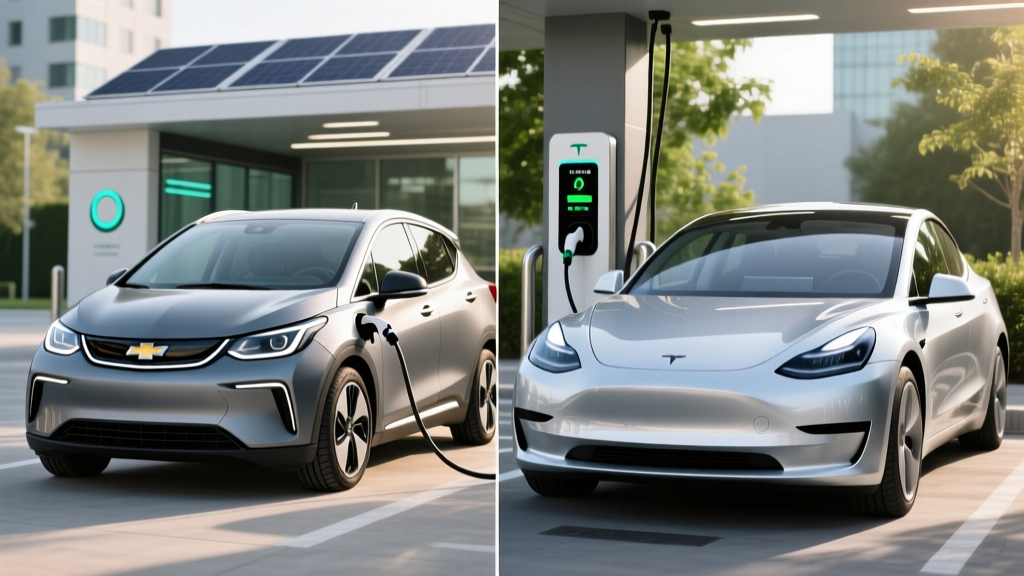
The Chevy Bolt EV and Tesla Model 3 occupy opposite ends of the affordable electric sedan/hatchback spectrum. One is the undisputed bargain king of new EVs; the other is the segment benchmark for range, charging speed, and tech. But when you factor in 2026 federal tax credit eligibility, real-world charging realities, and five-year ownership costs, the gap between them narrows in ways that might surprise you.
We've driven both extensively, charged them on Level 2 and DC fast chargers, and tracked their efficiency across seasons. Here's the data-driven breakdown to help you decide which one actually fits your life — not just your budget.
Side-by-Side Specs: Bolt EV vs Model 3 at a Glance
Before the analysis, here are the numbers that matter. All figures reflect the 2026 model year with the most comparable trims: the Bolt EV 2LT and the Model 3 Long Range RWD. We've also included the base Model 3 RWD for price context.
| Spec | 2026 Chevy Bolt EV 2LT | 2026 Tesla Model 3 RWD | 2026 Tesla Model 3 Long Range RWD |
|---|---|---|---|
| EPA Range | 259 mi | 363 mi | 363 mi |
| Battery (usable) | 65 kWh (NMC) | 60 kWh (LFP) | 79 kWh (NMC) |
| Efficiency (MPGe) | 120 MPGe combined | 132 MPGe combined | 130 MPGe combined |
| Peak DC Fast Charge | 55 kW (CCS1) | 170 kW (NACS) | 250 kW (NACS) |
| 10–80% DC Charge Time | ~55 min | ~30 min | ~25 min |
| Level 2 Charge Rate | 11.5 kW | 11.5 kW | 11.5 kW |
| 0–60 mph | 6.5 sec | 5.8 sec | 4.9 sec |
| Horsepower | 200 hp | 271 hp | 346 hp |
| Cargo Volume | 16.3 cu ft (57.0 cu ft seats folded) | 23.0 cu ft (trunk + frunk) | 23.0 cu ft (trunk + frunk) |
| Base MSRP | $29,995 (1LT) / $32,395 (2LT) | $38,990 | $44,990 |
| Battery/Powertrain Warranty | 8 yr / 100,000 mi | 8 yr / 120,000 mi (LWD) | 8 yr / 120,000 mi |
Sources: fueleconomy.gov, Chevrolet and Tesla manufacturer specifications.
Range and Real-World Efficiency
On paper, the Model 3 Long Range's 363-mile EPA estimate dwarfs the Bolt EV's 259 miles. But EPA numbers are a starting point, not a guarantee.
Chevy Bolt EV: EPA 259 mi. Expect ~220–240 mi in mixed highway driving at 70+ mph. In freezing temperatures (below 30°F), plan for 175–200 mi. The Bolt's smaller 65 kWh NMC battery and taller hatchback profile work against it at speed.
Tesla Model 3 LR: EPA 363 mi. Expect ~300–320 mi highway. Cold weather drops this to ~250–275 mi. Tesla's heat pump and superior thermal management give it an edge in winter. The base RWD model (LFP battery) loses slightly more range in cold weather — LFP chemistry is more temperature-sensitive than NMC.
The Bolt EV's 120 MPGe combined is respectable but trails the Model 3's 130–132 MPGe. Over 15,000 annual miles, that efficiency gap translates to roughly $60–$80 per year in electricity savings for the Tesla, depending on your local rate. Meaningful over time, but not a dealbreaker.
Charging Speed and Network Access
This is where the Bolt EV's most significant limitation becomes impossible to ignore. Despite the 2026 refresh, Chevrolet retained the Bolt's 55 kW peak DC fast-charging rate on the CCS1 connector. On a road trip, that means a 10–80% charge takes roughly 55 minutes — nearly double what the Model 3 requires.
| Scenario | Chevy Bolt EV | Tesla Model 3 LR |
|---|---|---|
| Level 1 (120V, 1.4 kW) | ~4 mi/hr | ~4 mi/hr |
| Level 2 (240V, 11.5 kW) | ~39 mi/hr | ~44 mi/hr |
| DC Fast Charge (peak) | 55 kW (CCS1) | 250 kW (NACS) |
| 10–80% DC Time | ~55 min | ~25 min |
| Miles added in 15 min DC | ~65 mi | ~175 mi |
The charge curve matters as much as peak rate. The Bolt EV's curve is relatively flat — it holds near 50 kW for most of the session before tapering above 85%. The Model 3 LR peaks at 250 kW around 15–25% SoC, then steps down progressively. You'll see 150–170 kW sustained through 50%, which is why the 10–80% time is so much shorter.
Network access is a critical differentiator. The Model 3 uses the NACS connector and has native access to the Tesla Supercharger network — over 20,000 stalls in North America with industry-leading uptime. The Bolt EV uses CCS1, connecting to Electrify America, EVgo, and ChargePoint DC stations. While the Supercharger network has opened to some non-Tesla vehicles via built-in adapters, the Bolt EV's 55 kW cap means it wouldn't benefit much from Supercharger speeds anyway.
For daily commuting with home Level 2 charging, the Bolt's DC speed is a minor inconvenience. For anyone taking road trips more than twice a year, it's a legitimate frustration.
Price, Tax Credits, and True Purchase Cost
The Bolt EV's headline advantage is its MSRP. At $29,995 for the 1LT and $32,395 for the 2LT, it undercuts the base Model 3 RWD by roughly $9,000 before any incentives.
But the IRS §30D federal tax credit changes the calculus. Under 2026 rules:
- Chevy Bolt EV: Qualifies for the full $7,500 credit, available as a point-of-sale transfer. The Bolt EV's battery meets critical-mineral and component sourcing requirements, and its MSRP is well under the $55,000 passenger-vehicle cap. Buyer income limits apply ($150K single / $300K joint MAGI).
- Tesla Model 3 RWD: Qualifies for $7,500 (subject to the same income caps and point-of-sale transfer). The base RWD with LFP battery has faced sourcing-related credit fluctuations in prior years — always verify current eligibility on the IRS clean vehicle credit page before purchasing.
- Tesla Model 3 Long Range: Eligibility for the full $7,500 depends on current battery-sourcing compliance. The LR's higher MSRP ($44,990) still clears the $55,000 cap.
| Model | MSRP | Federal Credit | Effective Price |
|---|---|---|---|
| Bolt EV 1LT | $29,995 | –$7,500 | ~$22,495 |
| Bolt EV 2LT | $32,395 | –$7,500 | ~$24,895 |
| Model 3 RWD | $38,990 | –$7,500* | ~$31,490* |
| Model 3 Long Range | $44,990 | –$7,500* | ~$37,490* |
*Credit eligibility depends on battery sourcing compliance and buyer income. Verify at irs.gov before purchase. State and local incentives may further reduce cost — check afdc.energy.gov for your area.
Even after credits, the Bolt EV 2LT costs roughly $9,000–$12,500 less than a comparably equipped Model 3. That gap is large enough to cover years of charging, insurance differences, or a home Level 2 installation.
Tech, Driver Assistance, and Interior
The Model 3's 15.4-inch center touchscreen controls nearly every vehicle function — there are no physical instrument cluster or stalks in the 2026 refresh. Love it or not, the interface is fast, responsive, and receives regular over-the-air updates that add features post-purchase.
The Bolt EV uses a more conventional layout: a 10.2-inch infotainment screen with physical buttons for climate, a digital instrument cluster, and wireless Apple CarPlay/Android Auto. It's intuitive and less distracting to operate while driving, though it lacks the Tesla's feature depth (no built-in navigation with real-time Supercharger routing, no Sentry Mode, no Dog Mode).
Both vehicles offer SAE Level 2 driver-assistance systems. Tesla's Autopilot (and optional FSD Supervised) and Chevrolet's Super Cruise (available on higher trims) require continuous driver attention. Neither system makes the vehicle self-driving. You must keep your hands on or near the wheel and eyes on the road at all times. Only Level 4 services like Waymo operate without a human driver — and those are limited robotaxi services, not consumer vehicles.
Super Cruise, when equipped, offers hands-free driving on over 750,000 miles of mapped divided highways in the US, using a driver-attention camera to verify you're watching the road. Tesla's Autopilot requires torque on the steering wheel. In practice, Super Cruise is less fatiguing on long highway stretches, while Autopilot handles a wider variety of road types (though not without supervision).
Five-Year Ownership Cost Breakdown
Purchase price is just the beginning. Here's how these two stack up over five years and 75,000 miles of mixed driving:
| Cost Category | Bolt EV 2LT | Model 3 LR |
|---|---|---|
| Purchase Price (after credit) | ~$24,895 | ~$37,490 |
| Electricity (75K mi, $0.14/kWh avg) | ~$3,150 | ~$2,950 |
| Insurance (5-year avg) | ~$7,500 | ~$9,800 |
| Maintenance | ~$1,200 | ~$1,400 |
| Estimated Depreciation | ~$10,500 | ~$13,000 |
| Total 5-Year Cost | ~$47,245 | ~$64,640 |
Insurance estimates based on national averages for a 35-year-old driver with clean record. Actual premiums vary significantly by state, age, and driving history. Tesla insurance premiums tend to run 20–35% higher than comparable non-Tesla EVs due to higher repair costs. Depreciation estimates based on 5-year retention trends from industry data.
The Bolt EV saves roughly $17,000 over five years — a gap large enough to fund a home solar installation, a complete home charging setup, or simply stay in your pocket. The Model 3's efficiency advantage saves about $200 in electricity over five years, which is negligible against the insurance and depreciation premium.
Practicality: Cargo, Comfort, and Daily Use
The Bolt EV is a subcompact hatchback with 16.3 cu ft behind the rear seats and a generous 57.0 cu ft with seats folded. That hatch opening swallows bulky items the Model 3's sedan trunk cannot. The rear seat is tighter for adults on long trips, though.
The Model 3 offers 23.0 cu ft total (trunk plus a small frunk), but the sedan trunk opening is narrower. Rear-seat legroom is actually slightly better than the Bolt's, and the ride quality on the refreshed Model 3 is noticeably improved — quieter and more compliant over rough pavement.
Bolt EV Practicality
- Hatchback versatility for cargo
- Tight rear seat for tall adults
- Compact footprint = easy parking
- No frunk
- Good outward visibility
Model 3 Practicality
- More rear-seat legroom
- Sedan trunk limits bulky items
- Frunk adds secure storage
- Quieter, more refined ride
- Minimalist interior not for everyone
The Decision Framework: Which One Is for You?
Choose the Chevy Bolt EV if:
- You want the lowest-cost new EV on the market — ~$22,500 after the federal credit is hard to argue with
- Your daily commute is under 80 miles round-trip and you charge at home
- You rarely take road trips over 200 miles (or don't mind a 55-minute charge stop)
- You need hatchback cargo flexibility for gear, groceries, or a dog
- You prefer physical buttons and a conventional instrument cluster
- Minimizing insurance costs is a priority
Choose the Tesla Model 3 if:
- You need 300+ miles of real-world range for frequent long-distance driving
- Fast DC charging matters — 25 minutes 10–80% vs 55 minutes is transformative on road trips
- Supercharger network reliability is important to you
- You want the most advanced software, OTA updates, and app ecosystem
- Performance is a factor — the LR's 4.9-second 0–60 is sports-sedan territory
- You can absorb the ~$12,500 higher purchase cost and higher insurance premiums
Final Verdict
There is no universal winner between the Chevy Bolt EV and the Tesla Model 3 — they serve different buyers at different price points with different priorities.
If your priority is financial efficiency — lowest purchase price, lowest insurance, lowest five-year cost — the Bolt EV is the rational choice. At roughly $22,500 after the federal credit, it's the most accessible new EV in America, and for a commuter who charges at home, its limitations rarely surface.
If your priority is capability — maximum range, fast road-trip charging, Supercharger access, and tech-forward ownership — the Model 3 justifies its premium. The 100+ mile range advantage and 30-minute faster charging aren't marginal gains; they fundamentally change how you use the car on longer trips.
The honest answer: both are excellent EVs. The Bolt EV proves you don't need to spend $40K to go electric. The Model 3 proves that spending more buys meaningful, measurable capability. Match the car to your actual driving life, not the one you imagine.
Frequently Asked Questions
Does the Chevy Bolt EV qualify for the full $7,500 federal tax credit in 2026?
Yes, as of early 2026 the Bolt EV qualifies for the full $7,500 §30D credit, available as a point-of-sale transfer at the dealer. Buyer income limits apply ($150K single / $300K joint). Always verify current eligibility at irs.gov before purchasing, as battery-sourcing rules can shift.
Can the Bolt EV use Tesla Superchargers?
Not directly. The Bolt EV uses a CCS1 connector, while Superchargers use NACS. Some Supercharger stations have been opened to non-Tesla vehicles via a built-in Magic Dock adapter, but the Bolt EV's 55 kW charge cap means it wouldn't benefit from Supercharger speeds. You'll primarily use Electrify America, EVgo, and ChargePoint DC stations.
Which is cheaper to insure — the Bolt EV or Model 3?
The Bolt EV, by a wide margin. National average premiums for the Model 3 run 20–35% higher than the Bolt EV due to Tesla's higher repair costs and parts pricing. Over five years, that gap can total $2,000–$3,000. Always get personalized quotes before deciding.
Is the Bolt EV's 259-mile range enough for most drivers?
For the vast majority of daily driving, yes. The average American drives about 37 miles per day. With home charging, you'd start every morning with a full battery. The 259-mile range becomes a concern primarily on road trips exceeding 200 miles or in extreme cold, where real-world range drops to ~175–200 miles.
Which has better cold-weather performance?
The Tesla Model 3 Long Range. Its heat pump system is more efficient at preserving cabin warmth and battery temperature in sub-freezing conditions. The Model 3 LR retains roughly 70–75% of its EPA range in cold weather (~250–275 mi), while the Bolt EV drops to roughly 65–75% (~175–200 mi). Both vehicles precondition their batteries while plugged in, which helps mitigate losses.