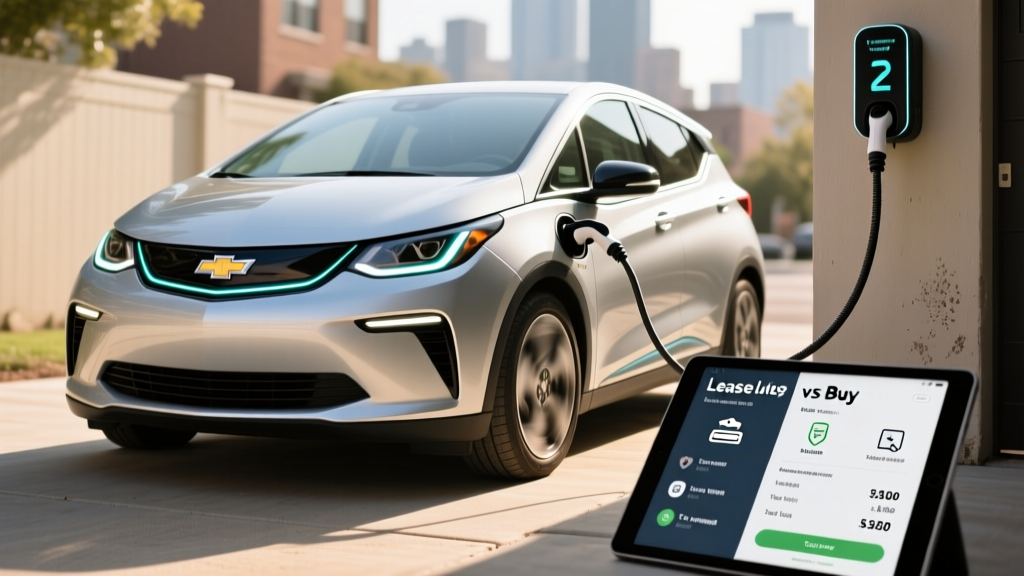
If you've been searching for an affordable entry into electric vehicles, the Chevrolet Bolt EV remains one of the most talked-about options on the used and new market. But with shifting federal incentive rules, rising insurance premiums, and the nuances of leasing versus buying, figuring out the true cost of ownership requires more than a glance at the MSRP. This guide dissects the real economics of a Bolt EV lease or purchase in 2026 — with hard numbers, not marketing fluff.
The Real 5-Year Total Cost of Ownership
The sticker price is only the starting line. What actually matters is what you'll spend over five years of driving — roughly 60,000 miles at the US average of 12,000 miles per year. Below is a realistic TCO breakdown for a Bolt EV compared to a similarly priced gas-powered compact (let's use a Chevrolet Trax as a baseline at ~$24,000 MSRP).
| Cost Category | Bolt EV (Purchase) | Gas Compact (Chevy Trax) |
|---|---|---|
| Purchase Price (base MSRP) | $26,500* | $24,000 |
| Federal Tax Credit (§30D) | –$7,500 (if eligible) | $0 |
| Effective Purchase Price | $19,000 | $24,000 |
| Fuel/Energy (60,000 mi) | $2,400 (home charging) | $7,200 (gas) |
| Maintenance (5 years) | $1,200 | $3,000 |
| Insurance (5 years) | $9,600 | $7,500 |
| Depreciation (5 years) | $10,500 | $8,400 |
| Total 5-Year Cost | $32,700 | $42,100 |
*Based on prior-generation Bolt EV pricing. The redesigned 2026 Bolt EV on the Ultium platform may carry a different MSRP. Check Chevrolet's configurator for current pricing.
The Bolt EV can save roughly $9,400 over five years — but that number hinges on qualifying for the full federal tax credit and doing most of your charging at home at residential electricity rates. Miss the tax credit, and the gap narrows dramatically.
Do You Qualify for the $7,500 Federal Tax Credit?
The IRS §30D Clean Vehicle Credit is the single biggest variable in EV affordability. It's also the most misunderstood. The credit is not a guaranteed $7,500 for every buyer of every EV. Eligibility depends on a matrix of requirements that changed significantly under the Inflation Reduction Act and continue to evolve.
- Income Caps: Modified AGI must not exceed $300,000 (married filing jointly), $225,000 (head of household), or $150,000 (single filers).
- MSRP Caps: Vehicle MSRP must not exceed $55,000 for sedans or $80,000 for SUVs/pickups/vans.
- Battery Sourcing: Battery components must be manufactured or assembled in North America, with increasing percentages required each year. Critical minerals must be sourced from the US or free-trade-agreement partners.
- Final Assembly: Vehicle must undergo final assembly in North America.
- Point-of-Sale Transfer: As of 2024, eligible buyers can transfer the credit to the dealer at the point of sale, receiving the $7,500 as an immediate price reduction rather than waiting to claim it on their tax return.
- One-Time Use: The credit is limited to one vehicle per taxpayer every three years.
Source: IRS.gov — Clean Vehicle Credit
The Bolt EV's base MSRP clears the $55,000 cap easily. Its final assembly in Orion Township, Michigan satisfies the North America requirement. The critical-minerals and battery-component sourcing thresholds are where eligibility can shift year to year. Before signing any lease or purchase agreement, verify the specific VIN's credit status on fueleconomy.gov and confirm with your dealer that the point-of-sale transfer is available.
Leasing vs. Buying: The Bolt EV Credit Loophole
Here's where Bolt EV lease economics get interesting. Under current IRS interpretation, vehicles leased through a dealership's financing arm can qualify for the commercial clean vehicle credit (§45W), which has no MSRP cap, no income cap, and no battery-sourcing requirements. The leasing company claims the credit and may — but is not required to — pass the savings to you as a lower monthly payment or capitalized cost reduction.
This means a Bolt EV lease could deliver $7,500 in savings to buyers who would otherwise be disqualified by income limits or battery-sourcing rules. However, this "lease loophole" is not guaranteed: the leasing company must choose to pass it through, and lease terms (money factor, residual value, mileage limits) determine whether the monthly payment is genuinely competitive. Always ask the dealer for a full lease breakdown showing the cap cost, residual, money factor, and how the credit is applied.
Charging vs. Gas: The Per-Mile Math
The Bolt EV's efficiency is where ownership economics shine — if you can charge at home. The EPA rates the Bolt EV at approximately 120 MPGe combined, which translates to roughly 28–30 kWh per 100 miles of driving.
| Scenario | Cost per Mile | Annual Cost (12,000 mi) |
|---|---|---|
| Bolt EV — Home Level 2 ($0.14/kWh avg) | $0.04 | $480 |
| Bolt EV — Public DC Fast Charging ($0.48/kWh avg) | $0.14 | $1,680 |
| Gas Compact (28 MPG combined, $3.50/gal) | $0.125 | $1,500 |
| Gas Compact (28 MPG combined, $4.50/gal) | $0.16 | $1,920 |
At home charging rates, the Bolt EV costs roughly 4 cents per mile — about a third of what a gas car costs. But rely entirely on public DC fast charging, and your per-mile cost actually exceeds gas. This is the single most important factor in EV ownership economics: home charging access is what makes EVs cheap to run.
For the Bolt EV's 65 kWh battery, a full Level 2 charge at home (assuming a 240V, 32-amp home charger delivering ~7.7 kW) takes about 8.5 hours from 0–100%. A typical overnight session from 20–80% takes roughly 5 hours — perfectly suited to off-peak electricity rates if your utility offers time-of-use pricing.
Maintenance Savings: What You Actually Skip
EVs eliminate several maintenance categories that gas cars require on a recurring basis. But "zero maintenance" is a myth. Here's what the Bolt EV still needs versus what it doesn't.
| Maintenance Item | Bolt EV | Gas Compact |
|---|---|---|
| Oil Changes | Never | Every 5,000–7,500 mi (~$40–$80 each) |
| Transmission Fluid | Never (single-speed reduction gear) | Every 30,000–60,000 mi |
| Spark Plugs | Never | Every 30,000–100,000 mi |
| Brake Pads | 80,000+ mi (regen braking saves pads) | 30,000–50,000 mi |
| Coolant | Check every 5 years (battery thermal system) | Every 30,000–50,000 mi |
| Cabin Air Filter | Every 15,000–20,000 mi | Every 15,000–20,000 mi |
| Tire Rotation | Every 7,500 mi (EVs can wear tires faster due to torque/weight) | Every 5,000–7,500 mi |
Over five years, a Bolt EV owner can expect to spend roughly $1,200 on maintenance compared to $3,000+ for a gas equivalent. The biggest savings come from skipped oil changes and dramatically extended brake life — regenerative braking handles most deceleration, meaning mechanical brake pads and rotors last far longer.
One caveat: EV tires. The Bolt EV's instant torque and ~3,500 lb curb weight can accelerate tire wear by 10–20% compared to a lighter gas car. Budget for a tire replacement around 35,000–40,000 miles rather than the 50,000+ you might expect from a gas compact.
Insurance: The Cost Nobody Talks About
Here's where EV ownership gets more expensive, not less. Bolt EV insurance premiums typically run 20–35% higher than a comparable gas-powered car. The reasons are structural:
- Higher repair costs: EV battery packs and power electronics are expensive to replace after collision damage. Even minor rear-end impacts can total a battery.
- Specialized labor: Fewer body shops are certified for high-voltage EV repairs, driving up labor rates.
- Higher vehicle values: The Bolt EV's MSRP is higher than many gas compacts, so comprehensive and collision coverage costs more.
- Parts availability: EV-specific components (charge ports, onboard chargers, battery modules) have longer lead times, increasing rental-car costs during claims.
For a 35-year-old driver with a clean record, expect Bolt EV insurance to average $1,900–$2,100 per year versus $1,400–$1,600 for a gas compact. Over five years, that's an extra $2,000–$2,500. Always get an insurance quote before committing to a purchase or lease — the premium difference can erase your fuel savings if you're a high-risk driver.
Depreciation and Resale Value
EV depreciation has been volatile. The Bolt EV specifically experienced a dramatic depreciation event when Chevrolet cut new pricing by nearly $6,000 in 2023 and subsequently paused production for the Ultium-platform redesign. Used Bolt EV values dropped sharply as a result — good news for used buyers, painful for original owners.
Over five years, expect a Bolt EV to retain roughly 40–50% of its original value (after tax credit), which translates to about $10,500 in depreciation on a $19,000 effective purchase price. A gas compact typically retains 55–65%, translating to ~$8,400 in depreciation on a $24,000 purchase.
Key factors affecting Bolt EV resale:
- Battery health: The Bolt EV's battery warranty covers 8 years/100,000 miles against defects and excessive capacity loss (below ~60–70% of original). A healthy State of Health (SoH) reading supports resale value.
- Charging hardware: The previous-generation Bolt EV uses CCS1 for DC fast charging. With the industry shifting toward NACS (Tesla's connector), CCS-only vehicles may face a slight resale disadvantage as NACS infrastructure expands.
- Market competition: As newer, faster-charging EVs enter the used market, older models with slower charge rates (the Bolt EV peaks at 55 kW on the prior gen, 150 kW on the redesigned model) will face downward pressure.
State, Local, and Utility Incentives
A few notable examples (verify current availability — programs change frequently):
- California: Up to $7,000 in combined state rebates for income-qualified buyers, plus HOV lane access.
- Colorado: Up to $5,000 state tax credit for new EVs under $80,000 MSRP.
- Utility rebates: Many utilities (PG&E, ConEd, Xcel Energy) offer $300–$1,000 toward Level 2 home charger purchase and installation.
- HOV lane access: Several states grant solo-occupant carpool lane access to EVs — a significant time savings in congested metro areas.
Bolt EV Lease vs. Purchase: Decision Framework
- You want the lowest monthly payment and can stay under 10,000–12,000 miles/year.
- Your income exceeds the §30D caps, but the lease loophole may still deliver credit savings.
- You plan to upgrade to a newer EV with better charging and range in 2–3 years.
- You don't want to worry about long-term battery degradation or resale value risk.
- You qualify for the full $7,500 §30D credit via point-of-sale transfer.
- You drive 12,000+ miles per year (lease overage penalties are typically $0.15–$0.25/mile).
- You have home Level 2 charging access and plan to keep the car 5+ years.
- You want to build equity and avoid perpetual car payments.
Frequently Asked Questions
How much does it really cost to own a Bolt EV over 5 years?
With the full $7,500 federal tax credit, home charging, and average insurance, expect roughly $32,700 over five years / 60,000 miles. Without the tax credit, that rises to ~$40,200. A comparable gas car costs around $42,100 over the same period. The biggest variables are tax credit eligibility, your electricity rate, and insurance premiums.
Can I get the tax credit on a Bolt EV lease?
Possibly. Under the §45W commercial vehicle credit, leasing companies can claim the credit on leased vehicles without the same income, MSRP, or battery-sourcing restrictions as the §30D purchase credit. However, the leasing company is not obligated to pass the savings to you. Ask for a detailed lease quote showing exactly how the credit affects your cap cost and monthly payment.
How much do I save on fuel and maintenance with a Bolt EV?
At $0.14/kWh home charging rates, you'll spend about $480/year on electricity versus $1,500–$1,920/year on gas. Maintenance savings add another ~$360/year. Combined, that's roughly $4,800 in fuel and maintenance savings over five years — but insurance premiums can eat $2,000+ of that back.
Are EVs more expensive to insure?
Yes, typically 20–35% more than equivalent gas vehicles. Higher repair costs, specialized labor requirements, and expensive battery components drive up premiums. Always get an insurance quote before committing to a purchase or lease.
How well does the Bolt EV hold its value?
The Bolt EV retains roughly 40–50% of its after-credit value over five years. Production pauses, price cuts, and the shift to NACS connectors have created depreciation headwinds. The 8-year/100,000-mile battery warranty provides some resale support, but expect faster depreciation than a comparable gas car.
What happens if the Bolt EV battery fails out of warranty?
GM's battery warranty covers 8 years/100,000 miles. Out-of-warranty replacement for a 65 kWh pack would cost approximately $14,000–$18,000 based on current EV battery replacement pricing ($200–$280/kWh installed). However, modern NMC batteries typically retain 85–90% capacity after 100,000 miles under normal use, making catastrophic out-of-warranty failure uncommon.