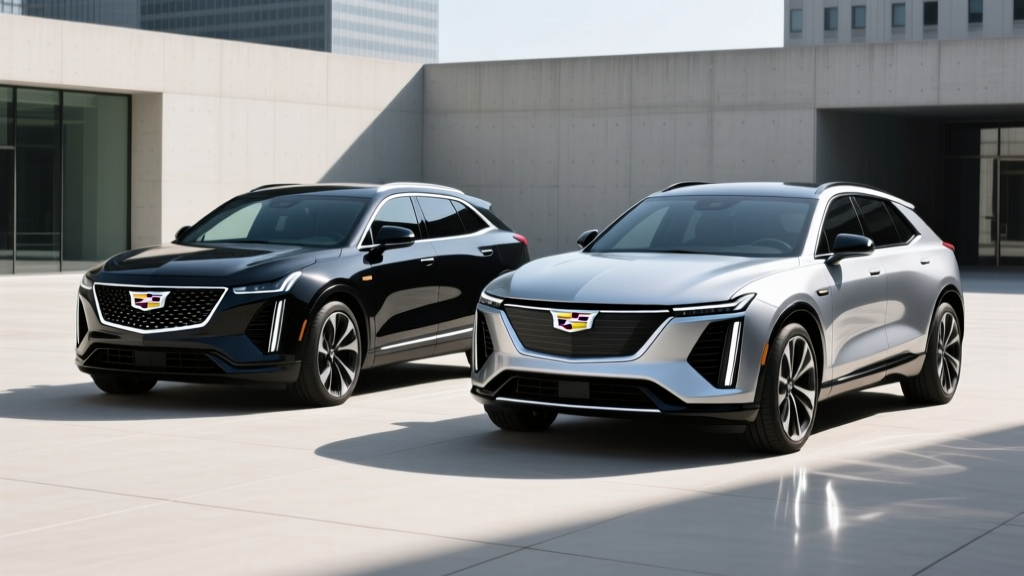
Quick Verdict: Two Cadillacs, Two Different Buyers
The 2026 Cadillac Lyriq and Vistiq share GM's Ultium platform and 102 kWh battery packs, but serve distinctly different needs. The Lyriq is a two-row luxury cruiser starting around $58,000, while the Vistiq adds a third row and family hauling capability at a $60,000+ entry point. Neither is universally "better" — the right choice depends on whether you prioritize range and efficiency, or passenger and cargo flexibility.
Side-by-Side Spec Comparison
| Specification | 2026 Cadillac Lyriq | 2026 Cadillac Vistiq |
|---|---|---|
| EPA Range (RWD/AWD) | 314 mi (RWD) / 307 mi (AWD) | ~300 mi (AWD) |
| Battery Capacity | 102 kWh (NMC) | 102 kWh (NMC) |
| DC Fast Charge (Peak) | 190 kW | 190 kW |
| 10-80% Charge Time | ~33 minutes | ~33 minutes |
| Level 2 Charge Rate | 19.2 kW | 19.2 kW |
| 0-60 mph | 4.6s (AWD) | ~5.5s (AWD, est.) |
| Horsepower | 500 hp (AWD) | ~500 hp (AWD) |
| Efficiency (MPGe) | 89 MPGe combined | ~85 MPGe combined (est.) |
| Cargo Volume (behind 2nd/3rd row) | 28 cu ft / 60.8 cu ft (max) | ~15 cu ft / ~45 cu ft / ~80 cu ft (max) |
| Seating Capacity | 5 passengers | 6-7 passengers |
| Base MSRP | ~$58,000 | ~$60,000 |
| Battery Warranty | 8 years / 100,000 miles | 8 years / 100,000 miles |
Range and Efficiency Winner: Lyriq
The Lyriq's lighter curb weight (approximately 5,700 lbs vs the Vistiq's estimated 6,000+ lbs) and more aerodynamic profile give it a measurable efficiency edge. At 89 MPGe combined versus the Vistiq's estimated 85 MPGe, the Lyriq costs roughly $50-75 less per year to charge for a driver covering 12,000 miles annually (assuming $0.15/kWh home electricity).
Both vehicles use the same 102 kWh Ultium battery pack with NMC (nickel manganese cobalt) chemistry. This chemistry offers high energy density but requires more careful thermal management than LFP alternatives. In our experience, preconditioning the battery before DC fast charging is essential — skip it and your peak charge rate may drop from 190 kW to 120-140 kW, adding 5-8 minutes to a 10-80% session.
Charging Speed: Tie (with caveats)
Both SUVs peak at 190 kW on DC fast chargers, delivering a 10-80% charge in approximately 33 minutes under optimal conditions. However, the charge curve matters more than peak numbers. Expect sustained rates of 150-170 kW through 50% State of Charge, tapering to 80-100 kW by 70%, and dropping sharply above 80%.
The 19.2 kW Level 2 onboard charger is among the fastest in the luxury EV segment. With a properly installed 100-amp circuit and hardwired wall connector, you'll add roughly 52 miles of range per hour of charging — enough to fully replenish either vehicle overnight on a standard 8-10 hour schedule.
Network compatibility note: Both vehicles use the CCS1 connector natively. While GM has committed to NACS (Tesla Supercharger) adoption, 2026 models may still require an adapter for Supercharger access. Verify current adapter availability and warranty coverage before relying on Tesla's network.
Performance: Lyriq's Edge
The Lyriq AWD's 500 horsepower and 4.6-second 0-60 time outpace the heavier Vistiq, which we estimate at 5.5 seconds to 60 mph. Both deliver confident passing power and smooth electric torque delivery, but the Lyriq feels noticeably more agile in urban driving and on winding roads.
Neither vehicle is a performance SUV in the Tesla Model X Plaid sense, but both offer more than adequate acceleration for daily driving. The Vistiq's additional weight is most noticeable during hard cornering and braking, where body roll and stopping distances increase modestly.
Interior Space and Practicality: Vistiq Wins
This is where the Vistiq justifies its existence. The third row accommodates adults on short trips and children comfortably on longer journeys. Behind the third row, you get approximately 15 cubic feet for groceries or strollers — tight but usable. Fold the third row and cargo space expands to roughly 45 cubic feet; fold both rear rows and you approach 80 cubic feet.
The Lyriq offers 28 cubic feet behind its second row and 60.8 cubic feet maximum. For couples or small families, this is generous. But if you regularly transport more than four people or need to haul cargo and passengers simultaneously, the Vistiq's flexibility is worth the range and efficiency trade-off.
Both interiors feature Cadillac's 33-inch LED display spanning the dashboard, premium materials, and available Super Cruise (Level 2 driver assistance on compatible highways). Super Cruise is impressive but requires driver attention — it's not autonomous driving.
Pricing and Tax Credit Considerations
Base Pricing (2026 Model Year)
- Lyriq Luxury RWD: ~$58,000 MSRP
- Lyriq Sport AWD: ~$63,000 MSRP
- Vistiq Luxury AWD: ~$60,000 MSRP
- Vistiq Sport AWD: ~$65,000 MSRP
Federal Tax Credit Eligibility (§30D)
Both vehicles are assembled in North America and may qualify for up to $7,500 in federal tax credits, but eligibility depends on:
- Buyer income caps: $150,000 single / $300,000 joint modified adjusted gross income
- MSRP caps: $80,000 for SUVs (both qualify)
- Battery sourcing requirements: Critical minerals and battery components must meet phased-in thresholds. Verify current-year compliance on IRS.gov before purchase.
- Point-of-sale transfer: You can transfer the credit to the dealer for an immediate price reduction, but this requires dealer participation and proper documentation.
Key insight: If both vehicles qualify for the full $7,500 credit, the effective price gap narrows. A Lyriq Luxury RWD drops to ~$50,500; a Vistiq Luxury AWD to ~$52,500. However, if battery sourcing rules disqualify certain trims or model years, the value equation shifts. Always confirm eligibility with your dealer and tax professional before committing.
Ownership Costs: Efficiency vs Insurance
Over five years and 60,000 miles, ownership costs diverge in predictable ways:
| Cost Category | Lyriq AWD | Vistiq AWD |
|---|---|---|
| Purchase Price (after $7,500 credit) | ~$55,500 | ~$57,500 |
| Electricity (60k miles @ $0.15/kWh) | ~$2,300 | ~$2,500 |
| Insurance (5-year estimate) | ~$12,000 | ~$13,500 |
| Maintenance (tires, cabin filter, fluid top-offs) | ~$1,800 | ~$2,000 |
| Depreciation (estimated) | ~$22,000 | ~$24,000 |
| 5-Year Total Cost | ~$93,600 | ~$99,500 |
The Vistiq's higher insurance premiums reflect its greater replacement cost and slightly higher repair complexity (third-row seating mechanisms, additional airbags). Depreciation estimates are preliminary — the Vistiq's newness means less historical data. Both vehicles benefit from lower maintenance costs than gas equivalents (no oil changes, fewer moving parts), but EV tire wear is 20-30% faster due to instant torque and heavier weight.
Decision Framework: Which Should You Choose?
Choose the Cadillac Lyriq if:
- You rarely carry more than four passengers
- Maximizing range and efficiency is a priority
- You prefer a more car-like driving experience
- You want the lowest total cost of ownership
- You don't need third-row seating or maximum cargo space
Choose the Cadillac Vistiq if:
- You regularly transport 5-7 people
- You need flexible cargo/passenger configurations
- You're willing to trade 10-20 miles of range for third-row utility
- Family hauling is a primary use case
- You value interior space over efficiency metrics
Real-World Charging and Range Considerations
Both vehicles face the same charging infrastructure realities. Home Level 2 charging is essential for convenient ownership — expect $800-2,000 for professional installation of a 100-amp circuit and hardwired wall connector (assuming your electrical panel has capacity; older homes may need a $1,500-3,000 panel upgrade).
On road trips, the 190 kW peak charge rate is competitive but not class-leading. Hyundai/Kia's E-GMP platform (Ioniq 5, EV6) peaks at 240 kW and delivers 10-80% in 18 minutes. For frequent long-distance travelers, this 15-minute difference per charge stop adds up.
Public charging reliability varies by network. Electrify America and EVgo offer widespread coverage but inconsistent uptime. Tesla Superchargers (with adapter) are more reliable but may not be available to GM vehicles in all regions by 2026. Plan routes using PlugShare or A Better Route Planner to verify charger availability and status.
Final Recommendation
The Lyriq is the more efficient, cost-effective choice for individuals and small families who prioritize range and driving dynamics. The Vistiq serves larger families and those who need third-row flexibility, accepting modest efficiency and cost penalties.
Neither vehicle is a compromise — both deliver premium interiors, strong performance, and competitive range. Your decision should hinge on passenger and cargo needs, not on which is objectively "better." Test drive both with your typical passenger load and cargo requirements. If you can't remember the last time you needed a third row, the Lyriq's efficiency and lower cost make it the smarter buy. If you're constantly juggling carpool duty and gear, the Vistiq's utility justifies its premium.
FAQ: Cadillac Vistiq vs Lyriq
Which has better range?
The Lyriq RWD achieves 314 miles EPA; the Vistiq AWD is estimated at ~300 miles. Real-world highway driving reduces both by 15-20%.
Do both qualify for the $7,500 federal tax credit?
Both may qualify, but eligibility depends on buyer income, battery sourcing compliance, and MSRP caps. Verify on IRS.gov before purchase.
Which charges faster?
Both peak at 190 kW with ~33-minute 10-80% times. Neither is class-leading — Hyundai/Kia platforms charge faster.
Is the Vistiq's third row usable for adults?
Adults fit on short trips, but the third row is best suited for children or occasional use. Long journeys favor the Lyriq's two-row comfort.
Which is cheaper to insure?
The Lyriq, by roughly $1,500 over five years, due to lower replacement cost and simpler repair complexity.
Can I use Tesla Superchargers with either vehicle?
GM has committed to NACS adoption, but 2026 models may require an adapter. Verify compatibility and warranty coverage before relying on Supercharger access.