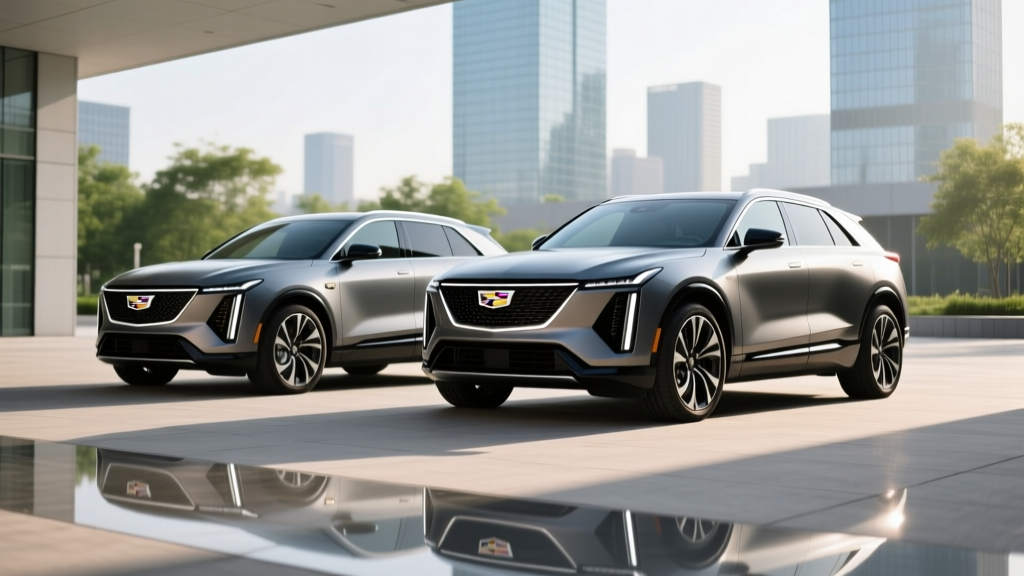
Cadillac's electric lineup now spans two distinct SUVs, and choosing between them requires more than a glance at the badge. The compact Cadillac Optiq arrives as an entry-level luxury EV aimed at urban buyers and younger households, while the midsize Cadillac Lyriq continues as the brand's flagship electric cruiser with more range, more cargo, and a higher price of entry. Both ride on variants of GM's Ultium platform, both offer the Super Cruise hands-free driving system, and both target the same luxury-EV shopper — but they solve very different problems.
This head-to-head breaks down the 2026 Optiq and Lyriq across range, charging, performance, pricing, tax-credit eligibility, and real-world ownership costs. The right choice depends entirely on your commute, your garage space, and whether you prioritize agility or long-haul comfort.
Side-by-Side Specs: Optiq vs Lyriq at a Glance
Before the deep dives, here are the numbers that matter most. All figures reflect 2026 model-year specifications for the most comparable trims (Optiq Luxury AWD vs. Lyriq Luxury AWD).
| Spec | 2026 Cadillac Optiq (AWD) | 2026 Cadillac Lyriq (AWD) |
|---|---|---|
| EPA Range | ~303 miles | ~314 miles |
| Battery (Usable) | ~85 kWh (NMC) | ~102 kWh (NMC) |
| Peak DC Fast Charge | ~150 kW | ~190 kW |
| 10–80% DC Charge Time | ~30 min | ~27 min |
| Level 2 AC Charge Rate | 11.5 kW | 19.2 kW |
| Horsepower | ~340 hp | ~500 hp |
| 0–60 mph | ~5.8 sec | ~4.6 sec |
| Efficiency (MPGe) | ~89 MPGe combined | ~89 MPGe combined |
| Cargo Volume (rear seats up) | ~26 cu ft | ~28 cu ft |
| Cargo Volume (rear seats folded) | ~52 cu ft | ~60 cu ft |
| Starting MSRP | ~$54,090 | ~$62,690 |
| Battery/Powertrain Warranty | 8 yr / 100,000 mi | 8 yr / 100,000 mi |
Sources: fueleconomy.gov, Cadillac official spec sheets. Real-world range typically runs 10–15% below EPA on sustained highway driving and drops further in cold weather below 32°F.
Range and Efficiency: How Far Can Each Really Go?
Optiq: EPA 303 mi → expect ~255–275 mi on a highway road trip at 70 mph; ~225–245 mi in freezing weather.
Lyriq: EPA 314 mi → expect ~265–285 mi highway; ~235–255 mi in freezing weather.
Both SUVs use NMC (nickel manganese cobalt) battery chemistry, which offers strong energy density but is more sensitive to extreme cold than LFP. Plan charging stops conservatively in winter.
The Lyriq's 102 kWh usable pack gives it a modest edge in total range, but both vehicles land in the ~300-mile EPA bracket — enough for most daily commutes and weekend trips without range stress. Efficiency is nearly identical at ~89 MPGe combined, which translates to roughly 33–35 kWh per 100 miles of driving.
Where the Lyriq pulls ahead is highway stamina. Its larger battery buffer means you'll arrive at a fast charger with more reserve, and you'll need fewer stops on a 500+ mile road trip. The Optiq's smaller footprint and lighter curb weight help it match the Lyriq's MPGe despite having fewer kilowatt-hours on board, but physics wins on long hauls: more stored energy means more miles between plugs.
Charging Speed and Network Access
Charging speed is where the Lyriq's larger platform shows a tangible advantage. Its 190 kW peak DC fast-charge rate (on a 350 kW-capable station) delivers a 10–80% session in roughly 27 minutes. The Optiq peaks closer to 150 kW, stretching that same session to about 30 minutes.
| Charging Level | Optiq | Lyriq |
|---|---|---|
| Level 1 (120V, 1.4 kW) | ~3–4 mi/hr | ~3–4 mi/hr |
| Level 2 (240V, home/public) | 11.5 kW → ~25 mi/hr | 19.2 kW → ~42 mi/hr |
| DC Fast Charge (peak) | ~150 kW → ~180 mi/hr peak | ~190 kW → ~220 mi/hr peak |
The bigger practical gap is Level 2 home charging. The Lyriq's 19.2 kW onboard charger is among the fastest in its class — it can fully replenish overnight on a 100-amp circuit (requires a hardwired Level 2 station and likely a panel upgrade). The Optiq's 11.5 kW charger is more typical and works fine on a standard 48-amp Level 2 circuit, which is easier and cheaper to install.
Network access: Both Cadillacs come with GM's Ultium Charge network access, which aggregates Electrify America, EVgo, ChargePoint, and others into a single app. Both also support the NACS (Tesla) connector via adapter or native port (2026 models are transitioning to native NACS). This gives both vehicles access to Tesla Superchargers — currently the most reliable DC fast-charging network in the U.S., per NHTSA and third-party reliability surveys.
Peak kW is not sustained kW. Both the Optiq and Lyriq hold their peak charge rate only up to roughly 50–55% State of Charge (SoC), then taper progressively. Above 80%, charging slows dramatically to protect the NMC cells. If you regularly need to charge past 80% on road trips, add 15–20 extra minutes to your stop.
Performance, Ride, and Driving Dynamics
The Lyriq AWD's 500 hp and 4.6-second 0–60 time make it the clear performance winner. It delivers confident highway merging, effortless passing, and a planted ride thanks to its longer wheelbase and adaptive damping (available on Sport and higher trims). It's a grand-touring EV, tuned for comfort over aggression.
The Optiq's 340 hp and 5.8-second 0–60 are hardly slow — that's quicker than most gas-powered luxury compacts — but the Optiq's real advantage is urban agility. Its shorter wheelbase and tighter turning radius make it noticeably easier to park, navigate tight city streets, and slot into compact garage spaces. If your daily drive involves congested downtown streets and parking structures, the Optiq feels more manageable day to day.
Both come standard with Super Cruise, GM's hands-free Level 2 driver-assistance system, which operates on over 750,000 miles of mapped roads in North America.
Super Cruise is a Level 2 system per SAE classification. It handles steering, acceleration, and braking on compatible highways, but the driver must remain attentive and ready to take over at any time. A driver-monitoring camera tracks your gaze. This is not autonomous driving — it's an advanced driver-assist feature.
Pricing, Tax Credits, and Total Purchase Cost
The Optiq's starting MSRP of ~$54,090 undercuts the Lyriq's ~$62,690 by roughly $8,600. That gap widens or narrows depending on trim, but the base-to-base difference is significant.
| Item | 2026 Optiq (Luxury AWD) | 2026 Lyriq (Luxury AWD) |
|---|---|---|
| Base MSRP | ~$54,090 | ~$62,690 |
| Federal §30D Credit (max) | Up to $7,500 | Up to $7,500 |
| Effective Price After Credit | ~$46,590 | ~$55,190 |
| MSRP Cap Eligible (SUV)? | Yes (SUV cap: $80,000) | Yes (SUV cap: $80,000) |
- MSRP cap: Vehicle must be under $80,000 for SUVs (both qualify).
- Buyer income cap: AGI must not exceed $150,000 (single), $225,000 (head of household), or $300,000 (joint).
- Battery sourcing: A percentage of critical minerals and battery components must be sourced from the U.S. or FTA partners. The credit splits into two halves ($3,750 each) — you may qualify for $3,750 or the full $7,500 depending on the specific build's supply chain.
- Point-of-sale transfer: You can transfer the credit to the dealer at purchase for an immediate price reduction, rather than waiting for tax filing.
- Assembly: Vehicle must undergo final assembly in North America (both Cadillacs qualify).
Source: IRS §30D Clean Vehicle Credit. Rules are subject to change — verify eligibility with a tax professional before purchasing. Credit amount depends on specific VIN battery sourcing.
The Optiq's lower MSRP makes it more likely to fall under the $80,000 cap even when optioned up. A fully loaded Lyriq Sport or Platinum trim can push past $70,000, still under the cap, but leaves less room for dealer add-ons or accessories without risking eligibility.
Ownership Costs: Efficiency, Insurance, and Maintenance
Both Cadillacs are similarly efficient at ~89 MPGe, so electricity costs per mile are nearly identical. At the U.S. average residential rate of ~$0.16/kWh, charging either vehicle costs roughly $0.05–$0.06 per mile — compared to $0.12–$0.15 per mile for a comparable gas-powered luxury SUV at $3.50/gallon.
Insurance is where costs diverge. The Lyriq's higher replacement value and more powerful drivetrain typically result in premiums 10–18% higher than the Optiq, based on early insurer data for the Ultium platform. Expect annual premiums of ~$2,200–$2,800 for the Lyriq vs. ~$1,900–$2,400 for the Optiq, depending on your state, driving record, and coverage levels.
Maintenance is minimal for both — no oil changes, no transmission fluid, no spark plugs. Expect cabin air filter replacements (~$50–$80 every 20,000 miles), tire rotations, and brake fluid checks. Regenerative braking significantly extends pad life. Budget ~$300–$500 per year for routine maintenance on either vehicle.
Tires are a notable EV ownership cost. Both SUVs are heavy (Optiq ~4,800 lbs, Lyriq ~5,700 lbs) and deliver instant torque, which accelerates tire wear. Expect to replace tires every 25,000–35,000 miles. The Lyriq uses larger, more expensive tires (~$300–$400 each vs. ~$250–$350 for the Optiq).
Category-by-Category Verdicts
EPA 314 mi vs. 303 mi. The Lyriq's larger 102 kWh pack provides a meaningful buffer on road trips and in cold weather. Edge goes to Lyriq.
190 kW peak vs. 150 kW, plus 19.2 kW Level 2 vs. 11.5 kW. The Lyriq charges faster at every level — if your home electrical panel can support it.
~$8,600 less at base MSRP, similar efficiency, same Super Cruise, same warranty. The Optiq delivers 90% of the experience for significantly less money.
500 hp and 4.6 sec 0–60 vs. 340 hp and 5.8 sec. The Lyriq AWD is a genuinely quick luxury SUV with effortless highway power.
Shorter wheelbase, tighter turning circle, easier to park. If you live in a city or deal with tight garages, the Optiq is the daily-driver pick.
60 cu ft max cargo vs. 52 cu ft, plus more rear legroom. Families hauling gear or car seats will appreciate the extra room.
Both feature Cadillac's 33-inch LED display, Google Built-in, and Super Cruise. The Lyriq offers more premium materials on upper trims, but the core tech is shared.
11.5 kW charger works on a standard 48-amp circuit (~$500–$1,200 install). The Lyriq's 19.2 kW charger needs a 100-amp circuit, often requiring a panel upgrade ($1,500–$3,000+).
Pros and Cons at a Glance
- Lower entry price (~$54K MSRP)
- Easier/cheaper home charging install
- Better urban maneuverability
- Same core tech and Super Cruise
- Qualifies for full §30D credit with room under MSRP cap
- Less total range (303 mi EPA)
- Slower DC and Level 2 charging
- Less cargo and rear-seat space
- Less powerful (340 hp)
- More range (314 mi EPA) and road-trip stamina
- Faster DC and Level 2 charging
- 500 hp, 4.6-sec 0–60
- More cargo and passenger room
- More premium feel on upper trims
- Higher price (~$62.7K+ MSRP)
- Costlier home charging install (panel upgrade likely)
- Higher insurance premiums
- Larger footprint — harder in tight urban spaces
- Heavier — faster tire wear
Decision Framework: Which Cadillac EV SUV Should You Buy?
- Your budget is closer to $50K–$58K and you want to maximize value after the federal credit.
- You primarily drive in urban or suburban environments with a commute under 60 miles round-trip.
- Your home electrical panel is 100–150 amps and you want to avoid a costly panel upgrade for Level 2 charging.
- You don't regularly take road trips over 300 miles or haul large cargo.
- You want Cadillac luxury, Super Cruise, and Ultium platform reliability at the lowest entry price.
- You regularly take road trips of 300+ miles and want maximum range and charging speed between stops.
- You need more rear-seat room for car seats or adult passengers, or more cargo space for gear.
- You value brisk acceleration (500 hp, 4.6 sec 0–60) and a grand-touring ride quality.
- Your home electrical panel can support a 100-amp circuit (or you're willing to invest in an upgrade).
- You're willing to pay ~$8,600+ more for the extra range, power, and space.
Frequently Asked Questions
Do both the Optiq and Lyriq qualify for the full $7,500 federal tax credit?
Both vehicles meet the MSRP cap (under $80,000 for SUVs) and North American assembly requirements. However, the actual credit amount — $3,750 or $7,500 — depends on the specific VIN's battery component and critical mineral sourcing percentages, which can vary by build date. The buyer must also meet IRS income caps ($150K single / $300K joint). Always verify the credit for your specific VIN at the point of sale and consult IRS guidance or a tax professional.
Which is cheaper to own over 5 years?
The Optiq wins on total cost of ownership for most buyers. Lower purchase price, lower insurance premiums, cheaper tire replacements, and a less expensive home charging setup add up to roughly $8,000–$12,000 in savings over five years compared to a similarly equipped Lyriq, assuming comparable mileage and electricity rates.
Can I use Tesla Superchargers with either vehicle?
Yes. 2026 Cadillacs are transitioning to the native NACS (North American Charging Standard) port. Vehicles with the older CCS port can use a GM-approved NACS adapter to access Tesla Superchargers. Both methods give you access to Tesla's network, which remains the most reliable DC fast-charging network in the U.S.
Is the Optiq just a smaller Lyriq, or is it a different vehicle?
The Optiq rides on a shorter wheelbase variant of GM's Ultium platform. It shares core architecture, battery chemistry (NMC), infotainment, and Super Cruise hardware with the Lyriq, but the body, interior dimensions, suspension tuning, and battery pack size are distinct. Think of it as a sibling, not a clone.
How long will the battery last in either vehicle?
Both are covered by GM's 8-year/100,000-mile battery warranty, which guarantees the pack will retain at least 70% of its original capacity. NMC batteries in the Ultium platform have shown degradation of roughly 5–8% over the first 100,000 miles based on early fleet data. With proper care (avoiding frequent 100% charges, using preconditioning for DC fast charging), most owners should see 85–90% capacity retention at 100,000 miles.
Which has better resale value?
Early data is limited for the Optiq (newer model). The Lyriq has held value comparably to other luxury EV SUVs, though EV depreciation remains higher than gas equivalents due to rapid tech advancement and battery concerns. Both benefit from Cadillac's brand cachet and the Ultium platform's service network.