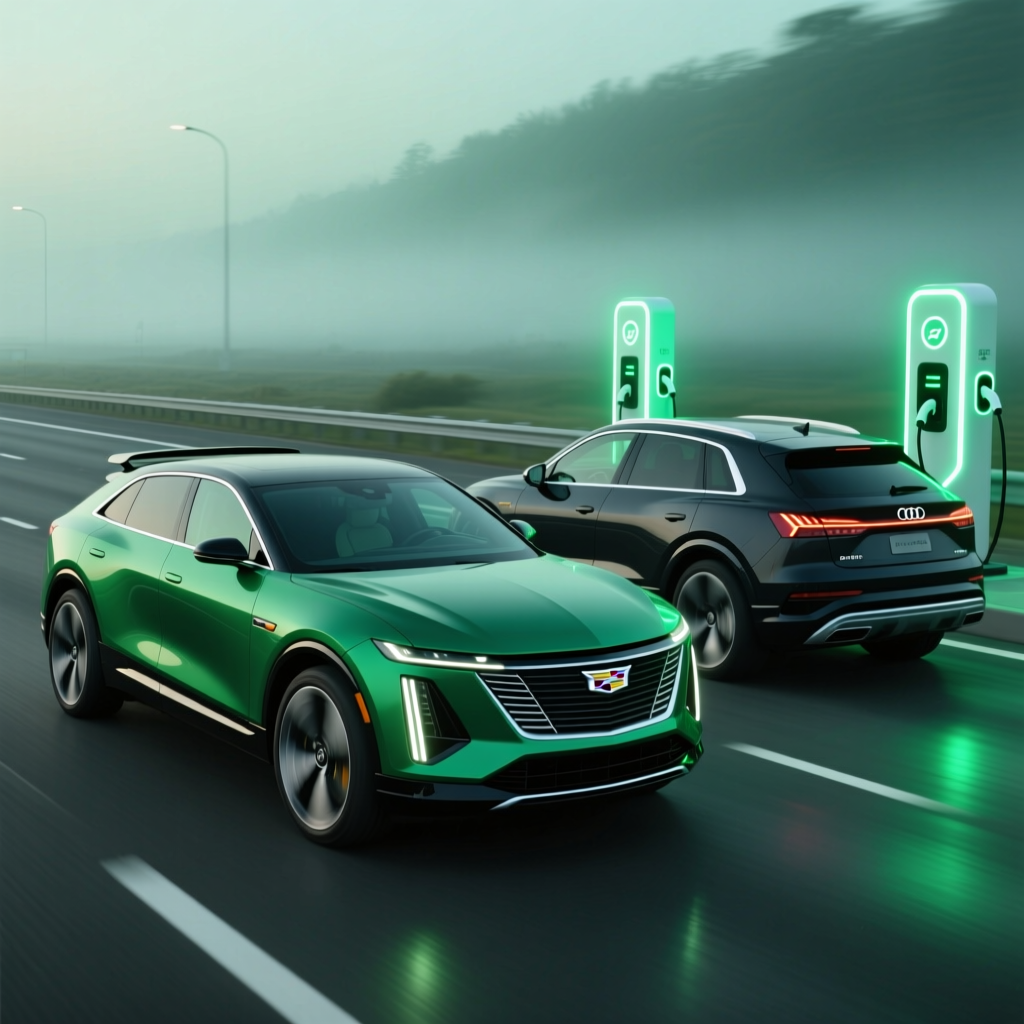
The luxury midsize electric SUV segment is a fiercely competitive battleground where contrasting automotive philosophies collide. On one side, we have the Cadillac Lyriq, a striking American cruiser built on General Motors’ dedicated Ultium battery platform that prioritizes head-turning design, massive screens, and hands-free driving technology. On the other side sits the Audi Q8 e-tron, a masterclass in German engineering that offers a refined, whisper-quiet cabin, standard air suspension, and traditional luxury ergonomics.
Choosing between these two premium electric vehicles (EVs) is not just about comparing specs; it is about deciding what kind of luxury experience you value most. Do you prefer the bold, tech-forward statement of the Cadillac, or the understated, dynamically superior ride of the Audi? In this comprehensive head-to-head comparison, we break down range, pricing, charging speeds, performance, interior space, and technology to help you decide which midsize electric SUV deserves a spot in your driveway.
For a deeper dive into each vehicle individually, be sure to read our full Cadillac Lyriq review and our detailed Audi Q8 e-tron review.
Side-by-Side Spec Comparison
Before diving into the nuances of daily driving and ownership, let us look at the core specifications that define these two midsize luxury EVs. Note that specifications can vary slightly based on trim levels and wheel options.
| Feature | Cadillac Lyriq | Audi Q8 e-tron |
|---|---|---|
| Battery Capacity (Usable) | ~102 kWh | ~106 kWh |
| EPA Range (Max) | Up to 314 miles (RWD) | Up to 300 miles (Sportback) |
| Horsepower | 340 hp (RWD) / 500 hp (AWD) | 402 hp (496 hp w/ Boost) |
| Torque | 325 lb-ft (RWD) / 450 lb-ft (AWD) | 490 lb-ft |
| 0-60 mph | ~6.3s (RWD) / ~4.6s (AWD) | ~5.1s (4.5s w/ Boost) |
| Max DC Fast Charging | 190 kW | 170 kW |
| Cargo Space (Behind Rear Seats) | 28.0 cu-ft | 28.5 cu-ft (SUV) / 24.8 cu-ft (Sportback) |
| Drivetrain | RWD standard, AWD optional | Quattro AWD standard |
Range and Efficiency
Range anxiety is a primary concern for EV buyers, and both automakers offer robust battery packs to mitigate those fears. The Cadillac Lyriq utilizes a 102 kWh usable battery pack. When equipped with rear-wheel drive (RWD) and smaller wheels, the EPA rates the Lyriq at an impressive 314 miles of range. Opting for all-wheel drive (AWD) drops that figure slightly to around 307 miles. Independent 75-mph highway range tests conducted by major automotive publications frequently show the Lyriq exceeding its EPA estimates in real-world conditions, a testament to its aerodynamic profile and efficient Ultium battery chemistry.
The Audi Q8 e-tron features a larger 114 kWh gross battery pack (with roughly 106 kWh usable). Despite the larger battery, the Q8 e-tron is a heavier vehicle with a more traditional, boxy SUV shape. The standard SUV body style achieves an EPA-estimated 285 miles of range, while the sleeker Sportback variant pushes that number to 300 miles. While the Audi falls slightly short of the Cadillac in maximum range, 285 to 300 miles is more than sufficient for daily commuting and moderate road trips.
In terms of efficiency (miles per kWh), the Cadillac Lyriq holds a distinct advantage. Its lighter curb weight and more aggressive aerodynamic tuning allow it to sip electrons more conservatively on the highway. If maximizing miles between charges is your top priority, the Lyriq is the clear winner in this segment. For more efficient options, check out our rankings of the best electric SUVs on the market.
Pricing and Value Proposition
When it comes to pricing, the Cadillac Lyriq and Audi Q8 e-tron target slightly different tiers of the luxury market, making value a major differentiator. The Lyriq generally starts in the upper $50,000 range for its base Luxury trim. Even at this entry-level price point, Cadillac includes a massive 33-inch LED display, a 19-speaker AKG audio system, and access to GM’s Super Cruise hands-free driving technology. Fully loaded Lyriq models top out in the low-to-mid $70,000 range, which is remarkably competitive for a vehicle of its size and tech density.
The Audi Q8 e-tron, conversely, commands a premium that reflects its German luxury badge and standard mechanical hardware. Starting prices typically hover in the mid-$70,000 range for the Premium trim. However, to unlock the Audi’s best features—such as the Prestige package, massaging seats, virtual digital mirrors, and advanced driver assistance systems—the price can easily swell into the high $80,000s or even cross the $90,000 threshold.
From a pure value perspective, the Cadillac Lyriq is the undisputed champion. It offers more standard range, more standard screens, and advanced semi-autonomous driving tech for thousands of dollars less than a similarly equipped Audi. The Q8 e-tron justifies its higher price tag with superior standard mechanicals (like air suspension) and a more prestigious badge, but budget-conscious luxury buyers will find the Lyriq much easier to swallow.
Charging Speed and Infrastructure
Fast charging capabilities dictate how viable an EV is for long-distance travel. The Cadillac Lyriq boasts a peak DC fast-charging rate of 190 kW. Under ideal conditions, Cadillac claims the Lyriq can add 76 miles of range in just 10 minutes, and charge from 10% to 80% in approximately 30 minutes. While 190 kW is respectable, it is not class-leading, and the Lyriq’s charging curve tends to taper off earlier than some competitors as the battery fills up.
The Audi Q8 e-tron has a slightly lower peak charging rate of 170 kW. However, peak numbers do not tell the whole story. Audi has engineered an incredibly flat and sustainable charging curve. The Q8 e-tron can sustain near-peak charging speeds for a much longer portion of the session, meaning a 10% to 80% charge also takes roughly 31 minutes. In real-world highway charging scenarios, the Audi often matches or beats competitors with higher peak numbers because it does not prematurely throttle the charging speed to protect the battery.
For Level 2 home charging, the Lyriq supports up to 19.2 kW (with the right home wall connector and electrical panel), allowing for a full overnight charge in roughly 5.5 hours. The Q8 e-tron comes standard with an 11.5 kW onboard charger, though a 19.2 kW charger is available as an option. Both vehicles are transitioning to the North American Charging Standard (NACS), granting them native access to the expansive Tesla Supercharger network via adapters or native ports on newer builds, vastly improving the road-trip experience for both SUVs.
Performance and Driving Dynamics
The driving experiences of these two SUVs are as different as their exterior designs. The Cadillac Lyriq is fundamentally a grand tourer. The standard RWD setup produces 340 horsepower, delivering smooth, linear acceleration that is perfectly adequate for highway merging and city driving. The optional AWD version bumps output to 500 horsepower, dropping the 0-60 mph time to a brisk 4.6 seconds. However, the Lyriq’s suspension tuning prioritizes isolation and comfort over corner-carving dynamics. It floats over bumps but can feel somewhat boat-like when pushed hard on winding roads.
The Audi Q8 e-tron is a showcase of Volkswagen Group’s engineering prowess. Standard Quattro AWD provides 402 horsepower, with a temporary boost function unlocking 496 horsepower and a 4.5-second 0-60 mph sprint. Where the Audi truly shines is in its ride quality and handling. Thanks to standard adaptive air suspension, the Q8 e-tron effortlessly absorbs harsh road imperfections while keeping the heavy battery pack tightly controlled in corners. The steering is precise, the cabin is remarkably devoid of wind and road noise, and the overall sense of dynamic refinement is a step above the Cadillac.
If you want a relaxed, isolated highway cruiser, the Lyriq is fantastic. But if you appreciate German chassis tuning, air suspension, and a vehicle that feels planted and composed at high speeds, the Audi Q8 e-tron is the superior driver’s vehicle.
Interior Space, Comfort, and Cargo
Both vehicles offer spacious, premium cabins capable of comfortably seating five adults, but they approach luxury from different angles. The Cadillac Lyriq features a modern, almost avant-garde interior design. The dashboard is dominated by lighting and screens, creating a lounge-like atmosphere. Rear legroom is generous, and the flat floor (thanks to the dedicated EV platform) makes the middle seat usable for shorter trips. Cargo space is rated at 28.0 cubic feet behind the second row, expanding to 60.8 cubic feet with the seats folded.
The Audi Q8 e-tron interior is a masterclass in traditional, tactile luxury. The materials—from the open-pore woods to the diamond-stitched leather and cold-rolled aluminum—feel incredibly substantial. The physical buttons and haptic touchscreens provide a satisfying, high-end user experience. Cargo capacity in the standard SUV body style is slightly larger at 28.5 cubic feet, expanding to 56.4 cubic feet with the rear seats folded. The Sportback variant sacrifices a bit of cargo height for its sloping roofline.
While the Lyriq offers a more futuristic and spacious-feeling cabin, the Audi wins on material quality, tactile feedback, and traditional luxury craftsmanship. Both vehicles excel in acoustic isolation, making them excellent choices for buyers who prioritize a quiet commute.
Technology and Infotainment
Technology is where the Cadillac Lyriq makes its loudest statement. The centerpiece is a massive 33-inch advanced LED display that seamlessly integrates the instrument cluster and infotainment screen into one curved pane of glass. It runs on Google Built-in, offering native Google Maps navigation, Google Assistant voice control, and access to the Play Store. Furthermore, the Lyriq offers GM’s acclaimed Super Cruise technology. On compatible mapped highways, Super Cruise allows for true hands-free driving, utilizing a driver-attention camera to ensure you are keeping your eyes on the road. It is one of the best and most reliable semi-autonomous systems on the market.
Audi takes a more conservative, ergonomic approach. The Q8 e-tron utilizes a dual-touchscreen MMI setup embedded in the center stack, paired with the excellent Virtual Cockit digital gauge cluster and an available head-up display. The haptic feedback on the screens mimics the feel of physical buttons, reducing the need to look away from the road. However, Audi lacks a true hands-free highway driving system comparable to Super Cruise; its adaptive cruise control requires the driver to keep their hands on the wheel.
For tech enthusiasts who want the biggest screens and the best hands-free driving aids, the Lyriq is the clear choice. For those who prefer intuitive ergonomics, excellent heads-up displays, and a less distracting interface, the Audi is the better fit. Explore more tech-heavy options in our guide to the best luxury EVs.
Warranty and Ownership Costs
Ownership costs extend beyond the sticker price, and warranties play a vital role in long-term peace of mind. The Cadillac Lyriq comes with a 4-year/50,000-mile basic warranty, a 6-year/70,000-mile powertrain warranty, and an 8-year/100,000-mile battery warranty. GM also frequently includes complimentary scheduled maintenance and OnStar connectivity for the first few years of ownership.
The Audi Q8 e-tron offers a 4-year/50,000-mile basic warranty and an 8-year/100,000-mile battery warranty. Audi typically includes complimentary scheduled maintenance for the first year or 10,000 miles. Insurance premiums for the Audi tend to be slightly higher due to its higher replacement costs and premium parts, while the Lyriq benefits from GM’ widespread domestic parts network. Depreciation is a factor for all luxury EVs, but the Lyriq’s lower entry price helps soften the initial financial blow compared to the Audi.
The Verdict: Which Midsize EV Should You Buy?
The choice between the Cadillac Lyriq and the Audi Q8 e-tron ultimately comes down to your personal definition of luxury and your budget.
Buy the Cadillac Lyriq if: You want the best value for your money. The Lyriq offers exceptional range, striking exterior styling, a massive curved display, and industry-leading Super Cruise hands-free technology, all for a significantly lower starting price than the Audi. It is the perfect choice for tech-forward buyers who prioritize highway comfort and cutting-edge design.
Buy the Audi Q8 e-tron if: You are a traditional luxury buyer who values build quality, driving dynamics, and prestige. The Q8 e-tron’s standard air suspension, whisper-quiet cabin, and superior chassis tuning make it a joy to drive. It is the ideal vehicle for those who want a refined, understated luxury experience and do not mind paying a premium for German engineering.
Frequently Asked Questions
Is the Cadillac Lyriq bigger than the Audi Q8 e-tron?
They are very closely matched in overall footprint, as both are midsize luxury SUVs. The Cadillac Lyriq is slightly longer and has a longer wheelbase, which translates to excellent rear-seat legroom. However, the Audi Q8 e-tron is slightly wider and offers a fractionally larger cargo area in its standard SUV body style. Both comfortably seat five adults.
Which SUV has better hands-free driving technology?
The Cadillac Lyriq wins this category decisively. GM’s Super Cruise allows for true hands-free driving on hundreds of thousands of miles of compatible divided highways across North America. The Audi Q8 e-tron offers excellent adaptive cruise control and lane-centering assist, but it still requires the driver to keep their hands on the steering wheel at all times.
Can the Audi Q8 e-tron and Cadillac Lyriq use Tesla Superchargers?
Yes. Both General Motors and Audi have committed to the North American Charging Standard (NACS). Depending on the production date of the vehicle, owners can access the Tesla Supercharger network using an official adapter, or via a native NACS charge port on newer models. This vastly improves the road-trip viability of both SUVs.
Which vehicle holds its value better?
Luxury EVs generally experience steeper depreciation curves than their gas-powered counterparts. However, the Cadillac Lyriq often retains its value slightly better in percentage terms simply because its initial purchase price is much lower than the Audi Q8 e-tron. The Audi’s higher starting MSRP and expensive optional packages mean it has more financial room to depreciate in the first three years of ownership.