Quick Answer: The 2026 Cadillac electric vehicle lineup consists of three models: the Lyriq midsize SUV (EPA range up to 314 miles, starting at $49,990), the Optiq compact SUV (EPA range up to 302 miles, starting at $53,990), and the flagship Escalade IQ (EPA range up to 460 miles, starting at $129,990). All three use GM's Ultium battery platform with NMC chemistry. Only the Lyriq potentially qualifies for a partial federal tax credit under current IRS §30D rules; the Optiq and Escalade IQ exceed MSRP caps or fall short on battery-sourcing thresholds. Buyers should prioritize home Level 2 charging access and understand that real-world highway and cold-weather range will run 15–25% below EPA stickers.
The 2026 Cadillac EV Lineup at a Glance
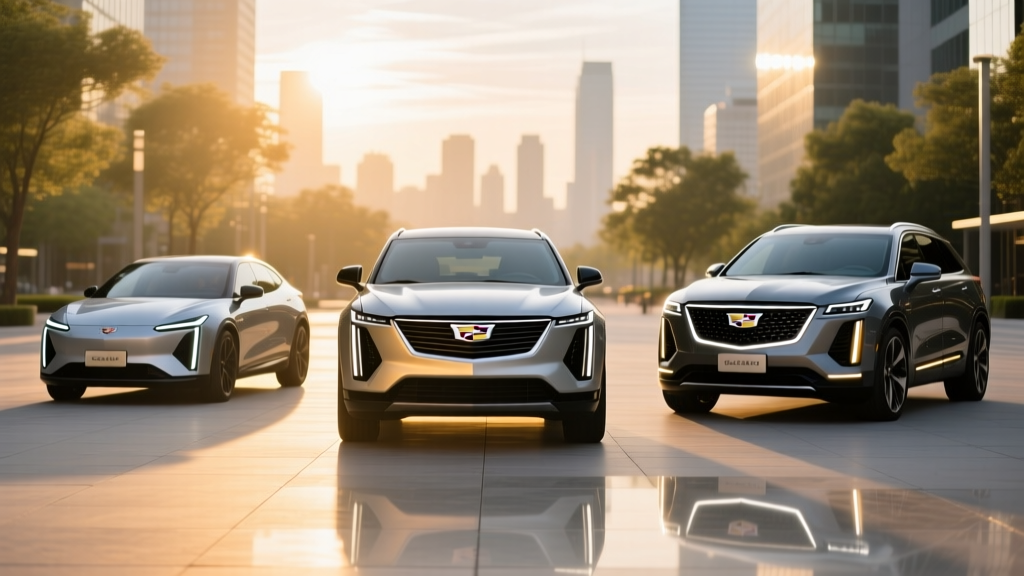
Cadillac's transition to an all-electric portfolio is nearly complete. For the 2026 model year, the brand offers three distinct battery-electric vehicles built on General Motors' Ultium platform, each targeting a different buyer segment and budget tier. Here is how they stack up on the numbers that matter most.
| Specification | Lyriq (AWD) | Optiq (AWD) | Escalade IQ (AWD) |
|---|---|---|---|
| Base MSRP | $49,990 | $53,990 | $129,990 |
| EPA Range (max config) | 314 mi | 302 mi | 460 mi |
| Battery (usable) | 102 kWh, NMC | 85 kWh, NMC | 200+ kWh, NMC |
| Peak DC Fast Charge | 190 kW | 150 kW | 350 kW (800V) |
| 10–80% DC Charge Time | ~33 min | ~34 min | ~20 min |
| Level 2 Charge Rate | 19.2 kW | 19.2 kW | 19.2 kW |
| Horsepower | 500 hp | 420 hp | 750 hp |
| 0–60 mph | 4.6 sec | 5.0 sec (est.) | 3.5 sec (est.) |
| MPGe (combined) | 89 MPGe | 91 MPGe (est.) | 69 MPGe (est.) |
| Battery Warranty | 8 yr / 100,000 mi | 8 yr / 100,000 mi | 8 yr / 100,000 mi |
| Federal Tax Credit (§30D) | Partial eligibility | Unlikely | Ineligible (MSRP cap) |
All three models come standard with all-wheel drive for 2026 and feature GM's Super Cruise Level 2 driver-assistance system on compatible mapped roads. The Lyriq is the volume seller and the most practical entry point; the Optiq is a newer, slightly smaller crossover aimed at urban professionals; and the Escalade IQ is a luxury flagship that competes directly with the Mercedes EQS SUV and Rivian R1S at the top of the market.
Range, Charging, and Real-World Ownership Costs
EPA range numbers provide a useful baseline, but they do not reflect the daily driving experience. Cold temperatures, sustained highway speeds above 70 mph, and aggressive acceleration all reduce range. Here is what Cadillac buyers should realistically expect.
Real-World Range Expectations:
- Lyriq AWD: EPA 314 mi → Expect ~250–275 mi on highway trips at 75 mph; ~220–240 mi in sub-freezing weather.
- Optiq AWD: EPA 302 mi → Expect ~240–265 mi highway; ~210–230 mi in cold conditions.
- Escalade IQ: EPA 460 mi → Expect ~370–400 mi highway; the massive battery provides a larger buffer but also longer charge times at lower-power stations.
Charging Speed and Infrastructure
The Lyriq and Optiq use a 400-volt architecture, which caps DC fast charging at 190 kW and 150 kW respectively. The Escalade IQ's 800-volt system enables peak charging up to 350 kW on compatible chargers — though sustained rates taper significantly above 80% state of charge. At a typical 150 kW Electrify America or EVgo station, the Lyriq will add roughly 140 miles in 20 minutes. The Escalade IQ, on a 350 kW-capable stall, can recover over 200 miles in the same window.
For home charging, all three accept up to 19.2 kW on Level 2 (requiring a hardwired wall connector on a 100-amp circuit). On a more common 48-amp / 11.5 kW home charger, plan for 9–11 hours to fully replenish the Lyriq's battery from near-empty. Most owners who charge nightly will rarely need a full 0–100% cycle.
| Cost Factor | Lyriq AWD (EV) | Cadillac XT5 AWD (Gas Baseline) |
|---|---|---|
| Base MSRP | $49,990 | $48,990 |
| Fuel/Energy Cost per Mile | ~$0.045 (home L2, $0.14/kWh) | ~$0.15 (premium, 24 mpg comb., $3.60/gal) |
| Annual Energy Cost (12,000 mi) | ~$540 | ~$1,800 |
| 5-Year Energy Cost | ~$2,700 | ~$9,000 |
| Estimated 5-Year Maintenance | ~$1,200 | ~$3,500 |
| 5-Year Insurance (avg.) | ~$12,500 | ~$9,800 |
| 5-Year Total Operating Cost | ~$16,400 | ~$22,300 |
Sources: fueleconomy.gov, AAA Your Driving Costs 2025. Insurance estimates via AAA average; individual rates vary significantly by state, age, and driving record.
The Lyriq saves roughly $5,900 in operating costs over five years compared to the gas XT5. However, higher insurance premiums — typical for EVs due to repair costs and battery replacement risk — eat into those savings. The purchase-price gap is minimal, making the Lyriq compelling for buyers who can charge at home and drive moderate daily distances.
Federal Tax Credit and Incentive Reality
The IRS §30D clean vehicle credit remains one of the most confusing aspects of buying an EV in 2026. Here is the current landscape for Cadillac's lineup:
§30D Federal Tax Credit Requirements (2026):
- MSRP Cap: SUVs must be ≤$80,000; sedans ≤$55,000. The Escalade IQ ($129,990 base) is ineligible.
- Buyer Income Cap: AGI ≤$150,000 (single), ≤$225,000 (head of household), ≤$300,000 (joint).
- Battery Sourcing: Critical minerals and battery components must meet escalating domestic/free-trade thresholds. GM has made progress on North American sourcing, but partial compliance may reduce the credit from $7,500 to $3,750 for some trims.
- Point-of-Sale Transfer: Eligible buyers can apply the credit as an upfront dealer discount rather than waiting for a tax refund.
- Commercial Lease Loophole: Leased EVs may qualify for a $7,500 commercial credit (§45W) passed through as a lease incentive, regardless of MSRP or buyer income caps. Ask your dealer about lease-specific pricing.
Always verify current eligibility at irs.gov and consult a tax professional before purchasing. Battery sourcing requirements tighten annually.
For the Lyriq, buyers who meet income requirements and purchase (rather than lease) may qualify for $3,750 to $7,500 depending on the specific battery pack's mineral sourcing in their delivery batch. The Optiq's eligibility is uncertain — its MSRP falls under the SUV cap, but battery-sourcing compliance has not been fully confirmed for all configurations. The Escalade IQ is firmly above the MSRP ceiling, though leasing may unlock the commercial credit.
Cadillac EV vs. Gas and Hybrid Alternatives
Not every Cadillac buyer is ready to go fully electric. Here is how the EV lineup compares to the brand's remaining gas and hybrid options on the metrics that drive purchase decisions.
| Factor | Lyriq (BEV) | XT5 (Gas) | XT6 (Gas) |
|---|---|---|---|
| Powertrain | Dual-motor AWD, 500 hp | 2.0T I4, 235 hp | 2.0T I4, 235 hp |
| EPA Efficiency | 89 MPGe | 24 mpg combined | 23 mpg combined |
| Range / Tank | 314 mi (EPA) | ~410 mi (19.5 gal tank) | |
| "Refuel" Time | ~33 min (10–80% DC) | ~5 min (gas station) | |
| Home "Refuel" Convenience | Plug in nightly, wake up full | N/A — must visit station | |
| Cargo Volume | 28.0 cu ft (behind 2nd row) | 22.5 cu ft | 12.6 cu ft (all rows up) |
| Towing Capacity | 1,500 lbs | 1,000 lbs | 4,000 lbs |
The Lyriq offers significantly more power, better cargo space, and far lower per-mile energy cost than the XT5. However, the XT5 wins on refueling speed for road-trip-heavy drivers and on towing if you need more than 1,500 pounds. The three-row XT6 remains gas-only and is the choice for buyers who need six or seven seats — the Lyriq and Optiq are strictly two-row, five-passenger vehicles.
For buyers still hesitant about full electrification but wanting lower fuel costs, Cadillac does not currently offer a plug-in hybrid (PHEV) in the U.S. market. The closest alternative is the Chevy Equinox EV on the same Ultium platform at a lower price point, or looking at competitors like the BMW X5 xDrive50e PHEV (38 miles electric-only range, 56 MPGe).
What First-Time Cadillac EV Buyers Must Know
Transitioning from a gas Cadillac to an electric one involves practical adjustments that go beyond the showroom. Address these before signing a purchase agreement.
Home Charging Access Is Non-Negotiable for Most Owners
Public DC fast charging works for road trips, but daily EV ownership depends on Level 2 home charging. A 48-amp Level 2 charger (such as the ChargePoint Home Flex or Emporia V2) installed on a 60-amp circuit adds roughly 30–35 miles of range per hour of charging — enough to fully replenish overnight for most commutes. Budget $500–$800 for the charger unit and $800–$2,500 for professional installation by a licensed electrician, depending on your panel capacity and run length. If your home has a 100-amp main panel, a panel upgrade to 200 amps may be required, adding $1,500–$3,000.
Apartment and Condo Charging Challenges
If you lack a garage or dedicated parking with electrical access, EV ownership becomes significantly harder. Workplace charging can supplement but not replace home charging for most drivers. Before buying, confirm that your building allows charger installation or that reliable public Level 2 stations are within walking distance. Relying solely on DC fast charging is expensive ($0.30–$0.50/kWh at public stations vs. $0.12–$0.16/kWh at home) and adds wear to the battery over time.
Cold Climate Considerations
All three Cadillac EVs use liquid-cooled and heated NMC battery packs with thermal preconditioning. In sustained sub-20°F weather, expect 20–30% range reduction due to cabin heating demands and reduced battery efficiency. The Lyriq's heat pump (standard on 2026 models) mitigates this compared to resistive heating, but cold-weather range loss is a fact of EV physics, not a Cadillac-specific flaw. Preconditioning the battery while plugged in — using scheduled departure times — preserves range and enables faster DC charging in cold conditions.
| Common Misconception | Fact |
|---|---|
| "Cadillac EV batteries need replacing after 5 years." | GM's Ultium batteries carry an 8-year/100,000-mile warranty guaranteeing ≥70% capacity retention. Real-world data from early Lyriq owners shows ~3–5% degradation after 30,000 miles. Full replacement, if ever needed, is estimated at $12,000–$18,000 depending on pack size. |
| "Super Cruise is self-driving." | Super Cruise is an SAE Level 2 system. It handles steering, acceleration, and braking on pre-mapped divided highways, but the driver must remain attentive. An infrared camera monitors eye gaze and will issue escalating warnings — then disengage — if you look away. |
| "I can charge at any public station." | Cadillac EVs use the NACS (Tesla-style) connector as standard for 2026. This grants access to Tesla Superchargers (with adapter for older CCS vehicles) as well as Electrify America and EVgo stations that have added NACS cables. CHAdeMO stations are not compatible. |
| "EVs cost more to own overall." | Over 5 years, the Lyriq's lower fuel and maintenance costs offset its slightly higher insurance and purchase price, resulting in lower total operating cost than the gas XT5 — provided you charge primarily at home. |
Decision Framework: Which Cadillac EV Is Right for You?
Choose the Lyriq if:
- You want the best value in the lineup with strong range (314 mi EPA) and a sub-$50K starting price.
- Your daily commute is under 80 miles and you have home Level 2 charging.
- You want to potentially capture a partial federal tax credit.
- You need a spacious two-row SUV with 28 cu ft of cargo volume and a frunk.
Choose the Optiq if:
- You prefer a more compact footprint for city driving and tighter parking.
- You want Cadillac's latest interior tech (33-inch LED dash display standard) in a smaller package.
- Budget flexibility exists above $53,000 and you do not need three rows or maximum towing.
Choose the Escalade IQ if:
- Budget is secondary to flagship luxury, 750 hp, and 460 miles of range.
- You need three-row seating with genuine adult space in the third row.
- You want 800-volt fast charging (350 kW peak) for long road trips with minimal downtime.
- You are comfortable with no federal purchase tax credit (lease may offer alternative savings).
Stick with a gas Cadillac (XT5/XT6) if:
- You cannot install home Level 2 charging and lack reliable workplace or public charging.
- You regularly tow more than 1,500 pounds.
- You drive in extreme cold (below -10°F) for extended periods and cannot tolerate range reduction.
- Your annual mileage exceeds 25,000 miles and road-trip charging downtime is unacceptable.
Super Cruise and Driver Assistance: What It Can and Cannot Do
SAE Automation Level: Level 2 (Partial Driving Automation)
Super Cruise is not autonomous driving. The system controls steering, throttle, and braking on over 750,000 miles of compatible divided highways in the U.S. and Canada. The driver must remain engaged and eyes-forward at all times. Hands-free operation is permitted only when the system confirms driver attention via the infrared steering-column camera. This is fundamentally different from SAE Level 4 robotaxi services like Waymo, which operate without any human driver in geofenced urban zones.
All three 2026 Cadillac EVs come with Super Cruise availability (included on higher trims, optional or subscription-based on base trims after an initial trial period). The system excels on long interstate drives, reducing fatigue significantly. However, it does not handle city streets, construction zones, unmapped roads, or adverse weather conditions where lane markings are obscured. Think of it as an advanced cruise control with lane-centering — remarkably good at what it does, but absolutely not a replacement for an attentive driver.
Super Cruise Limitations:
- Does not operate on non-divided roads, surface streets, or unmapped routes.
- Disengages in heavy rain, snow, or fog when sensors are impaired.
- Requires a subscription after the initial trial period (typically 3 years, then ~$25/month).
- Will not change lanes automatically on all roads — driver-initiated lane changes require turn-signal activation.
- Driver must take over immediately when alerted; failure to respond will bring the vehicle to a controlled stop and contact OnStar.
Frequently Asked Questions
Does the Cadillac Lyriq qualify for the full $7,500 federal tax credit?
It depends on the specific vehicle's battery sourcing and your income. Under current IRS §30D rules, the Lyriq's MSRP falls under the $80,000 SUV cap, making it potentially eligible. However, battery critical-mineral and component sourcing requirements may limit the credit to $3,750 for some production batches. Check the official eligibility list at fueleconomy.gov for your specific VIN before purchase, and consult a tax professional.
How long does it take to charge the Cadillac Lyriq at home?
On a 48-amp (11.5 kW) Level 2 home charger, a full charge from 10% to 100% takes approximately 9 hours. On a hardwired 80-amp (19.2 kW) charger, that drops to roughly 5.5 hours. Most owners charge nightly from 30–80% state of charge, which takes 3–4 hours and keeps the battery in its healthiest range.
Can I tow with the Cadillac Lyriq or Optiq?
The Lyriq is rated for 1,500 pounds of towing capacity — adequate for a small utility trailer or a pair of dirt bikes, but not for a boat or camper. The Optiq has a similar rating. If you need serious towing (4,000+ lbs), the gas XT6 or the Escalade IQ (expected rating TBD, likely 3,500–5,000 lbs) are better choices.
What connector does the 2026 Cadillac EV lineup use?
All 2026 Cadillac EVs use the NACS (North American Charging Standard) connector natively. This is the same connector used by Tesla vehicles, granting access to the Tesla Supercharger network — the most extensive and reliable DC fast-charging network in North America — without an adapter. For older CCS-equipped public chargers, Cadillac provides a CCS-to-NACS adapter.
Is the Escalade IQ worth $130,000 over a gas Escalade?
The Escalade IQ delivers 460 miles of range, 750 hp, 800V fast charging, and a redesigned interior with a 55-inch total LED display surface. Compared to the gas Escalade (~$83,000 base), you pay a roughly $47,000 premium for electrification, performance, and exclusivity. Operating costs are lower (~$0.05/mile vs. ~$0.18/mile on premium fuel), and the driving experience is dramatically quieter and more responsive. Whether that justifies the premium depends on your budget and how much value you place on EV ownership. There is no federal tax credit at this MSRP, though leasing may offer savings via the commercial credit pathway.
How does the Cadillac EV battery hold up over time?
GM warrants the Ultium battery for 8 years or 100,000 miles against defects and capacity loss below 70%. Early Lyriq owners (2024–2025 models) report approximately 3–5% range loss after 25,000–35,000 miles, which is consistent with NMC chemistry norms. To maximize longevity, avoid routinely charging to 100% on DC fast chargers, use scheduled charging to limit time at high state of charge, and precondition the battery in extreme temperatures. A full battery replacement, if needed out of warranty, is estimated at $12,000–$18,000 depending on the model and pack size.
Sources: fueleconomy.gov (EPA range and efficiency data), Cadillac official specifications, IRS §30D Clean Vehicle Credits. All specifications reflect 2026 model-year data as available. Pricing excludes destination charges and dealer fees. Tax credit eligibility is subject to change — verify before purchase.