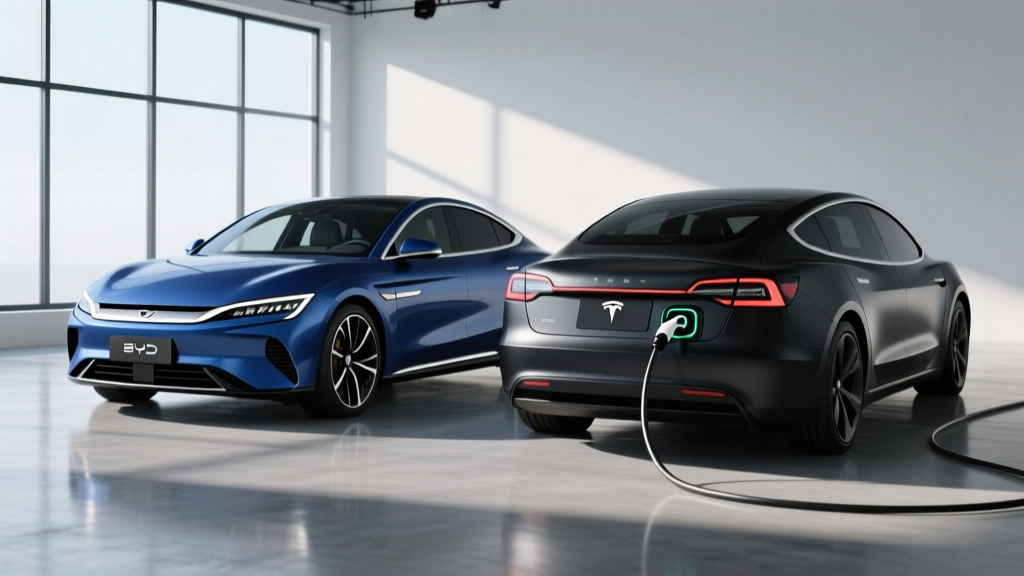
If you are shopping for an electric vehicle in 2026, the BYD vs Tesla debate is impossible to ignore. Tesla remains the benchmark for charging infrastructure and software integration in the United States, while BYD has become the world's largest EV manufacturer by volume, offering aggressive pricing and rapid technology iteration. But global sales dominance does not automatically translate to the best choice for a US buyer. Availability, federal tax credits, charging network access, and real-world efficiency all shape the ownership equation in ways that spec sheets alone cannot capture.
This comparison focuses on the models US buyers are most likely to cross-shop: the Tesla Model Y (Long Range AWD) and the BYD Sealion 7 (a mid-size electric SUV positioned against the Model Y in global markets). We will also address the broader brand-level differences in technology, charging ecosystems, and total cost of ownership. Where a BYD model is not currently sold in the US, we note that explicitly, because availability is the single biggest factor in this matchup.
Side-by-Side Specs: Tesla Model Y vs BYD Sealion 7
Numbers first. The table below compares the 2026 Tesla Model Y Long Range AWD against the BYD Sealion 7 (Performance AWD variant, as sold in European and Asia-Pacific markets). Note that EPA figures apply to the Tesla; BYD's WLTP numbers are converted to approximate EPA equivalents where noted, since fueleconomy.gov does not list BYD models not sold in the US.
| Specification | Tesla Model Y LR AWD | BYD Sealion 7 Performance AWD |
|---|---|---|
| Battery (usable) | 75 kWh (NMC) | 82.5 kWh (LFP — Blade Battery) |
| EPA Range | 320 miles | N/A (WLTP ~311 mi / est. EPA ~265 mi) |
| Efficiency | 122 MPGe (28 kWh/100mi) | ~105 MPGe est. (~32 kWh/100mi) |
| Peak DC Fast Charge | 250 kW | 240 kW |
| 10–80% DC Charge Time | ~27 minutes | ~30 minutes |
| Level 2 AC Charge Rate | 11.5 kW | 11 kW |
| 0–60 mph | 4.8 seconds | 4.5 seconds |
| Horsepower | 384 hp | 523 hp |
| Cargo Volume (rear seats up) | 30.2 cu ft | ~26.4 cu ft (est.) |
| Base MSRP (US) | $44,990 | Not sold in US (AU$65,990 ≈ $42,000) |
| Battery Warranty | 8 yr / 120,000 mi | 8 yr / 100,000 mi (global standard) |
Two things jump out immediately. First, Tesla's efficiency advantage is substantial — roughly 15% fewer kWh consumed per 100 miles, which compounds into lower charging costs and better real-world range from a smaller battery. Second, BYD's LFP Blade Battery offers a different longevity and safety profile than Tesla's NMC pack, which matters for long-term ownership. We unpack both below.
Range and Efficiency: Real-World Expectations
Tesla Model Y LR: EPA 320 miles. Expect ~270–285 miles on highway road trips (70–80 mph), and ~230–250 miles in freezing temperatures with cabin heat. Tesla's heat pump is standard and effective.
BYD Sealion 7: WLTP 311 miles (est. EPA ~265 miles). Expect ~225–240 miles highway, and ~190–210 miles in cold weather. LFP chemistry suffers greater cold-weather range loss than NMC — typically 25–35% in sub-freezing conditions vs. 15–25% for NMC.
The Tesla Model Y's efficiency edge comes from a combination of lower vehicle weight (~4,200 lbs vs. ~4,750 lbs for the Sealion 7), a more aerodynamic profile, and Tesla's industry-leading powertrain thermal management. On a 300-mile road trip, the Model Y will arrive with a meaningful buffer while the Sealion 7 would likely require a charging stop.
For daily commuting under 60 miles round-trip, both vehicles offer more than enough range. The gap matters primarily for road trips and cold-climate owners. If you live in Minnesota or Maine, Tesla's NMC pack and heat pump give it a tangible winter advantage.
Charging Speed and Network Access
Peak charging power tells only part of the story. The charge curve — how long a vehicle sustains its peak rate before tapering — determines your actual wait time at a DC fast charger.
| Metric | Tesla Model Y LR | BYD Sealion 7 |
|---|---|---|
| Peak DC Rate | 250 kW | 240 kW |
| Sustained Rate (10–50%) | ~200–230 kW avg | ~170–200 kW avg |
| 10–80% Time | ~27 min | ~30 min |
| Miles Added in 15 min | ~175 miles | ~140 miles (est.) |
| Connector (US/Global) | NACS (native) | CCS2 (global) / GB/T (China) |
| Preconditioning | Automatic via nav | Manual toggle in app |
The Tesla's charge curve is flatter and sustains higher power longer, thanks to aggressive battery preconditioning when you navigate to a Supercharger. BYD's LFP chemistry charges slightly slower on average, and the taper above 80% SoC is more pronounced — a characteristic of LFP cells that prioritize longevity over charge speed.
In the US, Tesla's Supercharger network comprises over 25,000 stalls and remains the most reliable DC fast-charging ecosystem, with uptime consistently above 95%. BYD does not operate a proprietary charging network outside China. If BYD enters the US market, its vehicles would rely on third-party networks (Electrify America, EVgo, ChargePoint) — which collectively have lower uptime and more fragmented payment systems. This is a decisive factor for road-trip-heavy buyers.
Price, Tax Credits, and Total Cost of Ownership
Here is where the comparison splits sharply depending on your market.
| Factor | Tesla Model Y LR AWD | BYD Sealion 7 |
|---|---|---|
| MSRP | $44,990 | Not available in US |
| §30D Federal Credit | Up to $7,500 (point-of-sale) | N/A — no US sales |
| Effective Price (after credit) | ~$37,490 | N/A |
| MSRP Cap (§30D) | Under $80,000 SUV cap ✓ | N/A |
| Battery Sourcing (§30D) | Partial credit; verify current-year IRS guidance | N/A |
Source: IRS §30D Clean Vehicle Credit. Eligibility depends on income caps ($150K single / $300K joint), MSRP limits, and battery component/critical mineral sourcing requirements that change annually. Verify with a tax professional before purchasing.
For US buyers, this is the comparison's central asymmetry: you cannot currently buy a BYD in the United States. BYD has focused its 2025–2026 expansion on Europe, Southeast Asia, Australia, and Latin America. US tariffs on Chinese-manufactured EVs (100% as of 2025) make direct import economically unviable, and BYD has not announced a US-market production facility.
In markets where both compete — Australia, the UK, Thailand, Brazil — the BYD Sealion 7 typically undercuts the Model Y by 5–12% on sticker price before incentives. But US buyers comparing these brands are effectively comparing a purchasable vehicle (Tesla) against a benchmark they have read about (BYD).
5-Year Ownership Cost Estimate (US — Tesla Model Y LR)
| Cost Category | 5-Year Estimate | Notes |
|---|---|---|
| Purchase (after credit) | $37,490 | Assumes full §30D credit eligibility |
| Electricity (home + DCFC) | $4,200 | 15,000 mi/yr, $0.14/kWh avg home, 15% DCFC at $0.40/kWh |
| Insurance | $12,500 | ~$2,500/yr avg; Tesla premiums run 15–25% above segment avg |
| Maintenance | $1,800 | Tire rotations, cabin filter, wiper fluid; no oil/transmission |
| Depreciation (est.) | $14,000 | ~38% over 5 years based on recent EV resale trends |
| Total 5-Year Cost | ~$69,990 |
BYD's global ownership costs are competitive on paper — lower insurance in some markets due to cheaper repair parts, and LFP batteries that degrade more slowly. But without US availability, these figures remain academic for American shoppers.
Technology, Software, and Driver Assistance
This category reveals the widest philosophical gap between the two brands.
Tesla Autopilot, FSD (Supervised), and BYD's ADAS suite are all SAE Level 2 driver-assistance systems. The driver must remain fully engaged, hands on or near the wheel, eyes on the road. Neither system is "self-driving." Only Level 4 robotaxi services (Waymo, Zoox in designated zones) operate without driver supervision.
Tesla's tech advantage centers on software integration. The 15.4-inch center display handles navigation, media, climate, and vehicle settings with minimal lag. Over-the-air updates add features regularly. Tesla's navigation-routed preconditioning, Sentry Mode dashcam recording, and Supercharger integration create a seamless ecosystem. FSD (Supervised) remains a $8,000 option (or $99/month subscription) that handles highway lane changes and some city-street navigation, though it requires constant driver oversight and has drawn NHTSA scrutiny for its driver-monitoring approach.
BYD's tech approach is more conventional. The Sealion 7's rotating 15.6-inch display is a signature feature, and the DiPilot ADAS suite includes adaptive cruise, lane centering, and automated parking. However, BYD's software ecosystem lacks Tesla's depth — no equivalent to Sentry Mode, limited OTA update scope, and no proprietary charging network integration. In markets outside China, BYD's infotainment localization (maps, voice assistant, app store) has drawn mixed reviews.
Category Verdicts: Who Wins Where?
🏆 Range & Efficiency: Tesla
320 EPA miles and 122 MPGe beat BYD's estimated 265 EPA miles and ~105 MPGe. Tesla extracts more miles per kWh, which lowers charging costs and extends real-world range, especially in cold weather.
🏆 Charging Network: Tesla
Supercharger reliability (95%+ uptime), automatic preconditioning, and NACS connector adoption by nearly every major automaker give Tesla an insurmountable network advantage in the US.
🏆 Battery Longevity: BYD
BYD's LFP Blade Battery is rated for 3,000+ full charge cycles with minimal degradation, versus NMC's typical 1,500–2,000 cycles. LFP also eliminates cobalt and nickel, reducing supply-chain and environmental concerns. Owners who plan to keep their EV 10+ years may see less capacity loss with BYD.
🏆 Performance: BYD (on paper)
523 hp and a 4.5-second 0–60 edge out the Model Y's 384 hp and 4.8 seconds. In practice, both deliver instant torque and confident highway merging. The gap is felt mainly in launch-from-stop scenarios.
🏆 Software & UX: Tesla
Tesla's integrated ecosystem — Supercharger routing, OTA updates, Sentry Mode, phone-as-key — remains the most cohesive in the EV market. BYD's software is functional but less polished outside China.
🏆 Global Value: BYD
In markets where both compete, BYD undercuts Tesla on price by 5–12% while offering comparable interior quality and more standard features. The value proposition is strongest in right-hand-drive markets (Australia, UK, Thailand).
🏆 US Availability: Tesla
BYD is not sold in the US and has no announced timeline for entry. For American buyers, this single factor resolves the comparison: Tesla is purchasable, BYD is not.
🏆 Cargo & Practicality: Tesla
30.2 cu ft of cargo space (plus a small frunk) edges out the Sealion 7's estimated 26.4 cu ft. The Model Y also offers an optional third row (very small children only), which the Sealion 7 does not.
Decision Framework: Which Should You Choose?
Choose Tesla If:
- You live in the US — it is the only option of the two that is purchasable, serviceable, and eligible for the §30D federal tax credit.
- You take regular road trips — the Supercharger network and 320-mile EPA range reduce charging-stop friction significantly.
- You live in a cold climate — NMC chemistry and Tesla's heat pump preserve more range in sub-freezing temperatures than LFP.
- You value software integration — navigation-routed charging, OTA updates, and Sentry Mode are meaningfully better than BYD's global-market software.
- You want strong resale value — Tesla's brand recognition and Supercharger access support higher used-EV demand.
Choose BYD If:
- You live outside the US — in Australia, the UK, Southeast Asia, or Latin America, BYD offers compelling value with competitive specs and lower pricing.
- You plan to own the vehicle 8–10+ years — LFP chemistry's superior cycle life means less battery degradation over a decade of ownership.
- You prioritize battery safety — BYD's Blade Battery passes nail-penetration tests without thermal runaway, a claim most NMC packs cannot make.
- You want maximum horsepower at a lower price — the Sealion 7 Performance delivers 523 hp at a price point below the Model Y in most non-US markets.
- You primarily drive in warm climates — LFP's cold-weather weakness is minimized in tropical or temperate regions.
Frequently Asked Questions
Can I import a BYD to the United States?
Practically, no. US tariffs on Chinese-manufactured EVs are currently 100%, which would roughly double the vehicle's cost. Additionally, BYD models are not certified to meet US FMVSS safety standards, making registration impossible without a lengthy and expensive homologation process. For US buyers, BYD is not a realistic option in 2026.
Is BYD's Blade Battery really safer than Tesla's NMC pack?
BYD's LFP Blade Battery has demonstrated superior thermal stability in nail-penetration and crush tests, resisting thermal runaway at temperatures where NMC cells typically fail. However, Tesla's structural battery pack and cell-level thermal barriers also provide robust protection. Both architectures have strong real-world safety records; LFP's advantage is in chemistry-level stability, while Tesla's is in pack-level engineering.
Does Tesla's §30D tax credit apply to every Model Y trim?
Not necessarily. The §30D credit depends on the buyer's adjusted gross income (caps: $150K single, $225K head of household, $300K joint), the vehicle's MSRP (must be under $80,000 for SUVs), and battery component/critical mineral sourcing requirements that the IRS updates annually. The credit can be transferred to the dealer at point of sale as a price reduction. Always verify current-year eligibility on IRS.gov and with your tax professional before committing to a purchase.
Will BYD ever sell cars in the US?
BYD executives have stated that US market entry is "under evaluation" but no timeline, production facility, or homologation program has been announced as of early 2026. The 100% tariff on Chinese EVs and geopolitical tensions make near-term entry unlikely. If BYD does enter, it would likely build a North American production facility (as it has done in Thailand, Brazil, and Hungary) to avoid import tariffs.
How do insurance costs compare?
Tesla insurance premiums run 15–25% above the mid-size SUV average, driven by higher repair costs (aluminum body, sensor recalibration) and elevated claim frequencies. In markets where BYD is sold, insurance costs tend to be 5–10% lower than Tesla's, partly due to cheaper body-panel replacement and less complex sensor suites. US buyers should obtain quotes before purchasing any EV — premiums vary significantly by state, driving record, and insurer.
Which holds its value better over 5 years?
In the US market, Tesla has historically retained value better than most EV competitors, though EV depreciation accelerated industry-wide in 2024–2025 due to price cuts and market saturation. The Model Y currently depreciates roughly 35–40% over five years. BYD's resale data outside the US is more limited but shows similar or slightly steeper depreciation in some markets, partly due to rapid model-year refreshes that make older versions feel outdated quickly.