The Quick Answer
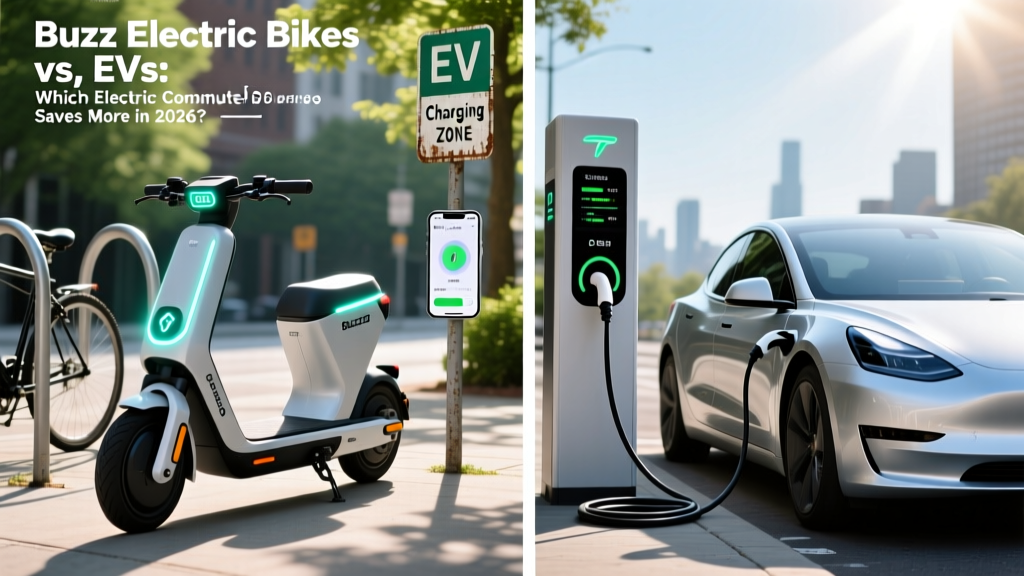
Buzz electric bikes (and similar e-bikes) cost roughly $1,200–$2,500 upfront, use about $0.01–$0.03 per mile in electricity, and need no insurance or registration in most states. A new compact EV like the 2026 Chevrolet Equinox EV or Nissan Leaf costs $30,000–$38,000 before incentives, runs $0.04–$0.06 per mile on electricity, and carries insurance and registration costs. If your one-way commute is under 15 miles and weather permits, a Buzz electric bike can replace a second car for a fraction of the cost. If you need highway capability, cargo space, passenger room, or year-round all-weather comfort, an EV is the practical choice. Many households find the best economics by pairing one EV with one e-bike for short trips.
What Buzz Electric Bikes Actually Are (And Aren't)
Buzz electric bikes fall into the broader category of Class 1, 2, or 3 e-bikes — pedal-assist or throttle-equipped bicycles with electric motors typically rated between 250W and 750W. Most Buzz models and comparable brands (Lectric, Rad Power, Aventon) feature hub motors, lithium-ion battery packs in the 360–500 Wh range (0.36–0.50 kWh), and claimed ranges of 20–45 miles per charge depending on assist level and terrain.
These are not electric motorcycles or mopeds. Under federal law (and most state laws), e-bikes with motors under 750W and top assisted speeds at or below 20 mph (Class 1/2) or 28 mph (Class 3) are classified as bicycles — meaning no driver's license, registration, or insurance is required in most jurisdictions. Always check your specific state and local regulations.
For context, a Buzz e-bike battery holds roughly 0.4 kWh of energy. A 2026 Chevrolet Equinox EV's battery holds about 85 kWh — over 200 times more. That's the fundamental difference in scale between these two electric vehicles.
Head-to-Head: Buzz E-Bike vs. Compact EV
The table below compares a typical Buzz-class e-bike against a mainstream compact EV using current 2026 pricing and EPA data from fueleconomy.gov:
| Factor | Buzz-Class E-Bike | 2026 Compact EV (e.g., Equinox EV / Leaf) |
|---|---|---|
| Upfront cost | $1,200–$2,500 | $30,000–$38,000 MSRP |
| Federal tax credit (§30D) | Not eligible | Up to $7,500 (subject to IRS §30D rules: income caps, MSRP caps, battery sourcing) |
| Battery capacity | 0.36–0.50 kWh (lithium-ion) | 60–85 kWh (NMC or LFP) |
| Range per charge | 20–45 miles (real-world) | 230–315 miles EPA (expect ~80% highway, ~65–75% in cold weather) |
| Top speed | 20–28 mph (assist-limited) | 100+ mph |
| Charging time (full) | 3–5 hours (standard 120V outlet) | Level 2: 7–10 hours; DC fast: 10–80% in ~20–30 min at 150+ kW |
| Electricity cost per mile | $0.01–$0.03 | $0.04–$0.06 (varies by utility rate) |
| Annual insurance | $0 (not required in most states) | $1,400–$2,200/year |
| Registration / licensing | None (most states) | $50–$200/year + license required |
| Annual maintenance | $50–$150 (tires, brakes, chain) | $300–$600 (tires, cabin filter, wipers, fluid top-offs) |
| Cargo capacity | 20–50 lbs (with panniers/rack) | 25–65 cu ft (seats folded) |
| Passengers | 1 (some models: 1 child seat) | 4–5 |
| Weather protection | None (rider exposed) | Full climate control |
| Highway capable | No | Yes |
Real Cost Breakdown: 5-Year Commute Comparison
Let's run the numbers for a 10-mile round-trip commute, 240 workdays per year (2,400 miles/year), over 5 years (12,000 total miles). This is where the e-bike economics become compelling for the right use case.
| Cost Category | Buzz E-Bike (5 Years) | Compact EV (5 Years) |
|---|---|---|
| Purchase price | $1,800 | $34,000 |
| Federal tax credit | $0 | −$7,500 (if eligible) |
| Net purchase | $1,800 | $26,500 |
| Electricity (12,000 mi) | $180 | $600 |
| Insurance (5 years) | $0 | $9,000 |
| Registration (5 years) | $0 | $600 |
| Maintenance (5 years) | $600 | $2,500 |
| Battery replacement reserve | $400 (typical replacement at year 4–5) | Covered under 8-yr/100,000-mi warranty |
| Total 5-year cost | $2,980 | $39,200 |
| Cost per mile | $0.25 | $3.27 |
The e-bike wins on pure commuting economics by a wide margin. But this comparison only works if the e-bike can actually replace the trips you need to make — and that's where real-world ownership considerations matter.
Real-World Ownership: When an E-Bike Works (And When It Doesn't)
The numbers above assume ideal conditions. Here's what actually determines whether a Buzz electric bike or any e-bike is a viable daily vehicle for you:
Climate and Seasonality
E-bike range drops 20–30% in cold weather (below 40°F) due to lithium-ion battery chemistry — the same physics that affect EV batteries, just more noticeable on a 0.4 kWh pack where every watt-hour counts. Riding in rain, snow, or extreme heat adds discomfort and safety risk. In cities like Phoenix, San Diego, or Austin, an e-bike can serve as a year-round commuter. In Chicago, Minneapolis, or Boston, expect to rely on it roughly April through October.
Charging Access
This is where e-bikes have a major advantage: you charge from any standard 120V outlet. No Level 2 installation, no electrician, no panel upgrade. A full charge on a 0.4 kWh battery takes 3–5 hours on a regular wall plug. If you live in an apartment without EV charging infrastructure, an e-bike may be your most practical electric vehicle.
Route and Infrastructure
A 10-mile commute on a protected bike lane at 18 mph is pleasant and safe. That same 10 miles on a 45-mph arterial road with no shoulder is dangerous and stressful. Check your local bike infrastructure before committing. Apps like Strava and Google Maps (bicycling layer) can help you evaluate route safety.
Cargo and Passenger Needs
Groceries for two? A commuter e-bike with rear panniers handles it. Weekly Costco run for a family of four? You need the EV. Dropping kids at school? The EV. The e-bike is a single-person, light-cargo solution.
Common Misconceptions: E-Bikes vs. EVs
| Myth | Fact |
|---|---|
| "E-bikes qualify for the federal EV tax credit." | No. The IRS §30D credit applies to four-wheeled vehicles meeting specific battery sourcing, MSRP, and buyer income requirements. E-bikes do not qualify. Some states and localities offer separate e-bike rebates — check your local programs. |
| "An e-bike is just as green as an EV." | Per mile, an e-bike uses roughly 1/10th to 1/15th the electricity of an EV. If your grid is fossil-heavy, the e-bike's smaller energy draw means even lower upstream emissions. Both beat gasoline vehicles, but the e-bike is more efficient per passenger-mile for solo commuting. |
| "E-bike batteries last forever." | Most e-bike lithium-ion packs are rated for 500–800 full charge cycles before degrading to ~80% capacity. With daily charging, expect noticeable range loss after 2–3 years and likely replacement by year 4–5 at a cost of $300–$600. |
| "I can ride an e-bike on any road." | Class 1 and 2 e-bikes (≤20 mph) are generally allowed on bike paths and roads where bicycles are permitted. Class 3 (≤28 mph) may be restricted from certain paths. Some states prohibit e-bikes on highways and specific bridges. Always verify local rules. |
| "An EV and an e-bike are competing purchases." | For many households, they're complementary. The EV handles highway trips, bad weather, cargo, and passengers. The e-bike handles short solo commutes at near-zero marginal cost. This two-vehicle strategy often beats owning two cars. |
Decision Framework: Buzz E-Bike, EV, or Both?
Choose a Buzz-class e-bike if:
- Your one-way commute is under 15 miles with safe bike infrastructure
- You live in a mild climate or accept seasonal use only
- You lack home EV charging access (apartment, street parking)
- Your budget is under $3,000 and you need transportation now
- You already own a car for longer trips and want to reduce its use
Choose a compact EV if:
- Your commute involves highways or exceeds 20 miles one-way
- You need year-round, all-weather transportation
- You regularly carry passengers or significant cargo
- You have or can install Level 2 home charging (budget $500–$2,000 for installation)
- You qualify for the §30D tax credit (check IRS eligibility rules — income caps: $150K single / $300K joint; MSRP caps: $55K cars / $80K SUVs/trucks)
Choose both if:
- You're a two-vehicle household looking to downsize from two gas cars
- You can use the e-bike for 60%+ of your weekly trips and the EV for the rest
- You want the lowest total household transportation cost
What First-Time E-Bike Buyers Should Know
If you're leaning toward a Buzz electric bike or similar model, here are the ownership realities most first-time buyers overlook:
- Security is critical. E-bike theft is rampant. Budget $100–$200 for a high-quality U-lock or chain lock, and consider GPS trackers. Many renters and homeowners insurance policies cover e-bikes — verify your policy.
- Helmet and safety gear. At 20–28 mph, an e-bike crash carries real injury risk. A certified helmet ($50–$150) is non-negotiable. Lights, mirrors, and high-visibility clothing add $50–$100.
- Battery care. Store the battery indoors when possible. Avoid charging to 100% and leaving it — keeping the state of charge between 20–80% extends cycle life, the same principle that applies to EV traction batteries.
- Service and parts. Unlike EVs with dealer networks, e-bike service is often DIY or local bike shop. Confirm that replacement parts (batteries, controllers, motors) are available for your specific model before purchasing.
- Weight. Most e-bikes weigh 45–70 lbs. If you need to carry it up stairs or onto a car rack, test the weight before buying.
Frequently Asked Questions
Do Buzz electric bikes qualify for any tax credits or incentives?
Not at the federal level. The IRS §30D clean vehicle credit applies only to qualifying four-wheeled plug-in vehicles. However, some states, cities, and utility companies offer e-bike rebates or vouchers — often $200–$500. Check your state energy office and local utility for current programs.
How long does a Buzz e-bike battery last before needing replacement?
Expect 500–800 full charge cycles before the battery degrades to approximately 80% of its original capacity. With daily commuting use, that translates to roughly 3–5 years. Replacement batteries typically cost $300–$600 depending on the model and capacity.
Can I commute year-round on an e-bike?
In mild climates (Southern California, Florida, Texas), yes — with rain gear. In northern climates, most riders use e-bikes from spring through fall and switch to a car or transit in winter. Cold temperatures reduce battery range by 20–30% and create icy road conditions that make two-wheeled travel hazardous.
Is an e-bike cheaper to own than a used gas car?
For commuting specifically, yes. A used gas car might cost $8,000–$15,000 upfront but still carries $1,200–$1,800/year in insurance, $100–$200/year in registration, $1,000–$1,500/year in fuel (at 2,400 miles/year and 25 MPG), and $500–$1,000/year in maintenance. That's $3,000–$4,500/year in ongoing costs versus under $200/year for an e-bike.
What's the real range of a Buzz-class e-bike?
Manufacturer claims of 40+ miles assume low assist levels, flat terrain, and a light rider. In real-world commuting with moderate pedal assist, expect 20–30 miles on a 0.4 kWh battery. Hilly terrain, heavier riders, and high assist levels reduce range further. If your round-trip commute exceeds 25 miles, consider a model with a larger battery or carry a spare.