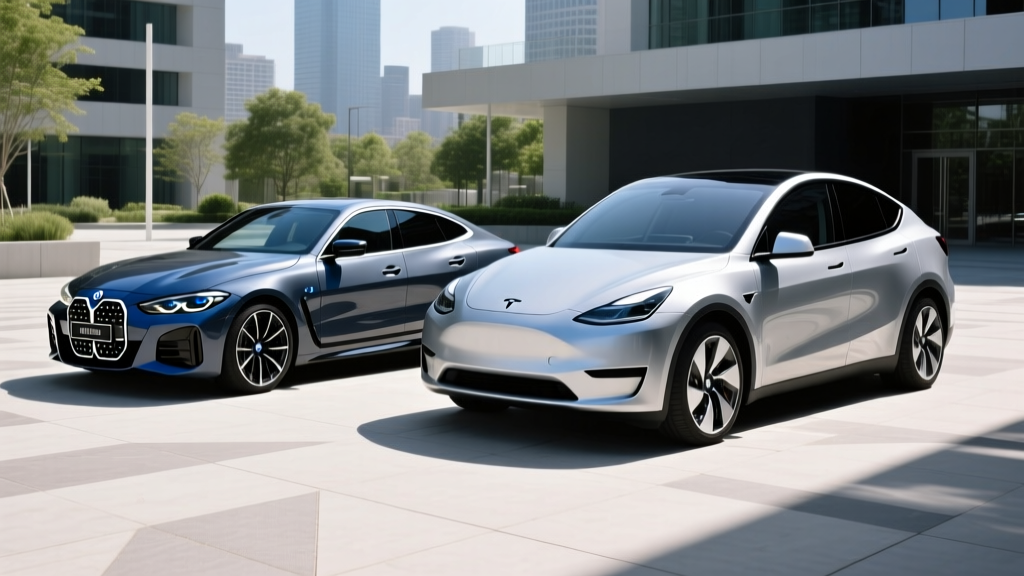
If you're cross-shopping a premium electric vehicle in the $50,000–$60,000 range, the BMW i4 and Tesla Model Y are likely on your shortlist. One is a luxury liftback with traditional build quality and driving dynamics; the other is a crossover with best-in-class efficiency and the industry's most mature charging network. They solve the EV ownership equation very differently — and the right choice depends on whether you prioritize driving feel, cargo space, charging convenience, or total cost.
This comparison uses current 2026 model-year specifications, EPA data, and IRS §30D tax credit rules to break down every dimension that matters to a real buyer.
Side-by-Side Specifications: BMW i4 vs Tesla Model Y
Before subjective impressions, the numbers. We're comparing the best-selling variants of each: the BMW i4 eDrive40 (single-motor, rear-wheel drive) and the Tesla Model Y Long Range AWD. Both are the volume trims most buyers cross-shop.
| Specification | BMW i4 eDrive40 | Tesla Model Y Long Range AWD |
|---|---|---|
| Body Style | Gran Coupe (liftback sedan) | Crossover SUV |
| EPA Range | 307 miles | 320 miles |
| Battery (usable / chemistry) | 81.5 kWh / NMC | ~75 kWh / NMC (CATL-sourced) |
| EPA Efficiency | 100 MPGe (33 kWh/100mi) | 123 MPGe (27 kWh/100mi) |
| Peak DC Fast Charge | 205 kW | 250 kW |
| 10–80% DC Charge Time | ~31 minutes | ~25 minutes |
| Level 2 Charge Rate | 11 kW (AC) | 11.5 kW (AC) |
| Charge Port / Connector | NACS (2025+ models) | NACS (native) |
| 0–60 mph | 5.5 seconds | 4.8 seconds |
| Horsepower | 335 hp | 384 hp |
| Drivetrain | RWD (single motor) | AWD (dual motor) |
| Cargo Volume (rear seats up) | 16.6 cu ft | 30.2 cu ft |
| Cargo Volume (rear seats folded) | 45.6 cu ft | 72.1 cu ft |
| Base MSRP | $57,900 | $48,990 |
| Battery Warranty | 8 yr / 100,000 mi | 8 yr / 120,000 mi |
| Vehicle Warranty | 4 yr / 50,000 mi | 4 yr / 50,000 mi |
Sources: EPA fueleconomy.gov — BMW i4, EPA fueleconomy.gov — Tesla Model Y, manufacturer specification pages.
Range and Efficiency: The Real-World Picture
On paper, the Model Y Long Range AWD edges the i4 eDrive40 by 13 EPA miles (320 vs 307). But efficiency tells a more important story: the Tesla consumes 27 kWh per 100 miles compared to the BMW's 33 kWh/100mi. That's an 18% efficiency gap, and it has downstream consequences for charging costs and real-world range retention.
BMW i4 eDrive40: EPA 307 miles. Expect ~260–280 miles in mixed highway driving at 70–75 mph. In cold weather (below 30°F), plan for 210–240 miles. The i4's heat pump (standard) helps, but its higher consumption means range loss hits harder on long trips.
Tesla Model Y Long Range AWD: EPA 320 miles. Expect ~275–295 miles in mixed highway driving. Cold weather brings this down to ~235–260 miles. Tesla's thermal management system is among the best in the industry, and the lower baseline consumption means less absolute range loss.
The Model Y's efficiency advantage isn't just an EPA number — it translates directly into fewer charging stops on road trips and lower electricity costs over the life of the car. For a driver covering 15,000 miles per year at $0.14/kWh (national average for home charging), the Tesla saves roughly $370/year in electricity compared to the i4.
Charging Speed and Network Access
Both vehicles now use the NACS (North American Charging Standard) connector, meaning both can access Tesla Supercharger stations natively — a significant shift from just two years ago when the BMW required an adapter.
| Metric | BMW i4 eDrive40 | Tesla Model Y Long Range |
|---|---|---|
| Peak DC Fast Charge Rate | 205 kW | 250 kW |
| Sustained Charge Rate (10–50%) | ~170–190 kW | ~210–240 kW |
| 10–80% DC Fast Charge | ~31 min | ~25 min |
| Miles Added in 15 min (DC) | ~140 miles | ~175 miles |
| Level 2 Home Charging (full) | ~8.25 hours | ~7 hours |
| Preconditioning for DC | Navigation-triggered | Navigation-triggered + app manual |
The Model Y charges roughly 6 minutes faster from 10–80%, which compounds meaningfully on road trips with multiple stops. On a 600-mile journey requiring two charging stops, you'll save about 12 minutes total in the Tesla — not transformative, but noticeable.
Both cars support battery preconditioning when navigating to a DC fast charger, warming the pack for optimal charge acceptance. Tesla adds the ability to manually trigger preconditioning via the app, which is useful if you're approaching a charger without using built-in navigation.
While both cars can now use Superchargers, Tesla owners still get a smoother experience: lower pricing at many stations, automatic plug-and-charge authentication, and better station uptime visibility in the app. BMW owners using Superchargers pay the standard non-Tesla rate (often 10–15% higher) and may need to initiate sessions through the Tesla app at some locations. Third-party networks like Electrify America and EVgo work identically for both vehicles.
Performance and Driving Dynamics
This is where the two vehicles diverge philosophically.
The BMW i4 eDrive40 delivers 335 hp through a single rear motor. Its 5.5-second 0–60 time is brisk but not thrilling. What the i4 offers instead is chassis balance, steering feel, and ride refinement that Tesla can't match. The adaptive M suspension (available on M Sport trims) and BMW's decades of ride-and-handling tuning give the i4 the character of a proper sport sedan. It's the car for drivers who care about turn-in response and highway stability.
The Tesla Model Y Long Range AWD produces 384 hp with dual motors and all-wheel drive, hitting 60 mph in 4.8 seconds. The instant torque delivery is addictive, and the AWD traction is a genuine advantage in snow and rain. But the ride quality, while improved in the refreshed Model Y, still transmits more road imperfections than the BMW, and steering feedback is minimal.
Faster 0–60, dual-motor AWD, and superior traction in adverse conditions give the Model Y the edge in straight-line performance and all-weather capability.
Superior steering feel, chassis tuning, ride comfort, and cabin quietness make the i4 the choice for drivers who value engagement over raw acceleration.
Interior, Cargo, and Practicality
The body-style difference is the biggest practical divider here. The Model Y is a crossover with an SUV-like seating position and massive cargo capacity. The i4 is a low-slung liftback — more car-like, with a lower load floor but significantly less volume.
| Metric | BMW i4 | Tesla Model Y |
|---|---|---|
| Cargo (seats up) | 16.6 cu ft | 30.2 cu ft |
| Cargo (seats folded) | 45.6 cu ft | 72.1 cu ft |
| Front Trunk (Frunk) | None | 4.1 cu ft |
| Seating Capacity | 5 | 5 (optional 7) |
| Infotainment Screen | 14.9" curved display (iDrive 8.5) | 15.4" touchscreen |
| Physical Controls | Yes — iDrive knob, steering wheel buttons | Minimal — nearly all touchscreen |
| Wireless CarPlay / Android Auto | Yes / Yes | No / No (Tesla OS only) |
If you regularly haul cargo, pets, or children's gear, the Model Y's nearly double cargo volume is a decisive advantage. The optional third row (suitable for small children) adds versatility the i4 simply cannot offer.
Inside the cabin, BMW's iDrive 8.5 with its curved display and physical iDrive controller provides a more conventional luxury experience. Wireless Apple CarPlay and Android Auto are standard. Tesla's minimalist interior routes everything through the central touchscreen — climate, mirrors, glovebox — which some buyers love and others find distracting. Tesla does not support CarPlay or Android Auto.
Nearly double the cargo space, optional third row, frunk, and crossover ride height make the Model Y far more versatile for families and active lifestyles.
Higher-grade materials, better sound insulation, physical controls, and smartphone integration give the i4 a more traditional luxury cabin experience.
Tech, ADAS, and Driver Assistance
Both vehicles come well-equipped with driver-assistance features, but they take different approaches to automation.
Both the BMW Driving Assistant Professional and Tesla Autopilot/FSD (Supervised) are SAE Level 2 systems. This means the driver must remain fully engaged — hands on or near the wheel, eyes on the road — at all times. Neither system is "self-driving." Only Level 4 services like Waymo operate without driver supervision, and those are limited to specific geofenced areas.
BMW Driving Assistant Professional (included or ~$1,700 depending on trim) offers adaptive cruise control with stop-and-go, lane-keeping with active lane change, and Traffic Jam Assistant that allows hands-off driving at speeds up to 40 mph on divided highways (with driver monitoring via interior camera). It's conservative but reliable, and the system's behavior feels natural and predictable.
Tesla Autopilot comes standard with adaptive cruise and lane centering. FSD (Supervised), currently an $8,000 add-on or $99/month subscription, adds automatic lane changes, navigation-on-Autopilot, traffic light and stop sign recognition, and city street driving capability. FSD has improved substantially but still requires attentive supervision and can make unexpected decisions in construction zones or unusual intersections. Tesla's data advantage from billions of miles of fleet driving gives FSD a broader operational envelope, but it remains a Level 2 system requiring driver oversight.
FSD (Supervised) offers a broader feature set and more automated driving scenarios than BMW's system, though both require constant driver attention.
BMW's system is more predictable, less prone to phantom braking, and its hands-off low-speed capability (with eye monitoring) is genuinely useful in traffic.
Pricing, Tax Credits, and Total Cost of Ownership
The price gap between these two is substantial, and federal tax credit eligibility widens it further.
| Cost Factor | BMW i4 eDrive40 | Tesla Model Y Long Range AWD |
|---|---|---|
| Base MSRP | $57,900 | $48,990 |
| Federal §30D Tax Credit | $0 (MSRP exceeds $55,000 sedan cap) | Up to $7,500 (SUV MSRP cap: $80,000) |
| Effective Price After Credit | $57,900 | ~$41,490 |
| Point-of-Sale Transfer | N/A | Available — reduces purchase price at dealer |
| Estimated Insurance (annual) | ~$2,400 | ~$2,100 |
| Annual Electricity Cost (15k mi) | ~$693 | ~$567 |
| Estimated 5-Year Total Cost | ~$76,500 | ~$58,800 |
Tax credit eligibility per IRS §30D rules. The BMW i4 is classified as a sedan, subject to the $55,000 MSRP cap — its base price of $57,900 disqualifies it entirely. The Model Y is classified as an SUV, subject to the $80,000 cap, and qualifies for the full credit if battery sourcing and buyer income requirements are met. Consult a tax professional for your specific situation.
- Buyer income cap: AGI ≤ $150,000 (single) or ≤ $300,000 (joint)
- MSRP cap: ≤ $55,000 for sedans; ≤ $80,000 for SUVs/trucks/vans
- Battery sourcing: Critical minerals and battery components must meet phased-in percentage thresholds from US/FTA countries
- Assembly: Final assembly in North America (Model Y: Fremont, CA ✓; BMW i4: Munich, Germany ✗ — additional disqualifier)
- Transfer option: Credit can be transferred to the dealer at point of sale as a purchase price reduction
The BMW i4 fails on MSRP, vehicle classification, and North American assembly. It does not qualify for the federal credit under any scenario. The Model Y Long Range qualifies for the full $7,500 if battery-component sourcing thresholds are met for the specific build month — confirm with your Tesla advisor and review the latest DOE eligibility list.
5-Year Ownership Cost Breakdown
| Category | BMW i4 eDrive40 | Tesla Model Y LR AWD |
|---|---|---|
| Purchase (after credit) | $57,900 | $41,490 |
| Insurance (5 yr) | $12,000 | $10,500 |
| Electricity (5 yr, home charging) | $3,465 | $2,835 |
| Maintenance (5 yr) | $2,200 | $1,500 |
| Estimated Depreciation | $22,000 | $16,000 |
| Total 5-Year Cost | ~$97,565 | ~$72,325 |
The Model Y's cost advantage is overwhelming: roughly $25,000 less over five years, driven primarily by the $7,500 tax credit, lower purchase price, and better efficiency. BMW's higher depreciation (luxury sedans lose value faster than popular crossovers) compounds the gap.
Decision Framework: Which Should You Choose?
Choose the Tesla Model Y Long Range AWD if:
- You want the best value: ~$16,000 less after tax credit, plus lower running costs
- You need cargo space for a family, gear, or pets (30.2 cu ft vs 16.6 cu ft)
- All-wheel drive is important for your climate
- You want the fastest DC charging in the segment (250 kW peak, ~25 min 10–80%)
- You value the Supercharger network's seamless plug-and-charge experience
- You want optional third-row seating for small children
- Efficiency matters to you: 123 MPGe vs 100 MPGe means real money saved annually
Choose the BMW i4 eDrive40 if:
- Driving dynamics and ride refinement are your top priorities
- You prefer a traditional luxury interior with physical controls and premium materials
- You want Apple CarPlay / Android Auto integration (Tesla doesn't offer either)
- You prefer a sedan/liftback profile over a crossover
- You value BMW's dealer service network and certified technician availability
- You don't need maximum cargo space or AWD
- The ~$16,000 price premium (after credit) is acceptable for the refinement upgrade
Frequently Asked Questions
Does the BMW i4 qualify for any EV tax credits?
The BMW i4 does not qualify for the federal §30D tax credit. It exceeds the $55,000 MSRP cap for sedans, and it's assembled in Munich, Germany (the credit requires North American final assembly). Some state-level incentives may still apply — check your state's energy office or AFDC state incentive database for local rebates.
Can the BMW i4 use Tesla Superchargers?
Yes. Starting with the 2025 model year, BMW equips the i4 with a native NACS charge port, granting direct access to Tesla Supercharger stations without an adapter. Charging speeds are limited to the i4's 205 kW peak, and non-Tesla vehicles may pay a slightly higher per-kWh rate at some stations.
Which has lower maintenance costs?
The Tesla Model Y. EVs in general require less maintenance than ICE vehicles (no oil changes, fewer moving parts), but Tesla's simpler architecture and over-the-air update capability reduce service visits further. BMW's more complex thermal management and traditional luxury components add modest maintenance costs. Expect roughly $1,500 over 5 years for the Tesla vs $2,200 for the BMW.
Is the Tesla Model Y safer than the BMW i4?
Both vehicles earn top safety ratings. The Model Y holds a 5-star overall rating from NHTSA and Top Safety Pick+ from IIHS. The BMW i4 also earns strong crash-test scores. Both include automatic emergency braking, blind-spot monitoring, and lane-keeping as standard. The Model Y's larger size and higher ride height provide a physics advantage in multi-vehicle collisions.
Which is better for road trips?
The Tesla Model Y, primarily due to faster charging (25 vs 31 minutes per stop), the Supercharger network's reliability, and better efficiency that stretches the distance between stops. On a 500-mile trip, expect one charging stop in the Model Y vs one longer stop (or two shorter ones) in the i4. The BMW's superior ride comfort partially offsets the Tesla's charging advantage on long highway stretches.
How do battery warranties compare?
Both cover 8 years, but Tesla covers 120,000 miles vs BMW's 100,000 miles. Both guarantee at least 70% battery capacity retention during the warranty period. Tesla's NMC battery has demonstrated strong longevity in fleet data, while BMW's Samsung SDI-sourced pack has also performed well. Neither should be a concern for typical ownership cycles.