Quick Answer: Which BMW Electric Sport Car Should You Buy?
If you want a BMW electric sport car that delivers genuine M-car thrills without a tailpipe, the 2026 BMW i4 M50 is the performance-sedan sweet spot: 536 hp, 0–60 mph in 3.7 seconds, EPA-estimated 245–270 miles of range, and a starting MSRP around $69,900. For SUV buyers needing space and speed, the 2026 BMW iX M60 offers 610 hp, EPA 288–296 miles, and a ~$111,500 starting price. Both use an 800V-capable architecture with DC fast-charging peaks above 200 kW, but neither qualifies for the full §30D federal tax credit due to battery-sourcing rules — plan your budget accordingly.
BMW's Electric Sport Car Lineup in 2026: What's Actually Available
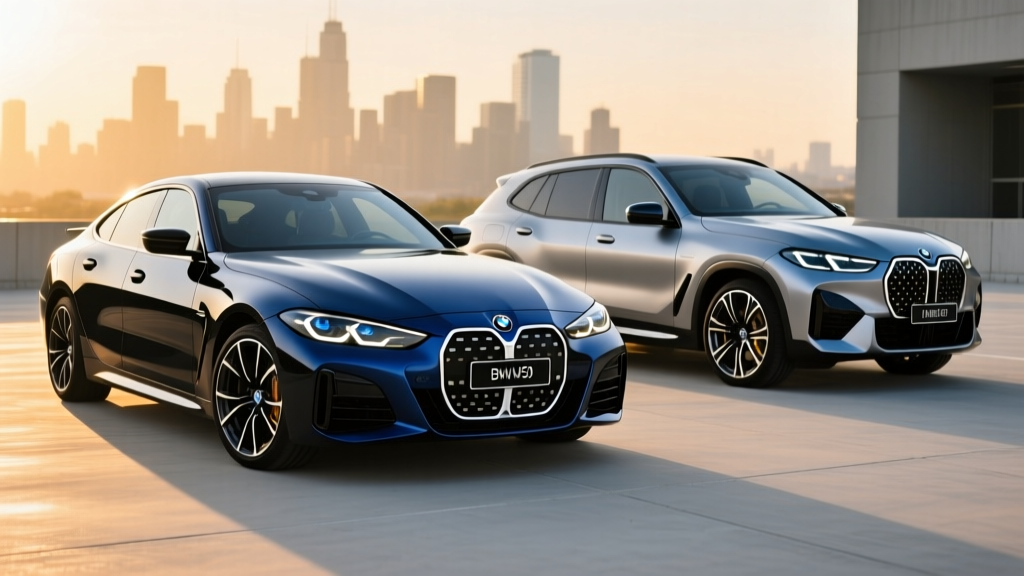
BMW's "M" performance division has gone electric. The brand's sport-oriented EV lineup in the U.S. centers on two production models, plus an incoming flagship. Here is where each stands as of the 2026 model year:
- BMW i4 M50 — A four-door gran coupe built on the CLAR platform (shared with the gas 4 Series). Dual-motor AWD, 536 hp, 586 lb-ft of torque.
- BMW iX M60 — A mid-size performance SUV. Dual-motor AWD, 610 hp, 811 lb-ft.
- BMW Neue Klasse i3 M (announced) — A next-generation electric sport sedan previewed as a concept. BMW has confirmed production intent for late 2026/2027 with 800V architecture and next-gen cylindrical cells. Specs remain preliminary.
This guide focuses on what you can actually buy and register today: the i4 M50 and iX M60. We'll cover range reality, charging behavior, total cost of ownership, and how these EVs compare to their gas-powered M siblings.
Real-World Range vs. EPA Stickers: The Honest Numbers
EPA range estimates for BMW's electric sport cars are conservative by design, but real-world results depend heavily on driving style, temperature, and route profile. Here's what the data shows:
| Spec | i4 M50 | iX M60 |
|---|---|---|
| Usable Battery Capacity | 81.5 kWh (NMC) | 105.2 kWh (NMC) |
| EPA Range (est.) | 245–270 mi | 288–296 mi |
| Real-World Highway (70 mph) | ~215–240 mi | ~250–270 mi |
| Real-World Cold Weather (20°F) | ~180–210 mi | ~215–245 mi |
| Combined MPGe | ~85 MPGe | ~79 MPGe |
| Energy Consumption | ~38 kWh/100mi | ~43 kWh/100mi |
| Drivetrain | Dual-motor AWD | Dual-motor AWD |
| Horsepower | 536 hp | 610 hp |
| 0–60 mph | 3.7 sec | 3.6 sec |
| Peak DC Fast Charge | 205 kW | 195 kW |
| 10–80% DC Charge Time | ~31 min | ~35 min |
| Level 2 AC Charge Rate | 11 kW | 11 kW |
| Starting MSRP | ~$69,900 | ~$111,500 |
| Battery/Powertrain Warranty | 8 yr / 100,000 mi | 8 yr / 100,000 mi |
Range Reality Check: The i4 M50's EPA-estimated 245–270 miles (depending on wheel size) drops to roughly 215–240 miles at sustained 70 mph highway speeds, and further to 180–210 miles in sub-freezing temperatures. BMW's thermal management system includes a heat pump (standard on 2026 models), which mitigates cold-weather losses compared to older EVs — but physics still applies. If your commute is under 80 miles round-trip, you'll rarely notice. If you road-trip frequently, plan charging stops every 180–200 miles for a safety buffer.
Charging Speed and the Curve Most Reviews Ignore
Peak charge rate is a headline number; sustained charge rate is what actually determines your road-trip experience. Here's how the i4 M50 and iX M60 behave on a DC fast charger:
| Level | Power | Miles Added per Hour | Typical Use Case |
|---|---|---|---|
| Level 1 (120V) | ~1.4 kW | ~3–4 mi/hr | Emergency / overnight trickle |
| Level 2 (240V, 48A) | 11 kW | ~28–32 mi/hr | Home / workplace daily charging |
| DC Fast Charge | Up to 205 kW (i4) / 195 kW (iX) | ~650+ mi/hr (peak) | Road trips, 10–80% in ~31–35 min |
The charging curve matters. Both BMWs hit their peak kW rate between roughly 10% and 40% state of charge (SoC). From 40–60%, the rate tapers to ~150 kW. Above 80%, it drops sharply to under 50 kW to protect the NMC battery cells. This is normal and intentional — but it means a 10–90% charge takes substantially longer than a 10–80% charge. For road trips, charge to 80% and go. For daily driving, charging to 80% overnight on Level 2 is optimal for battery longevity.
Home charging setup: Both vehicles accept 11 kW on Level 2 AC, which means a full charge from 10% takes roughly 8–10 hours (i4) or 10–12 hours (iX). A 48-amp Level 2 home charger on a 240V/60A circuit is the recommended setup. Installation costs typically range from $800–$2,500 depending on panel capacity and run length. If your home has a 200-amp electrical panel with spare capacity, expect the lower end. A panel upgrade to 200A can add $1,500–$3,500.
BMW Electric Sport Car vs. Gas M Car: The Cost Comparison
The most direct gas-car comparisons are the BMW M440i xDrive Gran Coupe (for the i4 M50) and the BMW X5 M Competition (for the iX M60). Here's how the economics stack up over five years of ownership, assuming 12,000 miles/year:
| Cost Category | i4 M50 (EV) | M440i xDrive (Gas) | iX M60 (EV) | X5 M Comp. (Gas) |
|---|---|---|---|---|
| Base MSRP | $69,900 | $63,900 | $111,500 | $113,100 |
| Federal Tax Credit (§30D) | $0* | $0 | $0* | $0 |
| 5-Yr Fuel/Energy Cost | ~$5,400 | ~$12,600 | ~$6,300 | ~$15,750 |
| 5-Yr Maintenance | ~$2,200 | ~$5,800 | ~$2,500 | ~$7,200 |
| 5-Yr Insurance (est.) | ~$14,500 | ~$12,800 | ~$18,000 | ~$16,500 |
| Estimated 5-Yr Depreciation | ~$31,500 | ~$28,700 | ~$52,400 | ~$50,900 |
| 5-Year Total | ~$123,500 | ~$123,800 | ~$190,700 | ~$203,450 |
*As of 2026, BMW's EVs do not qualify for the §30D federal tax credit due to battery component and critical-mineral sourcing requirements that do not meet current IRS rules. State incentives may apply — check your local DMV or energy office. Source: IRS §30D guidelines.
Key takeaways:
- Fuel savings are real and significant. At a national average of $0.15/kWh for home charging, the i4 M50 costs roughly $1,080/year in electricity vs. $2,520/year in premium gasoline for the M440i (at $4.50/gal and 22 mpg combined).
- Maintenance savings compound. No oil changes, no spark plugs, no transmission fluid. Brake wear is drastically reduced thanks to regenerative braking. BMW's scheduled maintenance for EVs is roughly 60% lower over five years.
- Insurance is higher for the EVs. Collision repair costs for battery-electric vehicles remain elevated. Expect premiums 10–15% higher than comparable gas models.
- Depreciation is the wildcard. EV depreciation has been volatile. The i4 M50 holds value comparably to its gas sibling, but the iX M60's higher MSRP means larger absolute dollar depreciation.
Federal Tax Credit, Incentives, and What Actually Applies
Here is the current §30D tax credit situation for BMW electric sport cars as of the 2026 model year:
§30D Federal Tax Credit Requirements
- MSRP Cap: Sedans must be under $55,000; SUVs/trucks under $80,000. The i4 M50 ($69,900) exceeds the sedan cap. The iX M60 ($111,500) exceeds the SUV cap.
- Income Cap: Modified AGI must be under $150K (single), $225K (head of household), or $300K (joint).
- Battery Sourcing: Battery components must be manufactured or assembled in North America; critical minerals must be sourced from the U.S. or a free-trade-agreement country. BMW's current battery supply chain does not meet these thresholds.
- Point-of-Sale Transfer: Eligible buyers can transfer the credit to the dealer for an upfront price reduction — but only if the vehicle itself qualifies.
Bottom line: Neither the i4 M50 nor the iX M60 qualifies for the federal §30D credit in 2026. Always verify current rules at IRS.gov before purchasing, as sourcing requirements tighten annually.
Some states offer their own incentives. California's CVRP has been restructured, and several states offer partial rebates for EVs that don't qualify federally. Check your state energy office for current programs.
Common Misconceptions About BMW's Electric Sport Cars
| Myth | Fact |
|---|---|
| "The battery will need replacing in 5 years." | BMW's NMC batteries are warrantied for 8 years/100,000 miles at 70% capacity retention. Industry data shows typical degradation of 10–15% over 100K miles. A full battery replacement (if ever needed) costs roughly $15,000–$22,000 out of warranty. |
| "It's not a real M car without an engine." | The i4 M50 hits 0–60 mph in 3.7 seconds — faster than the gas M440i (4.2 sec). Instant torque delivery and a lower center of gravity produce genuinely sporty handling, though the car is ~500 lbs heavier than its gas counterpart. |
| "You can't road-trip an electric BMW." | With DC fast charging at 205 kW (10–80% in ~31 minutes) and access to Electrify America, EVgo, and (via adapter or native NACS on newer models) Tesla Superchargers, road trips require planning but are entirely feasible. Expect a 25–35 minute charge stop every 180–200 miles. |
| "Charging at home is too expensive to install." | A Level 2 home charger installation averages $1,200–$2,500 including equipment, electrician labor, and permits. Over five years, home charging saves $5,000–$8,000 vs. gasoline — the installation pays for itself within 1–2 years. |
| "The i4 M50 qualifies for the $7,500 tax credit." | It does not in 2026. The MSRP exceeds the $55,000 sedan cap, and battery sourcing does not meet §30D critical-mineral requirements. |
Ownership Realities: What First-Time EV Buyers Need to Know
If you're considering a BMW electric sport car as your first EV, here are the practical realities that spec sheets don't cover:
Home charging is nearly essential. Public-only charging is viable but adds cost and inconvenience. DC fast charging costs roughly $0.35–$0.50/kWh at networks like Electrify America, compared to $0.12–$0.18/kWh at home. Over five years, exclusive public charging can erase most of the fuel-cost advantage. Before buying, confirm you can install a 240V Level 2 charger at home or have reliable workplace charging.
Cold weather is real, but manageable. Expect 20–30% range reduction below freezing. The i4 M50's heat pump (standard on 2026 models) recovers some efficiency by scavenging waste heat from the drivetrain. Preconditioning the battery while plugged in — using the BMW app to warm the car before departure — preserves range and enables faster DC charging on cold mornings.
Tire costs are higher. EVs are heavy and torque-dense. Expect to replace tires every 25,000–35,000 miles instead of the 40,000–50,000 typical on gas cars. BMW M-specific tires (like the Pirelli P Zero) run $280–$400 per corner.
The BMW app and charging ecosystem work, but aren't flawless. BMW's ConnectedDrive app handles preconditioning, charge monitoring, and route planning with charging stops. It's functional but occasionally laggy. Third-party apps like PlugShare and A Better Routeplanner remain essential for road-trip planning.
ADAS is Level 2, not autonomous. BMW's Driving Assistant Professional includes highway assist and lane-centering, but this is SAE Level 2 driver-assistance. You must keep your hands on the wheel and eyes on the road. It is not self-driving.
Decision Framework: Which BMW Electric Sport Car Is Right for You?
Choose the i4 M50 if:
- You want M-car acceleration (3.7-sec 0–60) in a sedan form factor under $75,000
- Your daily driving is under 200 miles and you have home Level 2 charging
- You value handling precision and a lower center of gravity over cargo space
- You're willing to forgo the federal tax credit for performance and brand
Choose the iX M60 if:
- You need SUV cargo space (35.5 cu ft rear, 77.9 cu ft folded) with genuine performance
- Your budget accommodates a $110K+ vehicle with higher insurance and depreciation
- You take road trips and value the extra 40–50 miles of EPA range
- You want the latest BMW interior tech (curved display, iDrive 8.5)
Wait for the Neue Klasse i3 M if:
- You want next-gen 800V architecture with potentially faster charging and better efficiency
- You can hold off until late 2026 or 2027 for a ground-up electric sport sedan
- 800V charging (potentially 10–80% in under 20 minutes) is a priority
Consider a gas BMW M440i or PHEV alternative if:
- You lack home charging access and rely entirely on street parking
- You frequently drive 400+ mile routes in regions with sparse DC fast-charging infrastructure
- The federal tax credit is a deal-breaker for your budget (the BMW X5 xDrive50e PHEV may qualify for partial credits — check current fueleconomy.gov listings)
Frequently Asked Questions
Does the BMW i4 M50 qualify for any federal tax credit in 2026?
No. The i4 M50 exceeds the §30D sedan MSRP cap of $55,000, and its battery sourcing does not meet the critical-mineral and component manufacturing requirements. Always verify current eligibility at IRS.gov before purchase, as rules evolve annually.
How long does it take to charge the i4 M50 at home?
On an 11 kW Level 2 home charger (240V, 48A), a full charge from 10% to 100% takes approximately 8–9 hours for the i4 M50's 81.5 kWh battery. Most owners charge from 20–80% overnight, which takes roughly 4.5 hours. A standard 120V outlet (Level 1) adds only 3–4 miles per hour and is not practical as a primary charging method.
Is the BMW i4 M50 faster than the gas M440i?
Yes, in straight-line acceleration. The i4 M50 hits 0–60 mph in 3.7 seconds vs. the M440i xDrive's 4.2 seconds, thanks to instant electric torque. However, the i4 M50 weighs roughly 500 lbs more, which affects cornering feel and tire wear. On a twisty back road, the gas M440i may feel more agile; on a drag strip or highway on-ramp, the i4 M50 wins decisively.
What happens if the battery degrades significantly?
BMW warranties the high-voltage battery for 8 years or 100,000 miles against capacity loss below 70% of original. Industry-wide data from sources like Geotab's fleet analysis shows average NMC battery degradation of roughly 2.3% per year under normal use. At that rate, a 10-year-old i4 M50 would retain approximately 77% of its original range — well above the warranty threshold.
Can I use Tesla Superchargers with a BMW i4 or iX?
BMW has confirmed NACS (North American Charging Standard) adoption for new models. For 2026 model-year vehicles, check your specific build — some 2026 BMWs ship with a native NACS port, while earlier CCS-equipped models require a BMW-approved CCS-to-NACS adapter for Supercharger access. The Electrify America and EVgo networks (CCS-native) remain fully compatible without adapters.
How does insurance cost compare between the i4 M50 and a gas BMW?
Expect to pay 10–15% more for insurance on the i4 M50 vs. the M440i. Average annual premiums for the i4 M50 run approximately $2,800–$3,200 depending on your state, driving record, and coverage level. Higher repair costs for battery-electric drivetrains and specialized body panels drive the premium difference.