Quick Answer: BMW Electric Bikes vs. an EV for Commuting
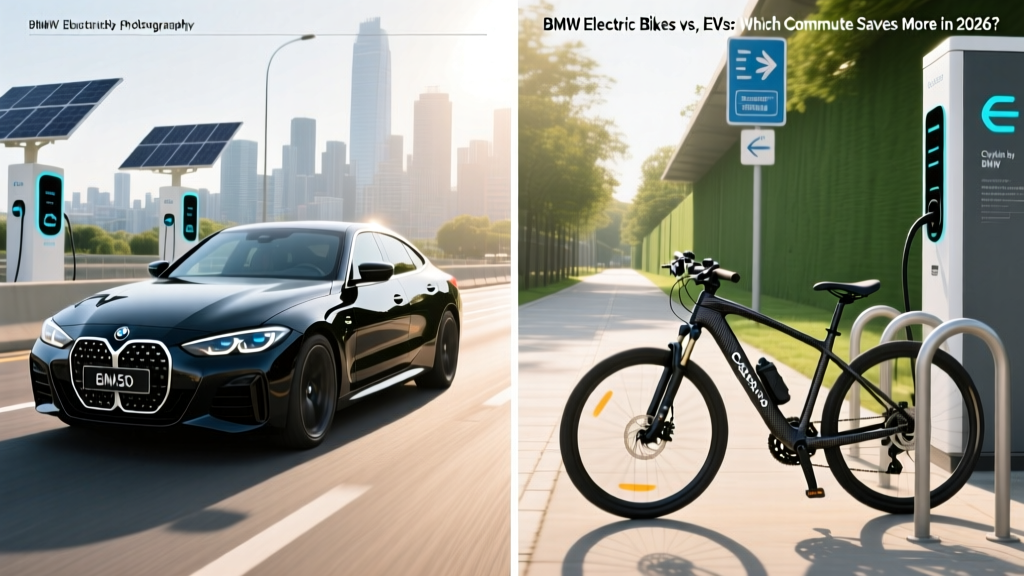
If your commute is under 15 miles round-trip and you have secure bike storage, a BMW e-bike (like the Active Hybrid e-Bike or the BMW M eBike concept) costs roughly $3,500–$5,500 upfront, pennies per charge, and eliminates parking expenses. A compact EV like the Chevrolet Bolt EV or Nissan Leaf costs $28,000–$36,000 before incentives but offers weather protection, cargo space, and year-round practicality. For most U.S. commuters, an EV handles far more daily scenarios — but a BMW e-bike can be a powerful supplemental vehicle that cuts your car usage dramatically.
At AutoEdgeView, we focus on electric cars, trucks, and SUVs — not bicycles or motorcycles. But readers searching for BMW electric bikes are often asking a deeper question: What's the smartest electrified way to handle my daily commute? This guide answers that by comparing BMW's e-bike lineup against a practical compact EV, using real 2026 costs, range figures, and ownership data.
BMW Electric Bikes: What's Actually Available?
BMW has offered bicycles and e-bikes through its lifestyle division for years. The current and recent lineup includes:
- BMW Active Hybrid E-Bike — A pedal-assist city/trekking e-bike with a Shimano drive system, ~60-mile range per charge, and a price around $3,500–$4,000.
- BMW M eBike (concept/limited) — A sportier e-mountain-bike-style model with higher torque output, priced near $5,000–$5,500 when available.
- BMW Cruise e-Bike — A more casual commuter option with pedal assist up to 20 mph (Class 1), typically around $3,000.
These are Class 1 pedal-assist bicycles — they do not have a throttle, and the motor cuts off at 20 mph. They are not electric motorcycles (like the BMW CE 04 scooter, which is a separate product category entirely). BMW e-bikes use mid-drive motors from Shimano or Brose, with battery capacities typically between 400–500 Wh (watt-hours).
Key limitation: BMW e-bikes are sold through select BMW dealerships and the BMW lifestyle shop. Availability in the U.S. is inconsistent, and service/parts support is far less robust than buying from a dedicated e-bike brand like Trek, Specialized, or Rad Power.
Head-to-Head: BMW E-Bike vs. Compact EV for Commuting
To make this comparison concrete, we're pitting the BMW Active Hybrid E-Bike against a 2026 Chevrolet Bolt EV (one of the most affordable new EVs available). Here's how they stack up on the metrics that matter for commuters:
| Spec / Metric | BMW Active Hybrid E-Bike | 2026 Chevrolet Bolt EV |
|---|---|---|
| Base Price | ~$3,800 | $28,785 MSRP (before incentives) |
| Range (per charge) | ~40–60 miles (pedal-assist dependent) | 259 miles EPA (fueleconomy.gov) |
| Battery Capacity | ~504 Wh (0.5 kWh) | 65 kWh (usable) |
| Charge Time (0–100%) | ~3.5 hours (standard outlet) | ~7 hours (Level 2, 240V); ~30 min 10–80% on DC fast charge |
| Energy Cost per "Fill-Up" | ~$0.07 (at $0.14/kWh) | ~$9.10 (at $0.14/kWh) |
| Cost per Mile (energy) | ~$0.001 | ~$0.035 |
| Top Assisted Speed | 20 mph (Class 1) | ~90 mph (electronically limited) |
| Weather Protection | None (rider exposed) | Full climate control, heated seats available |
| Cargo Capacity | Panniers/basket (~30–50 lbs with accessories) | ~27 cu ft trunk (rear seats up) |
| Passengers | 1 (rider only) | 5 |
| Annual Insurance (avg.) | ~$0 (or ~$100–200 via renters/homeowners rider) | ~$1,400–$1,800/year (varies by state/driver) |
| Federal Tax Credit | Not eligible (e-bike credit proposals have not passed as of 2026) | Potentially up to $7,500 via IRS §30D (irs.gov), subject to income, MSRP, and battery-sourcing rules |
Real Costs: 5-Year Commuting Ownership Breakdown
Let's model a 10-mile round-trip commute, 5 days per week, 48 weeks per year — that's 2,400 miles annually. Here's what five years of ownership actually costs for each option:
| Cost Category (5 Years) | BMW E-Bike | 2026 Chevy Bolt EV |
|---|---|---|
| Purchase Price | $3,800 | $28,785 |
| Federal Tax Credit | $0 | −$7,500 (if eligible) |
| Net Purchase Cost | $3,800 | $21,285 |
| Energy Cost (12,000 miles total) | ~$12 | ~$420 |
| Insurance (5 years) | ~$500 (optional rider) | ~$8,000 |
| Maintenance (tires, brakes, fluid, etc.) | ~$600 (chain, tires, brake pads, battery replacement reserve) | ~$1,500 (tires, cabin filter, wipers, brake fluid) |
| Parking (urban avg.) | $0 | ~$3,600 (if paid parking applies) |
| Total 5-Year Cost | ~$5,512 | ~$34,805 |
| Cost per Mile (total) | ~$0.46/mile | ~$2.90/mile |
The e-bike wins on pure cost by a massive margin. But this comparison only covers commuting. The Bolt EV handles weekend trips, grocery runs, airport drives, highway travel, and winter commutes — scenarios where an e-bike falls short.
Real-World Ownership Considerations
Numbers on a spreadsheet don't tell the full story. Here's what actually determines whether a BMW e-bike, an EV, or both make sense for your life:
Climate and Seasonality
If you live in Phoenix, San Diego, or Austin, an e-bike is viable for 10+ months per year. In Chicago, Minneapolis, or Boston? Expect 4–5 months where cold, snow, ice, or darkness make e-bike commuting impractical or unsafe. EVs don't care about weather — though cold temperatures do reduce range by 15–30% in sub-freezing conditions due to battery chemistry limitations and cabin heating demands.
Home Charging and Storage
Both options need a place to charge. An e-bike battery charges from any standard 120V outlet — you can bring the battery inside your apartment. An EV requires either Level 1 (120V, ~4 miles of range per hour) or a Level 2 (240V, ~25–30 miles per hour) home charger. Level 2 installation typically costs $800–$2,500 depending on your electrical panel, but it's the practical standard for daily EV ownership. If you live in an apartment or condo without charging access, an e-bike is dramatically easier to own.
Commute Distance and Route
Under 10 miles on bike-friendly streets or protected lanes? E-bike territory. Over 15 miles, crossing highways, or involving high-speed roads? You need a car. The Bolt EV's 259-mile EPA range means even a 40-mile commute is trivial, with range to spare for errands.
Security and Theft
E-bikes are high-theft targets. You need secure indoor storage at both ends of your commute. A quality U-lock and GPS tracker add $100–$250 to your costs. An EV is locked, alarmed, and far harder to steal.
Common Misconceptions About E-Bikes and EVs
| Myth | Fact |
|---|---|
| "E-bikes are basically free to own." | Energy costs are near-zero, but e-bike batteries degrade. Expect a replacement at 3–5 years for $500–$800. Tires, chains, and brake pads also wear. |
| "EVs are too expensive for commuting." | A Bolt EV after the $7,500 federal credit (if eligible) can drop below $22,000 — and it replaces your car entirely, not just your commute. |
| "BMW e-bikes have BMW engineering." | BMW e-bikes use third-party drivetrains (Shimano/Brose). The BMW badge adds a premium without the drivetrain advantage of a dedicated e-bike brand. |
| "E-bikes don't need a helmet or insurance." | Helmets are legally required in many states for e-bike riders. Insurance isn't mandatory but is strongly recommended — a collision with a car can total the bike and injure the rider. |
| "I can ride an e-bike in winter just fine." | Lithium-ion e-bike batteries lose 20–40% capacity below freezing. Icy roads make two-wheeled travel dangerous. Studded tires help but add cost and noise. |
Decision Framework: What Should You Actually Buy?
If / Then Decision Guide
- IF your commute is under 10 miles, you live in a mild climate, have secure bike parking, and already own a car for longer trips → Consider a BMW e-bike (or better, a Trek/Specialized e-bike with stronger dealer support) as a car-replacement for daily commuting.
- IF you don't own a car and need one vehicle to do everything → Buy a compact EV like the Bolt EV or Hyundai Kona Electric. An e-bike alone cannot replace a car for most U.S. lifestyles.
- IF you already own an EV or gas car and want to cut fuel costs on short trips → Add an e-bike to your household. It's the cheapest miles you'll ever travel.
- IF you're drawn to the BMW brand but want better e-bike support → Look at BMW's e-scooter, the CE 04 (an electric motorcycle, ~$12,000, 50-mile range, highway-capable) — it's a more serious BMW electric vehicle than their bicycles.
- IF you live in a cold/snowy climate → Prioritize an EV. E-bikes are seasonal tools in northern states, not year-round solutions.
What First-Time EV Buyers Should Know
If this comparison has pushed you toward an EV, here are the essentials for a first-time buyer in 2026:
- EPA range is optimistic for highway and cold weather. A 259-mile EPA rating means ~210–230 miles in real-world highway driving, and ~180–200 miles in freezing temperatures. Plan your trips accordingly.
- Home charging is the backbone. Budget $800–$2,500 for a Level 2 (240V) home charger installation. This is where 85%+ of EV charging happens. Without it, EV ownership is significantly harder.
- The §30D federal tax credit has strings. The credit is up to $7,500, but eligibility depends on your income (≤$150,000 single / ≤$300,000 joint), the vehicle's MSRP (≤$55,000 for cars), and battery mineral sourcing requirements that tighten yearly. It can now be applied as a point-of-sale discount. Check current rules at irs.gov and consult a tax professional.
- DC fast charging matters for road trips. Look for peak charge rates (in kW) and 10–80% times. The Bolt EV charges at up to 55 kW on DC — adequate but not fast. Vehicles like the Hyundai Ioniq 5 (peak 240 kW, 10–80% in ~18 minutes) are far better for frequent road-trippers.
- Insurance costs more for EVs. Expect 10–25% higher premiums vs. comparable gas cars due to higher repair costs and battery replacement expense. Get quotes before buying.
Frequently Asked Questions
Are BMW electric bikes good quality?
They're competent city e-bikes with reputable Shimano or Brose drivetrains, but you pay a brand premium. Dedicated e-bike manufacturers (Trek, Specialized, Canyon, Giant) offer better dealer networks, more model choices, and comparable or lower prices. A BMW e-bike is best if you're already a BMW loyalist and value the aesthetic.
Can I get a federal tax credit for an e-bike?
As of 2026, no. Proposed e-bike tax credit legislation (up to $1,500) has been introduced in Congress but has not passed. Only qualified plug-in electric vehicles (cars, trucks, SUVs) are eligible for the IRS §30D credit. Some states and cities offer local e-bike rebates — check your municipality.
How long do e-bike batteries last?
Most lithium-ion e-bike batteries are rated for 500–1,000 charge cycles before dropping to 80% capacity. With daily commuting, that's roughly 3–5 years of useful life. A replacement battery costs $500–$800 for most models. Store the battery indoors and avoid leaving it at 100% or 0% for extended periods to maximize lifespan.
Is an e-bike faster than driving in traffic?
In dense urban areas with bike lanes, yes — e-bikes can average 12–15 mph door-to-door, beating cars stuck in congestion. On suburban arterials or highways, no. A car is dramatically faster for any trip involving roads with speed limits above 35 mph.
What's the cheapest EV to buy in 2026?
The 2026 Chevrolet Bolt EV starts around $28,785 before incentives. If you qualify for the full $7,500 §30D credit, the effective price drops to ~$21,285 — cheaper than many gas-powered compact cars. The Nissan Leaf is also in this price range but uses a CHAdeMO DC charging connector, which has far less public charging infrastructure than the CCS or NACS standards.