What Do Blink EV Rates Actually Cost?
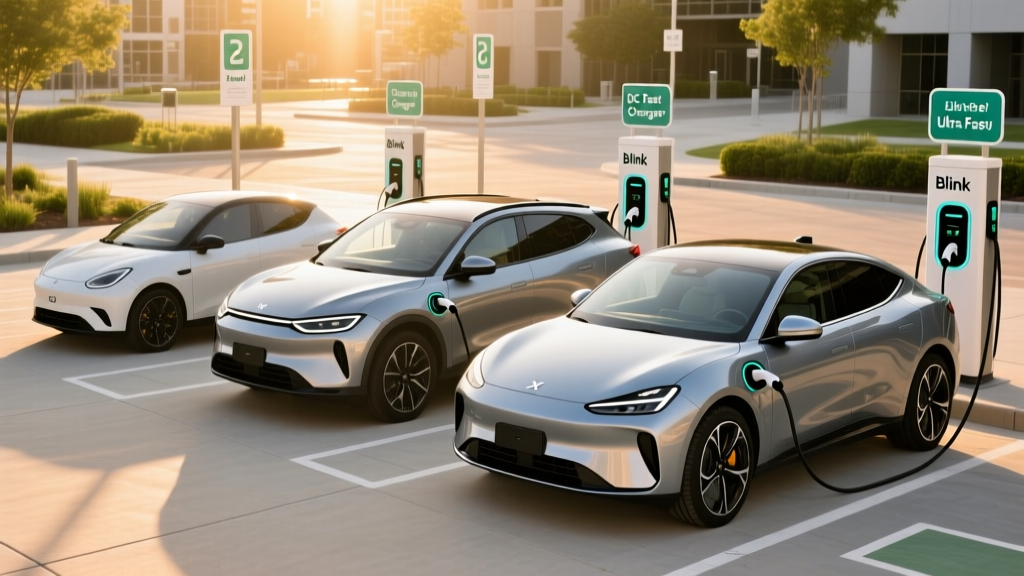
Blink's public charging rates in 2026 typically range from $0.39 to $0.79 per kWh for DC fast charging and $0.29 to $0.49 per kWh for Level 2 charging, depending on your state, the host site, and whether you're a Blink Member or a Guest user. Some locations also add a $1.00–$2.00 session fee on top of energy charges. Blink Members (free to join) save roughly $0.10–$0.15/kWh versus Guest rates. Compared to home Level 2 charging at the US average electricity rate of ~$0.17/kWh, Blink's DC fast charging costs roughly 3–4x more per mile driven.
If you've pulled up to a Blink charger and been surprised by the final cost, you're not alone. Blink operates one of the largest public charging networks in the US, with over 60,000 charging ports across all 50 states, but its pricing structure isn't always transparent at the plug. Understanding exactly what you'll pay — and how it stacks up against competing networks and home charging — is essential for budgeting real EV ownership.
How Blink Pricing Works: Per-kWh, Session Fees, and Membership
Blink uses two primary pricing components:
- Energy charge (per kWh): You pay for the actual electricity delivered to your vehicle, measured in kilowatt-hours (kWh). Remember: kWh is energy (what goes into your battery); kW is power (how fast it flows). You're billed on kWh.
- Session fee (flat): Some Blink host locations — particularly retail and workplace sites — add a flat per-session fee of $1.00–$2.00, regardless of how much energy you draw.
Blink offers two user tiers:
- Guest users: No account required. You pay the higher posted rate at the station, typically $0.49–$0.79/kWh for DC fast charging.
- Blink Members: Free to create an account and load funds. Members receive a discounted rate, typically $0.10–$0.15/kWh less than Guest pricing. Members also get access to the Blink app for remote session monitoring and charging history.
One important caveat: Blink does not set a single national price. Each charging station's rate is determined in part by the host property (shopping center, workplace, parking garage, etc.), which means two Blink stations in the same city can have meaningfully different rates. Always check the Blink app or the on-screen display before initiating a session.
Blink EV Rates vs. Competing Networks: A Cost Comparison
To put Blink's pricing in context, here's how typical 2026 rates compare across major US public charging networks for DC fast charging:
| Network | Typical DC Fast Rate (per kWh) | Session Fee | Membership Discount | Connector Types |
|---|---|---|---|---|
| Blink | $0.39–$0.79 | $0–$2.00 | ~$0.10–$0.15/kWh off | CCS, CHAdeMO, some NACS |
| Electrify America | $0.43–$0.56 | None | Pass+ ($4/mo): ~10–15% off | CCS, NACS (via adapter) |
| EVgo | $0.36–$0.52 | None | EVgo Plus ($4.99/mo): ~$0.10/kWh off | CCS, NACS, CHAdeMO |
| Tesla Supercharger | $0.25–$0.38 | None | N/A (same for all) | NACS (CCS via adapter for non-Tesla) |
| Home Level 2 (avg US) | $0.12–$0.22 | None | N/A | J1772 / NACS |
Sources: Network apps, fueleconomy.gov, and real-world user reports as of early 2026. Rates vary by location and time of day.
The key takeaway: Blink sits in the mid-to-upper range of public DC fast charging pricing. Tesla Superchargers remain the cheapest major network, while Electrify America and EVgo are generally comparable to or slightly cheaper than Blink at the median.
Real-World Cost to Charge: Blink vs. Gas vs. Home Charging
Let's translate per-kWh rates into something that matters: what it actually costs to drive 100 miles. We'll use a 2026 Hyundai Ioniq 5 (Long Range RWD, 84 kWh usable battery, EPA-estimated 303 miles range, ~28 kWh/100 mi efficiency) as our baseline EV, and a 2026 Toyota RAV4 (28 MPG combined) as the gas comparison.
| Charging/Fueling Method | Cost per kWh or Gallon | Cost per 100 Miles | Annual Cost (12,000 mi) |
|---|---|---|---|
| Home Level 2 (US avg $0.17/kWh) | $0.17/kWh | $4.76 | $571 |
| Blink DC Fast (Guest, ~$0.59/kWh avg) | $0.59/kWh | $16.52 | $1,982 |
| Blink DC Fast (Member, ~$0.47/kWh avg) | $0.47/kWh | $13.16 | $1,579 |
| Electrify America (~$0.48/kWh avg) | $0.48/kWh | $13.44 | $1,613 |
| Tesla Supercharger (~$0.30/kWh avg) | $0.30/kWh | $8.40 | $1,008 |
| Gas (RAV4, 28 MPG, $3.40/gal) | $3.40/gal | $12.14 | $1,457 |
Gas price source: US Energy Information Administration (EIA), weekly average regular gasoline, early 2026. Electricity rates from EIA state averages.
The data reveals a critical ownership truth: if you rely exclusively on Blink DC fast charging at Guest rates, you'll pay more per mile than driving a comparable gas car. The EV cost advantage exists primarily when you charge at home or use lower-cost networks like Tesla Superchargers.
However, most EV owners don't rely solely on public fast charging. The typical split is 80–90% home charging and 10–20% public/DC fast charging for road trips. At that ratio, your blended annual fueling cost drops to roughly $700–$900 — still significantly cheaper than gas.
Blink Level 2 Charging: Slower but Cheaper
Blink also operates thousands of Level 2 (AC) charging stations, typically delivering 7.2 kW to 19.2 kW of power. These are common at workplaces, shopping centers, and parking structures where you might park for 1–4 hours.
Level 2 Blink rates generally run $0.29–$0.49/kWh, with some locations offering free charging as a host-sponsored amenity. At $0.39/kWh, charging that same Ioniq 5 for 100 miles costs about $10.92 — still more than home charging but competitive with gas.
Level 2 is practical when:
- You can park for 2+ hours (workplace, shopping, movies)
- Your battery is above 20% and you just need a partial top-up
- You don't have access to home charging and need a reliable daily supplement
Level 2 is impractical for road trips, where DC fast charging at 50–350 kW can add 150–250 miles of range in 20–30 minutes.
Common Misconceptions About Blink and Public Charging Costs
| Myth | Fact |
|---|---|
| "All public chargers cost the same" | Rates vary dramatically by network, host site, state, and even time of day. Two Blink stations 5 miles apart can differ by $0.20/kWh. |
| "EVs are always cheaper to fuel than gas cars" | Only true when you charge primarily at home. Exclusive reliance on premium DC fast charging (Blink Guest, EA) can exceed gas costs per mile. |
| "I need a Blink membership to use their chargers" | No. Guest access is available at all Blink stations, though at a higher per-kWh rate. Membership is free and saves $0.10–$0.15/kWh. |
| "Blink chargers are all DC fast chargers" | Blink operates both Level 2 (AC, 7–19 kW) and DC fast (50–350 kW) stations. The majority of Blink's network is actually Level 2. |
| "Public charging will damage my battery" | Occasional DC fast charging has minimal impact on modern battery health. Sustained exclusive fast charging may accelerate degradation by 1–3% over 5 years compared to Level 2-only charging, per NREL studies. |
Who Should Use Blink — and Who Shouldn't?
Actionable Decision Framework
Use Blink regularly if:
- Your workplace, gym, or frequent shopping center has Blink Level 2 chargers and you can top up during normal activities
- You live in an apartment or condo without home charging access and Blink stations are conveniently located near your routine
- You're a Blink Member capturing the discounted rate, bringing costs closer to $0.39–$0.47/kWh for DC fast
- You drive a vehicle with CCS or CHAdeMO and Blink is the most available network in your area
Look elsewhere or prioritize home charging if:
- You have access to home Level 2 charging — at $0.12–$0.22/kWh, it's 3–5x cheaper than Blink DC fast
- You frequently road-trip on corridors well-served by Tesla Superchargers ($0.25–$0.38/kWh) or Electrify America
- You're a Guest user hitting Blink DC fast chargers regularly — the $0.59–$0.79/kWh rate erodes EV savings fast
- You drive a NACS-equipped vehicle (2025+ Ford, GM, Rivian, etc.) and find Blink's NACS availability limited in your region
Real-World Ownership Considerations Beyond the Per-kWh Rate
The per-kWh rate tells only part of the story. Here's what experienced EV owners factor in:
Charging speed and taper: Blink's DC fast chargers range from 50 kW legacy units to newer 180 kW and 350 kW stations. Peak rate matters, but so does the charge curve. Most EVs taper charging speed significantly above 80% State of Charge (SoC). A station advertising 180 kW peak might deliver an average of 90–110 kW across a 10–80% session, taking 25–35 minutes for a typical 80 kWh battery.
Station reliability: Blink's uptime has improved but remains inconsistent across locations. Check the Blink app for real-time station status before driving to a charger. Having a backup network (EVgo, Electrify America) in your area is wise.
Idle fees: Some Blink locations impose idle fees if your vehicle remains plugged in after charging completes. These can run $0.20–$0.50/minute — a $15–$30 surprise if you're shopping for an hour after your session ends.
Cold-weather impact: In freezing temperatures, expect 20–30% range loss and slower charging speeds unless your EV has battery preconditioning. This means you'll need more kWh (and more money) to cover the same distance in winter.
Federal tax credit context: Under current IRS §30D rules, new EV buyers may qualify for up to $7,500 in federal tax credits, subject to MSRP caps ($55,000 for sedans, $80,000 for SUVs/trucks), buyer income limits ($150K single / $300K joint), and battery critical-mineral sourcing requirements. The credit can now be transferred at point of sale, reducing your purchase price directly. These savings can offset years of public charging premiums.
Frequently Asked Questions About Blink EV Rates
Is Blink more expensive than other charging networks?
At Guest rates ($0.49–$0.79/kWh DC fast), Blink is among the more expensive major networks. As a Member ($0.39–$0.64/kWh), it becomes competitive with Electrify America and EVgo but still trails Tesla Superchargers ($0.25–$0.38/kWh) in most regions.
Does Blink charge by the minute or by the kWh?
Blink charges by the kWh (energy delivered) at the vast majority of its stations. A small number of legacy locations in states with utility-regulated pricing may charge by time (per minute), but this is increasingly rare. Session fees, where applied, are flat per-session charges.
Can I use a Blink charger without downloading the app?
Yes. Most Blink stations accept credit card payment directly at the terminal. However, you'll pay the Guest rate. Creating a free Blink account and loading funds via the app unlocks Member pricing.
How do I find the cheapest Blink station near me?
The Blink app shows real-time rates for each station. Third-party apps like PlugShare and ChargeHub also list Blink stations with user-reported pricing. Rates can vary within the same city, so it pays to compare before you drive.
Is it cheaper to charge at Blink or fill up with gas?
It depends on your rate tier and vehicle efficiency. At Blink Member DC fast rates (~$0.47/kWh) with an efficient EV like the Ioniq 5, you'll pay ~$13.16 per 100 miles — roughly comparable to a 28 MPG gas car at $3.40/gallon ($12.14). At Blink Guest rates, gas is cheaper. Home Level 2 charging ($4.76 per 100 miles) is where EVs clearly win.
Does Blink offer any subscription plans?
Blink's membership is free — no monthly fee. This differs from Electrify America's Pass+ ($4/month) or EVgo's Plus ($4.99/month). You simply create an account and receive the Member discount automatically.
Understanding Blink EV rates is ultimately about knowing when public charging makes financial sense and when it doesn't. For road-trip top-ups or apartment-dwellers without home access, Blink's wide network is a practical lifeline. For daily charging, nothing beats the economics of a home Level 2 setup — and that remains the single biggest factor in whether an EV saves you money or costs you more than the gas car it replaced.