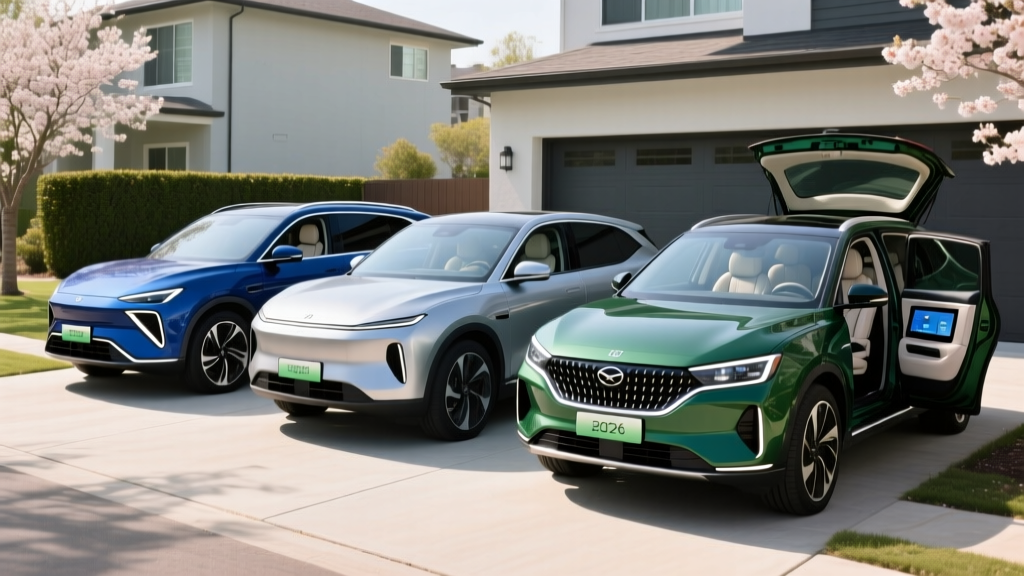
The short answer: If you need three rows of seating in an electric SUV in 2026, your strongest options are the Kia EV9 (279 mi EPA range, from ~$54,900), the Tesla Model X (335 mi EPA, from ~$79,990), and the Rivian R1S (up to 352 mi EPA, from ~$75,900). The Hyundai Ioniq 9 (announced, ~2026 launch) and refreshed Cadillac Escalade IQ round out the field. For most families, the EV9 Land offers the best balance of range, charging speed, price, and third-row usability — but only if you have reliable Level 2 home charging.
Why the 3 Row EV Market Finally Makes Sense for Families
Two years ago, shopping for a 3 row EV meant accepting compromise: either you paid over $80,000 for a Tesla Model X or Rivian R1S, or you settled for sub-250-mile range. In 2026, the segment has matured. The Kia EV9 has anchored the sub-$60K tier, Hyundai's Ioniq 9 is entering production, and legacy luxury brands have fielded competitive entries. The real shift isn't just more models — it's that 800-volt architectures now deliver 10-80% DC fast charges in roughly 20 minutes on the best platforms, making road trips with kids genuinely viable.
But families have specific needs that single-row commuters don't. Third-row cargo with seats up, LATCH accessibility across rows, towing for the boat or camper, and cold-weather range headroom all matter more when you're hauling five or six passengers. This guide breaks down what each model actually delivers beyond the press release.
Side-by-Side: 2026 3 Row EV Spec Comparison
| Spec | Kia EV9 Land AWD | Tesla Model X LR | Rivian R1S Dual Max | Cadillac Escalade IQ |
|---|---|---|---|---|
| EPA Range | 279 mi | 335 mi | 352 mi (Max pack) | ~450 mi (est.) |
| Battery (usable) | 99.8 kWh (NMC) | ~100 kWh (NMC) | 149 kWh (NMC) | ~200 kWh (NMC, Ultium) |
| Peak DC Charge | 236 kW (800V) | 250 kW | 200 kW | ~200 kW |
| 10–80% DCFC | ~24 min | ~30 min | ~35 min | ~40 min |
| Level 2 Rate | 10.9 kW | 11.5 kW | 11.5 kW | 19.2 kW |
| 0–60 mph | 5.0 sec | 3.8 sec | 4.5 sec | ~4.5 sec |
| Horsepower | 379 hp | 670 hp | 665 hp | 750 hp |
| Towing (max) | 5,000 lb | 5,000 lb | 7,700 lb | 8,000 lb |
| Cargo (behind 3rd) | 20.2 cu ft | ~15 cu ft | ~11 cu ft | ~23 cu ft |
| Base MSRP | $59,900 | $79,990 | $75,900 | ~$129,990 |
| Federal §30D Credit | Eligible (see IRS rules) | Eligible | Eligible | Eligible (MSRP cap applies) |
| Battery Warranty | 10 yr / 100,000 mi | 8 yr / 150,000 mi | 8 yr / 175,000 mi | 8 yr / 100,000 mi |
Sources: fueleconomy.gov, manufacturer spec pages. All figures reflect latest available 2025–2026 model year data. Range is EPA combined; real-world highway and cold-weather results will be lower.
Real-World Range Reality: A Kia EV9 rated at 279 mi EPA will typically return 230–250 mi on sustained 70–80 mph highway driving, and as low as 190–210 mi in sub-30°F winter conditions. The Rivian R1S Max pack's 352 mi EPA is more forgiving — expect ~290–310 mi highway. Always plan road trips around 80% of EPA range for comfort, especially with a full cabin of passengers and cargo.
EV vs. Gas 3-Row SUV: The Cost Reality
The most common question from family shoppers: does a 3 row EV actually save money versus a gas or hybrid SUV like the Toyota Grand Highlander Hybrid or Kia Telluride? The answer depends on your mileage, electricity cost, and how long you keep the vehicle.
| Cost Factor | Kia EV9 Land AWD | Kia Telluride SX-Prestige (Gas) | Toyota Grand Highlander Hybrid |
|---|---|---|---|
| MSRP (approx.) | $59,900 | $52,585 | $53,070 |
| Federal Tax Credit (§30D) | Up to $7,500* | $0 | $0 |
| Effective Purchase Price | ~$52,400 | $52,585 | $53,070 |
| Fuel/Energy Cost (15,000 mi/yr) | ~$650/yr** | ~$2,100/yr | ~$1,500/yr |
| Maintenance (annual avg.) | ~$300 | ~$700 | ~$600 |
| 5-Year Fuel + Maint. | ~$4,750 | ~$14,000 | ~$10,500 |
| Estimated Insurance (annual) | ~$2,200 | ~$1,700 | ~$1,750 |
*§30D eligibility depends on buyer income caps ($300K joint / $150K single), MSRP cap ($80K for SUVs), and battery critical-mineral sourcing. Verify at IRS.gov before purchase. Credit can be transferred at point of sale as a purchase-price reduction.
**Assumes $0.14/kWh national average home charging. Public DC fast charging costs significantly more ($0.35–$0.55/kWh).
The EV9 reaches cost parity with the gas Telluride within roughly 3 years of ownership when the federal credit applies and most charging is done at home. Insurance premiums remain 15–30% higher on EVs due to repair costs and parts pricing — a real expense that offsets some fuel savings.
Real-World Ownership: What First-Time 3 Row EV Buyers Must Know
Home Charging Is Non-Negotiable for Families
A 3 row EV with a ~100 kWh battery takes 9–11 hours on a Level 2 (240V, 48A) home charger from near-empty to full. Without home charging, you'll be visiting DC fast stations 2–3 times per week on school-commute mileage alone. Budget $800–$2,000 for a quality Level 2 charger (ChargePoint Home Flex, Wallbox Pulsar Plus, or the included Kia/Genesis portable unit) plus $500–$2,500 for electrician installation. If your home has a 100A electrical panel, expect a $1,500–$3,500 panel upgrade to support a 60A circuit.
Cold Climate Range Loss Is Real
In sustained sub-30°F temperatures, NMC batteries lose 20–35% of EPA-rated range. The EV9's heat pump helps, but families in Minnesota or Maine should plan for 190–210 real-world winter miles and route accordingly. Battery preconditioning (available on Tesla, Rivian, and Kia when navigating to a charger) mitigates charging-speed loss in cold weather — use it every time.
Third-Row and Cargo Trade-Offs
No 3 row EV matches the cargo volume of a minivan with all seats up. The EV9's 20.2 cu ft behind the third row is class-leading, enough for a double stroller and groceries. The Model X and R1S are tighter. If you regularly need all seven seats and cargo, consider whether a PHEV minivan (the Chrysler Pacifica Hybrid offers 32 mi electric-only range plus gas flexibility) better fits your pattern.
Charging on Road Trips with Kids
The EV9's 800V architecture delivers a genuine advantage: 10–80% in roughly 24 minutes at a 350 kW Electrify America or Tesla Supercharger (with NACS adapter). That's one bathroom-and-snack stop. The R1S's larger battery means longer charge sessions (~35 min 10–80%) but fewer stops overall. Plan routes through A Better Route Planner to model real stops with your typical passenger/cargo load.
Common Misconceptions About 3 Row EVs
| Myth | Fact |
|---|---|
| "The battery will need replacing in 5 years." | Modern NMC packs lose roughly 8–12% capacity over 100,000 miles. All models here carry 8–10 year battery warranties with a 70% capacity retention guarantee. |
| "You can't tow with an electric SUV." | The R1S tows 7,700 lb and the Escalade IQ targets 8,000 lb. Towing does cut range by 35–50%, but for short boat/camper hauls it's practical. |
| "Charging takes hours." | On a 350 kW DC fast charger, the EV9 adds ~150 miles in 15 minutes. Home Level 2 charging happens overnight while you sleep. |
| "The federal tax credit is gone." | As of 2026, the §30D credit remains available up to $7,500 for eligible buyers and vehicles, with point-of-sale transfer. Sourcing rules have tightened — confirm eligibility on IRS.gov. |
| "All 3 row EVs are over $80,000." | The EV9 starts at ~$54,900 (RWD) and ~$59,900 for the dual-motor AWD Land trim, making it competitive with loaded gas SUVs after the credit. |
Cost Breakdown: 5-Year Total Cost of Ownership
| Category | Kia EV9 Land AWD | Kia Telluride SX (Gas) |
|---|---|---|
| Purchase Price (after §30D) | $52,400 | $52,585 |
| Home Charger + Install | $2,000 | $0 |
| Fuel/Energy (5 yr, 75K mi) | $3,250 | $10,500 |
| Maintenance (5 yr) | $1,500 | $3,500 |
| Insurance (5 yr) | $11,000 | $8,500 |
| Estimated Depreciation (5 yr) | $22,000 | $20,000 |
| 5-Year Total | ~$90,150 | ~$95,085 |
The EV9's lower fuel and maintenance costs offset its higher insurance and depreciation, resulting in roughly $5,000 in savings over five years. The gap widens significantly if gas prices rise or if your utility offers off-peak EV charging rates below $0.10/kWh.
Decision Framework: Which 3 Row EV Fits Your Family?
Choose the Kia EV9 if: You want the best value, have home Level 2 charging, drive under 300 miles/day, and prioritize third-row cargo space. The Land AWD trim at ~$59,900 (potentially ~$52,400 after credit) is the sweet spot.
Choose the Tesla Model X if: Supercharger network access matters most to you, you value performance (3.8s 0–60), and your budget exceeds $80K. The falcon-wing doors help with car-seat loading but add repair complexity.
Choose the Rivian R1S if: You need serious towing (7,700 lb), off-road capability, and maximum range (352 mi EPA with the Max pack). It's the outdoor-adventure family's pick, though the ~$75,900 starting price reflects that.
Choose the Cadillac Escalade IQ if: Budget is flexible ($130K+), you want maximum luxury and range (~450 mi est.), and you value 19.2 kW Level 2 charging for faster overnight fills.
Consider a PHEV instead if: You lack home charging, regularly drive 400+ miles in a day, or live in a region with sparse DC fast-charging infrastructure. The Chrysler Pacifica Hybrid or Toyota Grand Highlander Hybrid eliminate range anxiety while still reducing fuel consumption.
Frequently Asked Questions
Is a 3 row EV practical for a family of five or more?
Yes, with caveats. Third-row seat comfort and LATCH accessibility vary. The EV9 and Escalade IQ offer the most usable third rows for adults on longer trips. For families with three car seats, verify LATCH positions — most EVs only offer LATCH on the second-row outboard seats, meaning a third car seat must go in the third row or use a seatbelt install.
How much does it cost to charge a 3 row EV at home?
A full charge of the EV9's ~100 kWh battery at the $0.14/kWh national average costs roughly $14, yielding about 279 miles of EPA range. That compares to $60–$80 for a tank of gas in the Telluride. Annual home-charging cost for 15,000 miles of driving is approximately $650.
Do 3 row EVs qualify for the $7,500 federal tax credit?
Several do, but eligibility is not universal. The §30D credit requires buyer income below $300,000 (joint) or $150,000 (single), an MSRP below $80,000 for SUVs, and compliance with battery critical-mineral and component sourcing rules. The Escalade IQ exceeds the MSRP cap. Always verify current eligibility at IRS.gov before committing to a purchase.
What about the Hyundai Ioniq 9?
The Ioniq 9 has been announced as a 2026 model sharing the EV9's E-GMP platform and 800V architecture, with targeted range of 300+ miles. Final EPA figures, pricing, and availability were not confirmed at the time of writing. We'll update this guide when official specs are published.
How does cold weather affect a 3 row EV's range?
Expect 20–35% range reduction in sustained sub-30°F temperatures, primarily from cabin heating demand and reduced battery efficiency. A heat pump (standard on the EV9, Model X, and R1S) recovers some of this loss. Precondition the battery before DC fast charging in cold weather to maintain charge speeds.
Should I wait for more 3 row EV options?
The segment is expanding — the Ioniq 9, VW ID. Buzz (3-row minivan), and potential entries from GM and Stellantis are in the pipeline. However, if you need a family EV now, the current lineup is genuinely competitive. Waiting means forgoing current §30D credit rules, which could change with future legislation.