Quick Answer: Is the Aventon Abound Electric Cargo Bike Worth It?
The Aventon Abound is a Class II electric cargo bike priced at $1,799 with a 720 Wh battery delivering roughly 25–50 miles of real-world range depending on pedal-assist level and cargo weight. It costs pennies per mile to charge, carries up to 440 lbs of cargo/passengers, and eliminates parking, insurance, and registration fees. However, it is not a full car replacement for most households — it excels as a last-mile commuter, school-run hauler, or grocery-getter within a 10–15 mile radius. If your daily trips are under 20 miles round-trip and you have secure storage, the Abound pays for itself within months compared to driving a gas car, and still undercuts a compact EV on pure operating cost.
What the Aventon Abound Actually Is (and Isn't)
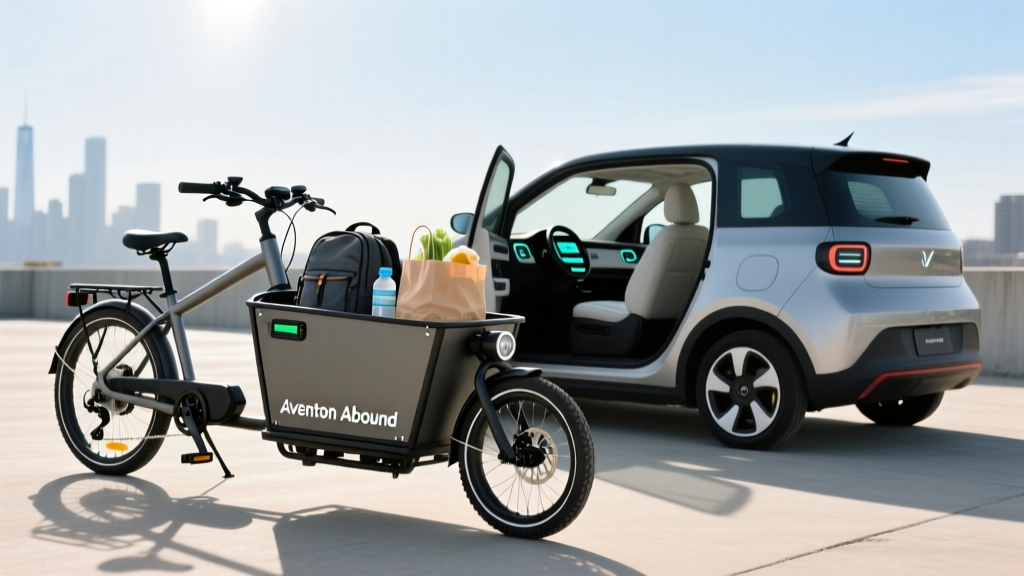
The Aventon Abound is a step-through electric cargo bike built around a 500W rear-hub motor (peaking at ~750W) and a removable 48V, 15Ah (720 Wh) lithium-ion battery. It ships as a Class II e-bike, meaning throttle-assisted up to 20 mph. Aventon also offers the Abound SR (speed-restricted) and the Abound LR variant with a larger battery for extended range.
Key specifications for the standard Abound:
- Motor: 500W nominal / ~750W peak, rear hub
- Battery: 48V × 15Ah = 720 Wh (removable, keyed lock)
- Claimed range: Up to 50 miles (pedal-assist level 1, flat terrain, light load)
- Real-world range: 25–35 miles at PAS 3–4 with 50+ lbs of cargo
- Top speed: 20 mph (Class II throttle-limited)
- Payload capacity: 440 lbs total (rider + cargo)
- Rear rack: Rated for 143 lbs (fits two child seats or large panniers)
- Charge time: ~4.5 hours from 0–100% on the included 2A charger
- Weight: ~81 lbs (bike) + ~8 lbs (battery)
- Price: $1,799 MSRP
For context, this battery stores 0.72 kWh of energy — roughly 1/100th of a Tesla Model Y's ~75 kWh pack. That's the fundamental physics constraint: an e-bike battery is measured in watt-hours (Wh), not kilowatt-hours (kWh) like a car. The energy density is low, but so is the vehicle mass, which is why efficiency per mile is outstanding.
Aventon Abound vs Compact EV: The Cost Breakdown
The most common question from prospective Abound buyers is whether it can replace a second car or complement one. Let's compare the Abound against a popular compact EV — the Chevrolet Equinox EV (2025 base 2LT, ~$33,000 after destination) — over a 5-year ownership horizon assuming 5,000 miles/year of local commuting and errands.
| Cost Category | Aventon Abound | Chevy Equinox EV (2LT) |
|---|---|---|
| Purchase price | $1,799 | $33,600 |
| Federal tax credit (§30D) | $0 (e-bikes excluded) | Up to $7,500 (if eligible*) |
| Net acquisition cost | $1,799 | $26,100 (best case) |
| Annual insurance | $0–$150 (optional) | ~$1,400 |
| Registration/title | $0 | ~$150/yr |
| Energy cost per mile | ~$0.005 (at $0.14/kWh) | ~$0.04 (at $0.14/kWh, 3.2 mi/kWh) |
| 5-year energy (25,000 mi) | ~$125 | ~$1,000 |
| Maintenance (5 yr) | ~$400 (tires, brakes, tune-ups) | ~$600 (tires, cabin filter, fluid top-offs) |
| 5-year total cost | ~$2,774 | ~$35,950 |
| Cost per mile (all-in) | ~$0.11/mi | ~$1.44/mi |
*The IRS §30D clean vehicle credit applies only to four-wheeled vehicles meeting MSRP caps, buyer income limits, and battery-sourcing requirements. E-bikes are not eligible. Always verify current-year eligibility with a tax professional.
The Abound's total 5-year cost is roughly 1/13th that of the Equinox EV. But this comparison is only valid for the trips the Abound can actually replace — short, low-speed, fair-weather rides within its range.
Real-World Range: What 720 Wh Actually Gets You
Aventon advertises up to 50 miles, but that figure assumes pedal-assist level 1, a lightweight rider, flat terrain, and no cargo. In practice, energy consumption on a cargo e-bike scales dramatically with load and assist level.
| Scenario | PAS Level | Load | Est. Range | Wh/mile |
|---|---|---|---|---|
| Light commute, flat | 1–2 | 170 lb rider | 40–50 mi | 14–18 |
| Mixed commute, some hills | 3 | 170 lb rider | 28–35 mi | 20–26 |
| School run + groceries | 3–4 | Rider + 2 kids + 40 lbs | 18–25 mi | 29–40 |
| Heavy cargo, hilly | 4–5 | Rider + 100 lbs cargo | 14–20 mi | 36–51 |
At PAS 4–5 with a heavy load, the 720 Wh battery can drain in under 20 miles. This is the single biggest ownership surprise for new cargo e-bike buyers: range collapses under load. If your round-trip commute with cargo exceeds 15 miles, you should consider the Abound LR variant or plan mid-day charging.
Charging the battery from empty takes approximately 4.5 hours on the included 2-amp charger (48V × 2A = 96W input). There's no DC fast-charging equivalent here — you plug into a standard 120V outlet. For daily use, most owners charge overnight and start each morning at 100%.
Charging at Home: Trivially Easy (and Cheap)
Unlike an electric car, which may require a $500–$2,000 Level 2 home charger installation, the Abound's battery is removable. You carry it inside like a laptop and plug it into any standard wall outlet. This eliminates the biggest barrier to EV ownership: home charging infrastructure.
The cost to fully charge the 720 Wh battery at the U.S. average residential rate of ~$0.14/kWh (per EIA data) is approximately:
0.72 kWh × $0.14 = ~$0.10 per full charge
Over a year of daily charging (365 × $0.10), you'd spend roughly $36.50 on electricity — less than a single tank of gas. Even at 5,000 miles per year, annual energy cost hovers around $25–$50 depending on your local rate and assist habits.
Common Misconceptions About E-Cargo Bikes
| Myth | Fact |
|---|---|
| "E-bikes are just toys, not real transportation" | The Abound carries 440 lbs — two children plus groceries — at 20 mph for 20+ miles. That covers ~59% of all U.S. vehicle trips (under 6 miles, per NHTS data). |
| "You need a special outlet or electrician" | The battery charges on any standard 120V household outlet. No installation required. |
| "E-bikes don't work in cold weather" | Lithium-ion batteries lose ~15–30% capacity below 32°F, but the Abound remains rideable. Store the battery indoors and insert it before riding to mitigate loss. |
| "E-bikes are unsafe in traffic" | The Abound includes integrated turn signals, a headlight, and a horn. Protected bike-lane infrastructure continues expanding in most metro areas. |
| "I'll save more buying a cheap used EV" | A $15,000 used EV still costs ~$1,200/yr in insurance plus registration. The Abound's all-in annual cost is under $300. |
Who Should Buy the Aventon Abound — and Who Shouldn't
The Abound occupies a specific niche. It is not for everyone, and pretending otherwise leads to buyer's remorse. Here's a practical decision framework:
Choose the Aventon Abound if:
- Your daily trips are under 15 miles round-trip
- You have secure storage (garage, shed, or indoor space — 81 lbs is a theft target)
- You want to replace car trips for school drop-off, groceries, or commuting
- You live in a metro area with bike lanes or low-traffic routes
- Your budget is under $2,500 and you want zero ongoing registration/insurance costs
- You're a second-car household looking to downsize to one car + one e-bike
Choose a compact EV instead if:
- You regularly drive more than 30 miles round-trip
- You need climate-controlled comfort year-round (rain, snow, extreme heat)
- You carry more than two passengers regularly
- You need highway-speed travel (45+ mph roads are unsafe on an e-bike)
- You require cargo space exceeding ~6 cubic feet (the Abound's rear rack + panniers)
- You have no secure ground-level storage for the bike
First-Time E-Bike Buyer Essentials
If you've never owned an electric vehicle of any kind, the Abound is a low-risk entry point — but there are ownership realities to understand:
Battery Longevity
The Abound's lithium-ion pack is rated for approximately 500–800 full charge cycles before capacity drops to ~80% of original. At daily charging, that's roughly 2–3 years before you notice meaningful range reduction. A replacement battery from Aventon typically costs $300–$400. Store the battery at 40–60% charge if you won't ride for several weeks, and never leave it fully depleted in freezing temperatures.
Maintenance
E-bikes require more mechanical maintenance than EVs: chain lubrication every few hundred miles, brake pad replacement every 1,000–2,000 miles (the Abound uses hydraulic disc brakes), and annual tune-ups at a local bike shop (~$80–$120). Tires on a cargo bike wear faster due to load — budget $40–$60 per tire annually if you ride daily.
Legal Classification
As a Class II e-bike, the Abound is legal on most bike paths and lanes where bicycles are permitted, with a motor-assisted top speed of 20 mph. Some municipalities restrict Class II throttle use on multi-use paths — check your local regulations. No license, registration, or insurance is required in most U.S. states, though a growing number of cities are debating helmet mandates for e-bike riders.
Theft Prevention
E-cargo bikes are high-value theft targets. Budget $50–$100 for a quality U-lock or chain lock, and consider a GPS tracker (~$30/year for service). Always remove the battery when parking in public — it's the most expensive single component.
Final Numbers: 5-Year Ownership at a Glance
| Metric | Aventon Abound | Compact EV (e.g., Equinox EV) | Gas Compact (e.g., Civic) |
|---|---|---|---|
| Upfront cost | $1,799 | ~$33,600 | ~$25,000 |
| Annual energy/fuel | ~$37 | ~$200 | ~$900 |
| Annual insurance | $0–$150 | ~$1,400 | ~$1,200 |
| Annual maintenance | ~$80 | ~$120 | ~$400 |
| 5-year total | ~$2,774 | ~$35,950 | ~$32,250 |
| Range per fill/charge | 25–50 mi | ~315 mi (EPA) | ~350 mi |
| Trips it can replace | ~50–60% of car trips | ~99% of car trips | ~99% of car trips |
The Abound doesn't compete with an EV on capability — it competes on cost per trip replaced. If 60% of your driving is short local errands, the Abound can absorb those trips at a fraction of a cent per mile, leaving your car (or a smaller, cheaper car) for the remaining 40%.
Does the Aventon Abound qualify for any tax credits?
No. The federal §30D clean vehicle credit applies only to four-wheeled motor vehicles. E-bikes are not eligible. Some states and municipalities offer e-bike rebates or incentive programs (Colorado, for example, has offered e-bike tax credits). Check your state energy office for current programs.
How long does the Aventon Abound battery last before replacement?
Expect 500–800 full charge cycles before the battery drops to ~80% capacity. With daily use, that translates to roughly 2–3 years of optimal range, after which you'll still have usable range but reduced distance per charge. Replacement batteries cost approximately $300–$400 from Aventon.
Can I ride the Abound in the rain?
Yes. The Abound is rated IPX4 for water resistance, meaning it handles rain and splashes. Avoid submerging the motor or battery, and dry the chain after wet rides to prevent rust. Fenders are included.
Is the Abound powerful enough for hills with cargo?
The 500W nominal / 750W peak hub motor handles moderate grades (5–8%) with cargo, but steep hills (10%+) with a full load will slow you to 8–12 mph and consume battery rapidly. If your route is consistently hilly with heavy cargo, consider a mid-drive cargo e-bike (like the RadWagon 5 or Tern GSD) which leverages the bike's gears for better hill-climbing torque.
How does the Abound compare to other electric cargo bikes?
At $1,799, the Abound undercuts competitors like the RadWagon 5 ($1,999), Tern GSD S10 (~$5,299), and Lectric XPress 750 ($1,799). It offers solid build quality and integrated accessories (lights, fenders, rear rack) at the lower end of the price spectrum. The trade-off is a hub motor (less efficient on hills than mid-drive) and a 720 Wh battery that's smaller than some competitors. For flat-to-moderate terrain and budget-conscious buyers, it's one of the strongest value propositions in the segment.