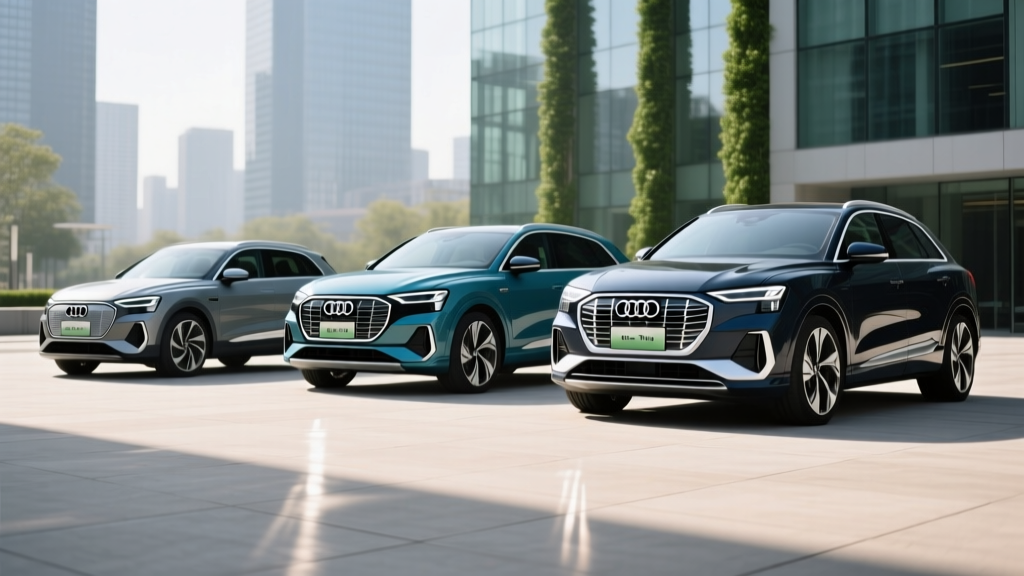
Quick Answer: Audi's 2026 SUV EV lineup spans three distinct tiers. The Q4 e-tron starts at $49,800 with up to 265 miles of EPA range and is the entry point for luxury electric driving. The new Q6 e-tron ($63,800) delivers 321 miles EPA on its 100 kWh battery with 270 kW DC fast charging. The flagship Q8 e-tron ($74,000) offers the most space and comfort at 285 miles EPA. None currently qualify for the full $7,500 federal §30D tax credit due to battery-sourcing requirements, but lease incentives and state rebates may apply.
Why an Audi SUV EV Makes Sense in 2026
Audi has quietly built one of the most complete electric SUV lineups in the luxury segment. Rather than a single halo vehicle, the brand offers three battery-electric SUVs covering the compact, midsize, and full-size categories. Each rides on a dedicated EV platform, uses modern battery chemistry, and supports DC fast charging well above the 150 kW threshold that separates adequate from excellent public charging performance.
For buyers cross-shopping an Audi SUV EV against a BMW iX, Mercedes EQB/EQE SUV, Tesla Model Y, or Genesis Electrified GV70, the decision hinges on range efficiency, charging infrastructure compatibility, and total ownership cost — not just badge prestige. Let's break down the numbers.
2026 Audi Electric SUV Lineup: Specs at a Glance
| Spec | Q4 e-tron (55 quattro) | Q6 e-tron (quattro) | Q8 e-tron (55 quattro) |
|---|---|---|---|
| Base MSRP | $49,800 | $63,800 | $74,000 |
| EPA Range | 265 mi | 321 mi | 285 mi |
| Battery (usable) | 77 kWh (NMC) | 94.9 kWh (NMC) | 106 kWh (NMC) |
| Peak DC Charge Rate | 175 kW | 270 kW | 170 kW |
| 10–80% DC Fast Charge | ~28 min | ~21 min | ~31 min |
| Level 2 Charge Rate | 11 kW | 11 kW | 11 kW |
| Horsepower | 340 hp | 456 hp | 402 hp |
| 0–60 mph | 5.0 sec | 4.6 sec | 5.4 sec |
| MPGe (combined) | 97 MPGe | 100 MPGe | 83 MPGe |
| Cargo Volume | 24.8 cu ft (rear seats up) | 28.6 cu ft | 28.2 cu ft |
| Battery Warranty | 8 yr / 100,000 mi | 8 yr / 100,000 mi | 8 yr / 100,000 mi |
Sources: fueleconomy.gov, Audi USA. Specs reflect 2026 model year.
Real-World Range: What to Actually Expect
EPA vs. Reality: The EPA sticker is a blended-cycle estimate. In real-world ownership, expect the following adjustments:
- Highway driving (70–80 mph): Subtract 10–15% from EPA. The Q6 e-tron's 321-mile rating drops to roughly 270–290 miles at sustained highway speeds.
- Cold weather (below 32°F): Expect 20–30% range loss without preconditioning. A Q4 e-tron rated at 265 miles may deliver 185–210 miles in freezing temperatures on short trips where the cabin heater cycles frequently.
- Mountain/terrain driving: Regenerative braking recovers some energy on descents, but sustained climbs consume significantly more. Budget 15–20% extra consumption on routes with 3,000+ feet of elevation gain.
The Q6 e-tron's advantage here is clear: its 321-mile EPA rating provides a larger buffer against real-world losses. On a cold-weather road trip, the Q6 e-tron still delivers usable 240+ mile segments between charges, while the Q4 e-tron and Q8 e-tron may require stops every 180–200 miles in winter conditions.
All three models feature a heat pump as standard equipment, which reduces cold-weather HVAC energy draw compared to resistive heating. Preconditioning the battery via the Audi app while plugged in at home also preserves range by warming the pack before departure using grid power rather than battery energy.
Charging Speed and Infrastructure Compatibility
This is where the generational gap between Audi's EVs becomes obvious. The Q6 e-tron, built on the newer PPE (Premium Platform Electric) architecture co-developed with Porsche, supports up to 270 kW peak DC fast charging. At an Electrify America or compatible 350 kW station, the Q6 e-tron can add roughly 160 miles of range in 10 minutes under ideal conditions.
The Q4 e-tron (MEB platform, shared with VW ID.4) peaks at 175 kW, while the Q8 e-tron (older J1 platform, related to the Porsche Taycan and e-tron GT) tops out at 170 kW. Neither is slow by absolute standards, but both add roughly 100–120 miles in that same 10-minute window.
| Charging Level | Power | Approx. Miles Added/Hour | Typical Use Case |
|---|---|---|---|
| Level 1 (120V) | 1.4 kW | 3–4 mi/hr | Emergency / overnight trickle |
| Level 2 (240V) | 11 kW | 28–35 mi/hr | Home daily charging |
| DC Fast (Q4/Q8) | 170–175 kW | ~600–700 mi/hr (peak) | Road trips, 10–80% in 28–31 min |
| DC Fast (Q6) | 270 kW | ~950+ mi/hr (peak) | Road trips, 10–80% in ~21 min |
Connector note: All 2026 Audi SUV EVs sold in North America ship with a NACS (Tesla-style) charge port, following the industry-wide transition. CCS1 adapters are available for legacy Electrify America and third-party stations still equipped with CCS connectors. This eliminates the connector-compatibility concern that existed in earlier model years.
Charge curve reality: Peak kW ratings are not sustained across the entire session. The Q6 e-tron's 270 kW peak occurs between roughly 10–30% SoC and tapers to ~150 kW by 60%, then ~80 kW by 80%. This is normal lithium-ion charging physics, not a defect. Plan road-trip stops to charge from 10–80% rather than waiting for a full charge — the final 20% can take as long as the first 70%.
Cost of Ownership: Audi SUV EV vs. Gas Equivalent
The upfront price of an Audi electric SUV is higher than a comparable gas-powered Audi Q5 or Q7, but operating costs shift the equation over time. Here's a five-year comparison assuming 12,000 miles/year and national average electricity/fuel prices.
| Cost Category | Q6 e-tron (EV) | Audi Q5 45 TFSI (Gas) |
|---|---|---|
| Base MSRP | $63,800 | $48,600 |
| Federal Tax Credit (§30D) | $0 (sourcing rules)* | $0 |
| 5-Year Fuel/Energy | $4,500 (home charging avg) | $10,200 (premium gas @ $4.10/gal, 25 MPG) |
| 5-Year Maintenance | ~$1,800 | ~$4,200 |
| 5-Year Insurance (est.) | $12,600 | $9,900 |
| Estimated 5-Year Depreciation | $28,000 | $22,000 |
| 5-Year Total Cost | ~$110,700 | ~$94,900 |
*As of 2026, Audi's electric SUVs do not meet the IRS §30D critical-mineral and battery-component sourcing requirements for the full $7,500 credit. Lease arrangements may qualify for the $7,500 commercial clean vehicle credit passed through as a lease incentive — confirm with your dealer and tax professional.
The EV saves roughly $8,500 in fuel and maintenance over five years, but higher insurance premiums and steeper depreciation partially offset those gains. The break-even point against the Q5 arrives around year 7–8 for most owners, or sooner if you have access to free/cheap workplace charging or live in a state with additional EV rebates.
Home Charging Cost Advantage
The $4,500 five-year energy estimate assumes 80% home charging at the national average residential rate of ~$0.16/kWh. If you rely exclusively on public DC fast charging at $0.40–$0.55/kWh, your five-year energy cost climbs to $9,000–$11,000, nearly matching gas. Home charging access is the single largest variable in EV ownership economics.
A Level 2 home charger installation (40-amp circuit, 240V) typically costs $800–$2,000 including equipment, electrician labor, and permitting. If your electrical panel requires an upgrade to 200 amps, add $1,500–$3,500. Most Audi EV owners install a Level 2 unit in the first month and charge overnight, waking to a full battery daily.
Federal and State Incentives: What Actually Applies
2026 §30D Federal Tax Credit Checklist for Purchase:
- Vehicle MSRP must not exceed $80,000 for SUVs (all three Audi models qualify at base; loaded trims may exceed the cap)
- Buyer modified AGI must not exceed $150,000 (single) / $300,000 (joint filing)
- Battery critical minerals must be sourced from US or FTA partners (currently disqualifies most Audi models)
- Battery components must be manufactured/assembled in North America (currently disqualifies most Audi models)
- Point-of-sale transfer available if all criteria are met — reduces dealer price directly
Because Audi's battery supply chain does not yet satisfy the sourcing thresholds, purchasing an Audi SUV EV in 2026 generally does not unlock the $7,500 credit. However, leasing bypasses this limitation — the commercial clean vehicle credit (§45W) can be claimed by the leasing company and passed through as a capitalized-cost reduction. Many Audi dealers advertise $7,500 lease credits on the Q4 e-tron and Q6 e-tron. Always confirm the credit is reflected in the lease terms, not just mentioned verbally.
State-level incentives vary widely. California's CVRP, Colorado's innovative motor vehicle credit, and various utility rebates can stack additional savings. Check your state energy office and local utility for current programs.
Common Misconceptions About Audi Electric SUVs
| Myth | Fact |
|---|---|
| "The battery will need replacement in 5 years" | Audi warranties the battery for 8 years/100,000 miles with a minimum 70% capacity retention threshold. Real-world degradation data from similar NMC packs shows ~8–12% loss over 100,000 miles. Full replacement (rare) costs $15,000–$22,000 out of warranty. |
| "You can't road-trip an EV" | The Q6 e-tron's 321-mile range and 21-minute 10–80% charging at 270 kW makes 500+ mile trips practical with one well-timed stop. The Electrify America and Tesla Supercharger networks cover all major US highway corridors. |
| "EVs are cheaper to own from day one" | Higher purchase price, insurance, and depreciation mean EVs typically break even around year 5–8 vs. gas equivalents, depending on charging costs and incentives. EVs are not universally cheaper — they shift costs from fuel to upfront purchase. |
| "All Audi EVs charge at the same speed" | The Q6 e-tron's PPE platform charges 55% faster (270 kW peak) than the Q4 e-tron (175 kW) or Q8 e-tron (170 kW). Platform generation matters significantly for road-trip convenience. |
| "You need a Tesla to use Superchargers" | Since 2024, Tesla has opened Supercharger access to non-Tesla EVs with NACS connectors. All 2026 Audi SUV EVs ship with NACS ports and can use the Tesla app to initiate charging at participating stations. |
Decision Framework: Which Audi SUV EV Is Right for You?
Choose the Q4 e-tron if:
- Your budget is under $55,000
- You primarily drive in-city and suburban routes under 50 miles/day
- You want the lowest entry price into Audi's EV lineup
- Compact dimensions matter for parking and urban maneuverability
Choose the Q6 e-tron if:
- You take regular road trips and want the fastest charging (270 kW) in the lineup
- You need 300+ miles of real-world range buffer for cold climates or highway driving
- You want the latest PPE platform technology and newest interior tech (dual-screen OLED, Android Automotive OS)
- Budget allows $65,000–$75,000 depending on options
Choose the Q8 e-tron if:
- You prioritize rear-seat comfort, ride quality, and cabin quietness over maximum range
- You need the most cargo and passenger space (similar footprint to a gas Q7)
- You value the air suspension and premium luxury features
- You're upgrading from a large luxury gas SUV and want a direct electric equivalent
Consider a PHEV (like the Audi Q5 TFSI e) instead if:
- You lack reliable home or workplace charging access
- You frequently drive 400+ mile routes through rural areas with sparse charging infrastructure
- You want electric commuting (23 miles EPA electric-only) without range compromise on longer trips
First-Time EV Buyer Essentials
If this is your first electric vehicle, three practical realities shape daily ownership:
1. Home charging is non-negotiable for convenience. Public-only charging is possible but adds 2–4 hours/week of dedicated charging time and costs 2–3× more per mile than home electricity. Before purchasing, confirm you can install a 240V/40-amp circuit near your parking spot. Renters and condo dwellers should investigate shared charging options or workplace charging before committing.
2. Plan around the 80% rule on road trips. Charging from 80–100% at a DC fast charger takes dramatically longer than 10–80% due to the charge curve taper. Plan your stops to arrive at 10–15% SoC and depart at 80%. This maximizes time spent driving versus time spent charging.
3. Winter requires active planning. Precondition your battery (via the myAudi app) before arriving at a DC fast charger in cold weather. The battery thermal management system will warm the pack to optimal charging temperature, reducing your stop from 40+ minutes to the rated ~21–31 minutes. Always charge to 80%+ before a cold morning departure to account for range loss during the day.
Frequently Asked Questions
Do any Audi electric SUVs qualify for the $7,500 federal tax credit in 2026?
Not through direct purchase — Audi's battery supply chain does not currently meet the IRS §30D critical-mineral and component-sourcing requirements. However, leasing an Audi EV often qualifies for the commercial clean vehicle credit, which dealers typically pass through as a $7,500 lease incentive. Confirm the incentive in writing before signing.
How long does it take to charge an Audi SUV EV at home?
With a Level 2 charger (11 kW / 48-amp circuit), the Q4 e-tron charges from 0–100% in approximately 7.5 hours, the Q6 e-tron in ~9 hours, and the Q8 e-tron in ~10 hours. Most owners charge from 20–80% overnight (roughly 4–6 hours), which is the recommended daily practice for battery longevity.
Is the Audi Q6 e-tron better than the Tesla Model Y?
They serve different priorities. The Q6 e-tron offers superior interior materials, a quieter cabin, more advanced driver-assist features (adaptive cruise with lane centering is standard), and a more traditional luxury dealership experience. The Model Y leads in charging network reliability (Supercharger exclusives), software updates, and cargo space. The Q6 e-tron's 321-mile EPA range edges the Model Y Long Range's ~310 miles, and its 270 kW peak charging is competitive. Choose Audi for luxury refinement; choose Tesla for ecosystem efficiency and value.
What happens if the battery degrades significantly?
Audi's battery warranty guarantees at least 70% capacity retention for 8 years or 100,000 miles, whichever comes first. If capacity drops below this threshold under normal use, Audi will repair or replace the battery at no cost. Real-world data from similar NMC battery packs suggests 8–12% degradation over 100,000 miles, well within the warranty buffer. Full out-of-warranty replacement costs $15,000–$22,000 depending on the model, but this scenario is uncommon within the first decade of ownership.
Can I tow with an Audi electric SUV?
The Q8 e-tron is rated to tow up to 4,000 pounds, the Q6 e-tron up to 4,400 pounds, and the Q4 e-tron up to 2,600 pounds. Note that towing reduces range by 30–50% depending on trailer weight and aerodynamics. If you tow frequently, the Q6 e-tron's combination of higher tow rating and longest range makes it the most practical choice.