Quick Answer: Which Audi Electric SUV Fits You?
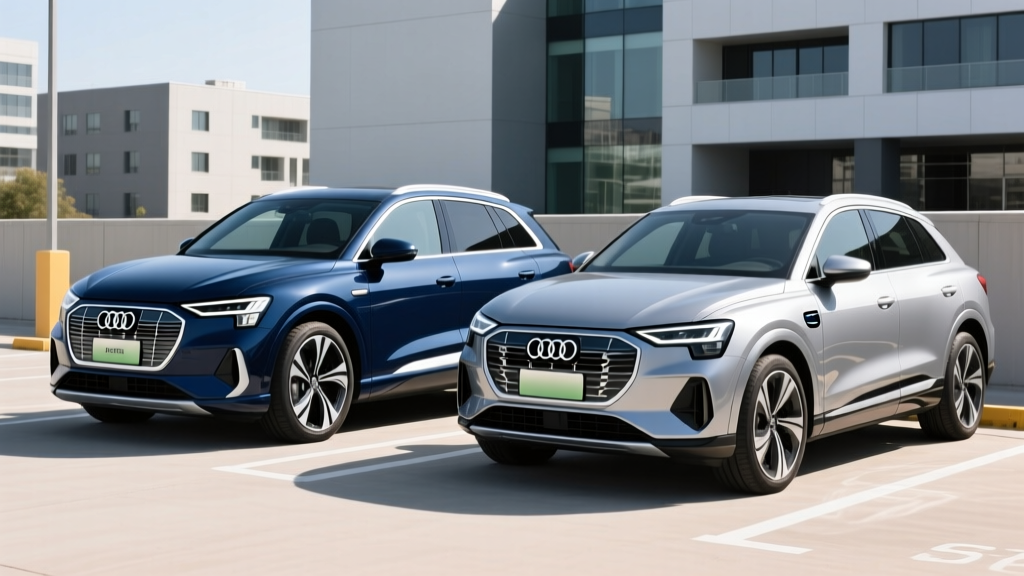
If you're shopping for an Audi electric SUV in 2026, Audi offers two core battery-electric options: the compact Q4 e-tron (starting around $49,800, EPA range up to 265 miles) and the midsize Q8 e-tron (starting around $74,400, EPA range up to 285 miles). The Q4 e-tron is the volume play — lower entry price, efficient 82 kWh battery, and DC fast charging to 175 kW. The Q8 e-tron delivers premium space, air suspension, and a larger 114 kWh battery with 170 kW peak charging. Neither currently qualifies for the full $7,500 federal §30D tax credit due to battery sourcing rules, but point-of-sale lease credits may apply. Your choice comes down to budget, cargo needs, and whether you prioritize value or flagship luxury.
Audi's Electric SUV Lineup at a Glance
Audi's BEV strategy in the US centers on two SUVs built on different Volkswagen Group platforms. The Q4 e-tron rides on the MEB platform (shared with the VW ID.4), while the Q8 e-tron uses the larger MLB-evo architecture. Both are available in standard and Sportback (coupe-roof) body styles, though the Sportback sacrifices some cargo volume for style.
| Spec | Q4 e-tron (Premium) | Q4 e-tron (Prestige AWD) | Q8 e-tron (Premium) | Q8 e-tron (Prestige) |
|---|---|---|---|---|
| Base MSRP | $49,800 | $58,200 | $74,400 | $82,800 |
| EPA Range | 265 mi (RWD) | 242 mi (AWD) | 285 mi (AWD) | 275 mi (AWD) |
| Battery (usable) | 82 kWh (NMC) | 82 kWh (NMC) | 114 kWh (NMC) | 114 kWh (NMC) |
| Horsepower | 282 hp (RWD) | 340 hp (AWD) | 402 hp (AWD) | 402 hp (AWD) |
| 0-60 mph | 7.5 sec | 5.7 sec | 5.5 sec | 5.5 sec |
| Max DC Fast Charge | 175 kW | 175 kW | 170 kW | 170 kW |
| 10-80% DC Time | ~28 min | ~28 min | ~31 min | ~31 min |
| Level 2 Rate | 11.5 kW | 11.5 kW | 11.5 kW | 11.5 kW |
| MPGe (combined) | 114 MPGe | 99 MPGe | 87 MPGe | 86 MPGe |
| Cargo (behind 2nd row) | 24.8 cu ft | 24.8 cu ft | 28.5 cu ft | 28.5 cu ft |
| Battery Warranty | 8 yr / 100,000 mi | 8 yr / 100,000 mi | 8 yr / 100,000 mi | 8 yr / 100,000 mi |
Sources: EPA / fueleconomy.gov, Audi USA. Real-world highway range typically runs 10-15% below EPA; cold weather (below 30°F) can reduce range by 20-30%.
Real-World Range: What the EPA Sticker Doesn't Tell You
EPA range estimates assume a mix of city and highway driving at moderate temperatures. In practice, your mileage will vary — sometimes significantly.
Real-World Range Expectations
Q4 e-tron AWD (EPA 242 mi): Expect ~210-220 mi on a flat highway at 70 mph in mild weather. In winter (20-30°F), plan for 170-190 mi. City driving with regen braking can push to 250+ mi.
Q8 e-tron (EPA 285 mi): Expect ~245-260 mi highway at 70 mph in mild weather. Winter drops this to 200-225 mi. The Q8's larger battery provides a bigger buffer, but its heavier curb weight (~5,800 lbs) and lower efficiency work against it on long road trips.
Both models use NMC (nickel manganese cobalt) battery chemistry, which offers higher energy density than LFP but is more sensitive to sustained high states of charge. Audi recommends daily charging to 80% for battery longevity and reserving 100% for road trips. The battery management system includes a buffer (roughly 5-7 kWh unusable) to protect against deep discharge and overcharge degradation.
The Q8 e-tron's thermal management system is more robust, with a dedicated heat pump standard on most trims. The Q4 e-tron includes a heat pump on higher trims (standard on Prestige). A heat pump is critical in cold climates — it can recover 5-8% of range in sub-freezing conditions by efficiently heating the cabin without drawing heavily from the traction battery.
Charging Speed and Infrastructure Reality
Charging speed is where many luxury EV buyers get surprised. Peak kW is a headline number; sustained charging matters more.
| Level | Power | Q4 e-tron (mi/hr) | Q8 e-tron (mi/hr) | Typical Use |
|---|---|---|---|---|
| Level 1 (120V) | 1.4 kW | ~4 mi/hr | ~3.5 mi/hr | Emergency / overnight trickle |
| Level 2 (240V, 48A) | 11.5 kW | ~32 mi/hr | ~28 mi/hr | Home daily charging |
| DC Fast (peak) | 175 / 170 kW | ~190 mi in 10 min | ~170 mi in 10 min | Road trips |
Charging curve reality: Neither Audi sustains peak kW for the full session. The Q4 e-tron hits 175 kW briefly around 20-30% SoC, then tapers to ~120 kW by 50%, and drops below 60 kW past 80%. The Q8 e-tron's curve is flatter but peaks lower — it holds ~150 kW from 10-40%, then tapers. This is why 10-80% times (~28-31 min) are the relevant metric, not peak kW.
Both models use the CCS1 connector natively. Audi has confirmed NACS (Tesla-style) adapter compatibility, enabling access to Tesla Superchargers with an adapter (sold separately, ~$200). This significantly expands road-trip charging options, particularly in rural corridors where Supercharger stations outnumber Electrify America and EVgo locations.
Home charging setup: A Level 2 home charger is practically mandatory for Audi e-tron ownership. At 11.5 kW, you'll need a 240V / 60A circuit (hardwired) or a NEMA 14-50 outlet on a 50A breaker. Installation costs typically run $800-$2,500 depending on panel proximity and whether your electrical panel needs an upgrade (200A service recommended). Plan for a full charge from 10-100% in about 8.5 hours (Q4) or 11 hours (Q8) on Level 2.
Audi Electric SUV vs Gas: The Cost Breakdown
How does an Audi e-tron stack up against its gas-powered counterpart? Let's compare the Q4 e-tron against the Audi Q5 (2.0T quattro), a similarly sized gas SUV.
| Cost Factor | Q4 e-tron AWD (Prestige) | Audi Q5 2.0T quattro (Premium Plus) |
|---|---|---|
| Base MSRP | $58,200 | $52,400 |
| Federal Tax Credit (§30D) | $0 (sourcing rules)* | $0 |
| Home Charger Install | $1,500 | $0 |
| Fuel / Electricity (5 yr) | $4,200 (home + public)** | $12,750 (premium gas @ $4.25/gal, 25 MPG) |
| Maintenance (5 yr) | $1,800 | $4,500 |
| Insurance (5 yr avg) | $11,500 | $9,200 |
| Estimated Depreciation | $24,000 | $19,500 |
| 5-Year Total Cost | $77,200 | $78,350 |
*As of 2026, Audi e-tron models do not meet §30D critical mineral and battery component sourcing requirements for the purchase credit. Lease customers may benefit from the commercial clean vehicle credit (§45W) passed through as a lease incentive — confirm with your dealer. IRS §30D rules.
**Electricity cost assumes 70% home charging at $0.16/kWh national avg and 30% public DC at $0.45/kWh. Your rate varies by utility and state.
The Q4 e-tron reaches near cost-parity with the Q5 over five years despite a higher sticker price, driven by fuel and maintenance savings. EV maintenance skips oil changes, spark plugs, and transmission fluid — you're mainly paying for tire rotations, cabin air filters, brake fluid checks, and wiper blades. Regenerative braking also extends pad life significantly.
However, the Q8 e-tron tells a different story. At $74,400+, it competes with the Q7 and SQ7, where the gas alternatives start $15,000-$20,000 lower. The fuel savings are real but take 7-8 years to close that gap. The Q8 e-tron is a luxury-first purchase; cost savings are a bonus, not the primary draw.
Federal Tax Credits and Incentive Reality
This is where Audi buyers face the toughest news. Under current IRS §30D rules, the federal clean vehicle credit requires:
- MSRP cap: SUVs must be under $80,000 (most Q4 e-tron trims qualify; Q8 e-tron Prestige may exceed)
- Income cap: AGI below $300,000 (joint) / $225,000 (head of household) / $150,000 (single)
- Battery sourcing: Critical minerals and battery components must meet phased-in percentages from US or FTA-partner countries — Audi's current supply chain does not meet these thresholds
- Assembly: Final assembly must occur in North America (the Q4 e-tron is built in Zwickau, Germany; the Q8 e-tron in Brussels, Belgium — neither qualifies)
The practical result: neither Audi electric SUV qualifies for the $7,500 purchase credit in 2026. However, leasing bypasses the sourcing and assembly requirements through the §45W commercial credit, which the leasing company can pass through as a capitalized cost reduction (typically $7,500 off the lease). If you're flexible on ownership vs. lease, this is the most reliable path to incentive savings on an Audi e-tron.
Check your state for additional incentives — California, Colorado, New York, and others offer $2,000-$5,000 rebates that stack regardless of federal eligibility. Utility companies also frequently offer $500-$1,000 rebates for home charger installation.
Common Misconceptions About Audi Electric SUVs
| Myth | Fact |
|---|---|
| "The battery will need replacing in 5 years" | Audi warranties the battery for 8 years/100,000 miles against degradation below 70% capacity. Industry data shows NMC packs losing ~10-15% over 8 years with normal use. Full replacement (if out of warranty) runs $15,000-$22,000 — rare but not free. |
| "I can't road trip in an EV" | With 242-285 mi EPA range and 10-80% DC charging in ~30 min, road trips require planning but are routine. Electrify America (which Audi partnered with on early charging) and Tesla Superchargers (via NACS adapter) cover most interstate corridors. |
| "EVs are worse in winter" | Range drops 20-30% in cold weather — real and measurable. But EVs start reliably in any temperature (no cold-crank issues), and preconditioning while plugged in warms the battery and cabin using grid power, preserving range. |
| "Public charging is always broken" | Reliability varies by network. Tesla Superchargers (via adapter) consistently exceed 95% uptime. Electrify America and EVgo average 85-90%. Use PlugShare or A Better Routeplanner to verify station status before trips. |
| "Insurance costs will bankrupt me" | EV insurance runs 15-25% higher than equivalent gas cars due to repair costs and battery replacement risk. Shop quotes from GEICO, State Farm, and EV-specialty carriers before buying — premiums vary widely by ZIP code and driving record. |
Who Should Buy an Audi Electric SUV — and Who Shouldn't
Decision Framework: Is an Audi e-tron Right for You?
Choose the Q4 e-tron if:
- Your budget is $50,000-$60,000 and you want a premium compact EV SUV
- Your daily commute is under 80 miles round-trip (easily covered on a single charge)
- You have access to Level 2 home or workplace charging
- You value the Audi interior quality and virtual cockpit over maximum range
- You're open to leasing to capture the $7,500 incentive pass-through
Choose the Q8 e-tron if:
- You need midsize SUV space (28.5 cu ft cargo, more rear legroom) and don't mind the $74K+ entry
- You want air suspension, available massage seats, and a quieter cabin at highway speed
- You regularly drive 200+ miles between charges and want the larger 114 kWh battery buffer
- Cost-per-mile savings aren't your primary purchase motivation
Look elsewhere (non-Audi) if:
- You need 320+ miles of range — consider the Tesla Model Y Long Range (320 mi) or Rivian R1S (up to 410 mi with Max Pack)
- Federal tax credit eligibility on purchase is essential — the Tesla Model Y, Ford Mustang Mach-E (select trims), and Chevy Equinox EV currently qualify
- You need three rows of seating — neither Audi e-tron SUV offers this; look at the Kia EV9 or Rivian R1S
- You lack any home or workplace charging access and live in an area with sparse public DC infrastructure — a PHEV like the Audi Q5 TFSI e (23 mi electric-only + gas) may be more practical
First-Time EV Buyer: What You Must Know Before Signing
If the Audi e-tron is your first EV, here are the ownership realities no brochure will tell you:
1. Home charging is non-negotiable for convenience. Relying solely on public charging turns a 10-second plug-in at home into a 30-minute detour 2-3 times a week. If you can't install Level 2 at home (apartment, street parking, older electrical panel), seriously evaluate whether an EV fits your lifestyle now — or whether a PHEV bridges the gap.
2. Your electrical panel may need an upgrade. A 60A circuit for a Level 2 charger requires spare capacity on your panel. Homes with 100A service often need a $2,000-$4,000 upgrade to 200A. Get an electrician's assessment before committing to the car.
3. Preconditioning is your secret weapon. Both Audi e-trons let you set a departure time while plugged in. The car warms or cools the battery and cabin using grid power, so you leave with a full charge and an efficient battery temperature. In winter, this alone can recover 15-20 miles of range.
4. Tire wear accelerates on EVs. The Q4 e-tron weighs ~4,700 lbs; the Q8 e-tron, ~5,800 lbs. Instant torque plus heavy weight wears tires 20-30% faster than gas equivalents. Budget $1,200-$1,800 for a set of EV-rated touring tires every 30,000-35,000 miles.
5. Depreciation is steeper than gas Audi SUVs. EV resale values have softened since 2023 as prices dropped and battery tech evolved. Expect 40-50% depreciation over 5 years vs. 35-40% for a Q5. Leasing transfers this risk to the lessor — another reason leasing is popular on e-trons.
Frequently Asked Questions
Does any Audi electric SUV qualify for the $7,500 federal tax credit?
Not on purchase, as of 2026. Neither the Q4 e-tron nor Q8 e-tron meets the §30D battery sourcing or North American assembly requirements. However, leasing either model typically unlocks a $7,500 lease incentive passed through from the commercial clean vehicle credit. Confirm with your Audi dealer's finance department.
How long does it take to charge an Audi e-tron at home?
On a Level 2 home charger (11.5 kW, 240V/48A), the Q4 e-tron charges from empty to full in about 8.5 hours; the Q8 e-tron takes about 11 hours. Most owners plug in nightly and wake up to a full battery — you rarely charge from 0%. A typical 40-mile daily drive uses about 15-18 kWh, replenished in under 2 hours on Level 2.
Can I use Tesla Superchargers with an Audi e-tron?
Yes, with a CCS-to-NACS adapter (approximately $200 from Audi or third-party suppliers). This opens access to 25,000+ Supercharger stalls nationwide. Charging speed is limited by the Audi's onboard acceptance rate (170-175 kW peak), not the Supercharger's capability.
What happens if the battery degrades significantly?
Audi's battery warranty covers capacity loss below 70% of original for 8 years or 100,000 miles. If degradation triggers a warranty claim, Audi will repair or replace modules to restore capacity above the threshold. Out-of-warranty full battery replacement costs $15,000-$22,000 depending on model, but industry data suggests most NMC packs retain 85-90% capacity at 100,000 miles with proper care (avoiding frequent 100% charges and excessive DC fast charging).
Is the Audi Q4 e-tron or Q8 e-tron better for road trips?
The Q8 e-tron has the edge for long-distance travel: 285 miles EPA range (43 more than the Q4 AWD), a larger battery buffer for detours, and a more comfortable highway ride with standard air suspension. However, its lower efficiency (87 MPGe vs. 99 MPGe for the Q4 AWD) means you'll stop slightly more often per mile traveled. Both handle road trips well with 10-80% DC charging in ~30 minutes — plan stops around the 200-mile mark in real-world conditions.
Should I buy or lease my Audi electric SUV?
In 2026, leasing is the financially stronger path for most buyers. The $7,500 commercial credit pass-through effectively lowers the capitalized cost, monthly payments can be comparable to financing (despite higher money factors), and you transfer depreciation risk to the lessor. If you drive under 15,000 miles/year and prefer swapping vehicles every 36 months, lease. If you plan to keep the car 6+ years, drive high mileage, or want equity buildup, buying makes sense — but accept that you'll pay the full sticker without federal credit assistance.