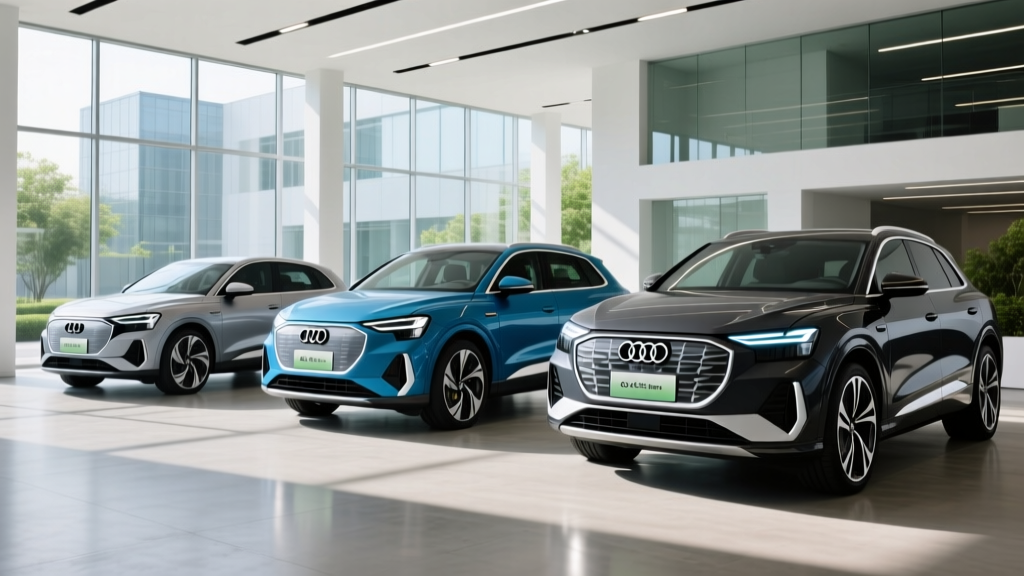
If you're researching an Audi SUV electric vehicle in 2026, you have three distinct options spanning from a compact crossover to a full-size luxury haul. The Q4 e-tron starts at roughly $49,800 and delivers up to 265 miles of EPA range, making it the entry point. The all-new Q6 e-tron sits in the middle at $63,800 with up to 321 miles and 270 kW DC fast charging on the PPE platform. The flagship Q8 e-tron (formerly just "e-tron") tops the range at $74,400 with 285 miles and the most cargo space. Your best choice depends on budget, daily commute distance, and whether you need third-row-adjacent utility or cutting-edge 800-volt charging architecture.
Quick Verdict: Which Audi Electric SUV Is Right for You?
- Choose the Q4 e-tron if you want the most affordable entry into Audi's EV lineup, commute under 40 miles daily, and can charge at home on Level 2.
- Choose the Q6 e-tron if you prioritize fast road-trip charging (10–80% in ~21 min), the latest tech platform, and mid-size luxury.
- Choose the Q8 e-tron if you need maximum cargo volume, air suspension comfort, and don't mind paying a premium for flagship refinement.
The 2026 Audi Electric SUV Lineup at a Glance
Audi's electric SUV strategy covers three size and price tiers. All three use the North American Charging Standard (NACS) connector for the 2026 model year, granting access to Tesla Supercharger stations alongside Electrify America and other networks. Here's how the spec sheets stack up:
| Spec | 2026 Q4 e-tron | 2026 Q6 e-tron | 2026 Q8 e-tron |
|---|---|---|---|
| EPA Range (max config) | 265 mi | 321 mi | 285 mi |
| Battery (usable) | 77 kWh (NMC) | 94.4 kWh (NMC) | 106 kWh (NMC) |
| Peak DC Charge Rate | 175 kW | 270 kW | 170 kW |
| 10–80% DCFC Time | ~28 min | ~21 min | ~31 min |
| Level 2 Rate | 11 kW (48A) | 11 kW (48A) | 11 kW (48A) |
| Horsepower | 282 hp (quattro) | 456 hp (quattro) | 402 hp (quattro) |
| 0–60 mph | 6.2 sec | 4.9 sec | 5.5 sec |
| Base MSRP | $49,800 | $63,800 | $74,400 |
| Battery Warranty | 8 yr / 100,000 mi | 8 yr / 100,000 mi | 8 yr / 100,000 mi |
| Platform | VW MEB | Porsche/Audi PPE (800V) | VW MLB (modified) |
Two things jump out from these numbers. First, the Q6 e-tron's 800-volt PPE architecture gives it a decisive charging-speed advantage — 270 kW peak versus 175 kW or less for its siblings. On a long road trip, that difference means fewer minutes idle at a rest stop. Second, the Q8 e-tron's larger battery doesn't translate to the longest range because the heavier vehicle and less aero-efficient shape work against it. More kWh in the pack doesn't automatically mean more miles — efficiency (kWh/100mi) matters just as much.
Real-World Range vs. EPA Stickers: What to Actually Expect
EPA vs. Real-World Range Estimates
| Model | EPA Range | Highway (70–75 mph) | Cold Weather (20°F) |
|---|---|---|---|
| Q4 e-tron quattro | 265 mi | ~225–240 mi | ~185–210 mi |
| Q6 e-tron quattro | 321 mi | ~275–295 mi | ~225–255 mi |
| Q8 e-tron quattro | 285 mi | ~240–260 mi | ~195–225 mi |
Source: fueleconomy.gov (EPA estimates). Real-world highway and cold-weather figures based on aggregated owner reports and independent testing.
Every EV loses range at sustained highway speeds and in cold temperatures — physics, not marketing. At 70–75 mph, aerodynamic drag increases exponentially, and you can expect a 10–15% reduction from the EPA combined figure. In freezing weather, battery chemistry becomes less efficient and cabin heating draws significant energy. Audi equips all three models with heat pumps (standard on Q6 e-tron, optional on Q4 and Q8), which recover waste heat from the drivetrain to warm the cabin more efficiently than resistive heating. A heat pump can claw back 15–25 miles of winter range compared to resistive-only systems.
For context, a driver in Phoenix commuting 30 miles round-trip year-round will rarely notice range limitations in any of these vehicles. A driver in Minneapolis making 200-mile winter highway trips should plan charging stops around the Q4 e-tron's reduced cold-weather range but will find the Q6 e-tron more forgiving thanks to its larger 94.4 kWh pack.
Charging Speeds and Home Setup: What Ownership Actually Looks Like
Charging is where the Q6 e-tron's PPE platform earns its keep. Here's what each charging level delivers:
| Level | Power | Q4 e-tron (mi/hr) | Q6 e-tron (mi/hr) | Q8 e-tron (mi/hr) |
|---|---|---|---|---|
| Level 1 (120V) | ~1.4 kW | ~3 mi/hr | ~4 mi/hr | ~3 mi/hr |
| Level 2 (240V, 48A) | 11 kW | ~25 mi/hr | ~30 mi/hr | ~27 mi/hr |
| DC Fast Charge (peak) | 170–270 kW | 175 kW peak | 270 kW peak | 170 kW peak |
Understanding kW vs. kWh: kW (kilowatts) measures the rate of charging — like water flowing through a hose. kWh (kilowatt-hours) measures the battery's total energy capacity — like the size of the tank. A 270 kW charger fills the battery faster, but the battery can only hold 94.4 kWh (Q6) total.
For home charging, a Level 2 wallbox on a 240V/60A circuit (hardwired) delivers the full 11 kW these Audis accept. Expect to pay $500–$800 for a quality Level 2 charger (ChargePoint Home Flex, Emporia Level 2, or Wallbox Pulsar Plus) and $800–$2,500 for professional installation by a licensed electrician, depending on your panel capacity and run distance. If your home has a 100A electrical panel, you may need a panel upgrade ($1,500–$3,000) to support a dedicated 60A EV circuit alongside existing loads. Always consult a licensed electrician for final specifications.
On DC fast chargers, the charge curve matters more than the peak number. The Q6 e-tron's 270 kW peak is sustained only at low state of charge (SoC) — roughly 10–30%. Above 50%, the rate tapers to around 150 kW, and above 80%, it drops further to protect battery longevity. Still, the 10–80% sprint in ~21 minutes is among the fastest in the luxury SUV segment, beating the Q8 e-tron by roughly 10 minutes per session.
Audi Electric SUV vs. Gas Equivalent: The Real Cost Comparison
Let's compare the Q6 e-tron against a similarly positioned gas SUV — the Audi Q5 45 TFSI (base MSRP ~$46,600) — over five years and 75,000 miles. This reveals where EVs save and where they don't.
| Cost Category (5 yr / 75k mi) | Q6 e-tron quattro | Audi Q5 45 TFSI |
|---|---|---|
| Purchase Price (MSRP) | $63,800 | $46,600 |
| Federal Tax Credit (§30D) | Up to $7,500* | $0 |
| Effective Purchase Price | ~$56,300 | $46,600 |
| Fuel / Electricity | ~$3,900 (home L2 @ $0.14/kWh) | ~$8,200 (premium @ $4.10/gal, 26 mpg) |
| Maintenance | ~$1,200 | ~$3,800 |
| Insurance (avg) | ~$10,500 | ~$8,400 |
| Estimated Depreciation | ~$28,000 | ~$22,000 |
| Total 5-Year Cost | ~$99,900 | ~$89,000 |
*Federal §30D tax credit eligibility depends on MSRP caps ($80,000 for SUVs), buyer income limits ($300k MFJ / $150k single), battery critical-mineral and component sourcing requirements, and point-of-sale transfer availability. Always verify current-year rules at IRS.gov and consult a tax professional. As of 2026, many Audi EVs face sourcing-related credit reductions — the full $7,500 is not guaranteed.
The EV saves roughly $4,300 on energy and $2,600 on maintenance (no oil changes, fewer brake replacements due to regenerative braking, no transmission fluid). But it costs more upfront (even after the credit), carries higher insurance premiums (common for EVs due to repair costs and parts pricing), and depreciates faster in current market conditions. The total cost gap narrows to roughly $11,000 over five years. If you drive more than 15,000 miles annually or have access to cheap overnight electricity (under $0.10/kWh), the math shifts in the EV's favor.
Tax Credit Eligibility: Don't Assume You'll Get $7,500
§30D Federal Tax Credit Requirements (2026)
- MSRP Cap: Vehicle base price must not exceed $80,000 for SUVs (all three Audi electric SUVs qualify at base, but loaded trims may not)
- Buyer Income Cap: Modified AGI must not exceed $300,000 (married filing jointly), $225,000 (head of household), or $150,000 (single)
- Battery Component Sourcing: Percentage of battery components manufactured or assembled in North America must meet annual thresholds ($3,750 portion)
- Critical Minerals Sourcing: Percentage of critical minerals sourced from the US or FTA partners must meet annual thresholds ($3,750 portion)
- Point-of-Sale Transfer: Eligible buyers can transfer the credit to the dealer for an immediate price reduction at purchase
- Filing Requirement: Must file IRS Form 8936 with your tax return if not transferred at point of sale
The critical-minerals and battery-component sourcing requirements have tightened each year since 2023. For 2026, the thresholds are high enough that some Audi configurations may qualify for only $3,750 or potentially $0 of the credit depending on supply-chain shifts. Before purchasing, ask the dealer for the vehicle's specific §30D credit determination — it's listed on the manufacturer's report to the IRS and can be verified at fueleconomy.gov.
Common Misconceptions About Audi Electric SUVs
| Myth | Fact |
|---|---|
| "The battery will need replacing in 5 years and cost $20,000." | Audi warranties the battery for 8 years/100,000 miles against degradation below 70% capacity. Real-world NMC degradation data from similar VW Group packs shows ~8–12% capacity loss at 100,000 miles. Full replacement is rare and covered if under warranty threshold. |
| "I can't take it on road trips — charging takes too long." | The Q6 e-tron adds ~190 miles of range in 21 minutes at a 270 kW DC fast charger. On a 500-mile trip, you'd stop twice for roughly 45 minutes total — comparable to gas-car rest stops and meal breaks. |
| "It's worse for the environment than a gas car because of the battery." | Lifecycle analyses from the EPA and ICCT show that even on a coal-heavy grid, an EV's lifetime emissions are lower than a comparable gas car within 1–2 years of driving. On a clean grid, the crossover is under 1 year. |
| "I need a special charger — it won't work at Tesla stations." | For 2026, all Audi EVs sold in North America use the NACS connector natively, granting direct access to Tesla Supercharger stalls (15,000+ locations) without an adapter. |
| "All-wheel-drive EVs are terrible in the snow." | Audi's electric quattro system provides independent torque vectoring to each axle. Combined with a low center of gravity from the floor-mounted battery pack, these SUVs perform well in winter conditions — though winter tires still matter more than the drivetrain. |
Decision Framework: Which Audi Electric SUV Should You Buy?
If... Then...
- If your budget is under $55,000 → Choose the Q4 e-tron Premium. It's the only model in the lineup near this threshold, and 265 miles of EPA range covers 95% of American commutes comfortably.
- If you take monthly road trips over 300 miles → Choose the Q6 e-tron. The 270 kW charging speed and 321-mile range minimize downtime. The PPE platform is Audi's most advanced EV architecture.
- If you need maximum cargo space (57+ cu ft) → Choose the Q8 e-tron. It offers the most interior volume and standard air suspension for long-distance comfort.
- If you only have Level 1 (120V) home charging → Reconsider any EV. Level 1 adds only ~3 miles per hour — roughly 36 miles overnight. Unless your daily driving is under 30 miles, invest in Level 2 installation or choose a PHEV like the Audi Q5 TFSI e (23 miles electric-only + gas backup).
- If you live in a cold climate (sub-30°F winters) → Prioritize the Q6 e-tron with its standard heat pump and largest usable battery. The extra kWh buffer absorbs cold-weather range loss better than the Q4's smaller pack.
- If federal tax credit eligibility is critical to your budget → Verify the specific VIN's §30D credit status before purchasing. Do not assume full $7,500 — sourcing rules may reduce it. Use the point-of-sale transfer option for immediate savings if eligible.
Frequently Asked Questions
Is the Audi Q4 e-tron being discontinued?
As of the 2026 model year, Audi continues to sell the Q4 e-tron in the US market. It remains the brand's most accessible electric SUV. However, Audi has signaled a shift toward the PPE platform for future models, so the Q4's MEB-based architecture may eventually be phased out in favor of a next-generation compact EV.
Can I charge an Audi electric SUV at a Tesla Supercharger?
Yes. For 2026, Audi equips all North American EVs with the NACS (North American Charging Standard) connector, which is the same connector used at Tesla Supercharger stations. No adapter is required. You'll use the Tesla app or in-car navigation to initiate sessions at Superchargers.
How much does it cost to charge an Audi Q6 e-tron at home?
Filling the Q6 e-tron's 94.4 kWh usable battery from 10% to 100% at home (assuming $0.14/kWh national average) costs roughly $11.90. That provides about 290 real-world miles — equivalent to roughly $46 in premium gasoline for a gas SUV achieving 26 mpg. Your actual cost depends on your utility rate; some EV-specific time-of-use plans offer rates as low as $0.07/kWh overnight.
What happens if the battery degrades past 70% capacity?
Audi's battery warranty covers capacity retention below 70% for 8 years or 100,000 miles, whichever comes first. If your battery falls below this threshold during the warranty period, Audi will repair or replace it at no cost. Out-of-warranty replacement costs are estimated at $12,000–$22,000 depending on the model, though wholesale battery prices continue to decline. Most owners will sell or trade the vehicle before reaching this point.
Which Audi electric SUV has the best safety ratings?
The Q8 e-tron earned a 5-star overall rating from NHTSA and Top Safety Pick+ from IIHS. The Q4 e-tron also holds a 5-star NHTSA rating. The Q6 e-tron, being newer, may have limited crash-test data available at launch — check IIHS and NHTSA for updates. All three include Audi pre sense basic and front collision avoidance as standard.
Do Audi electric SUVs qualify for state incentives too?
Many states offer additional rebates, tax credits, or HOV lane access for EV purchases. California's CVRP, Colorado's state tax credit, and New York's Drive Clean Rebate are examples. These vary by jurisdiction, change frequently, and have their own eligibility rules. Check your state's energy or environmental agency website for current programs — don't rely on dealer information alone.