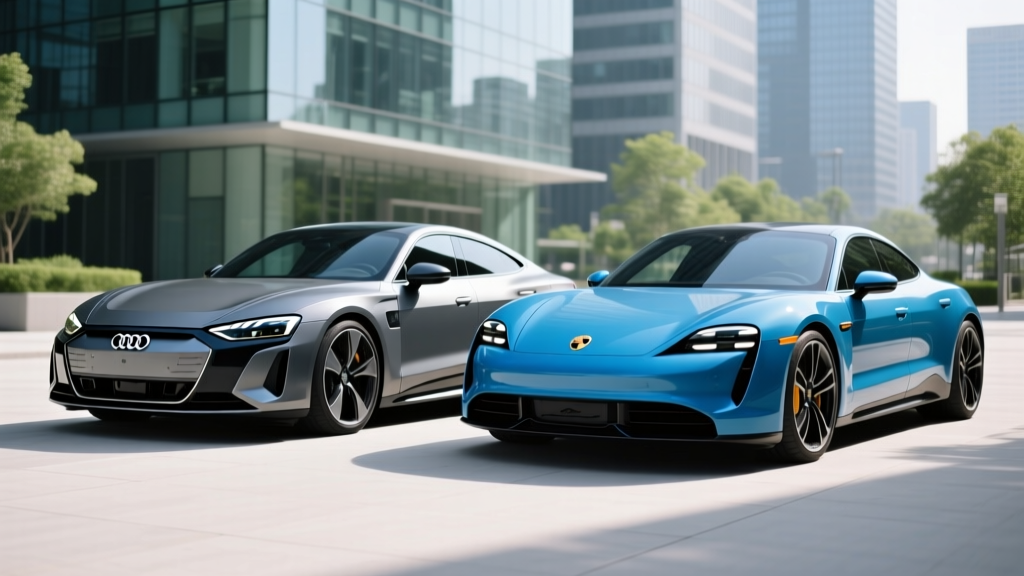
Two premium electric sport sedans, one shared J1 platform, and a surprising gap in price. The 2026 Audi e-tron GT and Porsche Taycan are mechanical siblings — both ride on Volkswagen Group's 800-volt J1 architecture with similar battery options and dual-motor layouts. Yet the way each brand tunes performance, packages technology, and prices its lineup creates a genuinely difficult choice for luxury EV buyers.
This comparison breaks down every spec that matters: real-world range versus the EPA sticker, actual charging curves at DC fast chargers, total cost of ownership, and the federal tax credit rules that can swing the value equation by thousands of dollars. All figures reflect 2026 model-year specifications.
Side-by-Side Spec Comparison: 2026 Audi e-tron GT vs Porsche Taycan
Both vehicles share core hardware — an 800-volt electrical architecture enabling rapid DC fast charging, a dual-motor all-wheel-drive layout (on AWD trims), and battery packs supplied in comparable sizes. The differences emerge in tuning, efficiency mapping, and pricing strategy. The table below focuses on the most directly comparable trims: the Audi S e-tron GT (the volume AWD model) against the Porsche Taycan 4S (Porsche's mid-tier dual-motor offering).
| Specification | 2026 Audi S e-tron GT | 2026 Porsche Taycan 4S |
|---|---|---|
| EPA Range (est.) | ~300 mi | ~285 mi |
| Battery (usable) | 97.0 kWh (NMC) | 97.0 kWh (NMC, Performance Battery Plus) |
| Peak DC Fast Charge | 320 kW | 320 kW |
| 10–80% DC Charge Time | ~18 min | ~18 min |
| Level 2 AC Charge (max) | 11 kW | 11 kW (19.2 kW optional) |
| 0–60 mph | 3.4 sec | 3.5 sec (with Launch Control) |
| Horsepower | 670 hp (boost) | 590 hp (overboost) |
| EPA Efficiency (MPGe) | ~85 MPGe | ~80 MPGe |
| Cargo (trunk + frunk) | 12.9 cu ft (rear) + 3.0 cu ft (frunk) | 14.3 cu ft (rear) + 2.9 cu ft (frunk) |
| Base MSRP | ~$137,000 | ~$107,000 |
| Battery Warranty | 8 yr / 100,000 mi | 8 yr / 100,000 mi |
Range and Charging: The 800-Volt Advantage, Quantified
Both vehicles leverage the J1 platform's 800-volt architecture, which enables peak DC fast charging at 320 kW — among the fastest production EVs available. At an Electrify America or Ionity 350 kW charger with the battery preconditioned (both vehicles automatically precondition when you navigate to a charger), you'll see peak rates of roughly 300–320 kW sustained between approximately 10% and 40% state of charge.
The charge curve matters more than the peak number. Both vehicles taper significantly above 55% SoC, dropping to roughly 150 kW around 60% and falling below 80 kW past 80%. This is why manufacturers quote 10–80% times rather than 0–100%. The ~18-minute 10–80% window is realistic under ideal conditions (warm battery, low SoC start, 350 kW station).
On Level 2 AC charging, both accept 11 kW as standard, adding roughly 30–33 miles of range per hour. Porsche offers an optional 19.2 kW onboard charger ($1,680), which cuts a full charge from ~9.5 hours to ~5.5 hours — meaningful if your home electrical panel supports a 100-amp circuit. Audi does not offer a comparable upgrade for the e-tron GT.
| Charging Level | Power | Audi e-tron GT (mi/hr) | Porsche Taycan (mi/hr) |
|---|---|---|---|
| Level 1 (120V) | ~1.4 kW | ~4 | ~4 |
| Level 2 (240V, standard) | 11 kW | ~31 | ~31 |
| Level 2 (240V, Porsche opt.) | 19.2 kW | N/A | ~52 |
| DC Fast (peak) | 320 kW | ~200+ (10–40% SoC) | ~200+ (10–40% SoC) |
Charging Network Note: Both vehicles use the CCS1 connector (or NACS with adapter on newer builds). Porsche and Audi owners both gain access to Electrify America's network (included with complimentary charging plans at purchase). Neither brand has native Tesla Supercharger access without an adapter, though NACS adapter availability has expanded through both OEMs as of 2025–2026. Check your specific build's connector configuration before purchase.
Performance: Where Porsche's Pedigree Shows — and Where Audi Closes the Gap
The Taycan has always been the driver's choice in this segment, and the 2026 model continues that tradition with sharper steering calibration, a standard two-speed rear axle (on higher trims), and Porsche's well-regarded stability management system. The Taycan Turbo GT (the performance flagship) produces up to 1,092 hp with Launch Control and hits 0–60 in a claimed 2.1 seconds.
But the Audi S e-tron GT's 670 hp and 3.4-second 0–60 time are no slouch — and in the real world, the gap between 3.4 and 3.5 seconds is imperceptible to most drivers. Where the Audi distinguishes itself is ride comfort: its standard adaptive air suspension is tuned slightly softer than the Taycan's, making it the better daily driver on imperfect roads.
Both vehicles feature regenerative braking, but neither offers true one-pedal driving to a full stop in the way a Tesla or Hyundai Ioniq does. You'll use the brake pedal regularly. The Porsche offers adjustable regen levels via steering-wheel paddles; the Audi uses a simpler automatic/coasting approach that many drivers find more intuitive after the first week.
Category Winners: Head-to-Head Verdicts
~300 mi EPA vs ~285 mi; slightly better efficiency at 85 vs 80 MPGe.
Identical 320 kW peak, ~18 min 10–80%. Porsche wins on L2 with optional 19.2 kW.
Sharper handling, available Turbo GT (1,092 hp), two-speed rear axle.
Softer air suspension tuning, quieter cabin at highway speeds.
Dual-touchscreen MMI is more intuitive than Porsche's multi-screen layout.
14.3 cu ft rear vs 12.9 cu ft; both have small frunks (~3 cu ft).
Starts ~$30,000 lower than the Audi S e-tron GT at equivalent performance.
Stronger resale value trajectory; Porsche badge commands premium in luxury segment.
Pricing and Federal Tax Credit: The $30,000 Question
Here's where the comparison gets interesting — and where the IRS §30D clean vehicle credit rules create a critical divergence.
The 2026 Audi S e-tron GT starts at approximately $137,000. The 2026 Porsche Taycan 4S starts at approximately $107,000. That's a $30,000 gap before options — and both vehicles are frequently optioned $15,000–$25,000 above base.
- MSRP Cap: Sedans must be ≤$55,000. Neither vehicle qualifies. (The $80,000 cap applies to SUVs/pickups/vans only.)
- Buyer Income Cap: AGI ≤$150,000 (single) / $300,000 (joint) — moot here since MSRP disqualifies both.
- Battery Sourcing: Critical mineral and battery component requirements — also moot due to MSRP cap.
- Point-of-Sale Transfer: Available for qualifying vehicles — but again, neither qualifies due to sedan MSRP cap.
Bottom Line: Neither the Audi e-tron GT nor the Porsche Taycan qualifies for the $7,500 federal EV tax credit under current §30D rules, because both exceed the $55,000 sedan MSRP cap by a wide margin. Some state-level incentives (e.g., California, Colorado) may still apply — check your state's energy office for current programs. Consult a tax professional for your specific situation.
Without the federal credit to offset costs, the $30,000 base-price gap between the Taycan 4S and the S e-tron GT becomes the full financial story. Even after adding comparable options (adaptive cruise, premium audio, upgraded wheels), the Porsche typically undercuts the Audi by $25,000–$35,000 at equivalent equipment levels.
The Audi RS e-tron GT (the performance flagship, ~$167,000) competes more directly with the Taycan Turbo (~$175,000) and Taycan Turbo GT (~$240,000), where the price gap narrows but the Porsche still leads in track capability.
Ownership Costs: Efficiency, Insurance, and Long-Term Value
Efficiency differences are small but compound over time. At 85 MPGe (Audi) versus 80 MPGe (Porsche), the e-tron GT uses approximately 34 kWh per 100 miles versus the Taycan's 36 kWh per 100 miles. At a national average electricity rate of $0.16/kWh and 12,000 miles/year, the annual home-charging cost difference is roughly $38 — negligible.
Insurance is where costs diverge more meaningfully. Based on 2026 average premiums for luxury performance EVs, expect approximately $3,200–$3,800/year for the Audi S e-tron GT and $3,500–$4,200/year for the Porsche Taycan 4S, depending on your driving record, location, and coverage level. Porsche's higher repair-cost profile and sportier driver demographic push premiums slightly higher.
Maintenance on both vehicles is minimal compared to ICE equivalents — no oil changes, no transmission fluid, fewer brake replacements thanks to regenerative braking. Budget roughly $400–$600/year for cabin air filters, wiper fluid, tire rotation, and brake inspection on either vehicle. Tire replacement is the biggest recurring cost: both wear through performance tires in 20,000–30,000 miles, with a set of four running $1,400–$2,000.
Depreciation favors Porsche. Historical data from luxury EV resale markets shows the Taycan retaining approximately 48–52% of its value after three years, while the e-tron GT retains roughly 42–47%. On a $137,000 Audi, that's approximately $79,000–$83,000 in depreciation over three years; on a $107,000 Porsche, it's approximately $51,000–$56,000. The Porsche depreciates less in both absolute and percentage terms.
| 5-Year Cost Category | Audi S e-tron GT | Porsche Taycan 4S |
|---|---|---|
| Purchase Price (base) | ~$137,000 | ~$107,000 |
| Estimated Charging (5 yr) | ~$3,200 | ~$3,400 |
| Insurance (5 yr) | ~$17,500 | ~$19,200 |
| Maintenance (5 yr) | ~$2,500 | ~$2,500 |
| Est. Depreciation (5 yr) | ~$79,000 | ~$54,000 |
| Est. Total 5-Yr Cost | ~$239,200 | ~$186,100 |
Note: Depreciation estimates are based on historical luxury EV resale trends and may vary with market conditions. Source: fueleconomy.gov for efficiency data.
Driving Dynamics and Daily Livability
On a 300-mile highway drive, the Audi S e-tron GT is the more relaxing companion. Its adaptive air suspension absorbs expansion joints and potholes with less feedback to the cabin, and the dual-pane acoustic glass keeps wind noise notably lower at 80 mph. The MMI infotainment system, while not perfect, responds quickly and its haptic-feedback lower screen for climate controls is more usable while driving than Porsche's touch-only climate strip.
The Porsche Taycan rewards on canyon roads and track days. Its steering is more communicative, its brake pedal feel is more linear (critical in an EV where regen blending can feel vague), and its available rear-axle steering makes the car feel smaller than its 195-inch length suggests. If you plan to attend HPDE (high-performance driving events), the Taycan is the clear choice — its thermal management system is specifically engineered for repeated high-load laps without battery derating.
Both vehicles offer SAE Level 2 driver-assistance systems — Audi's Adaptive Cruise Assist and Porsche's InnoDrive with Active Lane Keeping. These are not self-driving systems. You must keep your hands on the wheel and remain fully engaged at all times. Both systems handle highway cruising competently, but neither matches the smoothness of GM's Super Cruise or Ford's BlueCruise on mapped divided highways.
Pros and Cons at a Glance
Audi S e-tron GT
Pros:
- Longer EPA range (~300 mi)
- More comfortable highway ride
- Quieter cabin at speed
- More intuitive infotainment
- Standard heat pump
Cons:
- $30,000 more than comparable Taycan
- Less engaging to drive hard
- Smaller rear cargo area
- No 19.2 kW L2 charger option
- Steeper depreciation
Porsche Taycan 4S
Pros:
- Superior handling and steering feel
- Lower base price ($107,000)
- Stronger resale value
- Optional 19.2 kW AC charger
- Available Turbo GT (1,092 hp)
Cons:
- Shorter EPA range (~285 mi)
- Firmer ride on rough roads
- Heat pump optional on some trims
- Infotainment learning curve
- Higher insurance premiums
Decision Framework: Which One Should You Buy?
Choose the Audi S e-tron GT if:
- You prioritize daily ride comfort and highway quietness over corner-carving ability
- Range matters — you regularly drive 250+ miles between charges and want every extra mile
- You prefer Audi's infotainment layout and build-quality aesthetic
- You want a standard heat pump without navigating Porsche's options list
- Budget is flexible and you value the Audi design language
Choose the Porsche Taycan 4S if:
- Driving dynamics are your top priority — you want the best-handling EV sedan available
- You want to save $25,000–$30,000 versus the Audi at comparable equipment levels
- Resale value retention is important to your purchase calculus
- You plan to drive on track or attend performance events
- You want the option to upgrade to 19.2 kW Level 2 home charging
- You're considering stepping up to the Turbo or Turbo GT for extreme performance
Frequently Asked Questions
Do the Audi e-tron GT and Porsche Taycan share the same battery?
Both use the J1 platform's NMC lithium-ion battery pack. For 2026, the Performance Battery Plus offers approximately 97.0 kWh of usable capacity in both vehicles. However, each brand applies its own thermal management calibration, efficiency mapping, and power delivery software — which is why the Audi achieves slightly higher EPA range despite identical hardware.
Can either vehicle use Tesla Superchargers?
As of 2026, neither the Audi e-tron GT nor the Porsche Taycan has a native NACS (Tesla-style) charge port. Both can access Superchargers using a CCS-to-NACS adapter (sold separately by both OEMs and third parties). Charging speed through an adapter may be limited compared to native NACS vehicles. Both vehicles charge natively on Electrify America, EVgo, and other CCS networks.
Which is cheaper to insure?
The Audi S e-tron GT typically costs $200–$400 less per year to insure than the Porsche Taycan 4S, based on national averages for luxury performance EVs. However, insurance premiums vary significantly by driver profile, location, and coverage level. Get quotes from at least three carriers before purchasing either vehicle.
How do battery warranties compare?
Both vehicles carry an 8-year/100,000-mile battery warranty that guarantees the pack will retain at least 70% of its original capacity. This is industry-standard for luxury EVs. Neither brand has published widespread battery replacement cost data for the 2026 pack, but based on J1-platform precedent, expect a full replacement to cost $20,000–$28,000 out of warranty.
Which holds its value better?
The Porsche Taycan historically retains value better than the Audi e-tron GT. Three-year resale data shows the Taycan holding approximately 48–52% of MSRP versus 42–47% for the e-tron GT. Porsche's stronger brand equity in the performance segment and more limited production volumes contribute to this gap.
Is the Audi RS e-tron GT worth the upgrade over the S?
The RS e-tron GT (~$167,000) adds approximately 920 hp (boost mode), a 0–60 time of 2.5 seconds, and more aggressive suspension tuning. It competes with the Taycan Turbo rather than the 4S. If performance is your priority at this price level, the Porsche Taycan Turbo GT still outperforms it on track. The RS makes sense only if you prefer Audi's design and comfort characteristics and want maximum straight-line acceleration.
Final Recommendation
There is no wrong choice between the 2026 Audi S e-tron GT and the Porsche Taycan 4S — only the choice that better matches your priorities. The Porsche Taycan 4S is the more rational financial decision: lower purchase price, stronger resale value, and superior driving dynamics. It wins on value, performance, and long-term ownership cost.
The Audi S e-tron GT wins on daily comfort, range, and technology usability. If you spend most of your miles on highways rather than canyon roads, the Audi's quieter cabin, softer suspension, and extra 15 miles of EPA range make it the more livable daily driver — and for some buyers, that comfort is worth the $30,000 premium.
Test-drive both, back-to-back on the same roads, and let the seat of your pants settle the debate that the spec sheet cannot.