The Short Answer
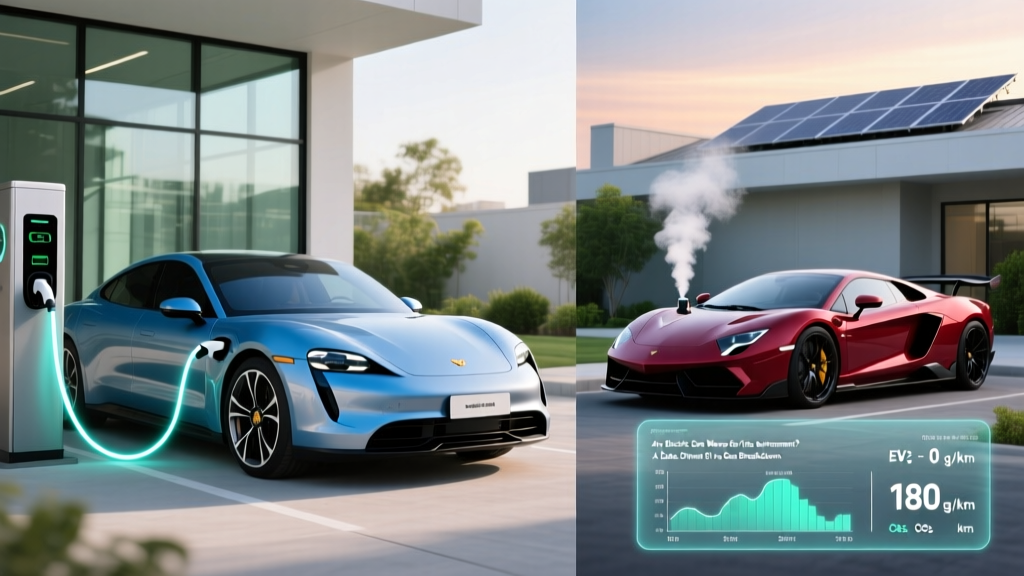
No — electric cars are not worse for the environment than gasoline cars over their full lifetime, even when accounting for battery manufacturing and electricity generation. According to the U.S. EPA and lifecycle analyses by Argonne National Laboratory, a typical EV sold in 2026 produces 60–70% fewer greenhouse gas emissions over its lifetime than a comparable 30 MPG gas car, even on the dirtiest U.S. electrical grids. The "break-even" point — where an EV's cleaner operation offsets its higher manufacturing emissions — arrives within 1 to 2 years of average driving (roughly 15,000–25,000 miles). After that, every mile driven is cleaner. However, the environmental advantage shrinks in coal-heavy grid regions and grows substantially in areas powered by renewables or nuclear.
Lifetime Emissions: EV vs Gas Car vs Hybrid
The core of the environmental debate comes down to lifecycle greenhouse gas (GHG) emissions — the total CO2-equivalent produced from mining raw materials, manufacturing the vehicle, fueling it over its life, and eventually recycling or disposing of it. Here's how the numbers stack up for a midsize sedan driven 150,000 miles over 10 years in the U.S. average grid mix (2026 data):
| Metric | Battery EV (e.g., Tesla Model 3) | Hybrid (e.g., Toyota Prius) | Gas Car (e.g., Honda Accord 1.5T) |
|---|---|---|---|
| Manufacturing Emissions | ~12 metric tons CO2e | ~7 metric tons CO2e | ~6 metric tons CO2e |
| Operation Emissions (150k mi) | ~10 metric tons CO2e | ~24 metric tons CO2e | ~48 metric tons CO2e |
| End-of-Life / Recycling | ~1 metric ton CO2e | ~0.5 metric tons CO2e | ~0.5 metric tons CO2e |
| Total Lifetime | ~23 metric tons CO2e | ~31.5 metric tons CO2e | ~54.5 metric tons CO2e |
| Grams CO2e per mile | ~153 g/mi | ~210 g/mi | ~363 g/mi |
The EV starts with a "carbon debt" from battery manufacturing — roughly double the production emissions of a gas car. But that debt is repaid quickly through zero tailpipe emissions and higher well-to-wheel efficiency. An electric motor converts 85–90% of electrical energy into motion; a gasoline engine converts only 20–30%, wasting the rest as heat.
Source: Argonne National Laboratory GREET Model
The Grid Matters: Where You Charge Changes the Math
Not all electricity is created equal. An EV charged in upstate New York (heavy nuclear and hydro) produces dramatically fewer emissions than one charged in West Virginia (coal-dominant). Here's how the same EV performs across different U.S. grid regions:
| Grid Region | EV (g CO2e/mi) | Gas Car Equivalent MPG |
|---|---|---|
| California (CAISO) | ~55 g/mi | ~130 MPG equivalent |
| New York (NYISO) | ~45 g/mi | ~160 MPG equivalent |
| Texas (ERCOT) | ~95 g/mi | ~75 MPG equivalent |
| Midwest (MISO) | ~120 g/mi | ~60 MPG equivalent |
| West Virginia | ~150 g/mi | ~48 MPG equivalent |
Even on the dirtiest U.S. grid (West Virginia), an EV still beats a 30 MPG gas car by a wide margin. And the grid is getting cleaner every year — the U.S. EIA projects renewables and nuclear will exceed 50% of generation by 2028. A gas car's emissions never improve; an EV gets cleaner as the grid decarbonizes.
Check your local grid mix at U.S. EIA State Electricity Profiles.
Battery Mining and Manufacturing: The Real Environmental Cost
This is where critics have the strongest argument — and it deserves honest treatment. EV battery production involves mining lithium, nickel, cobalt, manganese, and graphite, all of which carry environmental and ethical concerns:
- Lithium extraction (primarily Chile, Australia, China): Requires significant water in arid regions. A single EV battery (~75 kWh NMC) uses roughly 8–10 kg of lithium. New direct-lithium-extraction (DLE) technologies are reducing water use by up to 80%.
- Cobalt (primarily DRC): Associated with artisanal mining and labor concerns. The industry has responded — LFP batteries (used in Tesla Model 3 RWD, Ford Mustang Mach-E Select) use zero cobalt, and NMC chemistries have reduced cobalt content from ~20% to under 5% of cathode weight since 2015.
- Nickel (Indonesia, Philippines, Russia): High-pressure acid leach (HPAL) processing generates sulfuric acid waste. Class 1 nickel supply chains are tightening sustainability standards.
- Graphite (China dominates ~65% of supply): Processing involves hydrofluoric acid; synthetic graphite production is energy-intensive.
To put the mining impact in perspective: the oil industry extracts roughly 100 billion gallons of petroleum per year globally. The entire EV battery industry mines roughly 700,000 metric tons of key minerals annually. The scale of extraction for fossil fuels dwarfs battery minerals by orders of magnitude — and oil is burned once and gone, while battery minerals remain in the battery and can be recycled.
Common Misconceptions, Corrected
| Myth | Fact |
|---|---|
| "EV batteries end up in landfills" | Lithium-ion batteries are 95% recyclable by weight. Companies like Redwood Materials and Li-Cycle recover cathode metals at 95%+ purity. Most retired EV batteries are repurposed for stationary grid storage before recycling. |
| "An EV's battery won't last, so it's wasteful" | 2026-era EV batteries (NMC and LFP) are warrantied for 8 years/100,000 miles minimum (federal mandate). Real-world degradation data shows most batteries retain 85–92% capacity at 150,000 miles. Many EVs reach 200,000+ miles on the original pack. |
| "EVs are worse because power plants create pollution" | Even a coal-generated kWh produces less CO2 per mile driven than burning gasoline in a 30 MPG car, because electric motors are 3x more efficient. On the average U.S. grid, an EV is equivalent to a 90+ MPG gas car. |
| "Making an EV creates more CO2 than a gas car will ever emit" | Manufacturing an EV produces ~6 additional metric tons of CO2e vs a gas car. A gas car emits ~4.6 metric tons per year just from tailpipe exhaust. The EV's carbon debt is repaid in 1–2 years of driving. |
| "Hydrogen cars are cleaner than EVs" | 95% of hydrogen today is produced from natural gas ("gray hydrogen"). Even green hydrogen (from electrolysis) loses ~60% of input energy in conversion, vs ~10% loss charging a battery. Per mile, a fuel-cell vehicle uses 2–3x more primary energy than a BEV. |
Real-World Ownership Costs: EV vs Gas vs Hybrid
Environmental impact matters, but most buyers also weigh economics. Here's a 5-year total cost of ownership (TCO) comparison for a midsize vehicle driven 12,000 miles/year, using national average fuel and electricity prices (2026):
| Cost Category | EV (Tesla Model 3 RWD) | Hybrid (Toyota Prius LE) | Gas (Honda Accord EX) |
|---|---|---|---|
| Purchase Price (MSRP) | $38,990 | $28,350 | $32,100 |
| Federal Tax Credit (§30D) | −$7,500* | $0 | $0 |
| Effective Purchase | $31,490 | $28,350 | $32,100 |
| Fuel/Energy (5 years) | $3,600 (home L2, $0.15/kWh avg) | $6,300 (57 MPG, $3.50/gal) | $8,400 (30 MPG, $3.50/gal) |
| Maintenance (5 years) | $1,500 | $3,200 | $3,800 |
| Insurance (5 years) | $9,500 | $7,200 | $7,500 |
| Estimated Depreciation | $14,500 | $10,800 | $13,200 |
| 5-Year Total Cost | $60,590 | $55,850 | $65,000 |
| Cost Per Mile | $1.01/mi | $0.93/mi | $1.08/mi |
*Federal §30D tax credit eligibility depends on buyer income (≤$150k single / $300k joint), vehicle MSRP caps ($55k sedans / $80k SUVs/trucks), and battery critical-mineral sourcing requirements. Verify current-year rules at IRS.gov §30D. Credit may be applied as a point-of-sale rebate through the dealer.
Key takeaways: EVs save significantly on fuel and maintenance (no oil changes, fewer brake replacements due to regenerative braking, no transmission fluid). But insurance premiums run 15–30% higher on average, and depreciation can be steeper, especially for luxury EVs. A hybrid often delivers the lowest TCO for buyers without home charging access.
What First-Time EV Buyers Need to Know
If you're weighing an EV purchase and environmental impact is a factor, here's a practical decision framework based on real ownership patterns:
Should You Buy an EV, Hybrid, or Gas Car?
Choose a Battery EV if:
- You have access to home charging (Level 2, 240V) or reliable workplace charging
- Your daily commute is under 200 miles round-trip (covers 95% of U.S. drivers)
- You live in a region with a moderately clean or improving grid
- You want to minimize lifetime carbon emissions and qualify for the §30D tax credit
- You drive 12,000+ miles/year (higher mileage = faster payback on the EV premium)
Choose a Plug-in Hybrid (PHEV) if:
- You want electric-only commuting (25–50 miles) but need gas-engine range for road trips
- You lack reliable home charging but can plug in occasionally
- You live in an apartment or condo with no charging infrastructure
- You want to reduce emissions without any range-anxiety risk
Choose a Standard Hybrid (HEV) if:
- You have zero access to plug-in charging (street parking, no garage)
- You want maximum fuel savings with zero behavioral change
- Upfront cost is the primary constraint (HEVs carry only a $1,000–$2,000 premium over gas cars)
Stick with Gas (for now) if:
- You live in a charging desert (rural areas with limited DC fast-charging corridors)
- You regularly tow heavy loads in cold weather (EV towing range drops 40–50%)
- You drive fewer than 5,000 miles/year (the carbon payback period extends significantly)
Charging Access: The Biggest Environmental and Practical Variable
The single most important factor in whether an EV makes sense — environmentally and financially — is how you charge it. Here's the reality:
| Level | Power (kW) | Miles Added/Hour | Cost per kWh | Best For |
|---|---|---|---|---|
| Level 1 (120V household) | 1.4 kW | 3–5 mi/hr | $0.12–$0.20 | Overnight top-up, PHEVs, low-mileage drivers |
| Level 2 (240V home) | 7.2–11.5 kW | 25–44 mi/hr | $0.10–$0.20 | Daily charging, full overnight refill |
| DC Fast Charge | 50–350 kW | 150–800 mi/hr* | $0.30–$0.55 | Road trips, emergency top-up |
*Miles-per-hour figures assume sustained peak rate; real DCFC sessions taper above 80% SoC due to the charge curve. A typical 10–80% session on a 250 kW charger takes 18–25 minutes for a modern EV.
Home Level 2 installation costs $800–$2,500 for a quality 48-amp charger (e.g., ChargePoint Home Flex, Emporia Level 2) plus $500–$2,000 for electrician labor and permits. If your home has a 200-amp electrical panel with spare capacity, expect the lower end. A panel upgrade to 200A can add $1,500–$4,000. Home charging at $0.15/kWh averages ~$0.045/mile — roughly one-third the cost of gasoline at $3.50/gallon in a 30 MPG car.
If you cannot charge at home (apartment, street parking, HOA restrictions), your EV will rely on public DCFC at $0.35–$0.55/kWh, pushing fuel costs to $0.10–$0.16/mile — still cheaper than gas, but the savings narrow. In this scenario, a PHEV or HEV may be the more practical and lower-stress choice.
Cold Weather, Range Loss, and Environmental Trade-offs
EVs lose 20–40% of their EPA-rated range in sustained sub-freezing temperatures due to battery chemistry limitations and cabin heating demands. A vehicle rated at 310 miles EPA may deliver 190–250 miles in 20°F weather. This is real and worth planning for — but it doesn't flip the environmental equation:
- Cold weather increases gasoline car fuel consumption too (cold-start enrichment, thicker fluids, winter-blend fuel), typically dropping MPG by 10–20%.
- EVs with heat pumps (standard on most 2026 models from Hyundai, Kia, Tesla, Volkswagen) reduce cold-weather energy penalty by 25–30% compared to resistive heating.
- Preconditioning the battery while plugged in (a feature on virtually all modern EVs) recovers much of the range loss by warming the pack using grid power before departure.
From an emissions standpoint, even with cold-weather range loss, the EV still operates at a fraction of the carbon intensity of a gasoline car in the same conditions.
Frequently Asked Questions
Do EV batteries need to be replaced, and is that environmentally costly?
Most 2026 EV batteries are designed to outlast the vehicle. Federal law mandates a minimum 8-year/100,000-mile battery warranty (10 years/150,000 miles in CARB states like California). Real-world data from Tesla's 2025 Impact Report shows Model 3/Y packs retain ~88% capacity at 200,000 miles. Full battery replacement costs $8,000–$18,000 depending on pack size but is rarely needed within a vehicle's typical 15-year lifespan.
Are EVs worse for the environment if I live in a coal-heavy state?
Even on the most coal-dependent U.S. grid (West Virginia, ~70% coal), an EV still produces roughly 30% fewer lifetime emissions than a 30 MPG gas car. And coal's share is declining — the EIA projects coal will fall below 15% of U.S. generation by 2030. Your EV gets cleaner every year; your gas car doesn't.
What about the environmental impact of tire wear on heavier EVs?
EVs are 10–20% heavier than equivalent gas cars, which increases tire particulate emissions (PM2.5) by roughly 5–15%. This is a legitimate concern and an active area of tire development. However, regenerative braking significantly reduces brake-pad wear (a major source of particulate pollution), partially offsetting the tire issue. Overall non-exhaust particulates are comparable between EVs and gas cars.
Is a used EV environmentally better than a new EV?
Yes, in one sense: a used EV's manufacturing emissions are already "sunk," so your marginal impact is purely operational. Buying used also extends the vehicle's useful life, amortizing its carbon debt over more miles. If you can find a 2–3-year-old EV with a healthy battery (check State of Health via the vehicle's diagnostics or an OBD-II scan), it's arguably the most environmentally efficient choice available.
How do LFP vs NMC batteries compare environmentally?
LFP (lithium iron phosphate) batteries use no cobalt or nickel, reducing mining impact and supply-chain ethical concerns. They also tolerate more charge cycles (3,000+ vs ~1,500 for NMC), meaning longer useful life. The trade-off: LFP has ~15–20% lower energy density, so the battery pack is heavier for the same range. For environmental impact, LFP is generally the greener choice — and it's increasingly standard in base-trim EVs from Tesla, Ford, and BYD.
The Bottom Line
Electric cars are not worse for the environment — they are substantially cleaner over their full lifecycle in every U.S. grid region, with the advantage growing as the grid decarbonizes and battery recycling scales. The honest caveats are real: battery mining has environmental and ethical costs, cold weather reduces range, insurance is pricier, and home charging access is essential for maximizing both savings and convenience. For buyers who can charge at home and drive average or above-average mileage, a 2026 EV is the lowest-emission vehicle choice available today — and the economics increasingly match the environmental case.