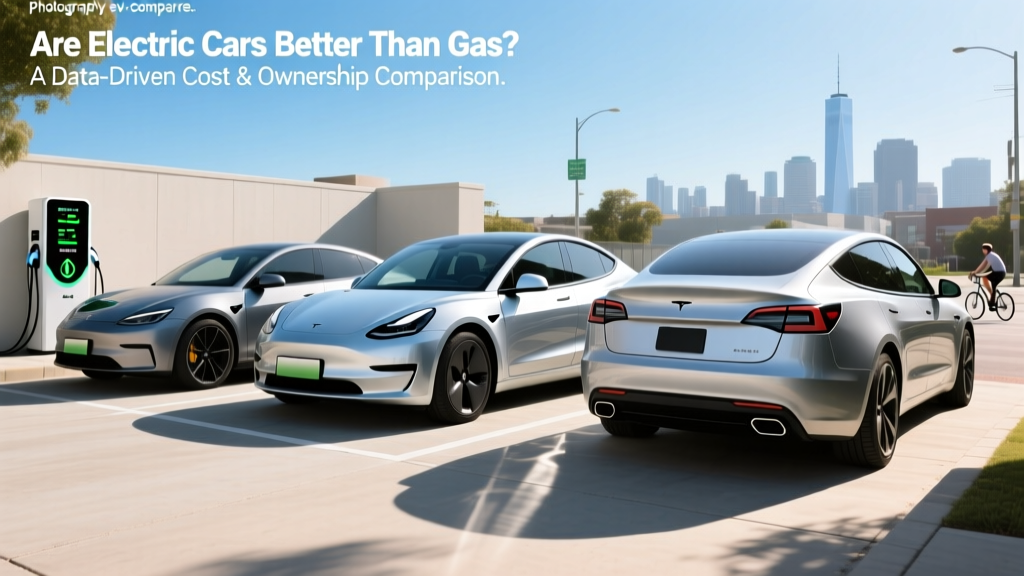
Quick Answer: Are Electric Cars Better Than Gas?
It depends on three things: whether you can charge at home, your daily driving distance, and your local electricity rates. If you have Level 2 home charging, drive under 250 miles daily, and electricity costs under $0.20/kWh, an EV will almost always cost less over 5 years than a comparable gas car — even with a higher sticker price. The average EV driver who charges at home saves $800–$1,200 per year on fuel alone (source: fueleconomy.gov). However, if you live in an apartment without charging access, regularly drive 400+ miles in cold weather, or need to tow heavy loads, a hybrid or gas vehicle may still be the more practical choice in 2026.
The Real Numbers: EV vs Gas Fueling Costs
The single biggest ownership advantage for EVs is fuel cost — but only when you understand the math. Let's compare two popular 2026 models: the Tesla Model Y Long Range (AWD) and the Toyota RAV4 AWD (gas).
| Metric | Tesla Model Y LR (EV) | Toyota RAV4 AWD (Gas) |
|---|---|---|
| EPA Efficiency | 119 MPGe combined (28 kWh/100mi) | 29 MPG combined |
| Energy/Fuel Unit Cost | $0.16/kWh (US avg residential) | $3.40/gal (US avg regular) |
| Annual Fuel/Energy Cost | $672 | $1,759 |
| Cost Per Mile | $0.045 | $0.117 |
| 5-Year Fuel Cost | $3,360 | $8,795 |
Annual savings with home charging: ~$1,087. Over five years, that's $5,435 back in your pocket. But this assumes 100% home charging at the US residential average of ~$0.16/kWh. If you rely entirely on DC fast charging at public rates ($0.35–$0.55/kWh), your annual energy cost jumps to $1,470–$2,310 — narrowing or even eliminating the savings gap. This is why home charging access is the single most important variable in the EV vs gas decision.
Purchase Price, Tax Credits, and the Upfront Gap
The sticker-price gap between EVs and gas cars has narrowed significantly by 2026, but EVs still carry a premium at purchase. Here's how the math works for a mid-size crossover comparison:
| Factor | Tesla Model Y LR | Hyundai Tucson AWD (Gas) | Hyundai Tucson PHEV |
|---|---|---|---|
| Base MSRP | $44,990 | $31,250 | $39,400 |
| Federal Tax Credit (§30D) | Up to $7,500* | $0 | Up to $7,500* |
| Effective Price After Credit | ~$37,490 | $31,250 | ~$31,900 |
| Price Gap vs Gas | +$6,240 | Baseline | +$650 |
*Federal §30D credit eligibility depends on multiple factors. Per IRS guidelines, the buyer must meet income caps ($150K single / $300K joint MAGI), the vehicle MSRP must be under $80K (SUVs/trucks) or $55K (sedans), and the battery must meet critical-mineral and component sourcing thresholds that tighten annually. The credit can now be transferred to the dealer at point of sale, effectively reducing your out-of-pocket cost at purchase. Always verify current-year eligibility before committing.
5-Year Total Cost of Ownership: Where EVs Win (and Where They Don't)
Fuel savings are only part of the picture. A complete comparison must include maintenance, insurance, depreciation, and financing. Here's a realistic 5-year / 75,000-mile TCO breakdown:
| Cost Category | Tesla Model Y LR (EV) | Toyota RAV4 AWD (Gas) |
|---|---|---|
| Purchase (after credit) | $37,490 | $31,250 |
| Fuel / Energy (5 yr) | $3,360 | $8,795 |
| Maintenance (5 yr) | $1,200 | $3,800 |
| Insurance (5 yr avg) | $9,750 | $7,250 |
| Depreciation (est.) | $18,500 | $14,000 |
| Total 5-Year Cost | $70,300 | $65,095 |
Key takeaways from this data:
- Maintenance: EVs eliminate oil changes, spark plugs, transmission fluid, and exhaust system repairs. Brake pad life extends to 100K+ miles thanks to regenerative braking. Expect to spend roughly $240/year on EV maintenance (cabin filter, wiper fluid, tire rotation) vs $760/year on gas cars.
- Insurance: EVs typically cost 15–25% more to insure due to higher repair costs for battery packs and specialized body panels. Shop quotes before buying — the premium varies wildly by carrier and state.
- Depreciation: EV resale values have stabilized since the 2023–2024 price wars, but still depreciate faster on average than Toyota/Honda gas models. Tesla's depreciation has improved with the refreshed Model Y, but expect 40–50% value loss over 5 years vs 35–45% for a RAV4.
Real-World Range: What the EPA Sticker Doesn't Tell You
EPA range estimates are measured under controlled conditions. In actual ownership, expect variation based on speed, temperature, and terrain. Here's what real-world testing and owner data consistently show:
Real-World Range Expectations (2026 Tesla Model Y Long Range)
EPA Rated: 320 miles
City/Suburban (65°F): ~300–320 miles (regen braking helps)
Highway (70 mph, 65°F): ~260–280 miles (aerodynamic drag dominates)
Highway (70 mph, 20°F): ~210–240 miles (cold reduces battery efficiency + cabin heating load)
Highway (70 mph, 100°F): ~270–290 miles (A/C less impactful than heating)
For most daily commutes under 60 miles round-trip, even worst-case winter range is irrelevant — you'll charge at home overnight and never think about it. Range becomes a real concern only on road trips exceeding 250 miles or in regions with sparse DC fast-charging infrastructure (parts of the rural Midwest, Mountain West, and Deep South remain charging deserts in 2026).
Charging Access: The Make-or-Break Factor
This is where the EV vs gas comparison becomes deeply personal. The convenience equation flips entirely depending on your living situation:
Charging Access Decision Framework
If you own a home with a garage or driveway: Install a Level 2 (240V) home charger. Cost: $500–$800 for the unit (e.g., ChargePoint Home Flex, Tesla Wall Connector) plus $500–$2,000 for electrician installation depending on panel capacity and conduit run. Total: $1,000–$2,800. You'll wake up every morning with a full "tank." This is the ideal EV scenario.
If you rent an apartment or condo without dedicated parking: You'll depend on workplace charging or public Level 2/DC stations. This adds 20–40 minutes of weekly charging time and significantly higher per-kWh costs. Consider a PHEV instead — it gives you 30–40 miles of electric commuting range with a gas backup.
If your electrical panel is maxed out (100A service): A panel upgrade to 200A may be required before installing Level 2. This adds $1,500–$3,500 to your installation cost. Factor this in before purchasing an EV.
If you regularly road-trip 300+ miles: DC fast charging on the road adds 20–35 minutes per stop (10–80% at 150–250 kW chargers). The Tesla Supercharger and Electrify America networks cover most interstate corridors, but plan routes in advance using A Better Route Planner.
| Level | Power (kW) | Miles of Range Added Per Hour | Typical Use Case |
|---|---|---|---|
| Level 1 (120V outlet) | 1.2–1.9 kW | 3–5 miles/hr | Overnight top-up, PHEVs |
| Level 2 (240V home/public) | 7.2–19.2 kW | 20–60 miles/hr | Daily home charging |
| DC Fast Charge | 50–350 kW (peak) | 150–800 miles/hr* | Road trips, rapid top-up |
*Peak rates are not sustained — charging slows significantly above 80% State of Charge to protect the battery. A "10–80%" charge at a 250 kW station typically takes 18–30 minutes depending on battery size and thermal management.
Common EV Misconceptions: Myth vs Fact
| Myth | Fact (with data) |
|---|---|
| "EV batteries need replacing every few years" | Modern LFP and NMC batteries are warranted for 8 years / 100,000 miles (federal minimum). Real-world degradation data shows most packs retain 85–92% capacity at 100K miles. Replacement, if needed, costs $8,000–$18,000 but is rare before 150K+ miles. |
| "EVs are worse for the environment because of electricity generation" | Even on the dirtiest US grids (coal-heavy regions), an EV produces 50–60% fewer lifetime emissions than a comparable gas car (Union of Concerned Scientists, 2025 update). On clean grids (Pacific NW, Northeast), the reduction is 70–80%. |
| "EVs can't handle cold weather" | Cold reduces range by 20–35% in sub-freezing temps due to battery chemistry and cabin heating. However, EVs start instantly in cold (no engine cranking), and preconditioning while plugged in mitigates most range loss. Heat pumps (standard on most 2026 EVs) cut heating energy use by ~30%. |
| "Public charging is always broken" | Reliability varies by network. Tesla Superchargers maintain 99%+ uptime. Electrify America and ChargePoint average 85–92% uptime in 2026 — improved from 2023 but still frustrating when you hit a downed unit. Always have a backup station in your route plan. |
| "EVs cost more to insure and always will" | The insurance gap is narrowing. As EV market share grows and repair networks expand, premiums are falling. Some carriers now offer EV-specific policies. Always get quotes before buying — the spread can be $200–$800/year depending on model and carrier. |
EV vs Gas vs Hybrid: Which Powertrain Fits Your Life?
Actionable Decision Framework
Choose a full EV (BEV) if:
- You can install a Level 2 charger at home
- Your daily driving is under 200 miles
- You want the lowest per-mile fuel cost ($0.03–$0.06/mi)
- You qualify for the federal tax credit (check IRS §30D rules)
- You want minimal maintenance and instant torque
Choose a plug-in hybrid (PHEV) if:
- You want electric commuting (30–45 mi) but need gas flexibility for road trips
- You can charge at home but your apartment complex limits electrical upgrades
- You live in a region with extreme cold or limited charging infrastructure
- You're not ready to fully commit to EV charging logistics
Choose a conventional hybrid (HEV) if:
- You cannot charge at home at all
- You want better MPG (45–55 combined) without any plugging in
- Your budget is tight and you want proven, low-risk technology
Stick with gas if:
- You tow 5,000+ lbs regularly (EV towing range drops 40–50%)
- You drive 500+ miles weekly in rural areas with no DC charging
- Your budget is under $28,000 and you need the lowest possible purchase price
What First-Time EV Buyers Must Know Before Purchasing
If you're transitioning from gas to electric, these practical realities will shape your ownership experience:
- kW vs kWh — learn the difference. kW (kilowatts) measures power — how fast you charge. kWh (kilowatt-hours) measures energy — how big your battery is. A 75 kWh battery charged at 11 kW (Level 2) takes ~7 hours from empty. At 150 kW (DC fast), 10–80% takes ~25 minutes. Confusing these is the #1 beginner mistake.
- Charge to 80%, not 100%, for daily use. NMC batteries (most EVs except Tesla Standard Range and some BYD models which use LFP) last longer when kept between 20–80% State of Charge. Set your charge limit in the car's app. LFP batteries can be charged to 100% regularly without harm.
- Precondition your battery before DC fast charging. Most EVs automatically warm the battery when you navigate to a charger. This enables peak charge rates. Without preconditioning, a cold battery may charge at half its rated kW.
- Download charging apps before your first road trip. PlugShare, A Better Route Planner, and your vehicle's native navigation are essential. Check charger status and recent user reviews before relying on a specific station.
- Budget for home charger installation. The car is only half the equation. A quality Level 2 charger plus professional installation runs $1,000–$2,800. Some utilities offer rebates of $200–$500 — check with your provider.
Frequently Asked Questions
Do electric cars really save money compared to gas?
Yes, if you charge at home. The average EV owner saves $800–$1,200 per year on fuel. Over 5 years, that's $4,000–$6,000. However, higher insurance premiums ($250–$500/year more) and potentially higher depreciation offset some of those savings. The net 5-year advantage is typically $2,000–$5,000 in the EV's favor for a home-charger owner.
How long do EV batteries last before needing replacement?
Federal law requires EV battery warranties of at least 8 years / 100,000 miles (10 years / 150,000 miles in CARB states like California). Real-world data from fueleconomy.gov and owner surveys shows most modern batteries retain 85–92% capacity at 100K miles. Full replacement is uncommon before 150K+ miles and costs $8,000–$18,000 depending on the pack size.
Is charging an EV really cheaper than buying gas?
At the US average residential electricity rate of ~$0.16/kWh, fueling an EV costs roughly $0.04–$0.06 per mile. A 29 MPG gas car at $3.40/gallon costs ~$0.12 per mile. That's a 50–65% per-mile savings. However, public DC fast charging at $0.35–$0.55/kWh costs $0.09–$0.15 per mile — comparable to gas. Home charging is where the economics work.
Can I own an EV if I live in an apartment?
It's possible but harder. You'll depend on workplace charging, public Level 2 stations, or DC fast chargers. This adds time and cost. Some states now require landlords to permit charger installation. If apartment EV ownership is your only option, consider a PHEV instead — you get 30–45 miles of electric range from any standard 120V outlet plus gas flexibility.
Are EVs better than gas cars in cold weather?
EVs start reliably in extreme cold (no engine cranking or cold-start issues), and cabin heating is instant. However, range drops 20–35% in sub-freezing temperatures. A 320-mile EPA-rated EV may deliver only 210–250 real-world miles in 10°F weather at highway speeds. Preconditioning while plugged in and using seat/steering wheel heaters (instead of cabin air) help recover 10–15% of that lost range.