Quick Answer: Are Electric Bikes Illegal?
No, electric bikes are not illegal in the United States. As of 2026, all 50 states permit e-bikes on public roads and paths, though regulations vary significantly by e-bike class, local jurisdiction, and where you ride. Federal law defines three e-bike classes (Class 1, 2, and 3), but states and cities set their own rules on helmet requirements, age limits, speed caps, and trail access. The confusion around "is electric bikes illegal" typically stems from specific local restrictions — such as certain bike paths banning throttled e-bikes or Class 3 speed-pedelecs — not a blanket prohibition.
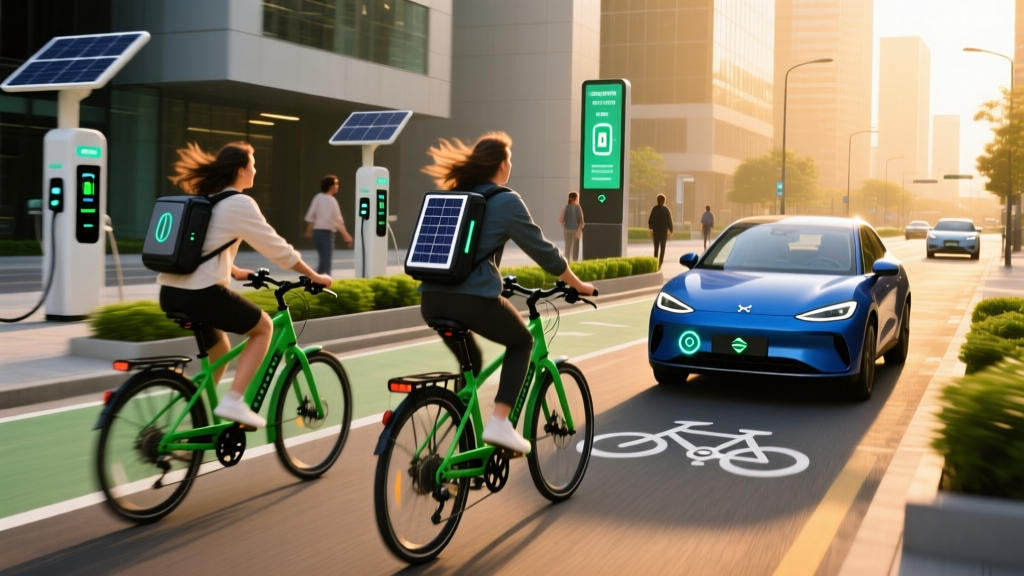
If you're researching e-bikes as a commuter alternative — or weighing an e-bike against a full electric vehicle for daily driving — the real question isn't legality. It's whether an e-bike or an EV better fits your commute distance, climate, cargo needs, and budget. This guide breaks down the legal landscape, then puts real numbers behind the e-bike vs. EV decision so you can choose with confidence.
E-Bike Classes and the Legal Landscape
Federal law (under the Consumer Product Safety Commission) defines an electric bicycle as a two- or three-wheeled vehicle with fully operable pedals and an electric motor of 750 watts (1 hp) or less, with a top motor-powered speed of 20 mph on a flat surface. Within that framework, the industry and most states recognize three classes:
| Class | Motor Type | Max Assisted Speed | Typical Wattage | Common Legal Restrictions |
|---|---|---|---|---|
| Class 1 | Pedal-assist only (no throttle) | 20 mph | 250–500W | Fewest restrictions; allowed on most bike paths |
| Class 2 | Throttle-assisted + pedal-assist | 20 mph | 250–750W | Banned on some natural-surface trails and certain multi-use paths |
| Class 3 | Pedal-assist only (no throttle) | 28 mph | 350–750W | Often requires helmet; age minimums (usually 16+); banned from many bike paths |
States like California, New York, and Colorado have adopted the three-class model broadly, but enforcement and trail-level access vary city by city. In New York City, for example, Class 3 e-bikes are legal on streets but prohibited on most sidewalks and some greenway paths. In Colorado, Class 1 and 2 e-bikes are generally allowed on paved trails, while Class 3 may be restricted. Always check your local parks department or DMV website before purchasing.
E-Bike vs. Electric Car: Commute Cost Comparison
For commuters covering 5–15 miles round-trip, an e-bike can dramatically undercut even an efficient EV. But the comparison shifts quickly once your commute exceeds 20 miles, you need climate-controlled cabin space, or you carry passengers. Here's how the numbers stack up for a 10-mile daily round-trip commute in 2026:
| Cost Factor | Class 2 E-Bike (e.g., Rad Power RadCity 5 Plus) | 2026 Chevrolet Equinox EV 2LT (FWD) | 2026 Toyota Prius (LE, Gas Hybrid) |
|---|---|---|---|
| Purchase Price (MSRP) | $1,999 | $34,995 | $29,445 |
| Federal Tax Credit (§30D) | Not eligible | Up to $7,500 (income/sourcing rules apply) | Not eligible (HEV) |
| Net After Credit | $1,999 | ~$27,495 (if eligible) | $29,445 |
| Energy Cost Per Charge / Fill-Up | $0.04–$0.08 (0.5 kWh at $0.16/kWh) | $9.60–$13.20 (60 kWh at $0.16–$0.22/kWh) | ~$35 (10 gal at $3.50/gal) |
| Cost Per Mile (Energy) | $0.004–$0.008 | $0.03–$0.04 | $0.09–$0.10 |
| Annual Energy Cost (2,500 mi commute) | $10–$20 | $75–$100 | $225–$250 |
| Annual Maintenance | $100–$200 (tires, brake pads, chain) | $300–$500 (cabin filter, tire rotation, fluid top-off) | $500–$800 (oil changes, filters, brakes) |
| Insurance (Annual) | $0–$150 (optional; often covered under homeowners) | $1,400–$2,200 | $1,200–$1,800 |
| Registration / Title | $0 (no registration in most states) | $100–$400/year (varies by state) | $100–$400/year |
| Total 5-Year Cost | $2,600–$3,900 | $38,000–$42,000 | $38,000–$42,000 |
The e-bike's 5-year total cost is roughly 10% of the EV or hybrid — but that comparison only holds if the e-bike can actually replace your car for most trips. For many urban and suburban commuters, it can't.
When an E-Bike Replaces a Car — and When It Can't
An e-bike works as a primary commuter vehicle when your situation meets most of these criteria:
- Commute distance: Under 15 miles one-way (most e-bikes offer 25–45 miles of real-world range on a single charge depending on assist level, terrain, and rider weight)
- Climate: Mild winters or willingness to ride in rain/cold with proper gear; e-bike battery range drops 20–35% in temperatures below 40°F
- Cargo: Groceries, a laptop bag, or pannier-friendly loads — not car seats, lumber, or weekly Costco hauls
- Passengers: Solo commuting only (some cargo e-bikes carry one child passenger)
- Route: Dedicated bike lanes or low-traffic roads available; highway commuting is not an option on an e-bike
- Storage: Secure indoor or locked storage at home and work (e-bike theft is a significant concern in urban areas)
If three or more of those criteria don't apply, you're better served by an EV or PHEV as your primary vehicle — possibly with an e-bike as a secondary option for short errands.
EV Ownership Realities First-Time Buyers Should Know
If you've decided an e-bike alone won't cover your needs and you're evaluating a full electric vehicle, here are the numbers and realities that matter most:
Range: EPA Sticker vs. Real World
The EPA range estimate assumes a mix of city and highway driving at moderate temperatures. In practice:
- Highway driving at 70+ mph: Expect 15–25% less than EPA range due to aerodynamic drag
- Cold weather (below 30°F): Expect 20–40% range loss, depending on whether the vehicle has a heat pump
- Combined highway + cold: A 310-mile EPA-rated EV may deliver 200–230 miles in real winter highway conditions
Charging Speed: kW vs. kWh
This is the single most confused topic in EV ownership. kWh (kilowatt-hours) measures battery capacity — how much energy the battery holds, like gallons in a gas tank. kW (kilowatts) measures charging power — how fast energy flows into the battery, like gallons-per-minute at a gas pump.
| Charging Level | Power (kW) | Miles Added Per Hour | Typical Use Case |
|---|---|---|---|
| Level 1 (120V household outlet) | 1.0–1.4 kW | 3–5 miles | Overnight top-up; PHEV-friendly |
| Level 2 (240V home/public) | 7.2–19.2 kW | 25–60 miles | Daily home charging; full overnight recharge |
| DC Fast Charge (public) | 50–350 kW | 150–1,000+ miles (peak rate) | Road trips; 10–80% in 18–45 min depending on vehicle |
A vehicle advertising "240 kW peak DC fast charging" does not sustain 240 kW for the entire session. Charging follows a curve: the battery accepts peak power at low state-of-charge (SoC), then tapers as it fills. A 10–80% session at a 350 kW charger might average 150–180 kW sustained. Always check the 10–80% time, not just the peak kW number.
Federal Tax Credit: §30D Rules for 2026
The IRS §30D clean vehicle credit offers up to $7,500 for qualifying new EVs, but eligibility depends on multiple factors:
- MSRP caps: Vans/SUVs/pickups ≤ $80,000; sedans ≤ $55,000
- Buyer income caps: AGI ≤ $150,000 (single), $225,000 (head of household), $300,000 (joint)
- Battery sourcing: Critical minerals and battery components must meet escalating domestic/free-trade-agreement sourcing thresholds each year
- Point-of-sale transfer: As of 2024, buyers can transfer the credit to the dealer for an immediate price reduction at purchase
Not every EV qualifies. Always verify current eligibility on the IRS and fueleconomy.gov before committing to a purchase.
Common Misconceptions: E-Bike and EV Myths vs. Facts
| Myth | Fact |
|---|---|
| "E-bikes are illegal on all public roads" | E-bikes are legal in all 50 states; specific trail or path restrictions apply locally, not blanket bans |
| "You need a driver's license to ride an e-bike" | Most states do not require a license for Class 1 or 2 e-bikes; some require one for Class 3 (28 mph) speed pedelecs |
| "EVs are worse for the environment than gas cars" | Over a vehicle's lifetime, EVs produce fewer emissions in every US grid region, per EPA lifecycle analysis — even on coal-heavy grids |
| "EV batteries need replacing every 5 years" | Modern NMC and LFP batteries are warrantied for 8 years/100,000 miles minimum (federally mandated); real-world degradation averages 1–2% per year |
| "E-bikes are basically free to own" | Low cost, not zero: expect $100–$200/year in maintenance, $50–$150 in battery replacement every 3–5 years, and potential theft loss without insurance |
| "Charging an EV takes hours on road trips" | At a 250+ kW DC fast charger, modern EVs add 150–200 miles in 15–20 minutes — comparable to a gas station stop with food and restroom break |
Decision Framework: E-Bike, EV, Hybrid, or Gas?
Choose an e-bike if:
- Your commute is under 15 miles one-way with bike-lane access
- You live in a mild climate or have cold-weather riding gear
- You want to spend under $2,500 total and avoid insurance, registration, and fuel costs
- You don't need to carry passengers or large cargo regularly
Choose a plug-in hybrid (PHEV) if:
- Your commute is 20–40 miles and you have home Level 2 charging
- You want electric-only daily driving but gas flexibility for road trips
- You're not ready to rely on public DC fast-charging infrastructure
- Example: 2026 Toyota RAV4 Prime — 42 miles electric-only, 38 MPG combined on gas, ~$46,000 MSRP
Choose a battery-electric vehicle (BEV) if:
- You have reliable home Level 2 charging (or workplace charging)
- Your daily driving is under 250 miles and you take road trips 3–5 times per year
- You want the lowest per-mile energy cost and minimal maintenance
- You qualify for the §30D tax credit (check income and vehicle eligibility)
- Example: 2026 Hyundai Ioniq 5 SEL — 310 miles EPA, 84 kWh battery, 240 kW peak DC charging (10–80% in ~18 min), ~$43,500 MSRP before credit
Stick with gas or hybrid if:
- You have no access to home or workplace charging
- You regularly drive 300+ miles between stops in areas with sparse DC fast-charger coverage
- You tow heavy loads (trailers, boats) where EV range drops 40–60% under load
Home Charging Access: The Hidden Dealbreaker
Whether you choose an e-bike or an EV, charging access is the practical gatekeeper. For e-bikes, a standard 120V outlet is sufficient — a full charge takes 3–6 hours and costs pennies. For EVs, home Level 2 charging is the baseline for convenient ownership:
| Home Charging Setup | Equipment Cost | Electrician Installation | Permit / Panel Upgrade | Total Estimated Cost |
|---|---|---|---|---|
| Level 1 (120V, no install) | $0 (included cable) | $0 | $0 | $0 |
| Level 2 (240V, existing 200A panel) | $300–$700 (charger) | $500–$1,500 | $100–$300 | $900–$2,500 |
| Level 2 (240V, panel upgrade to 200A) | $300–$700 | $1,500–$3,000 | $1,500–$3,500 (panel) | $3,300–$7,200 |
If you live in an apartment or condo without dedicated parking and charging, an e-bike may be your most practical electrified option right now — or a PHEV that can survive on Level 1 overnight charging (adding 3–5 miles per hour, which covers most PHEV batteries in 8–10 hours).
Frequently Asked Questions
Do I need to register my e-bike with the DMV?
In most states, Class 1 and Class 2 e-bikes do not require registration, licensing, or insurance. Class 3 e-bikes (28 mph) may require registration in a handful of states. Check your state DMV or department of transportation for specifics.
Can I ride an e-bike on sidewalks?
Most cities prohibit e-bike use on sidewalks, just as they prohibit adult bicycle riding on sidewalks. Some cities allow Class 1 e-bikes on multi-use paths but ban Class 2 (throttle) and Class 3 models. Local ordinances always override state defaults.
Are e-bikes allowed on mountain bike trails?
It depends. On federal land (USFS, BLM), Class 1 e-bikes are increasingly permitted on motorized trails but generally banned on non-motorized singletrack. State parks and local trail systems set their own rules — many allow Class 1 but restrict Class 2 and 3.
How does e-bike range compare to EV range?
A typical commuter e-bike offers 25–45 miles of real-world range per charge (depending on assist level, rider weight, terrain, and temperature). A 2026 EV like the Tesla Model 3 Long Range delivers 341 miles EPA. E-bikes are designed for short, repeated trips with easy overnight charging — not road trips.
Is an e-bike a realistic replacement for a second car?
For households with two cars where one is used primarily for short commutes and errands under 10 miles, replacing that second car with an e-bike can save $4,000–$8,000 annually in insurance, fuel, maintenance, and depreciation. The math works best in walkable or bikeable suburbs and cities with dedicated cycling infrastructure.
What's the real cost per mile: e-bike vs. EV vs. gas car?
Energy cost per mile: e-bike ~$0.005, EV ~$0.03–$0.04, gas car (30 MPG at $3.50/gal) ~$0.12. Including insurance, maintenance, and depreciation, total cost per mile is approximately: e-bike $0.05–$0.10, EV $0.40–$0.55, gas car $0.50–$0.65 (based on 12,000 miles/year over 5 years).
Electric bikes are legal, affordable, and practical for the right commute — but they solve a different problem than a full electric vehicle. If your daily driving stays short, your climate cooperates, and your cargo needs are light, an e-bike is the most cost-efficient electrified transport available. If you need range, weather protection, passenger space, or highway capability, a modern EV or PHEV is the answer. The key is matching the vehicle to your actual driving patterns — not the marketing.