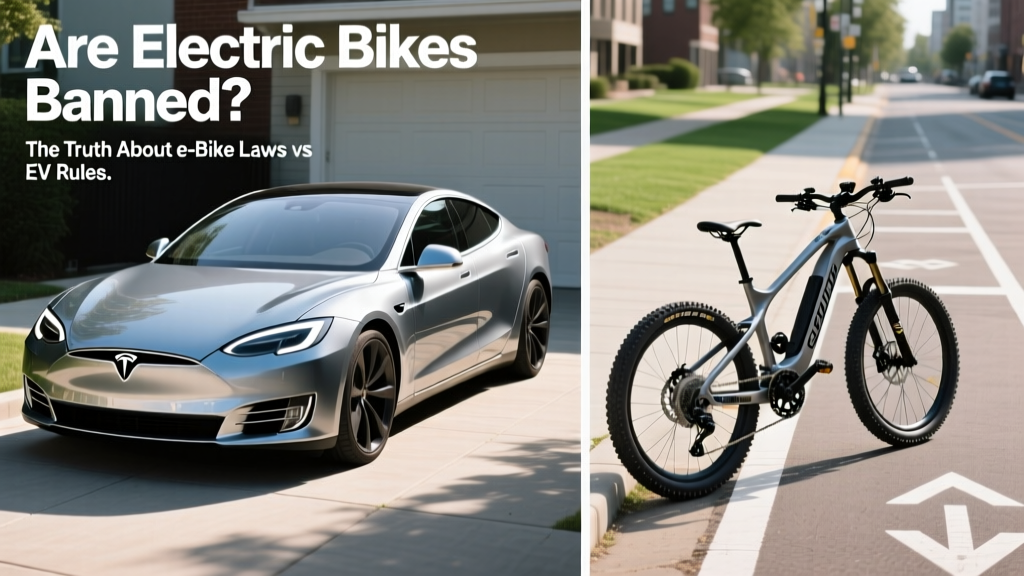
Quick Answer: Are Electric Bikes Banned?
No, electric bikes are not banned in the United States. However, e-bike regulations vary significantly by state, municipality, and trail system. As of 2026, most U.S. states follow a three-class system (Class 1, 2, and 3) that determines where e-bikes can legally operate — including roads, bike lanes, and off-road trails. Some local jurisdictions and land-management agencies (such as certain state parks and federal trails) do restrict or ban specific e-bike classes, particularly throttle-equipped (Class 2) and higher-speed (Class 3) models on natural-surface trails.
If you landed here wondering whether electric bikes are banned, you're not alone. Search interest in e-bike legality has surged as sales surpassed 800,000 units annually in the U.S. But at AutoEdgeView, our focus is electric vehicles — four-wheeled EVs, PHEVs, and the charging and ownership ecosystem around them. So in this guide, we'll answer the e-bike question directly, then pivot to the comparison that actually matters for most buyers weighing electrified transport: how does an electric car stack up against gas, hybrid, and yes, even an e-bike in terms of real cost, range, and daily practicality?
Understanding E-Bike Classifications and Where Bans Apply
The U.S. Consumer Product Safety Commission and most state legislatures categorize e-bikes into three classes. These classifications determine where restrictions or outright bans may apply:
| Class | Motor Assist | Max Assisted Speed | Throttle? | Common Restrictions |
|---|---|---|---|---|
| Class 1 | Pedal-assist only | 20 mph | No | Rarely banned; allowed most places bikes go |
| Class 2 | Pedal-assist + throttle | 20 mph | Yes | Banned on some natural-surface trails, certain state parks |
| Class 3 | Pedal-assist only | 28 mph | Varies by state | Often banned from sidewalks, multi-use paths; age restrictions in some states |
The bans that do exist are almost always location-specific, not blanket prohibitions. For example, some mountain-bike trail networks managed by the International Mountain Bicycling Association (IMBA) or local land trusts restrict Class 2 and Class 3 e-bikes to protect trail surfaces and user safety. National Park Service trails have their own rules — some allow Class 1 only, others ban all motorized assist. City streets and protected bike lanes, however, generally permit all three classes.
The key takeaway: before purchasing an e-bike, check your specific city ordinances, state laws, and the trail systems you plan to ride. Resources like NHTSA and state DMV websites maintain updated e-bike classification maps.
Why This Matters for EV Buyers: The Electrified Transport Spectrum
Understanding e-bike rules is useful context if you're evaluating the full spectrum of electrified transportation. Many buyers researching "are electric bikes banned" are actually exploring whether any electric vehicle faces regulatory hurdles. The short answer for four-wheeled EVs: there are no bans on electric cars in any U.S. state. In fact, states like California, Colorado, and New York actively incentivize EV adoption through rebates, HOV-lane access, and expanding charging infrastructure.
But the regulatory landscape for EVs does involve important rules — particularly around the federal §30D tax credit, which has specific eligibility requirements that function like a different kind of "restriction." Let's break that down alongside a cost comparison.
EV vs Gas vs Hybrid vs E-Bike: Real Cost Breakdown
Here's where numbers matter more than opinions. Below is a five-year total cost of ownership comparison across four common electrified (and non-electrified) options, assuming 12,000 miles driven annually and national average energy/fuel prices as of early 2026.
| Category | EV (e.g., 2026 Hyundai Ioniq 6 SE) | PHEV (e.g., 2026 Toyota RAV4 Prime) | Gas Car (e.g., 2026 Toyota Camry LE) | E-Bike (Class 1 commuter) |
|---|---|---|---|---|
| Base MSRP / Purchase Price | $38,650 | $43,690 | $29,495 | $1,800–$3,500 |
| Federal Tax Credit (§30D) | Up to $7,500 (eligibility varies) | Up to $7,500 (eligibility varies) | $0 | $0 (some local rebates) |
| Annual Fuel / Energy Cost | ~$540 (at $0.15/kWh) | ~$680 (mixed electric/gas) | ~$1,560 (at $3.50/gal, 30 MPG) | ~$15 (electricity) |
| 5-Year Fuel/Energy Total | $2,700 | $3,400 | $7,800 | $75 |
| Annual Maintenance | ~$300 | ~$500 | ~$750 | ~$150 |
| 5-Year Maintenance Total | $1,500 | $2,500 | $3,750 | $750 |
| Annual Insurance (avg) | ~$1,800 | ~$1,600 | ~$1,400 | ~$0 (or $100 for theft/accident) |
| 5-Year Insurance Total | $9,000 | $8,000 | $7,000 | $0–$500 |
| Estimated 5-Year TCO | ~$44,350 | ~$49,590 | ~$48,045 | ~$2,575–$4,825 |
A few critical caveats on these numbers:
- Tax credit eligibility is not guaranteed. The §30D credit requires the buyer to meet income caps ($150K single / $300K joint for new EVs), the vehicle must fall under MSRP caps ($55K for sedans, $80K for SUVs/trucks), and battery components and critical minerals must meet phased-in domestic-sourcing thresholds. Always verify current-year rules at IRS.gov §30D and consult a tax professional.
- EV insurance premiums run 15-30% higher than comparable gas vehicles, reflecting higher repair costs and battery-replacement risk.
- E-bikes can't replace a car for most households. They excel at 2-15 mile commutes in fair weather but don't solve highway commuting, family hauling, or extreme-weather transport.
Real-World EV Ownership: What First-Time Buyers Must Know
Whether you're coming from an e-bike search or a gas car, first-time EV buyers encounter the same practical questions. Here are the data-driven answers:
Home Charging: The Single Biggest Ownership Variable
Approximately 75-80% of EV charging happens at home. A Level 2 home charger (240V, typically 32-48 amps / 7.7-11.5 kW) adds roughly 25-44 miles of range per hour of charging — enough to fully replenish most EVs overnight. Installation costs range from $500-$2,500 if your electrical panel has capacity, but can jump to $3,000-$5,000+ if a panel upgrade (100A to 200A) is needed.
If you lack home charging access (apartment dwellers, street parking), public DC fast charging becomes your lifeline — and at $0.30-$0.50/kWh at networks like Electrify America or EVgo, your annual fuel cost can double to $1,000-$1,200.
Range Reality: EPA vs the Real World
EPA range estimates are tested under controlled conditions. Real-world range depends on speed, temperature, terrain, and climate-control use:
- Highway driving at 75 mph: Expect 80-90% of EPA range
- Cold weather (below 32°F): Expect 60-75% of EPA range without a heat pump; 75-85% with one
- City driving with regen braking: Often matches or slightly exceeds EPA range
For example, the 2026 Hyundai Ioniq 6 SE carries an EPA rating of 361 miles on its 77.4 kWh battery. In real-world highway testing at 70 mph in moderate temperatures, expect roughly 290-320 miles. In sub-freezing conditions, that drops to approximately 240-275 miles.
Charging Speed: kW Power vs kWh Capacity
This distinction trips up many new buyers. kW (kilowatts) measures power — how fast energy flows into your battery. kWh (kilowatt-hours) measures energy capacity — how much your battery holds. Think of kW as the flow rate of a hose and kWh as the size of the bucket.
A typical 2026 EV like the Ioniq 6 can accept a peak DC fast-charge rate of 240 kW. At that rate, a 10-80% charge takes roughly 18 minutes. However, charging speed follows a curve — it peaks at low state-of-charge and tapers significantly above 80% to protect battery health. That last 20% can take as long as the first 70%.
Common EV and E-Bike Misconceptions: Myth vs Fact
| Myth | Fact |
|---|---|
| "Electric bikes are banned everywhere." | E-bikes are legal on most U.S. roads and bike lanes. Bans are limited to specific trails and parks, usually for Class 2/3 models. |
| "EV batteries need replacement every 5 years." | Modern NMC and LFP batteries are warrantied for 8 years/100,000 miles (10 years/150,000 in CARB states). Real-world data shows ~8-12% degradation at 100K miles. Full replacements cost $5,000-$15,000 but are rarely needed within a vehicle's normal lifespan. |
| "EVs are worse for the environment because of battery mining." | Lifecycle analyses from the ICCT and Union of Concerned Scientists show EVs produce 50-70% fewer lifetime emissions than gas cars, even accounting for battery production — and the grid is getting cleaner every year. |
| "You'll be stranded with no charging stations." | The U.S. now has over 70,000 public charging ports. However, rural "charging deserts" remain real in parts of the Mountain West, rural South, and Alaska. Route planning with apps like PlugShare or A Better Routeplanner is essential for road trips in these regions. |
| "All EVs qualify for the $7,500 tax credit." | Eligibility depends on MSRP caps, buyer income limits, and battery-component/critical-mineral sourcing rules that tighten annually. Many popular EVs qualify for partial ($3,750) or no credit depending on your situation. Check the IRS source list and your tax professional. |
EV vs Gas vs Hybrid: Head-to-Head Specs
| Spec | 2026 Hyundai Ioniq 6 SE (EV) | 2026 Toyota RAV4 Prime (PHEV) | 2026 Toyota Camry LE (Gas/HEV) |
|---|---|---|---|
| EPA Range / Electric Range | 361 mi (EPA) | 42 mi electric + 550 mi total (gas) | 572 mi (51 MPG combined) |
| Battery / Energy | 77.4 kWh (NMC) | 18.1 kWh (NMC) | 1.6 kWh (HEV assist) |
| Powertrain Output | 225 HP (RWD) / 320 HP (AWD) | 302 HP combined | 225 HP combined |
| 0-60 mph | 6.9 sec (RWD) / 5.1 sec (AWD) | 5.7 sec | 7.2 sec |
| DC Fast Charge (10-80%) | ~18 min (peak 240 kW) | N/A (Level 2 only, ~2.5 hrs) | N/A |
| Level 2 Home Charge (0-100%) | ~7.5 hrs (at 10.9 kW) | ~2.5 hrs (at 6.6 kW) | N/A |
| Efficiency | 140 MPGe combined | 94 MPGe (electric) / 38 MPG (gas) | 51 MPG combined |
| Base MSRP | $38,650 | $43,690 | $29,495 |
| Battery Warranty | 10 yr / 100,000 mi | 10 yr / 150,000 mi | 10 yr / 150,000 mi (hybrid system) |
Data sourced from fueleconomy.gov and manufacturer specification pages. Real-world efficiency varies with driving style, climate, and terrain.
Decision Framework: Which Electrified Option Fits You?
Choose an e-bike if:
- Your commute is 2-15 miles on bike-friendly infrastructure
- You live in a mild climate or are comfortable riding in rain/cold
- You want the lowest possible cost ($0.01/mile energy cost)
- You already have a car or access to one for longer trips
Choose a BEV (battery electric vehicle) if:
- You have reliable home or workplace Level 2 charging access
- Your daily driving is under 250 miles and you road-trip fewer than 6 times per year
- You want the lowest per-mile energy cost for a four-wheeled vehicle (~$0.04-$0.05/mile at home)
- You're motivated by eliminating tailpipe emissions and reducing maintenance
Choose a PHEV (plug-in hybrid) if:
- You can charge at home but frequently take long road trips beyond comfortable EV range
- You want 30-42 miles of electric-only commuting with gas-engine backup
- You live in an area with sparse DC fast-charging infrastructure
- You want to reduce fuel consumption without full EV commitment
Choose a conventional HEV (hybrid, non-plug-in) if:
- You have no access to any charging (no garage, no workplace charger)
- You want better MPG without changing your fueling habits at all
- Upfront cost is a primary concern and you don't qualify for EV tax credits
Stick with gas if:
- You drive fewer than 5,000 miles per year (the fuel savings won't offset EV premiums)
- You live in a remote area with no charging infrastructure and extreme cold
- You need heavy towing capacity that current EVs handle less efficiently (though trucks like the F-150 Lightning and Rivian R1T are closing this gap)
Frequently Asked Questions
Are electric bikes banned on U.S. roads?
No. E-bikes are street-legal in all 50 states. Class 1 and Class 2 e-bikes (up to 20 mph) are generally treated like conventional bicycles. Class 3 e-bikes (up to 28 mph) may face age restrictions or bike-lane limitations in some states. Always check your local jurisdiction.
Are electric bikes banned on trails?
It depends on the trail and managing agency. Many paved multi-use paths allow all e-bike classes. Natural-surface mountain bike trails may restrict or ban Class 2 (throttle) and Class 3 e-bikes. Federal land agencies (USFS, BLM, NPS) have their own policies — some treat e-bikes as motorized vehicles requiring OHV-designated trails.
Do I need a license or registration for an e-bike?
In most states, no. E-bikes meeting the three-class definition (motor under 750W, max speed under 20-28 mph depending on class) are classified as consumer products, not motor vehicles. A few states have specific registration or helmet requirements for Class 3.
How does e-bike cost compare to owning an EV?
An e-bike costs $1,800-$3,500 upfront with negligible operating costs (~$15/year in electricity). A new EV starts around $30,000-$40,000 before incentives but offers weather protection, highway capability, cargo space, and passenger capacity. They solve different transportation problems. Many EV-owning households also own an e-bike for short errands.
What's the biggest mistake first-time EV buyers make?
The most common mistake is not assessing home charging access before purchasing. Buying an EV without a plan for reliable Level 2 charging (home or workplace) forces dependence on public DC fast chargers, which cost 2-4x more per kWh, take longer per session, and may have reliability issues. Budget $500-$2,500 for a home Level 2 installation, and verify your electrical panel capacity with a licensed electrician before committing.
Does cold weather really affect EV range that much?
Yes. At temperatures below 32°F, expect 15-30% range reduction depending on the vehicle's thermal management system. EVs with heat pumps (standard on many 2026 models including Hyundai, Tesla, and BMW) lose less range than those using resistive cabin heating. Preconditioning your battery while plugged in mitigates some cold-weather efficiency loss and improves DC fast-charge speeds.