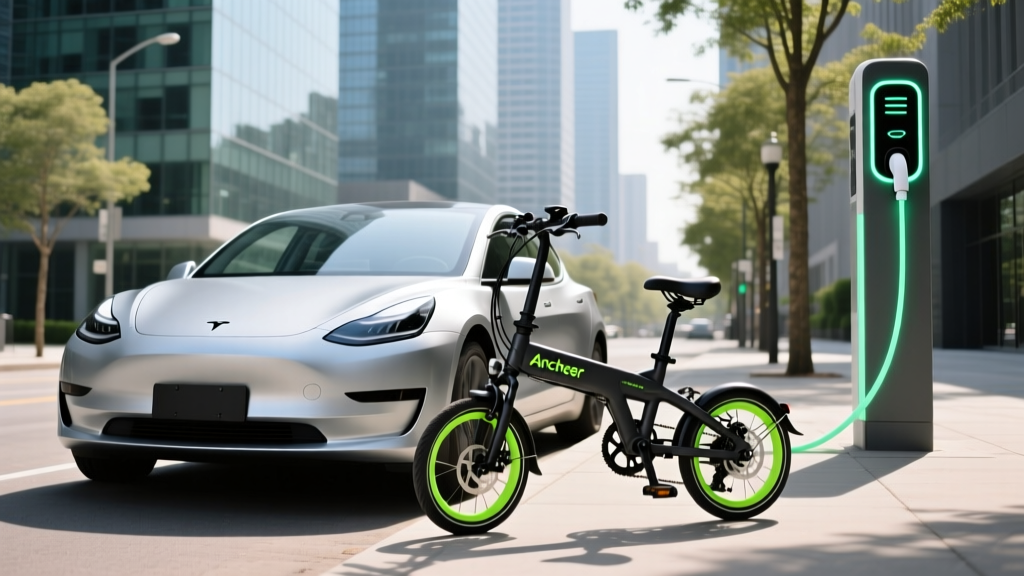
Quick Answer: An Ancheer electric folding bike (typically $400–$700, 15–28 mile range, 3–5 hour charge) makes sense for last-mile or short urban commutes under 15 miles round-trip. A budget EV like the 2026 Nissan Leaf S ($29,990 MSRP, 212-mile EPA range, ~$500–$800/year electricity cost) handles full daily driving, highway trips, and weather extremes. The e-bike wins on upfront cost and parking; the EV wins on range, safety, cargo, and year-round usability. Many owners pair a primary EV with an e-bike for short errands.
The Ancheer Electric Folding Bike: Specs, Range, and Real-World Limits
Ancheer produces several folding electric bike models, most commonly equipped with 250W–350W hub motors and 36V lithium-ion battery packs ranging from 6 Ah to 10 Ah (roughly 216–360 Wh of usable energy). These are Class 1 or Class 2 e-bikes under US federal law, capped at 20 mph assisted speed. Here is what that translates to in practice:
- Advertised range: 15–28 miles (pedal-assist mode, flat terrain, 150 lb rider)
- Real-world range: Expect 10–18 miles in throttle-only mode, hilly terrain, or with a heavier rider; cold weather (below 40°F) reduces lithium-ion output by 15–30%
- Charge time: 3–5 hours from empty using the included 2A charger on a standard 120V outlet
- Weight: 35–48 lbs depending on model — foldable but not trivial to carry up stairs
- Top speed: 15–20 mph (legally limited)
- Price range: $399–$699 depending on model and battery size
The Ancheer folding e-bike occupies a specific niche: budget-friendly, portable, adequate for a 5–10 mile one-way commute on bike-friendly streets. It is not a car replacement. There is no weather protection, minimal cargo capacity, and no safety cage. Riders assume the full risk profile of cycling in traffic.
Budget EV Commuter Alternative: What a 2026 Nissan Leaf or Chevy Equinox EV Actually Costs
To build an honest comparison, we need a realistic EV baseline. The two most accessible commuter EVs in 2026 are the Nissan Leaf S and the Chevrolet Equinox EV LT. Here is how the numbers stack up against the Ancheer e-bike on a per-commute basis:
| Metric | Ancheer E-Bike (36V 8Ah) | 2026 Nissan Leaf S | 2026 Chevy Equinox EV LT |
|---|---|---|---|
| Base MSRP | $499 | $29,990 | $34,995 |
| Usable Energy / Battery | ~288 Wh (0.288 kWh) | 58 kWh (NMC) | 85 kWh (NMC) |
| Range (EPA / Advertised) | 15–28 mi (claimed) | 212 mi (EPA) | 319 mi (EPA) |
| Real-World Commuter Range | 10–18 mi | ~170–190 mi (mixed driving) | ~260–290 mi (mixed driving) |
| Charge Time (0–100%) | 3–5 hr (120V) | ~7.5 hr (Level 2, 7.2 kW) | ~9.5 hr (Level 2, 11.5 kW) |
| DC Fast Charge (10–80%) | N/A | ~45 min (50 kW CHAdeMO) | ~30 min (150 kW CCS) |
| Energy Cost per 20-mi Round Trip | ~$0.01 (0.29 kWh × $0.16/kWh avg) | ~$0.80 (3.2 kWh × $0.16/kWh avg, ~160 Wh/mi) | ~$0.96 (3.6 kWh × $0.16/kWh avg, ~180 Wh/mi) |
| Annual Energy Cost (250-day commute) | ~$3 | ~$200 | ~$240 |
| Top Speed | 20 mph | 90+ mph | 110+ mph |
| Weather Protection | None | Full climate control | Full climate control with heat pump |
| Cargo | Backpack / small pannier | 23.6 cu ft (rear seats up) | 26.4 cu ft (rear seats up) |
| Federal Tax Credit (§30D) | Not eligible | Up to $7,500 (income/MSRP/sourcing rules apply) | Up to $7,500 (income/MSRP/sourcing rules apply) |
A few things jump out. The energy cost difference is real but small in absolute terms — roughly $200–$240 per year for an EV versus $3 for an e-bike. The e-bike's advantage is almost entirely in upfront cost ($499 vs. $29,990+) and parking convenience. The EV's advantages — range, safety, speed, cargo, all-weather capability — dominate for any commute beyond 10 miles or in climates with rain, snow, or extreme heat.
Real Cost of Ownership: E-Bike vs. EV Over 5 Years
Purchase price alone misleads. Let's build a 5-year total cost of ownership (TCO) model assuming a 20-mile daily round-trip commute, 250 commuting days per year, and national-average electricity rates ($0.16/kWh as of early 2026, per EIA data).
| Cost Category (5 Years) | Ancheer E-Bike | 2026 Nissan Leaf S | 2026 Chevy Equinox EV LT |
|---|---|---|---|
| Purchase Price | $499 | $29,990 | $34,995 |
| Federal Tax Credit (§30D) | $0 | –$3,750 to –$7,500* | –$3,750 to –$7,500* |
| Home Charging Setup (Level 2) | $0 (120V outlet) | $500–$1,500 | $500–$1,500 |
| Electricity (5 Years) | $15 | $1,000 | $1,200 |
| Insurance (5 Years) | $0–$150 (optional) | $6,000–$9,000 | $6,500–$10,000 |
| Maintenance (Tires, Brakes, Battery) | $200–$400 | $800–$1,200 | $800–$1,200 |
| Battery Replacement Reserve | $150–$250 (1–2 packs) | $0 (under 8yr/100k warranty) | $0 (under 8yr/100k warranty) |
| Total (Before Credit) | $864–$1,314 | $38,290–$43,190 | $43,995–$49,395 |
| Total (Max Credit Applied) | $864–$1,314 | $30,790–$35,690 | $36,495–$41,895 |
* §30D credit eligibility depends on buyer income caps ($150K single / $300K joint for new EVs), vehicle MSRP caps ($55K cars / $80K SUVs/trucks), and battery critical-mineral and component sourcing requirements per IRS guidelines. The Leaf qualifies for up to $3,750–$7,500 depending on sourcing compliance; the Equinox EV similarly. Always verify current-year rules with a tax professional.
The e-bike is dramatically cheaper over five years — roughly $1,000 all-in versus $30,000–$42,000 for an EV even after maximum tax credits. But this comparison only holds if the e-bike replaces the car. In reality, most households still need a car for groceries, family trips, highway driving, and bad weather. The realistic question is whether the e-bike replaces enough car trips to justify itself alongside an existing vehicle.
Charging Reality: What '3–5 Hours' Actually Means for Daily Use
The Ancheer's 3–5 hour charge window sounds slow compared to EV DC fast charging, but context matters. An e-bike battery at 288 Wh holds less energy than a single EV kWh. Charging 288 Wh over 4 hours draws roughly 72 watts — essentially a laptop charger. You plug it into any standard 120V outlet at home or work, no electrician required, no panel upgrade, no permit.
For an EV, Level 2 home charging (the practical standard) requires:
- A dedicated 240V circuit (typically 40A or 50A)
- Equipment cost: $300–$700 for a quality Level 2 charger (e.g., ChargePoint Home Flex, Emporia Vue)
- Electrician labor: $300–$1,500 depending on panel proximity and conduit runs
- Possible panel upgrade: $1,500–$3,000 if your home has a 100A service with limited breaker slots
- Total realistic install: $600–$2,200 for most homes with a 200A panel
If you rent an apartment without garage access or live in a building without EV-ready wiring, home charging is unavailable — and public DC fast charging at $0.30–$0.50/kWh roughly triples your per-mile electricity cost. The e-bike, by contrast, charges anywhere there is a wall outlet. This is a genuine structural advantage for apartment dwellers.
Common Misconceptions: E-Bikes and EVs Compared
| Myth | Fact |
|---|---|
| "An e-bike replaces a car for commuting." | Only if your commute is under 15 miles round-trip, on safe bike infrastructure, and you don't need cargo, passengers, or weather protection. For most US commuters, the average one-way trip is 16 miles (FHWA NHTS data), which already pushes an Ancheer e-bike to its range limit. |
| "EVs are too expensive compared to e-bikes." | On purchase price alone, yes. But if you already need a car, comparing a $499 e-bike to a $30,000 EV is a false choice — you would be comparing the e-bike to a $25,000–$35,000 gas car, where the EV often wins on 5-year operating cost. |
| "E-bike batteries last forever." | Budget e-bike lithium-ion packs typically endure 500–800 full charge cycles before degrading to 80% capacity. At one full cycle per day, that is 1.5–2 years of daily commuting before noticeable range loss. Replacement packs cost $100–$200. EV batteries, by contrast, are warranted for 8 years/100,000 miles at 70%+ capacity retention and typically last 15+ years in real-world data. |
| "Folding e-bikes are easy to carry on transit." | |
| "I don't need a car if I have an e-bike." | Feasible only in dense, bike-friendly cities with robust transit for longer trips. In most US metro areas, an e-bike supplements a car rather than replacing it. |
Decision Framework: E-Bike, EV, or Both?
Choose the Ancheer electric folding bike if:
- Your round-trip commute is 15 miles or less on bike-safe routes
- You live in an apartment or rental with no EV charging access
- You already own a car (gas or EV) and want to replace short errands
- Your budget is under $700 and you need a vehicle today
- You ride in mild weather most of the year (above 40°F, minimal rain)
- You can store and charge the bike indoors (battery fire risk is real with budget lithium packs — never charge unattended overnight)
Choose a budget EV (Leaf, Equinox EV, Hyundai Kona Electric) if:
- Your commute exceeds 15 miles one-way or includes highway segments
- You need to carry passengers, groceries, or cargo regularly
- You live in a climate with cold winters, heavy rain, or extreme heat
- You have access to home Level 2 charging or reliable workplace charging
- You want the safety of a crash-tested vehicle with airbags, ABS, and ADAS
- You qualify for the §30D tax credit (check income and sourcing rules on irs.gov)
Choose both (EV as primary + e-bike for short trips) if:
- You have an EV for commuting and road trips, and want to cut 2–5 mile errand trips that waste battery cycles and time searching for parking
- Your household has secure indoor storage for the e-bike
- You want to minimize total transportation cost while retaining full-weather capability
First-Time EV Buyer Essentials (If You Are Upgrading from E-Bike or Gas)
If you are reading this and considering your first EV purchase — whether you currently ride an Ancheer e-bike or drive a gas car — here are the non-obvious realities that spec sheets do not highlight:
1. Real-world range is 15–25% below EPA in cold weather. A 212-mile Leaf drops to roughly 160–175 miles at 20°F. Heat pumps (standard on the Equinox EV, not on the Leaf) mitigate this by 5–10 percentage points. If your worst-case winter commute is 40 miles round-trip, you need at least 200 miles of EPA-rated range to maintain a comfortable buffer.
2. Home Level 2 charging is the single biggest quality-of-life factor. Owners with home charging report 90%+ satisfaction; those relying solely on public charging report frequent frustration with broken chargers, occupied stalls, and variable pricing. Budget $800–$1,500 for a professional Level 2 install unless your panel is maxed out.
3. Insurance costs 10–25% more for EVs than comparable gas cars, driven by higher repair costs for battery packs and specialized body panels. Get quotes before purchasing — the premium difference can erase fuel savings in some states.
4. The §30D tax credit is not guaranteed. Battery sourcing requirements have disqualified several popular models in prior years. Always check the current qualified vehicle list on fueleconomy.gov before signing a purchase agreement. The credit can now be transferred to the dealer at point of sale, reducing your out-of-pocket cost immediately — but only if you meet income caps.
5. DC fast charging is for road trips, not daily use. Frequent DC fast charging (above 50 kW) accelerates battery degradation slightly. Plan to do 80%+ of your charging at home on Level 2 for optimal battery longevity.
FAQ: Ancheer E-Bike and EV Commuting Questions
Is the Ancheer electric folding bike street-legal in the US?
Yes, most Ancheer models comply with federal e-bike classification (Class 1 or 2, max 20 mph assisted, under 750W motor). State and local rules vary — some cities prohibit e-bikes on sidewalks or certain trails. Check your local ordinances. No registration, license, or insurance is required in most states for Class 1–2 e-bikes.
How long does an Ancheer e-bike battery last before needing replacement?
Expect 500–800 full charge cycles before capacity drops to ~80%. At one full cycle per commuting day, that is roughly 2–3 years. Replacement packs cost $100–$200 through Ancheer or third-party suppliers. Store and charge the battery between 20–80% state of charge for longest life, and never store it fully depleted or fully charged for extended periods.
Can I charge an EV and an e-bike on the same home electrical panel?
Almost always, yes. A Level 2 EV charger draws 32–48 amps on a 240V circuit. An e-bike charger draws under 1 amp on a 120V circuit. The e-bike is electrically negligible. The EV charger is the load that matters — a 200-amp home panel typically supports a 40A–50A EV circuit without upgrades. Homes with 100-amp panels may need a $1,500–$3,000 service upgrade.
Does the Ancheer e-bike qualify for any tax credits or incentives?
Not the federal §30D clean vehicle credit, which applies only to four-wheeled motor vehicles. Some states and utilities offer e-bike rebates (Colorado, California, and several municipal programs have offered $300–$1,500 e-bike incentives). Check your state energy office or local utility for current programs.
Is an e-bike safer than a car for commuting?
No. NHTSA data consistently shows that cyclists — including e-bike riders — face significantly higher fatality and injury rates per mile traveled than vehicle occupants. An EV provides a crash structure, airbags, electronic stability control, and available ADAS features like automatic emergency braking. If your commute involves high-speed roads or heavy traffic, a car is materially safer.
What happens to my e-bike range in winter?
Lithium-ion battery internal resistance increases in cold temperatures. Expect 15–30% range loss below 40°F, and up to 40% loss below 20°F, particularly in throttle-only mode. Pedal-assist mode partially offsets this by adding human power. Store and charge the battery indoors (above 50°F) for best cold-weather performance.