The Short Answer
Airports piloting hydrogen or electric ground operations at scale — including baggage tugs, shuttle buses, and ground support equipment (GSE) — are overwhelmingly choosing battery-electric over hydrogen fuel-cell for most tasks. The reason is pure economics: electric GSE costs roughly $0.08–$0.14 per mile to operate versus $0.25–$0.45 per mile for hydrogen, and Level 2 depot charging infrastructure is far cheaper to install than on-site hydrogen production and storage. For consumer EV buyers, these airport pilots confirm what data already shows: battery-electric wins on total cost of ownership for daily predictable routes, while hydrogen remains a niche solution for long-haul heavy-duty applications where battery weight and charging downtime are prohibitive.
Why Airports Are the Perfect EV and Hydrogen Proving Ground
Airports operate some of the most intensive fleet environments on earth. Ground support equipment — belt loaders, pushback tugs, cargo tractors, passenger shuttles — runs 18–22 hours per day, covers predictable routes, and returns to a central depot. This is the exact use case where battery-electric vehicles excel: short, repeatable cycles with overnight charging windows.
Major hubs including Los Angeles International (LAX), Dallas-Fort Worth (DFW), and Amsterdam Schiphol have committed to zero-emission GSE targets, with many aiming for full electrification by 2030–2035. The FAA's Airport Zero Emissions Infrastructure pilot program has funded feasibility studies at dozens of U.S. airports, and the results consistently favor battery-electric for vehicles under Class 6 (under 26,000 lbs GVWR).
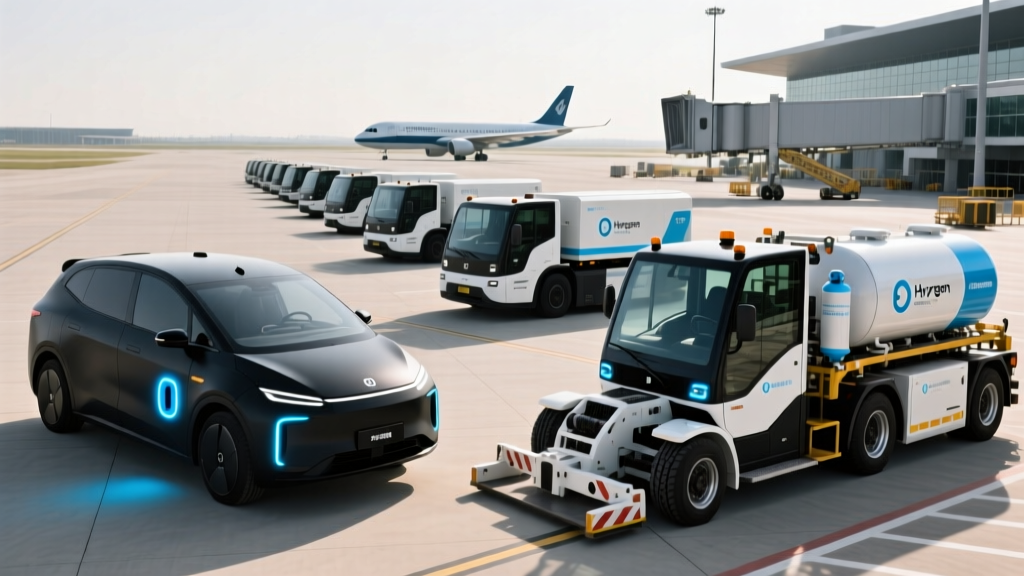
Hydrogen fuel-cell pilots exist — notably for heavy cargo tractors and long-range shuttle buses at hubs like Munich and Seoul Incheon — but they remain a fraction of total deployments. The infrastructure cost gap is the primary barrier: a single hydrogen refueling station capable of servicing 20–30 vehicles costs $3–$5 million to build, compared to $150,000–$400,000 for a depot of 20 Level 2 DC fast chargers.
Electric vs. Hydrogen Ground Ops: The Numbers That Matter
When airports evaluate electric versus hydrogen for ground operations, the comparison mirrors the consumer EV versus hydrogen car debate. Here is how the economics break down for a typical airport electric shuttle bus (Class 5, ~35 passengers) versus its hydrogen fuel-cell equivalent:
| Metric | Battery-Electric (BEV) | Hydrogen Fuel-Cell (FCEV) |
|---|---|---|
| Vehicle Purchase Price | $320,000–$400,000 | $450,000–$550,000 |
| Battery/Fuel Cell Capacity | 220 kWh (LFP) | 60 kW fuel cell + 12 kg H₂ tanks |
| Daily Range (Real-World) | 130–160 miles | 220–280 miles |
| Energy/Fuel Cost per Mile | $0.10–$0.14 (at $0.12/kWh) | $0.30–$0.45 (at $12–$18/kg H₂) |
| Refueling/Recharge Time | 3–4 hours (Level 2) / 45 min (DCFC) | 10–15 minutes |
| Infrastructure Cost (Per Vehicle Share) | $8,000–$20,000 | $100,000–$170,000 |
| Annual Maintenance | $4,500–$6,000 | $9,000–$14,000 |
| 10-Year Total Cost of Ownership | $680,000–$820,000 | $1,100,000–$1,450,000 |
The data is unambiguous: battery-electric wins on cost by a wide margin for routes under 150 daily miles with depot charging access. Hydrogen's advantage — faster refueling and longer range — matters only when vehicles cannot afford multi-hour charging downtime or exceed battery range limits.
What Airport Fleet Data Teaches Consumer EV Buyers
Airport GSE electrification is essentially a large-scale, real-world EV ownership experiment. The lessons translate directly to consumer purchasing decisions in 2026.
Lesson 1: Predictable Routes Eliminate Range Anxiety
Airport tugs and shuttles run the same loops daily. When you know your daily mileage — say 45 miles round-trip commute plus errands — a 250-mile EPA-rated EV with real-world highway range of ~210 miles provides a 4x buffer. Range anxiety is a function of unpredictability, not absolute range. Airport fleets prove that when routes are known, even modest-range EVs operate without issue.
Lesson 2: Depot (Home) Charging Is the Economic Engine
Every airport EV pilot confirms the same finding: vehicles that charge at depot overnight at commercial electricity rates ($0.08–$0.14/kWh) achieve operating costs 60–75% below diesel or hydrogen equivalents. For consumers, this translates to home Level 2 charging at residential rates ($0.10–$0.18/kWh depending on utility) yielding fuel costs of $0.03–$0.05 per mile — versus $0.12–$0.16 per mile for a 28 MPG gas car at $3.40/gallon.
Lesson 3: Cold Weather Impacts Are Real but Manageable
Airports in Minneapolis, Denver, and Chicago report 20–35% range reduction in sub-freezing conditions for electric GSE — consistent with consumer EV data. The mitigation is the same: thermal preconditioning, route planning with buffer, and oversizing battery capacity by ~25% for cold-climate operations. LFP batteries, increasingly used in both fleet and consumer EVs, show slightly worse cold-weather performance than NMC chemistries but offer superior cycle life (3,000–5,000 cycles vs. 1,500–2,500 for NMC).
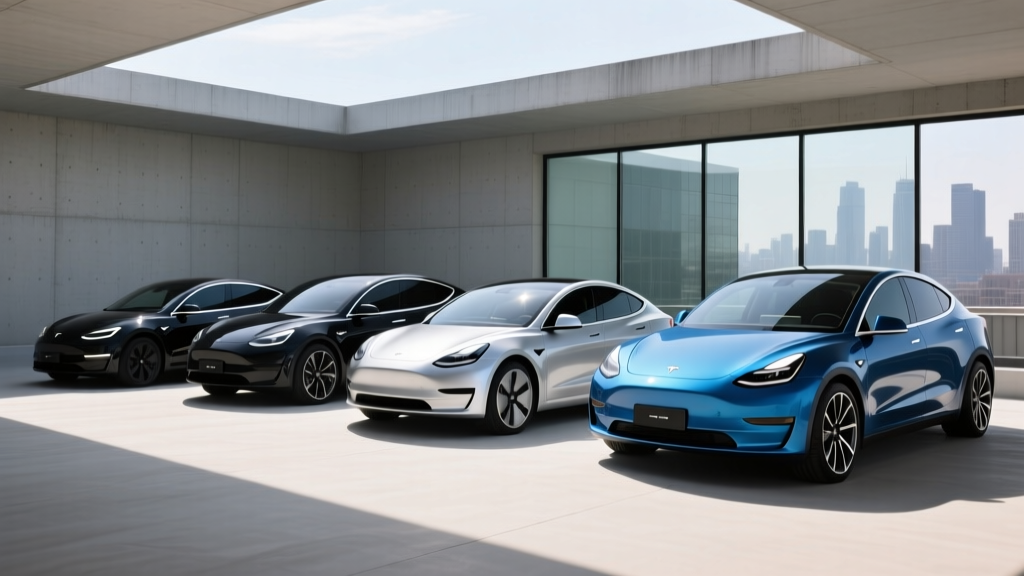
| Cost Category | 2026 Tesla Model Y (Long Range AWD) | 2026 Toyota RAV4 (AWD Gas) |
|---|---|---|
| MSRP (Base) | $44,990 | $33,425 |
| Federal Tax Credit (§30D) | Up to $7,500 (eligibility varies) | $0 |
| Effective Purchase Price | ~$37,490 | $33,425 |
| Fuel/Energy (75,000 mi / 5 yr) | $2,475 (home L2, $0.13/kWh) | $8,550 (28 MPG, $3.19/gal) |
| Maintenance (5 yr) | $1,800 | $4,200 |
| Insurance (5 yr avg.) | $9,750 | $7,200 |
| 5-Year Total Cost | $51,515 | $53,375 |
| Cost Per Mile | $0.69 | $0.71 |
Sources: fueleconomy.gov, IRS §30D. Tax credit eligibility depends on MSRP caps, buyer income limits, and battery-sourcing requirements. Consult a tax professional.
Hydrogen's Narrow but Real Use Case
Airports haven't abandoned hydrogen entirely. Munich Airport's hydrogen-powered heavy cargo tractors and Incheon's fuel-cell shuttle buses demonstrate where hydrogen makes sense: vehicles that need 300+ mile daily range, carry heavy payloads where battery weight becomes prohibitive, and can refuel in under 15 minutes to maintain continuous operations.
For consumers, this maps to a simple reality. The Toyota Mirai (the last remaining hydrogen passenger car sold in the U.S.) exists for drivers who cannot charge at home, need 350+ mile range, and live near the ~60 hydrogen stations concentrated in California. For everyone else, battery-electric is the rational choice.
Common Misconceptions About Airport Electrification and Consumer EVs
| Myth | Fact |
|---|---|
| "Airports choose hydrogen because batteries can't handle heavy work" | Battery-electric handles 85–90% of GSE tasks. Hydrogen is reserved for specific heavy-duty, long-range edge cases. |
| "EV batteries won't last in fleet use, so they won't last for consumers" | Airport GSE batteries (LFP chemistry) are rated for 4,000+ cycles. Consumer EV batteries are warrantied for 8 years/100,000 miles with 70%+ capacity retention, and real-world data shows most degrade only 10–15% over 8 years. |
| "Electric ground ops are just a pilot — they don't scale" | Over 25,000 electric GSE units are in active service globally as of 2025–2026, well past pilot stage at major hubs. |
| "Hydrogen is the future for all vehicles" | Well-to-wheel efficiency for green hydrogen is ~25–35%, versus ~70–80% for battery-electric. Physics favors batteries for light-duty transport. |
| "EVs are more expensive to own than gas cars" | Higher purchase price is offset within 3–5 years by fuel and maintenance savings, especially with the §30D credit and home charging. |
Real-World Ownership Considerations for First-Time EV Buyers
Airport fleet managers deal with the same constraints consumer buyers face. Here is what the data says about practical EV ownership in 2026:
Home Charging Access Is the Deciding Factor
If you can install a Level 2 home charger (240V, 32–48 amps, delivering 7.7–11.5 kW), EV ownership is dramatically cheaper and more convenient than gas. Installation costs range from $800–$2,500 for a straightforward setup to $3,000–$5,500 if your electrical panel needs a 200-amp upgrade. Without home charging, you will depend on public DC fast charging at $0.30–$0.50/kWh, erasing most fuel-cost savings.
Climate Matters for Range Planning
If you live where winter temperatures regularly drop below 20°F, budget 25–35% range loss. A vehicle with a 310-mile EPA rating will deliver ~200–230 real-world winter miles. Heat pumps (standard on most 2026 EVs from Hyundai, Kia, Tesla, and BMW) reduce this penalty to 15–25%.
Charging Speed Is More Important Than Peak Range
Airport fleets prioritize charge rate over battery size because downtime costs money. The same applies to consumers: a vehicle that charges at 250 kW peak (10–80% in ~18 minutes) is more practical for road trips than one with 400 miles of range that charges at only 150 kW (10–80% in ~32 minutes). Look for sustained charge curves, not just peak numbers — many EVs taper sharply above 60% SoC.
Insurance Costs Are Higher — Budget for It
EV insurance premiums run 15–25% higher than comparable gas vehicles due to higher repair costs and specialized parts. The Tesla Model Y averages $1,950/year nationally versus ~$1,440 for a gas RAV4. Shop quotes from EV-friendly insurers (Geico, Progressive, State Farm) before purchasing.
Decision Framework: Should You Go Electric, Hybrid, or Wait?
Choose a battery-electric vehicle (BEV) if:
- You have home charging access (garage, driveway, or dedicated outlet)
- Your daily driving is under 100 miles round-trip
- You qualify for the §30D federal tax credit (income under $150K single / $300K joint; vehicle MSRP under $55K cars / $80K SUVs/trucks)
- You want the lowest per-mile operating cost
Choose a plug-in hybrid (PHEV) if:
- You have home charging but regularly drive 200+ miles in a single day
- You live in an area with sparse public DC fast-charging infrastructure
- You want electric-only commuting (25–45 miles) with gas backup for road trips
Stick with a gas hybrid (HEV) or wait if:
- You have no access to home or workplace charging
- Your apartment or HOA restricts charger installation
- You drive 400+ miles weekly in rural areas with limited charging infrastructure
Consider hydrogen (FCEV) only if:
- You live in California near a hydrogen station cluster
- You cannot charge at home and need 350+ mile range
- You accept limited model availability (Toyota Mirai only) and higher fuel costs
Frequently Asked Questions
Are airports actually using electric vehicles at scale, or is it still a pilot?
It is well past pilot stage. Major airports including LAX, DFW, Schiphol, and Changi operate hundreds of electric GSE units each. The global electric GSE market exceeded 30,000 units in service by late 2025, with annual growth rates of 18–22%. The FAA and IATA both track these deployments as part of aviation sustainability mandates.
Why don't more airports use hydrogen if it refuels faster?
Cost and infrastructure complexity. A hydrogen refueling station costs $3–$5 million and requires either on-site electrolysis or pressurized hydrogen delivery by truck. The fuel itself costs $12–$18/kg (equivalent to $5–$8 per gallon of diesel in energy terms). Battery-electric depot charging costs a fraction of that to install and leverages existing electrical grid infrastructure.
Does airport electrification data apply to my consumer EV purchase?
Yes, directly. Airport fleets validate the same fundamentals: home/depot charging economics, battery longevity under heavy use, cold-weather range loss, and the total-cost-of-ownership advantage of electric over hydrogen and gas for predictable daily routes. The physics and economics scale from a baggage tug to a family SUV.
What is the §30D federal EV tax credit in 2026, and who qualifies?
The §30D credit provides up to $7,500 for new qualifying EVs, subject to: buyer income caps ($150K single, $225K head of household, $300K joint MAGI), vehicle MSRP caps ($55,000 for sedans, $80,000 for SUVs/trucks/vans), and battery component and critical-mineral sourcing requirements that tighten annually. The credit can be transferred to the dealer as a point-of-sale discount. Check IRS.gov and consult a tax professional for your specific eligibility.
How long do EV batteries actually last?
Federal law mandates a minimum 8-year/100,000-mile warranty on EV batteries with at least 70% capacity retention. Real-world data from fleet operators (including airport GSE) shows LFP batteries retaining 85–90% capacity after 150,000 miles, and NMC batteries retaining 80–88% over the same distance. Full battery replacement costs $8,000–$18,000 depending on the vehicle, but is rarely needed within the first 12–15 years of ownership.