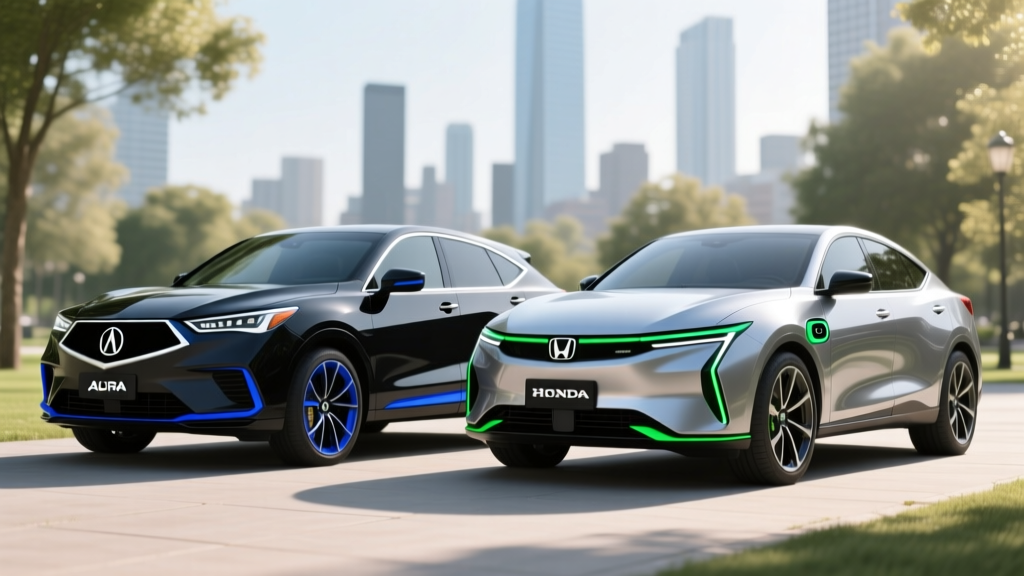
Honda's corporate siblings share bones but target different buyers. The 2026 Honda Prologue and 2026 Acura ZDX both ride on GM's Ultium platform, built in Spring Hill, Tennessee, yet their pricing, tuning, and feature sets diverge meaningfully. If you're cross-shopping these two-row electric SUVs, the decision hinges on whether premium badging and a more powerful Type S variant justify a $10,000+ premium — especially once federal tax credits enter the equation.
Side-by-Side Specs: Acura ZDX vs Honda Prologue
| Spec | Honda Prologue (EX AWD) | Acura ZDX (A-Spec AWD) | Acura ZDX Type S |
|---|---|---|---|
| EPA Range | 296 mi | 278 mi | 248 mi |
| Battery (usable) | 85 kWh, NMC | 102 kWh, NMC | 102 kWh, NMC |
| Peak DC Fast Charge | 190 kW | 190 kW | 190 kW |
| 10–80% DCFC Time | ~28 min | ~32 min | ~32 min |
| Level 2 Rate | 11.5 kW | 11.5 kW | 11.5 kW |
| Horsepower | 288 hp | 358 hp | 500 hp |
| 0–60 mph | 7.8 s | 6.1 s | 4.7 s |
| Efficiency (MPGe) | 95 MPGe | 87 MPGe | 77 MPGe |
| Cargo (rear seats up) | 25.2 cu ft | 26.4 cu ft | 26.4 cu ft |
| Starting MSRP | $47,400 | $58,550 | $73,450 |
| Battery/Powertrain Warranty | 8 yr / 100,000 mi | 8 yr / 100,000 mi | 8 yr / 100,000 mi |
Sources: fueleconomy.gov, Honda & Acura press sites. Real-world highway range typically runs 10–15% below EPA; cold weather can shave another 15–25%.
Range & Charging: Efficiency Favors the Prologue
Despite sharing the Ultium architecture, the Prologue stretches its smaller 85 kWh pack further thanks to lower curb weight and less aggressive tuning. The Acura's 102 kWh pack delivers more total energy but pays a penalty at the pump: identical 190 kW peak charging rates mean the ZDX's larger battery takes roughly four minutes longer to reach 80%.
- Prologue EX AWD: EPA 296 mi → expect ~255–270 mi highway, ~220 mi in freezing temps.
- ZDX A-Spec AWD: EPA 278 mi → expect ~240–255 mi highway, ~205 mi in freezing temps.
- ZDX Type S: EPA 248 mi → expect ~210–225 mi highway; the performance motors and 22-inch wheels punish efficiency.
Both SUVs use CCS1 connectors (no native NACS on 2026 models, though adapters for Tesla Superchargers are available). Public DC charging at Electrify America or EVgo stations works identically in both. The charge curve is typical GM Ultium: strong pull from 10–50% SoC, tapering noticeably past 70%. Neither will set records against Hyundai's E-GMP platform, which still 10–80% charges in ~18 minutes at 350 kW stations.
Performance & Driving Dynamics
The Prologue's 288 hp dual-motor setup delivers adequate acceleration for daily commuting and confident highway merging. The ZDX A-Spec's 358 hp provides noticeably firmer shove, but the real differentiator is the Type S: 500 hp and a 4.7-second 0–60 time transform it into a genuine performance SUV that can embarrass sports sedans at stoplights.
Chassis tuning diverges here too. The Acura gets firmer dampers, thicker stabilizer bars, and (on Type S) air suspension with adaptive damping. You feel the difference on back roads. The Prologue prioritizes ride comfort, soaking up potholes with more compliance. Neither offers true one-pedal driving strong enough to bring the vehicle to a complete stop — you'll still use the brake pedal in stop-and-go traffic, which frustrates some EV converts.
Pricing, Tax Credits, and True Cost to Buy
Here's where the math flips for many buyers. Under current IRS §30D rules, the Honda Prologue qualifies for up to the full $7,500 federal tax credit when taken at point-of-sale, provided the buyer meets income caps ($150k single / $300k married filing jointly) and the vehicle is placed in service for personal use. Because the Prologue is assembled in Tennessee with GM-sourced battery cells, it generally clears the critical-minerals and battery-component sourcing requirements.
The Acura ZDX, also built in Spring Hill on the same line, qualifies under the same rules. However, the MSRP cap matters: §30D limits SUVs to an $80,000 MSRP ceiling. The ZDX Type S at $73,450 still qualifies, but any options packages that push it past $80,000 disqualify it entirely. Always verify the final window sticker.
| Model | MSRP | Max §30D Credit | Effective Price |
|---|---|---|---|
| Prologue EX AWD | $47,400 | $7,500 | ~$39,900 |
| ZDX A-Spec AWD | $58,550 | $7,500 | ~$51,050 |
| ZDX Type S | $73,450 | $7,500 | ~$65,950 |
Credit eligibility depends on buyer income, tax liability, and final MSRP. Verify current rules at IRS.gov before purchase. State/local incentives vary — check DSIRE.org for your jurisdiction.
The Prologue's effective sub-$40k price puts it squarely against the Tesla Model Y and Hyundai Ioniq 5. The ZDX A-Spec, even after credit, still costs $11,000 more — a premium you're paying for leather, a 14-speaker Bang & Olufsen audio system, and a more isolated cabin. Whether that's worth it is personal.
Category Winners
Ownership Costs: Efficiency, Insurance, and Maintenance
The Prologue's superior efficiency compounds over time. At the national average electricity rate of ~$0.16/kWh, charging the Prologue's 85 kWh pack from empty costs roughly $13.60. The ZDX's 102 kWh pack costs ~$16.32. Over 15,000 miles annually, that's a ~$135/year gap — modest, but it adds up over five years.
Insurance premiums run 8–12% higher on the ZDX, driven by its higher replacement cost and Type S performance variant. Expect ~$1,900–$2,300/year for the Prologue versus ~$2,200–$2,700/year for the ZDX A-Spec (Type S can exceed $3,000 depending on your zip code and driving record). Both require zero oil changes, and brake pad life extends well past 80,000 miles thanks to regenerative braking. Tire rotation every 7,500 miles remains the primary recurring cost.
Decision Framework: Which Should You Buy?
- You want the lowest effective purchase price (sub-$40k after credit)
- Maximizing range per charge is your top priority
- You prioritize ride comfort over sporty handling
- You drive 12,000–15,000 miles/year and value lower running costs
- You don't need premium audio or luxury interior materials
- You want Type S performance (500 hp, 4.7s 0–60) and air suspension
- Premium cabin materials and B&O audio matter to you
- You need slightly more cargo space (26.4 vs 25.2 cu ft)
- You're willing to pay an $11,000+ premium after credits for the badge and refinement
- You want a more driver-focused chassis on canyon roads
Final Verdict
For most two-row electric SUV shoppers, the Honda Prologue is the rational choice. Its sub-$40k effective price after the federal credit, 296-mile EPA range, and 95 MPGe efficiency make it one of the most accessible Ultium-based EVs on the market. The Acura ZDX justifies its premium only if you genuinely value the Type S powertrain, air suspension, and luxury amenities — and are willing to absorb higher insurance and charging costs. Neither is a bad EV; they're simply different answers to the same question.
Frequently Asked Questions
Do both qualify for the full $7,500 federal tax credit?
Generally yes, under 2026 §30D rules, provided the buyer's adjusted gross income falls below $150k (single) or $300k (married filing jointly), the MSRP stays under $80,000 for SUVs, and the vehicle is assembled in North America with compliant battery sourcing. Both are built in Tennessee. Always confirm on the final window sticker and consult a tax professional.
Can I charge either at Tesla Superchargers?
Not natively — both use CCS1 connectors. However, GM provides a Tesla Supercharger adapter (included or available depending on trim) that enables access to the NACS-equipped Supercharger network. Confirm adapter availability with your dealer at purchase.
Which handles cold weather better?
Both use a heat pump for cabin heating, which helps preserve range in cold climates. Expect 15–25% range loss below freezing for either vehicle. The ZDX's larger 102 kWh battery gives it a larger absolute buffer, but the Prologue's better baseline efficiency means its percentage loss is similar.
Is the Prologue just a cheaper ZDX?
They share the Ultium platform and many hard points, but the Prologue gets a smaller battery, softer suspension, different interior materials, and Honda-specific infotainment tuning. The ZDX offers more power, more cargo room, and luxury features the Prologue cannot match. They're siblings, not clones.
What's the real-world highway range?
Expect roughly 10–15% below EPA on sustained highway driving at 70–75 mph. That puts the Prologue around 255–270 miles and the ZDX A-Spec around 240–255 miles. The Type S drops to roughly 210–225 miles at highway speeds due to its aggressive powertrain and 22-inch wheels.