Quick Answer: What Are AC Electric Cars?
Virtually every modern EV uses an AC (alternating current) motor — either an AC induction motor or a permanent-magnet synchronous motor (PMSM) that runs on AC via an inverter. The battery stores DC (direct current) energy in kWh, and the car's inverter converts that DC to AC to spin the motor. When people search for "AC electric cars," they're usually asking about one of three things: the motor type, the charging type (AC Level 1/Level 2 vs DC fast charging), or whether the car runs on household AC power. This guide covers all three — with real 2026 specs, costs, and a decision framework to help you choose.
AC Motors in Electric Cars: Induction vs Permanent Magnet
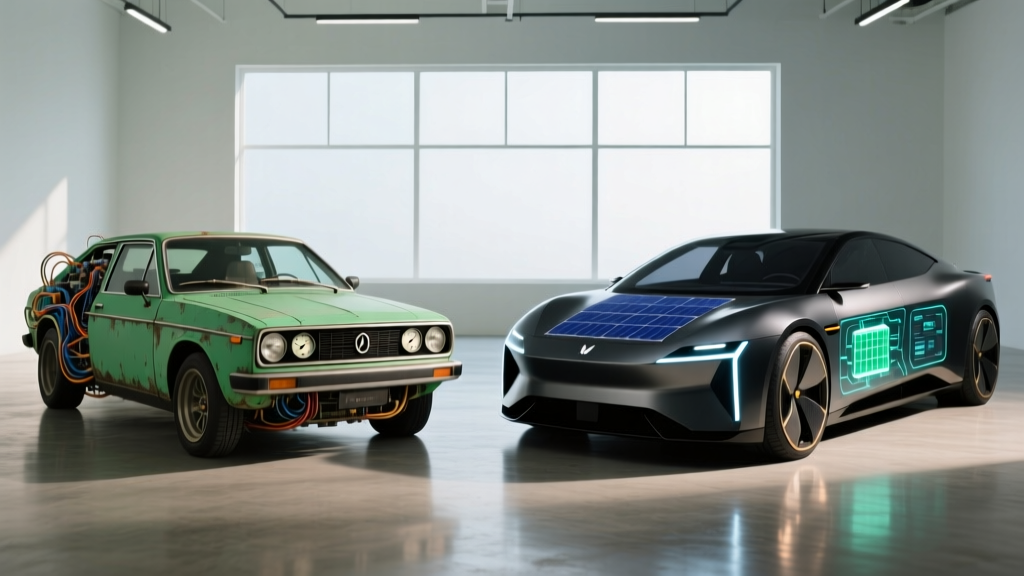
The traction motor is what turns the wheels, and nearly all production EVs in 2026 use AC motors. There are two dominant designs, each with distinct engineering trade-offs:
| Attribute | AC Induction Motor | Permanent Magnet (PMSM) |
|---|---|---|
| How it works | Rotating magnetic field induces current in rotor — no permanent magnets | Permanent magnets on rotor create field; stator AC drives rotation |
| Efficiency (typical) | 88–92% | 93–97% |
| Peak power examples | Tesla Model S Plaid rear motor: ~340 kW | Hyundai Ioniq 6: 168 kW (RWD), 239 kW (AWD) |
| Cost to manufacture | Lower (no rare-earth magnets) | Higher (neodymium/dysprosium magnets) |
| Highway efficiency | Stronger at high RPM (less drag loss) | Slightly lower at very high RPM |
| City/stop-and-go efficiency | Lower (rotor losses when not energized) | Higher (instant torque, minimal losses) |
| Notable 2026 examples | Tesla Model S/X (front motor for coasting), older Model 3 RWD | Hyundai Ioniq 5/6, Ford Mustang Mach-E, BMW i4, Chevy Equinox EV, Tesla Model 3/Y (rear) |
| Regen braking strength | Moderate | Stronger (one-pedal driving easier) |
Many dual-motor AWD EVs use a hybrid approach: a permanent magnet motor on the rear axle for efficiency and an AC induction motor on the front axle that can freewheel (disconnect) when not needed, reducing drag. Tesla pioneered this in the Model S and Model 3 AWD, and it remains common in 2026 across brands like Rivian (R1T/R1S) and the BMW iX.
Key insight: You don't choose an EV by motor type alone — but motor type explains why some EVs are more efficient in city driving (PMSM wins) while others hold efficiency better at sustained 80 mph highway speeds (induction can edge ahead). For most buyers, the overall vehicle efficiency rating (MPGe and kWh/100mi on fueleconomy.gov) matters more than the motor architecture.
AC Charging vs DC Fast Charging: Speeds, Costs, and What You Need
This is where the "AC electric cars" question gets practical. Every EV battery stores energy as DC. The difference is whether the AC-to-DC conversion happens inside the car (AC charging) or at the charger itself (DC fast charging).
| Level | Power (kW) | Miles Added/Hour | Typical Use | 10–80% Time (75 kWh battery) | Equipment Cost |
|---|---|---|---|---|---|
| Level 1 (120V AC) | 1.0–1.4 kW | 3–5 mi/hr | Emergency / overnight top-up | ~50+ hours (impractical) | $0 (included cord) |
| Level 2 (240V AC) | 7.2–19.2 kW | 25–60 mi/hr | Home daily charging, workplace | ~5–8 hours | $300–$700 (charger) + $500–$2,500 (install) |
| DC Fast Charge | 50–350 kW | 150–1,000+ mi/hr | Road trips, quick top-ups | 18–45 min (varies by vehicle) | Public use: $0.30–$0.60/kWh |
AC charging (Level 1 and Level 2) sends alternating current from your home's electrical panel to the car. The car's onboard charger converts that AC to DC to fill the battery. The onboard charger's capacity limits your speed — most 2026 EVs have an 11.5 kW onboard charger, meaning even if you plug into a 19.2 kW Level 2 station, you'll only pull 11.5 kW.
DC fast charging bypasses the onboard charger entirely. The station does the AC-to-DC conversion at much higher power and sends DC directly to the battery. This is why a 250 kW Tesla Supercharger or a 350 kW Electrify America station can add 200+ miles in 15–20 minutes — the car's onboard charger isn't the bottleneck.
Peak DC Charge Rates for Popular 2026 EVs
| Vehicle | Battery (kWh usable) | Peak DC Rate (kW) | 10–80% Time | Onboard AC Charger |
|---|---|---|---|---|
| Tesla Model Y Long Range | 75 kWh (NMC) | 250 kW | ~25 min | 11.5 kW |
| Hyundai Ioniq 5 (84 kWh) | 77.4 kWh (NMC) | 240 kW (800V) | ~18 min | 10.9 kW |
| Chevy Equinox EV 3RS | 85 kWh (NMC) | 190 kW | ~30 min | 11.5 kW |
| Ford Mustang Mach-E Extended Range | 91 kWh (NMC) | 150 kW | ~38 min | 10.5 kW |
| BMW i4 eDrive40 | 81.5 kWh (NMC) | 205 kW | ~28 min | 11 kW |
| Tesla Model 3 RWD (LFP) | 57.5 kWh (LFP) | 170 kW | ~25 min | 11 kW |
Real-world charging caveat: Peak kW is not sustained kW. Every EV's charge curve tapers significantly above 80% State of Charge (SoC) to protect the battery. A Hyundai Ioniq 5 that peaks at 240 kW at 10% SoC may be pulling only 40 kW by the time it hits 85%. For road-trip planning, the 10–80% time is the number that matters — not the peak rate.
EV vs Gas vs Hybrid: Real Cost Comparison for 2026
Whether an AC-motor EV saves you money depends on your driving patterns, electricity rates, and whether you can charge at home. Here's a concrete 5-year comparison based on 15,000 miles/year:
| Cost Factor | 2026 Tesla Model 3 RWD (EV) | 2026 Toyota Prius (HEV) | 2026 Honda Civic 2.0 (Gas) |
|---|---|---|---|
| Base MSRP | $38,990 | $28,550 | $24,950 |
| Fed. Tax Credit (§30D)* | Up to $7,500 (see IRS rules) | $0 | $0 |
| Effective purchase price | ~$31,490 | $28,550 | $24,950 |
| Fuel/energy cost (5 yr) | $3,750 (home charging, $0.14/kWh) | $5,625 (57 MPG, $3.50/gal) | $8,750 (35 MPG, $3.50/gal) |
| Maintenance (5 yr) | ~$1,200 (tires, cabin filter, fluid top-ups) | ~$2,800 (oil, filters, brakes) | ~$3,500 (oil, filters, brakes, spark plugs) |
| Insurance (5 yr avg) | ~$10,500 ($2,100/yr) | ~$7,500 ($1,500/yr) | ~$7,200 ($1,440/yr) |
| Estimated depreciation | ~$14,000 | ~$9,500 | ~$10,000 |
| 5-Year Total | ~$60,940 | ~$53,975 | ~$54,400 |
*Federal §30D tax credit eligibility depends on buyer income caps ($150K single / $300K joint), vehicle MSRP caps ($55K sedans / $80K SUVs/trucks), and battery critical-mineral sourcing requirements. Rules are current for 2026 but subject to legislative change. Verify at irs.gov or consult a tax professional. Point-of-sale transfer is available from participating dealers.
The takeaway: The EV wins on energy and maintenance costs by a wide margin — roughly $5,000–$7,500 less than gas over 5 years. But higher insurance premiums and steeper depreciation (EVs have depreciated faster than hybrids since 2023) can erode that advantage. The break-even point depends heavily on your local electricity rate, annual mileage, and whether you qualify for the full tax credit.
Home Charging Access: The Make-or-Break Factor
Here's the most important ownership reality that EV marketing glosses over: AC Level 2 home charging is what makes EV ownership convenient and affordable. Without it, you're relying on DC fast charging at $0.30–$0.60/kWh — roughly double the cost of home electricity and far less convenient.
Level 2 home installation costs in 2026:
- Best case: $800–$1,200 total. You have a 200-amp panel with spare capacity, and the charger mounts within 10 feet of the panel. Equipment: ~$400 (e.g., Emporia Vue, ChargePoint Home Flex). Electrician: ~$500–$800.
- Typical case: $1,500–$2,500. Requires running a new 240V/50A circuit 30–50 feet from the panel through walls or conduit. Permit: $50–$200 depending on jurisdiction.
- Worst case: $3,000–$5,000+. Your panel is maxed out at 100A or 150A and needs a service upgrade to 200A. The utility may charge $500–$1,500 for the upgrade, and the electrician's work doubles.
If you live in an apartment or condo without dedicated parking and charging access, an EV becomes significantly harder to own. In that scenario, a hybrid (HEV) or plug-in hybrid (PHEV) like the Toyota RAV4 Prime (42 miles electric-only range, EPA) may be the better electrified choice — you get electric commuting when you can plug in, with no range anxiety when you can't.
Common EV Misconceptions — Fact-Checked with Data
| Myth | Fact (with data) |
|---|---|
| "EV batteries need replacing every few years." | Modern NMC and LFP batteries are warranted for 8 years / 100,000 miles (federal minimum). Real-world data from Tesla's 2025 Impact Report shows average degradation of ~12% at 150,000 miles. LFP packs (Tesla Model 3 RWD, standard-range BYD models) show even slower degradation due to chemistry. |
| "EVs don't work in cold weather." | Cold reduces range — typically 20–35% at 20°F per AAA and Consumer Reports testing. A 300-mile EPA EV may deliver 200–240 real-world miles in deep cold. Preconditioning (warming the battery while plugged in) recovers 10–15% of that loss. Heat pumps, standard on most 2026 EVs, cut cabin-heating energy use by ~30%. |
| "Public charging is always broken." | Reliability varies by network. Tesla Superchargers maintain ~99.5% uptime. Electrify America and EVgo report 90–95% session success rates in 2025–2026. Non-Tesla CCS chargers still have more downtime than Superchargers, but NACS adoption (Ford, GM, Rivian, Hyundai now using NACS adapters or native ports) is expanding Supercharger access to nearly all new EVs. |
| "EVs are worse for the environment because of battery mining." | Lifecycle analyses by the ICCT and Argonne National Laboratory show EVs produce 50–70% fewer lifetime CO₂ emissions than comparable gas cars on the current US grid mix — even accounting for battery manufacturing. As the grid decarbonizes, that gap widens further. |
| "You'll save money immediately." | Upfront EV cost is still higher. The savings accrue over 3–5 years through lower fuel and maintenance costs, and only if you qualify for the tax credit and charge primarily at home. Public-only charging can make an EV more expensive to fuel than a 50+ MPG hybrid. |
Decision Framework: Should You Buy an EV, Hybrid, or Gas Car?
If-Then Guide for 2026 Buyers
- IF you have home Level 2 charging access (or can install it for under $2,500) AND drive under 300 miles/day AND qualify for the §30D credit → Choose a full EV. Models like the Tesla Model 3 ($38,990), Hyundai Ioniq 5 ($42,600), or Chevy Equinox EV ($33,600) offer 250–315 miles EPA range and the lowest per-mile energy cost.
- IF you lack home charging and rely on street parking AND your commute is under 40 miles → Choose a PHEV (Toyota RAV4 Prime, 42 mi electric; Jeep Wrangler 4xe, 22 mi electric). You charge overnight at work or a public Level 2 and use gas for longer trips.
- IF you frequently drive 400+ mile road trips through rural areas with sparse charging → Choose a hybrid (HEV) like the Toyota Prius (57 MPG combined) or Hyundai Tucson Hybrid (38 MPG). No plug needed, no range anxiety.
- IF you live in extreme cold (below 0°F regularly) AND need reliable long-range winter driving → Consider a hybrid or a long-range AWD EV with a heat pump (Tesla Model Y, BMW iX). Expect 25–35% winter range reduction on EVs.
- IF your budget is under $28,000 and you need a new vehicle → Choose a hybrid or efficient gas car. No new EV currently starts below ~$30,000 after credits. The used EV market offers options (Nissan Leaf, older Chevy Bolt) but verify battery health (State of Health / SoH) before buying.
What First-Time EV Buyers Must Know Before Signing
Before you put down a deposit, verify these five items:
- Your home electrical panel capacity. Hire an electrician for a $100–$200 panel assessment before buying. If you need a 200A upgrade, budget $3,000–$5,000 and 2–6 weeks lead time.
- Your real-world range needs. Take the EPA range, subtract 15% for highway driving at 75+ mph, and another 20–30% for winter if you live in a cold climate. A 310-mile EPA EV may give you 200 reliable winter highway miles. Plan for your worst-case day, not your average day.
- Tax credit eligibility — yours and the car's. The §30D credit has three hurdles: your income (AGI under $150K single / $300K joint), the vehicle's MSRP (under $55K for sedans, $80K for SUVs/pickups), and battery sourcing (critical minerals and components must meet phased-in domestic-content thresholds). Check the latest eligible vehicle list at fueleconomy.gov.
- Insurance quotes. Get quotes before buying. EV insurance premiums run 15–30% higher than comparable gas cars, per IIHS and industry data, due to higher repair costs and battery replacement risk.
- The charging network along your common routes. Download PlugShare or A Better Routeplanner and map your most frequent long trips. If there are reliable DC fast chargers every 150–200 miles along your route, an EV works. If not, a hybrid may be smarter.
Frequently Asked Questions
Do all electric cars use AC motors?
Nearly all production EVs use AC motors — either AC induction or permanent magnet synchronous (PMSM). The battery stores DC energy, and an inverter converts it to the three-phase AC that drives the motor. Some very small or low-speed EVs (neighborhood electric vehicles, e-bikes) use DC brushless motors, but every mainstream car, SUV, and truck EV sold in the US in 2026 uses AC motor technology.
Can I charge an EV from a regular household outlet?
Yes — that's Level 1 AC charging at 120V, delivering about 1.0–1.4 kW (roughly 3–5 miles of range per hour). It's sufficient for PHEVs with small batteries or as an emergency backup, but impractical as a daily charging solution for a full EV with a 60–100 kWh battery. A full charge from empty could take 50–80 hours. Most EV owners install a 240V Level 2 charger for 25–60 miles of range per hour.
Why do EVs have both AC and DC charging ports?
They don't have separate ports in most cases. In North America, the J1772 connector (or NACS for Tesla and now Ford/GM/Hyundai/Rivian) handles both AC Level 2 charging and DC fast charging through the same inlet — the pins and communication protocol differ. The AC pins feed the onboard charger; the DC pins bypass it and go straight to the battery. CHAdeMO (used on the older Nissan Leaf) was a separate DC-only connector, but it's being phased out in favor of CCS and NACS.
Is a permanent magnet motor better than an AC induction motor?
For most buyers, PMSM is the better choice — it's more efficient in city and mixed driving, enables stronger regenerative braking, and delivers slightly better range per kWh. AC induction motors are cheaper to build (no rare-earth magnets), handle high-RPM highway driving efficiently, and can disconnect cleanly in dual-motor AWD setups. That's why Tesla uses induction on the front axle and PMSM on the rear in dual-motor vehicles.
What happens if my EV battery degrades past warranty?
Federal law mandates a minimum 8-year / 100,000-mile battery warranty covering defects and excessive capacity loss (typically defined as dropping below 70% of original capacity). In practice, most NMC and LFP packs retain 85–90% capacity at 100,000 miles based on fleet data. Out-of-warranty replacement costs $8,000–$20,000 depending on the vehicle and battery size, though prices continue to decline. Many owners never need a replacement within the vehicle's useful life.