The Short Answer: No Fully Electric 4Runner Exists Yet
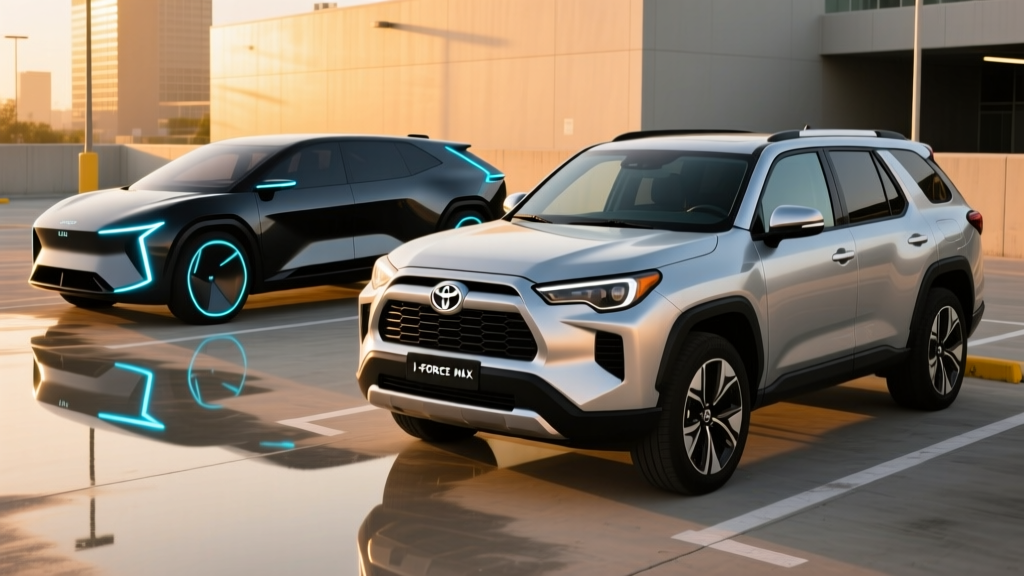
As of the 2026 model year, Toyota does not offer a battery-electric 4Runner. The closest electrified option is the 2026 4Runner i-FORCE MAX hybrid, a traditional hybrid (HEV) pairing a 2.4-liter turbocharged four-cylinder with an electric motor for a combined 326 horsepower and 465 lb-ft of torque. It is not a plug-in hybrid and not a BEV. If you're searching for a "4Runner electric," what you'll actually find is this hybrid powertrain — which improves fuel economy and low-end torque but still requires gasoline and cannot be plugged in. A fully electric 4Runner has not been officially announced by Toyota.
2026 Toyota 4Runner i-FORCE MAX: Hybrid Powertrain Specs
The 2026 4Runner rides on Toyota's TNGA-F body-on-frame platform, shared with the Tacoma, Land Cruiser, and Sequoia. The i-FORCE MAX hybrid powertrain places a 48-hp electric motor between the engine and the 8-speed automatic transmission. This is a mild full-hybrid system — it can propel the vehicle at low speeds on electric power alone for very short distances, but it has no meaningful electric-only range and no plug.
| Specification | Value |
|---|---|
| Powertrain | 2.4L turbo I-4 + electric motor (HEV) |
| Combined Horsepower | 326 hp |
| Combined Torque | 465 lb-ft |
| Transmission | 8-speed automatic |
| EPA Fuel Economy (4x2) | ~23 MPG combined (est.) |
| EPA Fuel Economy (4x4) | ~22 MPG combined (est.) |
| Towing Capacity | Up to 6,000 lbs |
| Battery Type | Nickel-metal hydride (NiMH), ~1.9 kWh |
| Drivetrain | RWD or part-time/full-time 4WD |
| Starting MSRP (SR5 i-FORCE MAX) | ~$52,000 |
| Hybrid Battery Warranty | 10 years / 150,000 miles |
For context, the non-hybrid 2026 4Runner with the standard i-FORCE 2.4L turbo (no electric assist) produces 278 hp and 317 lb-ft and returns roughly 20-21 MPG combined. The hybrid's primary advantages are a 2-3 MPG improvement, significantly more torque for off-road crawling and towing, and smoother low-speed behavior.
4Runner Hybrid vs Gas vs a Hypothetical EV: Cost Comparison
Buyers cross-shopping the 4Runner typically compare it against the gas-only 4Runner trim, the Jeep Wrangler 4xe (a plug-in hybrid), or the all-electric Ford Bronco competitor space. Here's how a 5-year ownership projection looks across those scenarios:
| Category | 4Runner Hybrid (HEV) | 4Runner Gas-Only | Jeep Wrangler 4xe (PHEV) | Hypothetical 4Runner EV |
|---|---|---|---|---|
| Purchase Price (MSRP est.) | $52,000 | $46,000 | $53,000 | $60,000 (est.) |
| Federal Tax Credit (§30D) | $0 (HEV ineligible) | $0 | $0–$3,750* | $0–$7,500* |
| Fuel/Energy (75k mi) | $8,150 | $9,400 | $5,200 | $3,000 |
| Maintenance (5 yr) | $3,200 | $3,500 | $3,400 | $1,800 |
| Insurance (5 yr avg) | $9,500 | $8,800 | $10,200 | $10,800 |
| Est. Depreciation | $22,000 | $20,000 | $26,000 | $30,000 (est.) |
| Total 5-Yr Cost (est.) | $94,850 | $87,700 | $91,600 | $98,100 |
*Tax credit eligibility depends on MSRP caps, buyer income limits, and battery sourcing requirements under IRS §30D rules. The Wrangler 4xe credit has been reduced due to sourcing changes. Always verify current eligibility with a tax professional.
Fuel costs based on $3.50/gal regular, 12,000 miles/year. EV energy cost assumes $0.14/kWh national average. Actual costs vary significantly by region and driving pattern.
The hybrid 4Runner saves roughly $1,250 in fuel over five years compared to the gas-only model — not enough to offset its ~$6,000 higher MSRP on fuel savings alone. The hybrid's value proposition is primarily the extra torque (465 vs 317 lb-ft) and slightly better drivability, not economics.
Why Toyota Hasn't Built an Electric 4Runner (Yet)
Toyota's electrification strategy has prioritized hybrids across its lineup, with BEVs reserved for dedicated EV platforms like the bZ4X crossover. The 4Runner faces specific engineering challenges that make a battery-electric version difficult:
- Body-on-frame architecture: The TNGA-F platform was designed with hybrid and ICE powertrains in mind. Retrofitting a large battery pack under a ladder frame while maintaining ground clearance and off-road articulation is an unsolved packaging problem.
- Off-road credibility: 4Runner buyers demand serious trail capability. A heavy battery pack increases unsprung weight and reduces approach/departure angles unless the chassis is redesigned from scratch.
- Towing demands: The 4Runner's 6,000-lb tow rating would require a battery pack well over 100 kWh for a BEV version, pushing curb weight past 6,500 lbs and potentially triggering MSRP and weight-related credit limitations.
- Market positioning: Toyota's hybrid-first approach has proven commercially successful. The 4Runner's loyal buyer base has not strongly signaled demand for a BEV.
If Toyota does announce an electric 4Runner, expect it on a dedicated EV platform — possibly a battery-electric variant of TNGA-F — no earlier than the 2028 model year based on current product roadmaps.
Should You Buy the Hybrid 4Runner or Wait?
Common 4Runner Electrification Myths vs Facts
| Myth | Fact |
|---|---|
| "The 4Runner hybrid can plug in and drive on electric only." | False. The i-FORCE MAX is a conventional HEV with no plug and negligible electric-only capability. |
| "The hybrid battery will need expensive replacement." | Toyota covers the hybrid battery for 10 years/150,000 miles. NiMH packs in Toyota hybrids have demonstrated 200,000+ mile longevity in real-world use. |
| "An electric 4Runner is coming in 2026 or 2027." | Toyota has made no official announcement. Any dates are speculation. |
| "The hybrid gets dramatically better MPG." | The improvement is modest — roughly 2-3 MPG combined over the gas-only model. The bigger gain is torque. |
| "The hybrid qualifies for the $7,500 federal tax credit." | It does not. §30D credits apply only to plug-in hybrids (PHEVs) and battery-electric vehicles (BEVs), not conventional hybrids. |
Decision Framework: Which 4Runner Is Right for You?
Choose the 4Runner i-FORCE MAX Hybrid if:
- You want maximum low-end torque for rock crawling, towing, or trail driving
- You drive 15,000+ miles/year and want marginally lower fuel costs
- You value Toyota's proven hybrid reliability and 10-year battery warranty
- You don't have or want home charging infrastructure
- You need a vehicle available to purchase today
Choose the gas-only 4Runner (i-FORCE) if:
- You want the lowest purchase price and don't need the extra torque
- Your annual mileage is under 10,000 miles (fuel savings won't offset the hybrid premium)
- You prefer a simpler powertrain with fewer components
Wait for a future electric 4Runner if:
- You have reliable Level 2 home charging and access to DC fast charging
- Your daily driving is under 200 miles round-trip
- You want to eliminate gasoline costs entirely
- You're willing to wait 2-4+ years with no guaranteed product announcement
Consider the Jeep Wrangler 4xe (PHEV) instead if:
- You want electric-only driving for short commutes (~21 miles EPA electric range)
- You want plug-in capability with a gasoline backup for long trips and trails
- You're open to a different brand with different reliability history
Real-World Ownership Considerations for the 4Runner Hybrid
The hybrid 4Runner's ownership experience is nearly identical to the gas-only model. There's no charging to manage, no range anxiety, and no change in how you refuel. Key practical notes:
- Cold weather: The hybrid system may show slightly reduced fuel economy in sub-freezing temperatures as the engine runs more frequently to provide cabin heat. Expect a 1-2 MPG drop in winter — far less dramatic than the 20-30% range loss a BEV would experience.
- Off-road use: The hybrid's electric motor delivers instant torque at zero RPM, which is genuinely useful for low-speed rock crawling. The system seamlessly blends electric and gas power; you won't notice transitions.
- Maintenance: The hybrid adds no additional scheduled maintenance items. Toyota's hybrid systems use the same coolant and oil change intervals as the gas engine. Regenerative braking reduces brake pad wear.
- Resale value: According to fueleconomy.gov data and historical Toyota hybrid resale patterns, the i-FORCE MAX trims are expected to hold value well, consistent with the 4Runner's reputation as a segment depreciation leader.
What a Future Electric 4Runner Would Need to Get Right
If and when Toyota builds a battery-electric 4Runner, here are the benchmarks it would need to hit based on current EV market standards and buyer expectations:
| Spec | Target (Based on Market) | Comparable: Rivian R1S |
|---|---|---|
| EPA Range | 300+ miles | 352 miles (Max Pack) |
| Battery Capacity | 120-140 kWh (est.) | 149 kWh (Max Pack) |
| DC Fast Charging | 250+ kW peak, 10-80% in ~25 min | 200+ kW peak |
| Towing Capacity | 6,000+ lbs | 7,700 lbs |
| Ground Clearance | 9+ inches | 14.9 inches (max) |
| Starting Price (est.) | $58,000–$65,000 | $79,900 |
| Tax Credit Eligibility | Depends on battery sourcing | Limited by MSRP/income caps |
The biggest challenge would be price. A 120+ kWh battery pack alone costs the manufacturer roughly $12,000-$15,000 at current cell prices, making a sub-$55,000 electric 4Runner unlikely before solid-state batteries achieve cost parity — a milestone most analysts project for the early 2030s.
Frequently Asked Questions
Is there a fully electric Toyota 4Runner available in 2026?
No. The 2026 Toyota 4Runner is available with either a turbocharged gas engine or the i-FORCE MAX hybrid powertrain. Neither is a battery-electric vehicle, and neither can be plugged in. Toyota has not announced a BEV 4Runner.
Does the 4Runner hybrid qualify for any federal tax credits?
No. The IRS §30D clean vehicle credit applies only to plug-in electric vehicles (BEVs and PHEVs). Conventional hybrids like the 4Runner i-FORCE MAX are not eligible. Some states may offer minor incentives for hybrids, but these vary by jurisdiction — check your state's energy office for current programs.
How much does the hybrid system add to the 4Runner's price?
The i-FORCE MAX hybrid powertrain adds approximately $4,000-$6,000 over the equivalent gas-only trim depending on configuration. This premium buys 48 additional horsepower, 148 additional lb-ft of torque, and roughly 2-3 MPG improvement.
Will Toyota make an electric 4Runner eventually?
Toyota has committed to offering electrified options across its lineup by 2030, but has not confirmed a battery-electric 4Runner specifically. Given the 4Runner's body-on-frame architecture and off-road mission, a BEV version would likely require a new platform generation. The earliest realistic timeline would be the next full redesign cycle, potentially 2028-2030.
Is the 4Runner hybrid good for off-roading?
Yes. The i-FORCE MAX's electric motor provides instant torque at zero RPM, which is advantageous for low-speed technical trail driving. The TRD Off-Road and TRD Pro trims with the hybrid powertrain retain all the mechanical hardware (locking differentials, crawl control, multi-terrain select) of the gas-only models. The hybrid battery is mounted to protect ground clearance.
What's the best alternative if I want an electric off-road SUV now?
The closest current-market options are the Rivian R1S (starting ~$79,900, up to 352 miles EPA range) and the upcoming electric Jeep Recon (announced, not yet available as of early 2026). Both are significantly more expensive than the 4Runner. For a more affordable electrified off-roader, the Jeep Wrangler 4xe plug-in hybrid offers ~21 miles of electric-only range with full trail capability.