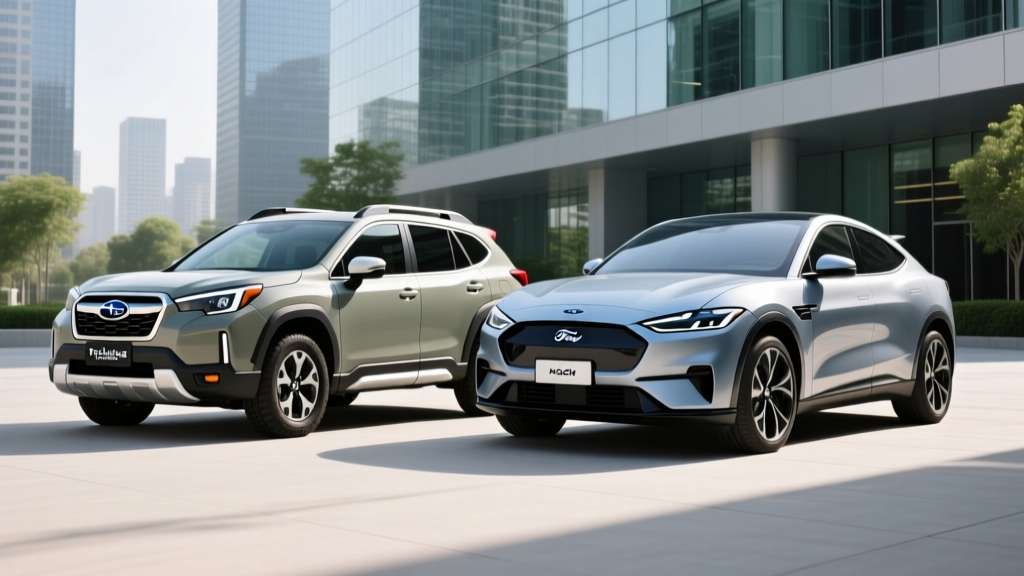
The electric midsize SUV segment is crowded, but two nameplates approach the formula from very different angles. The 2026 Subaru Trailseeker—Subaru's first dedicated global EV built on the e-Subaru platform co-developed with Toyota—prioritizes all-weather capability, ground clearance, and rugged utility. The 2026 Ford Mustang Mach-E, now in its sixth model year, leans into sport-sedan driving dynamics, fast charging, and a mature software ecosystem. If you're cross-shopping the 2026 Subaru Trailseeker vs Mach-E, the right answer depends entirely on whether your weekends involve gravel forest roads or highway fast-charging corridors.
Below, we break down every spec that matters to EV buyers—EPA range, battery chemistry, real-world charging curves, federal tax credit eligibility, and five-year ownership costs—so you can make a data-driven decision.
Side-by-Side Specs: 2026 Trailseeker vs 2026 Mach-E
Before the analysis, here are the headline numbers. All figures reflect the most popular all-wheel-drive trims: the Trailseeker Premium AWD and the Mach-E Premium AWD (Extended Range battery). The Trailseeker is an announced 2026 model; specs are based on Subaru's preliminary disclosures and may shift slightly before deliveries begin.
| Specification | 2026 Subaru Trailseeker Premium AWD | 2026 Ford Mach-E Premium AWD (ER) |
|---|---|---|
| EPA Range | ~280 mi (preliminary) | 320 mi |
| Real-World Range (highway/cold) | ~225–250 mi | ~265–290 mi |
| Battery Capacity (usable) | ~72.8 kWh (NMC) | 91 kWh (NMC) |
| Peak DC Fast Charge Rate | ~150 kW | ~210 kW |
| 10–80% DC Fast Charge Time | ~32 min (est.) | ~23 min |
| Level 2 Charge Rate (kW) | 7.2 kW | 10.5 kW |
| 0–60 mph | ~6.5 sec | 5.1 sec |
| Horsepower | ~215 hp | 312 hp |
| MPGe (combined) | ~102 MPGe (est.) | 98 MPGe |
| Cargo Volume (rear seats up) | ~28 cu ft | 29.7 cu ft |
| Cargo Volume (seats folded) | ~65 cu ft | 59.7 cu ft |
| Ground Clearance | 8.3 in | 5.7 in |
| Towing Capacity | ~2,700 lb (est.) | 2,300 lb |
| Starting MSRP | ~$41,995 | $45,995 |
| Battery/Powertrain Warranty | 8 yr / 100,000 mi | 8 yr / 100,000 mi |
Range and Efficiency: More Miles or More Capability?
The Mach-E Extended Range AWD carries a 91 kWh usable NMC (nickel manganese cobalt) battery and earns an EPA-rated 320 miles. That's among the best in its class and translates to genuinely relaxed road-trip planning—you can typically stretch 250+ miles between DC fast-charge stops at 70 mph without sweating the buffer.
The Trailseeker uses a smaller ~72.8 kWh NMC pack. Subaru targets roughly 280 miles of EPA range, which is respectable for a vehicle with rally-bred ground clearance and standard AWD, but it falls about 40 miles short of the Mach-E. Where the Trailseeker claws back efficiency is around town: its estimated 102 MPGe combined slightly edges the Mach-E's 98 MPGe, thanks to Subaru's focus on low-speed torque delivery and aggressive regenerative braking calibration.
The practical takeaway: If your commute is under 60 miles round-trip and you charge at home nightly, the 40-mile range gap is irrelevant. If you regularly drive 300+ miles between cities, the Mach-E's larger battery means one fewer charging stop per trip.
Charging Speed and Network Access
Charging is where the Mach-E's maturity shows. Ford's Extended Range pack sustains a DC fast-charging peak near 210 kW on a 350 kW CCS charger, and the charge curve is well-managed—holding above 150 kW through 50% state of charge (SoC) before tapering. A 10–80% session takes approximately 23 minutes under optimal battery temperature conditions. Starting in 2025, Ford EVs gained access to Tesla's Supercharger network via a NACS adapter (and native NACS port on 2026 models), dramatically expanding reliable fast-charging coverage.
The Trailseeker peaks at an estimated 150 kW on DC fast charging. That 60 kW deficit matters on road trips: a 10–80% session will take roughly 32 minutes, about nine minutes longer per stop. Subaru has confirmed NACS compatibility for the 2026 Trailseeker, so Supercharger access is available—but the slower charge curve means you'll spend more time at each stall.
On Level 2 home charging, the Mach-E's 10.5 kW onboard charger fills the 91 kWh pack in about 9 hours (overnight). The Trailseeker's 7.2 kW charger needs roughly 10.5 hours for its smaller 72.8 kWh pack. Both are practical for overnight replenishment on a 48-amp Level 2 circuit.
Performance and Driving Dynamics
This category is not close. The Mach-E Premium AWD delivers 312 horsepower and hits 60 mph in 5.1 seconds. It rides on a low-slung battery pack that gives it a near sports-sedan center of gravity, with sharp turn-in and minimal body roll. Ford's MagneRide adaptive dampers (available on GT trims) further sharpen the experience. Even in base AWD form, the Mach-E is genuinely quick and engaging.
The Trailseeker's estimated 215 hp and 6.5-second 0–60 time are adequate for merging and passing but never thrilling. Subaru tuned this EV for low-speed trail capability, not canyon carving. The X-MODE AWD system—carried over from Subaru's ICE lineup—manages torque distribution for snow, mud, and gravel. The 8.3 inches of ground clearance clears obstacles that would scrape the Mach-E's undercarriage.
Performance verdict: The Mach-E wins on pavement. The Trailseeker wins off it.
Price, Tax Credits, and Value
Sticker price tells only part of the story. Federal tax credit eligibility under IRS §30D can shift the value equation by thousands of dollars.
| Cost Factor | 2026 Subaru Trailseeker Premium AWD | 2026 Ford Mach-E Premium AWD (ER) |
|---|---|---|
| Base MSRP | ~$41,995 | $45,995 |
| Federal §30D Credit Eligibility | Up to $7,500 (battery sourcing dependent) | Up to $7,500 (battery sourcing dependent) |
| Point-of-Sale Transfer | Yes, if eligible | Yes, if eligible |
| Buyer Income Cap (AGI) | $150K single / $300K joint | $150K single / $300K joint |
| SUV MSRP Cap | $80,000 | $80,000 |
| Estimated Price After Max Credit | ~$34,495 | ~$38,495 |
| Destination Charge | ~$1,420 | $1,895 |
Both vehicles are classified as SUVs for the §30D MSRP cap ($80,000), so neither is at risk of pricing out. However, the $4,000 MSRP gap between the Trailseeker and Mach-E persists even after credits—making the Subaru the more affordable entry point. That said, credit eligibility depends on critical-mineral sourcing and battery-component manufacturing requirements that shift annually. Verify your specific eligibility with a tax professional before purchase, as partial credits ($3,750) may apply if only one sourcing threshold is met.
The Mach-E has been eligible for the full $7,500 credit in recent years thanks to Ford's North American battery supply chain. The Trailseeker, as a new model, will need Subaru to confirm its battery sourcing meets 2026 thresholds—something to verify at the dealer before signing.
Five-Year Ownership Cost Breakdown
Purchase price is just the beginning. Here's how these two stack up over five years and 75,000 miles of mixed driving.
| 5-Year Cost Category | Trailseeker Premium AWD | Mach-E Premium AWD (ER) |
|---|---|---|
| Purchase (after $7,500 credit) | ~$35,915 (incl. dest.) | ~$40,390 (incl. dest.) |
| Electricity (75,000 mi, $0.16/kWh avg) | ~$2,820 | ~$2,940 |
| Insurance (avg annual) | ~$1,850/yr ($9,250 total) | ~$2,050/yr ($10,250 total) |
| Maintenance (5 yr) | ~$1,200 | ~$1,400 |
| Estimated Depreciation (5 yr) | ~$14,000 | ~$17,500 |
| Estimated 5-Year Total | ~$63,185 | ~$72,480 |
The Trailseeker holds a roughly $9,300 advantage over five years, driven primarily by lower purchase price and projected depreciation. Insurance premiums for the Mach-E run higher due to its performance profile and costlier repair parts. Electricity costs are nearly identical—the Trailseeker's slightly better MPGe offsets its smaller battery. Note that the Trailseeker's depreciation estimate is preliminary; as a first-year model, residual values carry more uncertainty.
Category-by-Category Verdicts
320 mi EPA vs ~280 mi. On highway road trips, the gap widens to 40+ real-world miles. For cross-country drivers, fewer stops matter.
210 kW peak, 10–80% in ~23 min vs ~150 kW and ~32 min for the Trailseeker. Plus Supercharger network maturity via native NACS.
~$4,000 less before incentives, lower insurance, lower projected depreciation. Five-year TCO advantage of ~$9,300.
8.3 in ground clearance, X-MODE AWD, ~2,700 lb towing. The Mach-E simply isn't built for unpaved roads.
312 hp, 5.1 sec 0–60, low center of gravity. The Mach-E drives like a sport sedan; the Trailseeker drives like a crossover.
Six years of SYNC refinement, BlueCruise hands-free driving on 130,000+ miles of divided highways, and robust OTA updates.
~65 cu ft with seats folded vs 59.7 cu ft. The Trailseeker's boxier roofline and flat load floor haul more gear.
Subaru's EyeSight and Ford's Co-Pilot360 are both strong Level 2 systems. Neither is "self-driving"—both require active driver supervision at all times.
Decision Framework: Which Should You Choose?
Choose the 2026 Subaru Trailseeker if:
- You live in a snow-belt state and need real ground clearance and AWD traction for unplowed roads
- You regularly drive on gravel, forest service roads, or light off-pavement trails
- You want a lower purchase price and lower projected five-year ownership cost
- You need maximum cargo volume with seats folded (roof racks, camping gear, dog crates)
- Your daily commute is under 80 miles round-trip and you charge at home
- You tow a small trailer (up to ~2,700 lb)
Choose the 2026 Ford Mustang Mach-E if:
- You take frequent highway road trips of 300+ miles and value fewer charging stops
- You want the fastest DC charging in this segment (~23 min 10–80%)
- Driving engagement matters—quick acceleration, sporty handling, low center of gravity
- You want a mature software platform with hands-free highway driving (BlueCruise)
- You prefer a proven model with six years of reliability data and established residual values
- Your driving is 95% on paved roads
Final Recommendation
There is no universal winner in the 2026 Subaru Trailseeker vs Mach-E comparison—only the right answer for your specific driving life.
The Mach-E is the objectively more capable EV in terms of range, charging speed, and on-road performance. If you're a road-tripper, a commuter who values driving dynamics, or someone who wants the most mature tech platform, the Mach-E's advantages compound over every trip. The 40-mile range gap and 9-minute charging advantage per stop add up to hours saved over a year of highway driving.
The Trailseeker is the smarter buy for buyers whose lives extend beyond pavement. Subaru didn't try to make a Mach-E fighter—they made an electric Subaru. The X-MODE AWD, 8.3 inches of ground clearance, and higher towing capacity serve a buyer the Mach-E simply can't. And at roughly $4,000 less before incentives, with lower insurance and maintenance costs, the Trailseeker delivers genuine value for budget-conscious families who need all-weather confidence.
Before you sign, verify §30D tax credit eligibility for the specific VIN you're purchasing—battery sourcing rules change, and the point-of-sale transfer requires dealer participation. Test-drive both in conditions that mirror your daily life: the Mach-E on a winding on-ramp, the Trailseeker on a gravel road. The right choice will be obvious.
Frequently Asked Questions
Does the 2026 Subaru Trailseeker qualify for the $7,500 federal EV tax credit?
It is expected to, but final eligibility depends on battery-component and critical-mineral sourcing requirements under IRS §30D for the 2026 tax year. Subaru has not published final sourcing documentation as of this writing. Confirm eligibility with your dealer and a tax professional before purchase. Both vehicles must meet the $80,000 SUV MSRP cap and buyer income limits ($150K single / $300K joint AGI).
Can the Trailseeker use Tesla Superchargers?
Yes. The 2026 Trailseeker is expected to feature a native NACS charge port, granting direct access to Tesla's Supercharger network without an adapter. The Mach-E also transitioned to native NACS for 2026, though earlier model years require Ford's NACS adapter.
Which has lower maintenance costs over five years?
The Trailseeker holds a slight edge, estimated at ~$1,200 vs ~$1,400 for the Mach-E over five years. Both benefit from EV drivetrain simplicity (no oil changes, no transmission fluid), but the Mach-E's higher-performance components and larger brake rotors can cost marginally more when service is needed.
How does cold weather affect range on each vehicle?
Expect 15–25% range loss in sustained sub-freezing temperatures for both vehicles. The Trailseeker's ~280-mile EPA range could drop to ~210–240 miles in winter highway driving. The Mach-E's 320-mile range may fall to ~255–275 miles. Both offer battery preconditioning for DC fast charging—always use it when navigating to a charger in cold weather to maintain charge speed.
Is the Trailseeker's battery LFP or NMC?
Subaru has indicated the Trailseeker uses NMC (nickel manganese cobalt) chemistry, which offers higher energy density than LFP but requires more careful charge management for longevity. Daily charging to 80–90% SoC is recommended, with 100% reserved for road trips. The Mach-E also uses NMC in its Extended Range pack.
Which is safer?
Both vehicles are expected to earn top marks. The Mach-E has historically earned IIHS Top Safety Pick status. The Trailseeker, as a new model, has not yet been crash-tested by IIHS or NHTSA as of this writing. Subaru's EyeSight system has consistently performed well in crash-avoidance evaluations across the brand's lineup.