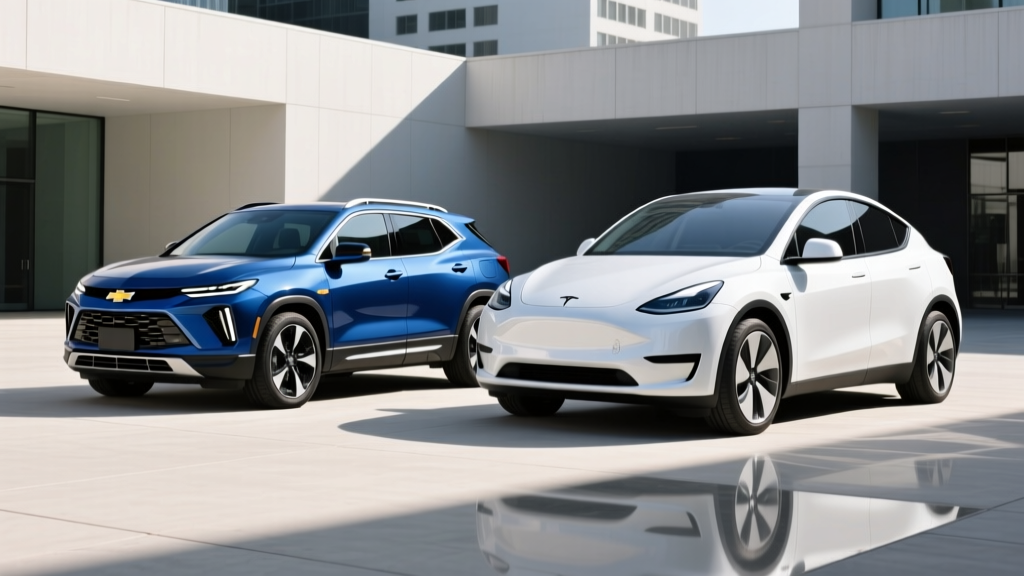
The midsize electric SUV segment pits two fundamentally different philosophies against each other. The 2026 Chevrolet Blazer EV brings GM's Ultium platform with aggressive pricing, a traditional SUV silhouette, and access to Tesla's Supercharger network via NACS. The 2026 Tesla Model Y counters with class-leading efficiency, a mature charging ecosystem, and the industry's most advanced driver-assist software. Both are compelling — but for very different buyers.
We've driven, charged, and analyzed both SUVs extensively. Below is a spec-driven breakdown with real-world caveats that spec sheets omit.
Side-by-Side Specs: Blazer EV vs Model Y
| Spec | 2026 Chevy Blazer EV (2LT AWD) | 2026 Tesla Model Y (Long Range AWD) |
|---|---|---|
| EPA Range | 279 mi | 320 mi |
| Real-World Range (highway/cold) | ~230–250 mi | ~270–290 mi |
| Battery (usable) | 102 kWh (NMC, Ultium) | ~78 kWh (NMC/NCA) |
| Efficiency (MPGe combined) | 89 MPGe | 111 MPGe |
| Efficiency (kWh/100 mi) | ~38 kWh/100 mi | ~28 kWh/100 mi |
| Peak DC Fast Charge | 190 kW | 250 kW |
| 10–80% DC Fast Charge | ~34 min | ~25 min |
| Level 2 Charge Rate | 11.5 kW (48A) | 11.5 kW (48A) |
| 0–60 mph | 6.1 sec | 4.8 sec |
| Horsepower | 288 hp | 384 hp |
| Cargo Volume (rear seats up) | 30.3 cu ft | 30.2 cu ft |
| Cargo Volume (rear seats folded) | 62.0 cu ft | 72.0 cu ft |
| Base MSRP | $44,600 (2LT AWD) | $47,990 (Long Range AWD) |
| Battery/Powertrain Warranty | 8 yr / 100,000 mi | 8 yr / 120,000 mi |
Sources: fueleconomy.gov, Chevrolet and Tesla official specifications. Real-world range estimates based on highway driving at 70+ mph and cold-weather (below 35°F) testing.
Range and Efficiency: The Model Y's Enduring Advantage
Tesla's efficiency engineering remains the benchmark. The Model Y Long Range AWD achieves 111 MPGe combined (roughly 28 kWh/100 mi), squeezing 320 miles from a ~78 kWh battery. The Blazer EV needs a massive 102 kWh Ultium pack to manage just 279 miles — a 38 kWh/100 mi consumption rate that reflects its heavier curb weight (~5,200 lbs vs ~4,400 lbs) and less aerodynamic profile.
This matters beyond range. Higher consumption means higher electricity costs per mile, more time at chargers, and more wear on brake components from regenerative braking that must manage greater mass.
41 more EPA miles and 27% better energy efficiency. The gap grows in cold weather and at highway speeds.
Charging Speed and Network Access
Both vehicles now use the NACS (North American Charging Standard) connector, meaning both access Tesla's Supercharger network natively — a significant shift from prior model years when the Blazer EV required a CCS-to-NACS adapter.
However, peak charge rates differ substantially. The Model Y peaks at 250 kW at V3/V4 Superchargers, sustaining high rates through a favorable charge curve and reaching 80% in roughly 25 minutes. The Blazer EV peaks at 190 kW, with a more gradual taper above 60% SoC, pushing its 10–80% time to approximately 34 minutes.
| Charging Level | Blazer EV | Model Y |
|---|---|---|
| Level 1 (120V / 1.4 kW) | ~4 mi/hr | ~4 mi/hr |
| Level 2 (240V / 11.5 kW) | ~29 mi/hr | ~37 mi/hr |
| DC Fast (peak kW) | 190 kW | 250 kW |
| DC Fast 10–80% | ~34 min | ~25 min |
| DC mi added in 15 min | ~78 mi | ~162 mi |
That 15-minute fast-charge delta — 78 miles vs 162 miles — is the most consequential number for road-trippers. The Model Y's combination of lower consumption and higher charge rate means dramatically shorter stops.
On the network side, both vehicles now access the same Supercharger stalls. But Tesla owners benefit from tighter software integration: automatic preconditioning when navigating to a charger, seamless Plug & Charge authentication, and real-time stall availability in the native navigation. Chevy's integration has improved via the myChevrolet app and Google Built-in navigation, but it's a step behind in seamlessness.
Faster peak rate, better charge curve, superior preconditioning, and tighter network integration. The Blazer EV's access to Superchargers closes the gap, but Tesla still charges faster.
Performance and Driving Dynamics
The Model Y Long Range AWD delivers 384 hp and a 4.8-second 0–60 time — genuinely quick for a family SUV. Its low center of gravity, sport-tuned suspension, and precise steering make it the more engaging driver's car. The Blazer EV's 288 hp and 6.1-second 0–60 are adequate but unremarkable. Its tuning prioritizes ride comfort over cornering confidence, with a softer suspension that absorbs potholes well but leans through curves.
If you want an SS variant, the Blazer EV SS (557 hp, 0–60 under 4.0 seconds) closes the performance gap — but starts above $60,000 and sacrifices range.
Faster acceleration, sharper handling, and more engaging driving dynamics at comparable price points. The Blazer EV SS competes, but at a steep premium.
Interior, Tech, and Driver Assistance
The two interiors represent opposing design philosophies. The Blazer EV offers a conventional layout: physical climate controls, a 17.7-inch infotainment screen with Google Built-in (Maps, Assistant, Play Store), wireless Apple CarPlay/Android Auto, and a 11-inch driver display. Materials are hard-plastic-heavy in lower trims but improve substantially in RS and SS grades.
The Model Y continues its minimalist approach: a single 15.4-inch touchscreen controls everything, with no instrument cluster and no Apple CarPlay/Android Auto (Tesla uses its own interface). The 2026 refresh ("Juniper") adds ventilated front seats, ambient lighting, a rear-seat touchscreen, power-folding second row, and improved sound insulation — addressing the most common complaints from prior model years.
On driver assistance, Tesla's Autopilot (standard) and FSD Supervised ($8,000 add-on) offer the most capable Level 2 system on the market, with smooth lane-keeping, automatic lane changes, and city-street navigation. However, FSD Supervised remains SAE Level 2 — the driver must remain engaged, hands on the wheel, eyes on the road. It is not self-driving.
Chevy's Super Cruise (available on RS and SS trims, included for 3 years then ~$25/month) excels on mapped highways with hands-free driving and a driver-attention camera. It's less versatile than FSD (no city streets) but inspires more confidence on long interstate stretches due to its geofenced precision. Both are Level 2 systems requiring full driver supervision.
Model Y for software depth, FSD capability, and OTA updates. Blazer EV for conventional ergonomics, Apple CarPlay, and Super Cruise's highway confidence. Choose based on your interface preference.
Pricing, Tax Credits, and Total Cost of Ownership
Sticker price tells only part of the story. Federal tax credit eligibility under IRS §30D can dramatically alter the value equation.
| Cost Factor | 2026 Blazer EV 2LT AWD | 2026 Model Y Long Range AWD |
|---|---|---|
| Base MSRP | $44,600 | $47,990 |
| Federal §30D Credit (est.) | Up to $7,500 | Up to $7,500 |
| Effective Price (with full credit) | ~$37,100 | ~$40,490 |
| MSRP Cap (§30D SUV limit: $80K) | ✅ Under cap | ✅ Under cap |
| Battery Sourcing (§30D compliance) | ✅ Qualifies (US-assembled modules) | ✅ Qualifies (US-built, domestic cells) |
| Estimated Insurance (annual avg) | ~$2,200 | ~$2,600 |
| Est. Electricity Cost (15K mi/yr, $0.14/kWh) | ~$798/yr | ~$588/yr |
| 5-Year Fuel/Energy Cost | ~$3,990 | ~$2,940 |
| 5-Year Insurance (est.) | ~$11,000 | ~$13,000 |
| Maintenance (5 yr est.) | ~$1,200 | ~$1,000 |
Tax credit eligibility depends on buyer income limits (AGI ≤ $150K single / $300K joint), vehicle MSRP caps, and battery critical-mineral sourcing requirements that change annually. The credit can be transferred to the dealer at point of sale as a price reduction. Verify current-year rules at IRS.gov §30D. Consult a tax professional.
Over five years, the Model Y's efficiency advantage saves roughly $1,050 in electricity. But the Blazer EV's lower insurance premiums (~$2,000 less over five years) and lower base price narrow the total cost gap considerably. After credits, the Blazer EV costs approximately $3,400 less upfront and roughly breaks even on operating costs over five years when insurance is factored in.
Lower MSRP, competitive tax credit, lower insurance. The Model Y's efficiency savings don't fully offset its higher purchase price and insurance costs over a typical ownership period.
Cargo, Practicality, and Daily Use
With rear seats up, cargo volume is nearly identical: 30.3 cu ft (Blazer EV) vs 30.2 cu ft (Model Y). Fold the rear seats, and the Model Y pulls ahead at 72.0 cu ft vs 62.0 cu ft — a meaningful difference for families hauling bulky items.
The Model Y also offers a front trunk (frunk) for additional storage, while the Blazer EV uses that space for mechanical components. The Blazer EV counters with a more traditional SUV ride height, wider door openings, and easier child-seat installation thanks to its more upright seatback design.
Towing favors the Blazer EV: 4,000 lbs (with trailering package) vs the Model Y's 3,500 lbs. Neither is a heavy-duty hauler, but the gap matters for small boat or utility trailer owners.
Model Y for maximum cargo space and frunk. Blazer EV for towing, easier ingress/egress, and traditional SUV ergonomics.
Decision Framework: Which Should You Buy?
- You want the lowest entry price in a midsize electric SUV with Supercharger access
- You prefer physical controls, wireless Apple CarPlay/Android Auto, and a conventional interior layout
- You prioritize highway hands-free driving via Super Cruise on mapped interstates
- You need higher towing capacity (4,000 lbs)
- You want a softer, more comfortable ride over sporty handling
- Lower insurance premiums matter to your monthly budget
- Maximum range and efficiency are your top priorities (320 mi EPA, 111 MPGe)
- You take frequent road trips and want the fastest DC charging (250 kW, ~25 min 10–80%)
- You want the most advanced Level 2 driver-assist system (FSD Supervised) for city and highway use
- You value over-the-air updates that add features post-purchase
- Maximum cargo space with seats folded (72 cu ft) and a frunk matter to your lifestyle
- You prefer a minimalist, screen-centric interface
Frequently Asked Questions
Can the 2026 Blazer EV charge at Tesla Superchargers without an adapter?
Yes. The 2026 Blazer EV comes equipped with a native NACS charge port, providing direct access to Tesla's Supercharger network without any adapter. This was a key improvement over earlier model years that required a CCS-to-NACS adapter for Supercharger access.
Which is cheaper to own over five years — the Blazer EV or Model Y?
It's close. The Blazer EV starts ~$3,400 cheaper (after estimated credits) and costs ~$2,000 less in insurance over five years. The Model Y saves ~$1,050 in electricity over the same period due to its superior efficiency. Net result: the Blazer EV holds a modest cost advantage for most buyers, though exact figures depend on your state, insurance profile, and electricity rates.
Is Tesla FSD actually self-driving?
No. Tesla's Full Self-Driving (Supervised) is an SAE Level 2 driver-assist system. It can navigate city streets, handle intersections, and change lanes — but the driver must remain fully engaged, with hands on the wheel and eyes on the road at all times. You are legally and practically responsible for the vehicle. True self-driving (Level 4) currently exists only in geofenced robotaxi services like Waymo.
Does the Blazer EV battery degrade faster than the Model Y's?
Both use NMC-based chemistries with comparable projected degradation — roughly 10–12% capacity loss over 150,000 miles based on current Ultium and Tesla battery data. Both carry 8-year battery warranties (Blazer EV: 100,000 mi; Model Y: 120,000 mi) guaranteeing at least 70% capacity retention. GM's Ultium platform is newer with less long-term field data, while Tesla's battery management has years of proven fleet data behind it.
Which has better cold-weather range?
The Model Y. Both vehicles experience 20–30% range loss in sub-freezing temperatures, but the Model Y's standard heat pump recovers waste heat more efficiently than the Blazer EV's resistive heating system. Expect ~230 miles from the Blazer EV and ~270 miles from the Model Y in 20°F weather at highway speeds.
What about the Blazer EV SS?
The Blazer EV SS (557 hp, 0–60 under 4.0 sec, starting ~$60,600) competes with the Model Y Performance on acceleration. However, its range drops to roughly 256 miles EPA, and its price pushes past the Model Y's territory. It's a compelling performance SUV but changes the value calculus significantly.
Final Verdict
There is no universal winner between the 2026 Chevrolet Blazer EV and the 2026 Tesla Model Y — only the right choice for your priorities. The Model Y is the objectively more efficient, longer-range, faster-charging vehicle with superior technology depth. The Blazer EV is the more affordable, more traditionally comfortable SUV with competitive range, Supercharger access, and lower ownership friction (insurance, ergonomics, CarPlay).
If you road-trip often, care deeply about efficiency, and embrace Tesla's software ecosystem, the Model Y justifies its premium. If you want a practical, comfortable electric SUV at the lowest possible entry price and prefer a conventional driving experience, the Blazer EV is the smarter buy. Both are strong contenders — your priorities decide.