Quick Answer: Does the 2020 Hellcat Have Electric Brakes?
No. The 2020 Dodge Challenger SRT Hellcat uses a conventional hydraulic disc brake system with massive 15.4-inch front Brembo rotors and 6-piston calipers. It does not have electric brakes, regenerative braking, or any electrified powertrain components. The Hellcat is a pure internal-combustion muscle car powered by a 6.2L supercharged HEMI V8 producing 717 horsepower (797 hp in the Hellcat Redeye variant).
If you're asking because you're curious about how EV-style regenerative braking compares to a performance gas car's braking system — or you're weighing a muscle car against a high-performance EV — this guide breaks down exactly how these fundamentally different braking technologies work, what they cost to maintain, and which approach makes sense for different driving patterns.
What Brakes Does the 2020 Hellcat Actually Use?
The 2020 Dodge Challenger SRT Hellcat is equipped with a high-performance hydraulic braking system engineered to handle the thermal load of a 4,400+ lb car traveling at extreme speeds:
- Front: 15.4-inch (391 mm) vented rotors with 6-piston Brembo calipers
- Rear: 13.8-inch (350 mm) vented rotors with 4-piston Brembo calipers
- Brake type: Hydraulic, vacuum-assisted, with ABS and electronic brake-force distribution
- Brake pads: Semi-metallic performance compound (SRT-tuned)
- 60-0 mph stopping distance: Approximately 110 feet (per Car and Driver testing)
There is zero electrical energy recovery happening during braking. Every time you press the brake pedal, kinetic energy is converted entirely into heat through friction — energy that is permanently lost. This is fundamentally different from how electric vehicles manage deceleration.
How EV Regenerative Braking Works (and Why It's "Electric")
When people ask about "electric brakes," they're usually referring to regenerative braking — a system standard on every battery-electric vehicle (BEV) and most hybrids. Here's how it differs from the Hellcat's setup:
In an EV, the electric motor reverses its function during deceleration. Instead of consuming electricity to turn the wheels, the motor acts as a generator, converting the car's kinetic energy back into electrical energy and sending it to the battery pack. This creates drag that slows the vehicle — often enough to bring it to a complete stop without touching the friction brake pedal (known as one-pedal driving).
EVs still carry traditional hydraulic friction brakes for emergency stops and hard braking, but regenerative braking handles the majority of daily deceleration. The result:
- Brake pad life: EV brake pads routinely last 100,000+ miles because regen does 80-90% of the work. The Hellcat's performance pads may need replacement every 20,000–35,000 miles under aggressive driving.
- Energy recovery: An EV recaptures energy during every stop. The Hellcat recovers nothing — all braking energy becomes waste heat.
- Maintenance cost: EV owners report spending $100–$200 on brake service over 5 years. Hellcat owners can spend $800–$1,500+ on rotor and pad replacements in the same period.
Hellcat vs Performance EV: Braking and Ownership Cost Comparison
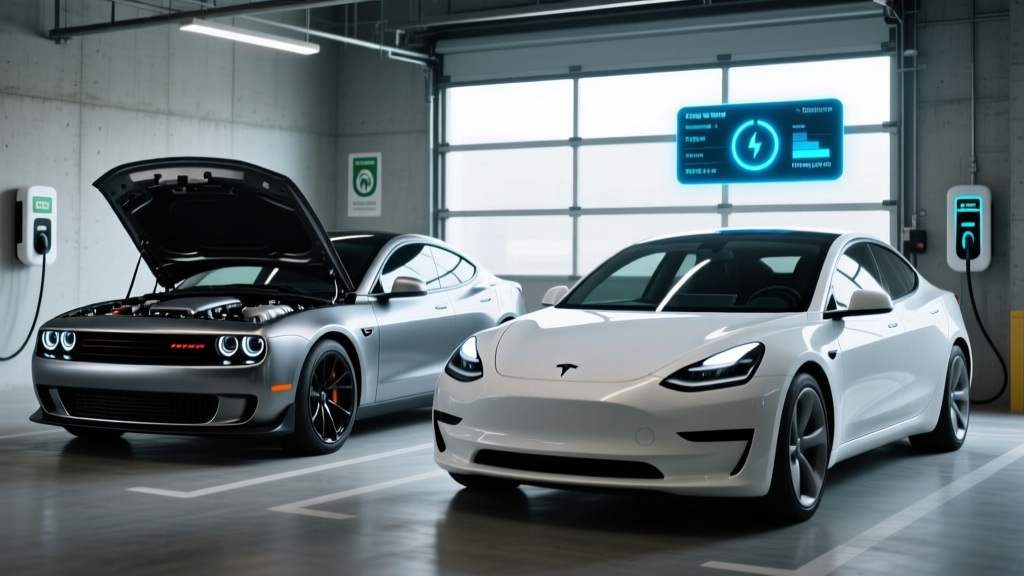
Let's put the Hellcat's braking and ownership costs side-by-side against a comparable performance EV — the 2025 Tesla Model S Plaid — to illustrate the real financial difference:
| Category | 2020 Dodge Hellcat | 2025 Tesla Model S Plaid |
|---|---|---|
| Powertrain | 6.2L SC V8 (717 hp) | Tri-motor AWD (1,020 hp) |
| Brake system | Hydraulic Brembo discs | Regen + hydraulic discs |
| Brake pad replacement interval | ~20,000–35,000 mi | ~100,000+ mi |
| 5-year brake maintenance est. | $1,200–$2,500 | $150–$400 |
| Fuel/energy cost (5 yr, 75k mi) | ~$14,500 (13 MPG, $3.80/gal) | ~$3,200 (home charging, $0.14/kWh) |
| EPA combined efficiency | 16 MPG combined | 116 MPGe combined |
| Oil changes (5 yr) | $600–$1,000 | $0 |
| Total 5-yr energy + brake cost | ~$16,300–$18,000 | ~$3,350–$3,600 |
The Hellcat's EPA-rated fuel economy is 16 MPG combined (13 city / 22 highway). At 15,000 miles per year and $3.80/gallon premium fuel, you'll spend roughly $2,900 annually on gas. The Model S Plaid, charging primarily at home at $0.14/kWh and consuming roughly 30 kWh/100 mi, costs about $630 per year in electricity.
Why the "Electric Brakes" Question Comes Up
Several factors drive confusion about whether the Hellcat has electric or regenerative brakes:
| Myth / Misconception | Fact |
|---|---|
| "All modern cars have some form of electric braking" | Only electrified vehicles (BEVs, PHEVs, HEVs) use regenerative braking. Pure ICE cars like the Hellcat use only hydraulic friction brakes. |
| "The Hellcat's brake-by-wire system is electric" | The 2020 Hellcat uses a traditional vacuum-assisted hydraulic brake system. It does not use brake-by-wire technology. |
| "Performance cars need electric brakes to stop faster" | Large Brembo rotors with multi-piston calipers provide immense stopping power. Electric/regen braking supplements but does not replace friction brakes for emergency stops. |
| "Regenerative braking is weaker than hydraulic brakes" | Regen typically provides 0.2–0.3g of deceleration — sufficient for normal stops. Hard braking (0.8g+) requires friction brakes, which all EVs also carry. |
| "Dodge added mild-hybrid tech to the Hellcat" | The 2020 Hellcat has no hybrid system, no 48V mild-hybrid assist, and no electric motor of any kind. |
Real-World Ownership: What Hellcat Buyers Should Budget For
If you're cross-shopping a Hellcat against a performance EV, braking costs are just one piece of the ownership picture. Here are the practical realities:
Fuel Costs Dominate the Budget
The Hellcat's 6.2L supercharged V8 demands premium fuel (91 octane or higher). In real-world driving — especially with any aggressive throttle use — expect 11–14 MPG combined, not the EPA's optimistic 16 MPG. At 12,000 miles/year and $4.00/gallon premium, annual fuel cost lands around $3,400–$4,300.
Brake Wear Under Performance Driving
If you track the car or drive aggressively on canyon roads, brake pad and rotor wear accelerates dramatically. Track-day pad sets ($300–$600) may last a single weekend. Rotors ($400–$800 each for Brembo replacements) can warp or crack under sustained high-heat use.
Insurance Premiums
Performance V8 muscle cars carry steep insurance costs. Expect $2,500–$4,500/year for a Hellcat depending on your age, location, and driving record. Performance EVs are also expensive to insure, though some insurers offer discounts for vehicles with advanced ADAS features.
Decision Framework: Hellcat, Performance EV, or Something Else?
Choose the 2020 Hellcat If:
- You want raw V8 sound, supercharger whine, and muscle-car heritage that no EV replicates
- You don't mind $3,500+ annual fuel costs and frequent brake maintenance
- You have access to affordable premium fuel and don't drive in heavy stop-and-go traffic daily
- Long-distance road trips and refueling convenience matter more than per-mile cost
Choose a Performance EV (Model S Plaid, Taycan, Lucid Air) If:
- You want comparable or superior acceleration (Model S Plaid: 0-60 in 1.99 sec vs Hellcat's 3.6 sec) with dramatically lower running costs
- You can install a Level 2 home charger (240V, ~$500–$2,000 installation) and want $600/year "fuel" costs
- You want near-zero brake maintenance thanks to regenerative braking
- You value instant torque, a low center of gravity, and silent daily driving
Choose a Performance PHEV or Hybrid If:
- You want some electric-only commuting range (20–40 miles) but also want engine sound for weekend drives
- You lack reliable home charging access but still want reduced fuel costs in city driving
- You want to hedge against charging-desert anxiety on road trips
What First-Time EV Buyers Should Know About Braking
If the "electric brakes" question led you here and you're considering your first EV, here are the braking essentials:
- Regen strength varies by model. A Tesla Model 3's standard regen mode provides aggressive one-pedal driving. A Ford Mustang Mach-E offers adjustable regen levels from mild to strong. Test-drive to find your preference.
- Cold weather reduces regen. Below ~40°F, battery chemistry limits how fast the pack can accept charge, reducing regenerative braking strength. You'll use friction brakes more in winter — a real consideration in cold climates.
- Brake fluid still needs service. Even though pads last longer, EV manufacturers recommend brake fluid flushes every 2–3 years because the fluid absorbs moisture over time.
- Rust can form on rotors. Because EV friction brakes are used infrequently, rotors can develop surface rust. Some EVs (like newer Volvos and Porsches) include automatic "rust cleaning" routines that briefly apply the friction brakes to keep rotors clean.
Frequently Asked Questions
Does any Dodge vehicle have regenerative braking?
As of the 2026 model year, Dodge has not released a production vehicle with regenerative braking. The brand's parent company Stellantis has announced electrification plans, but no Dodge-badged EV or hybrid is currently on sale. The Dodge Hornet (a rebadged Alfa Romeo Tonale) offers a PHEV variant in some markets with mild regenerative braking.
Can you add regenerative braking to a gas car?
No. Regenerative braking requires an electric motor connected to the drivetrain and a battery pack to store recovered energy. You cannot retrofit this to a conventional ICE vehicle. The only way to get regen is to buy an electrified vehicle (BEV, PHEV, or HEV).
How much do Hellcat brake replacements cost?
A full front brake job (pads + rotors) on a 2020 Hellcat typically costs $1,200–$2,000 at a shop, or $600–$1,000 if you source parts and do it yourself. Rear brakes add another $800–$1,400. Brembo performance rotors are significantly more expensive than standard replacement parts.
Do EVs still need brake pad replacements?
Eventually, yes — but far less often. Most EV owners report original brake pads lasting 100,000–150,000 miles. Some Tesla owners have documented original pads at 200,000+ miles. The primary brake maintenance item for EVs is periodic fluid flushes ($80–$150 every 2–3 years).
Is the Hellcat faster than a Tesla Model S Plaid?
In a straight line, no. The Hellcat's 0-60 mph time is approximately 3.6 seconds. The Tesla Model S Plaid achieves 0-60 in 1.99 seconds (with rollout subtracted) — making it one of the quickest production cars ever built. The Hellcat's advantage is top-end character: supercharger whine, V8 exhaust note, and a 6-speed manual transmission option that no EV offers.
Sources: EPA Fuel Economy — 2020 Dodge Challenger SRT Hellcat, Car and Driver — Dodge Challenger Hellcat Review and Specs, Stellantis — Dodge Brand