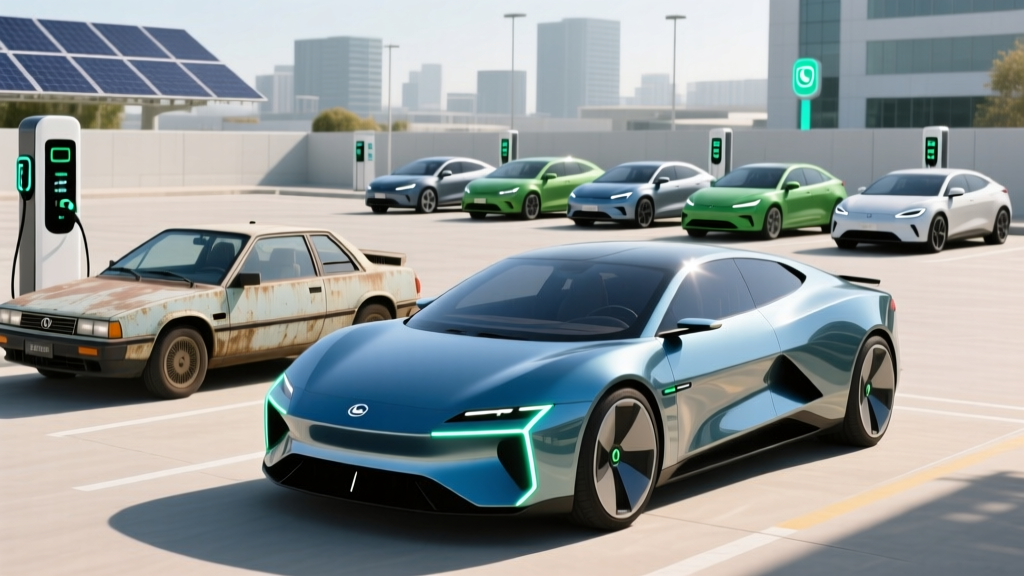
The short answer: A 1980 electric car typically delivered 40–60 miles of range on heavy lead-acid batteries, took 8–12 hours to charge on a standard 120V outlet, and topped out around 50–60 mph. In 2026, mainstream EVs like the Chevrolet Equinox EV (EPA 319 miles, 85 kWh usable battery) or Hyundai Ioniq 5 (EPA 318 miles, 240 kW peak DC fast charging, 10–80% in ~18 minutes) have made the technology unrecognizable by comparison. The real question for today's buyer isn't whether EVs work — it's whether a modern EV fits your driving pattern, charging access, and budget. This guide bridges the history to help you make a data-driven purchase decision now.
What a 1980 Electric Car Actually Looked Like
In 1980, the electric vehicle landscape was defined by conversion vans, neighborhood electric vehicles, and experimental prototypes rather than production cars you could walk into a dealership and buy. Vehicles like the Sebring-Vanguard CitiCar (produced through the late 1970s and into 1980) exemplified the era:
- Battery: Lead-acid, typically 6–12 deep-cycle 6V batteries (total ~3.6–7.2 kWh of usable energy)
- Range: 35–60 miles in ideal conditions, often less in cold weather or at highway speeds
- Top speed: 50–60 mph (many were classified as low-speed vehicles)
- Charging: Standard 120V household outlet, 8–12 hours for a full charge (~0.6–1.2 kW)
- Weight penalty: Lead-acid batteries added 600–1,000 lbs, crushing efficiency
- Price: Roughly $3,000–$10,000 in 1980 dollars (about $11,500–$38,000 adjusted for inflation)
The fundamental limitation wasn't the electric motor — it was energy density. Lead-acid batteries store roughly 30–40 Wh/kg. Modern lithium-ion NMC cells store 250–300 Wh/kg, and LFP cells store 160–200 Wh/kg. That's a 5x–8x improvement in energy per pound, which is why a 2026 EV can carry an 85 kWh battery pack weighing ~900 lbs instead of a 7 kWh lead-acid bank weighing 800 lbs.
1980 vs 2026: The Numbers That Matter
Here's a direct comparison between a representative 1980-era electric vehicle and three popular 2026 EVs spanning different price points. All 2026 figures are EPA-rated unless noted.
| Specification | ~1980 EV (CitiCar-class) | 2026 Chevy Equinox EV 2LT | 2026 Hyundai Ioniq 5 SEL | 2026 Tesla Model Y Long Range |
|---|---|---|---|---|
| EPA Range | ~40 mi (est.) | 319 mi | 318 mi | 320 mi |
| Battery Chemistry | Lead-acid | NMC (Ultium) | NMC | NMC |
| Usable Battery (kWh) | ~5–7 kWh | 85 kWh | 77.4 kWh | 75 kWh |
| Peak DC Charge Rate | N/A (AC only) | 150 kW | 240 kW | 250 kW |
| 10–80% DC Fast Charge | N/A | ~30 min | ~18 min | ~20 min |
| Level 2 (240V) Charge | ~1 kW / 8–12 hr | 11.5 kW / ~8 hr | 10.9 kW / ~7 hr | 11.5 kW / ~7 hr |
| 0–60 mph | ~20+ sec | ~7.9 sec | ~5.1 sec (RWD) | ~4.8 sec |
| Top Speed | ~55 mph | 112 mph | 115 mph | 125 mph |
| Base MSRP (2026) | ~$3,000 (1980$) | ~$33,600 | ~$42,600 | ~$44,990 |
| Battery Warranty | None/limited | 8 yr / 100,000 mi | 10 yr / 100,000 mi | 8 yr / 120,000 mi |
The gap is staggering in every column. A modern mid-range EV carries more than 10x the usable energy, charges at 150–250x the power (kW), and delivers range that exceeds what most drivers need in a week of commuting — all from a battery pack that weighs roughly what the entire 1980 lead-acid bank weighed.
Real Costs: What EV Ownership Actually Costs in 2026
The most common question from first-time EV buyers isn't about range — it's about money. Here's a realistic 5-year cost breakdown comparing a 2026 EV (Chevrolet Equinox EV 2LT at ~$33,600 MSRP) to a comparable gas-powered compact SUV (2026 Toyota RAV4 LE at ~$30,000 MSRP) averaging 12,000 miles/year.
| Cost Category | 2026 Chevy Equinox EV | 2026 Toyota RAV4 (Gas) |
|---|---|---|
| Purchase Price (MSRP) | $33,600 | $30,000 |
| Federal §30D Tax Credit | Up to $7,500 (if eligible*) | $0 |
| Effective Purchase Price | ~$26,100 | $30,000 |
| Fuel / Electricity (5 yr) | $2,700 (home charging at $0.14/kWh, 3.2 mi/kWh) | $7,500 (30 MPG combined at $3.50/gal) |
| Maintenance (5 yr) | ~$1,200 (cabin filter, tire rotation, wiper fluid) | ~$3,500 (oil changes, filters, brakes, transmission fluid) |
| Insurance (5 yr avg) | ~$8,400 ($168/mo avg) | ~$6,600 ($110/mo avg) |
| Depreciation (est. 5 yr) | ~$12,000 | ~$11,000 |
| Estimated 5-Year Total Cost | ~$50,400 | ~$58,600 |
*The IRS §30D credit has income caps ($150K single / $300K joint), MSRP caps ($55K cars / $80K SUVs/trucks), and battery-sourcing requirements that change annually. The Equinox EV has qualified for the full $7,500 in recent years, but always verify current-year eligibility on IRS.gov or with a tax professional. The credit can now be transferred to the dealer at point of sale, reducing your out-of-pocket cost on delivery day.
The EV wins on total cost of ownership primarily through fuel and maintenance savings — roughly $7,100 over five years. Insurance remains the EV's cost disadvantage, running 15–25% higher on average due to higher repair costs and parts pricing. If you lack home charging and rely exclusively on public DC fast charging at $0.35–$0.50/kWh, your electricity cost climbs to $4,800–$6,900 over five years, narrowing the gap significantly.
What First-Time EV Buyers Must Know Before Purchasing
If you're coming from a gas vehicle — whether you've been driving since the 1980s or bought your first car last year — the ownership experience has real differences that go beyond plugging in. Here are the critical realities, organized by what trips up new owners most.
Charging Access Is Your #1 Decision Factor
Home Level 2 charging (240V, 7–12 kW) transforms EV ownership from a chore into a non-event. You wake up every morning with a full battery. Without it, you're depending on public infrastructure that varies wildly in reliability.
- Home Level 2 installation: $500–$2,500 total (charger $300–$700 + electrician $200–$1,500 + possible panel upgrade $1,000–$3,000 for older homes with 100A service)
- Apartment/condo charging: Check whether your building has EV-ready outlets or is willing to install them — this should influence your vehicle choice
- Public DC fast charging: Networks like Electrify America, EVgo, and Tesla Superchargers deliver 50–350 kW, but real-world reliability varies. Plan for 10–15% of chargers being out of service on any given trip
Real-World Range vs. EPA Stickers
The EPA range number on the window sticker is a useful baseline, but it's tested under controlled conditions. Here's what to actually expect from a 2026 EV rated at 300+ miles EPA:
- City/suburban driving (moderate climate): 280–320 miles — often close to or slightly above EPA thanks to regenerative braking
- Highway driving at 70–80 mph: 230–270 miles — aerodynamic drag dominates at speed, reducing efficiency 15–25%
- Cold weather (below 32°F): 180–240 miles — battery chemistry slows, cabin heating draws 2–5 kW continuously; a heat pump (standard on many 2026 models) mitigates this by ~30%
- Towing or heavy cargo: 150–200 miles — expect 40–50% range reduction under load
This is why a 300-mile EPA rating is the practical minimum for road-trip-capable EVs in 2026. If your regular drives exceed 200 miles one-way, prioritize models with 320+ miles EPA and 200+ kW DC fast charging to keep stops under 25 minutes.
Battery Longevity: The Data, Not the Fear
Battery degradation is the most cited fear among prospective EV buyers — and it's the one with the best real-world data to ease concerns. Modern liquid-cooled NMC and LFP battery packs are lasting far longer than early predictions:
- Average degradation at 100,000 miles: 8–12% capacity loss for NMC; 5–8% for LFP
- Average degradation at 200,000 miles: 15–20% for NMC; 10–15% for LFP
- Warranty floor: Federal law mandates a minimum 8-year/100,000-mile battery warranty (10 years in CARB states); most manufacturers guarantee 70% capacity retention
- Replacement cost (out of warranty): $8,000–$18,000 depending on pack size and chemistry, though full replacements remain rare
LFP (lithium iron phosphate) batteries, now used in base trims of vehicles like the Tesla Model 3 Standard Range and some Ford models, trade ~15% lower energy density for significantly longer cycle life and the ability to charge to 100% daily without degradation concerns. If you plan to keep a vehicle 10+ years, LFP is worth prioritizing.
EV vs Gas vs Hybrid: Which Powertrain Fits You?
Not everyone should buy a battery-electric vehicle in 2026 — and that's fine. Here's a decision framework based on real driving patterns and access, not ideology.
Choose a BEV (full electric) if:
- You have home or workplace Level 2 charging access
- Your daily driving is under 150 miles round-trip
- You want the lowest per-mile fuel cost ($0.04–$0.06/mi on home electricity vs $0.12–$0.15/mi for gas)
- You're eligible for the §30D tax credit, bringing effective purchase price below comparable gas vehicles
- You plan to keep the vehicle 5+ years to recoup the higher upfront cost through fuel/maintenance savings
Choose a PHEV (plug-in hybrid) if:
- You want 25–45 miles of electric-only range for daily commuting but need gas flexibility for frequent road trips
- You lack reliable public fast-charging infrastructure near your routes
- You live in an area with extreme cold (below 0°F regularly) where EV range loss is severe
- Examples: 2026 Toyota RAV4 Prime (42 mi electric, 38 MPG combined on gas), 2026 Jeep Wrangler 4xe (22 mi electric)
Choose a conventional hybrid (HEV) if:
- You have no charging access at all (no home outlet, no workplace charger)
- You want better fuel economy without any plug-in behavior change
- Your budget is tighter and you want to avoid the EV insurance premium
- Examples: 2026 Toyota Camry Hybrid (52 MPG combined), 2026 Honda CR-V Hybrid (40 MPG combined)
Stick with gas if:
- You drive fewer than 5,000 miles/year (fuel savings won't offset higher EV purchase price)
- You tow heavy loads regularly and need the range density of liquid fuel
- You live in a rural charging desert with no DC fast chargers within 50+ miles
Common EV Misconceptions — Corrected With Data
| Myth | Fact (with numbers) |
|---|---|
| "EV batteries need replacing every few years like phone batteries." | Modern liquid-cooled EV batteries lose ~1–2% capacity per year. At 10 years, expect 80–88% remaining capacity. The EPA and manufacturer data show most packs outlast the vehicle's economic life. |
| "EVs are worse for the environment because of electricity generation." | Even on the dirtiest US grid (coal-heavy regions), an EV produces ~30–40% fewer lifetime emissions than a comparable gas car. On cleaner grids (Pacific Northwest, New England), the reduction is 60–75%. Source: EPA Green Vehicles. |
| "Charging takes forever." | Home Level 2 charging happens while you sleep — zero active time. DC fast charging at 200+ kW adds 150–200 miles in 15–20 minutes. The charge curve tapers above 80% SoC, which is why road-trip strategy targets 10–80% stops. |
| "EVs are all expensive luxury cars." | The 2026 Chevy Equinox EV starts at ~$33,600 before incentives. After the $7,500 §30D credit (if eligible), effective price drops to ~$26,100 — below many gas-powered compact SUVs. |
| "The power grid can't handle everyone switching to EVs." | Most EV charging happens overnight during off-peak hours when grid capacity is underutilized. Utility time-of-use rates incentivize this. Mass adoption will require grid upgrades, but current capacity supports significant EV penetration. |
| "EVs don't work in cold climates." | Range drops 20–35% in sub-freezing temps — real and measurable. But a 300-mile EV still delivers 195–240 miles in cold weather. Preconditioning the battery while plugged in mitigates charging-speed loss. Norway, where EVs outsell gas cars, has harsh winters. |
Your Action Plan: Buying an EV in 2026
Here's a step-by-step checklist to move from research to purchase with confidence:
- Audit your charging access first. Can you install a 240V Level 2 outlet at home? Get an electrician quote before choosing a vehicle — it determines whether a BEV or PHEV makes sense.
- Calculate your real daily mileage. Pull your odometer readings or use a tracking app for two weeks. If 95% of your driving is under 80 miles/day, any 2026 EV with 250+ miles EPA will work with weekly charging.
- Verify §30D tax credit eligibility. Check IRS.gov for current income caps, MSRP limits, and battery sourcing requirements. Ask the dealer to confirm point-of-sale transfer availability.
- Test the charging ecosystem. Download PlugShare or A Better Routeplanner. Map your most common road trips and identify DC fast chargers along the route. If gaps exist, a PHEV may be the smarter choice.
- Get insurance quotes before purchasing. EV insurance runs 15–25% higher on average. Get a binding quote for the exact trim you're considering — it can shift the total-cost-of-ownership math.
- Drive both a BEV and a PHEV back-to-back. Feel the difference in regenerative braking, one-pedal driving, and the seamless torque delivery. Make sure the driving experience matches your expectations.
Frequently Asked Questions
Were there any production electric cars available to consumers in 1980?
Not in the modern sense. The Sebring-Vanguard CitiCar (produced through ~1980) was the closest thing — a low-speed, lead-acid electric vehicle with ~40 miles of range and a top speed around 50 mph. It was more of a neighborhood vehicle than a highway-capable car. True highway-capable production EVs didn't arrive until the GM EV1 in 1996, and the modern EV era began with the Nissan Leaf and Tesla Roadster in 2010–2008 respectively.
Why did electric cars disappear after the early 1900s and not return until recently?
Three factors: the discovery of cheap Texas crude oil, the invention of the electric starter (eliminating hand-cranking), and Henry Ford's mass-produced Model T undercutting EV prices by 2:1. Battery technology stagnated for 80 years — lead-acid energy density barely improved. It took lithium-ion battery development (commercialized by Sony in 1991, adapted for EVs in the 2000s) to make practical electric cars possible again.
How much does it cost to charge an EV at home vs. public chargers?
Home Level 2 charging at the US average residential rate of ~$0.14/kWh costs about $0.04–$0.05 per mile in a typical EV getting 3–3.5 miles per kWh. Public DC fast charging at $0.35–$0.50/kWh costs $0.10–$0.16 per mile — competitive with gas but not the bargain that home charging is. This is why home charging access is the single biggest factor in EV satisfaction.
What's the difference between kW and kWh, and why does it matter?
kW (kilowatts) measures power — the rate at which energy flows, like water pressure from a hose. kWh (kilowatt-hours) measures energy — the total amount stored or consumed, like gallons in a tank. A 77 kWh battery stores 77 kWh of energy. Charging at 150 kW means energy flows in at 150 kilowatts — theoretically filling that 77 kWh battery in ~31 minutes (though real-world charge curves slow above 80% SoC). Confusing the two is the most common EV mistake — always check which unit a number uses.
Is a 2026 EV actually better for my wallet than a hybrid?
It depends on your situation. If you have home charging, drive 10,000+ miles/year, and qualify for the §30D tax credit, a BEV's lower fuel and maintenance costs typically save $5,000–$8,000 over 5 years despite higher insurance. If you lack home charging or drive under 5,000 miles/year, a hybrid's lower purchase price and zero charging hassle make it the better financial choice. Run the numbers for your specific mileage, electricity rate, and insurance quote before deciding.