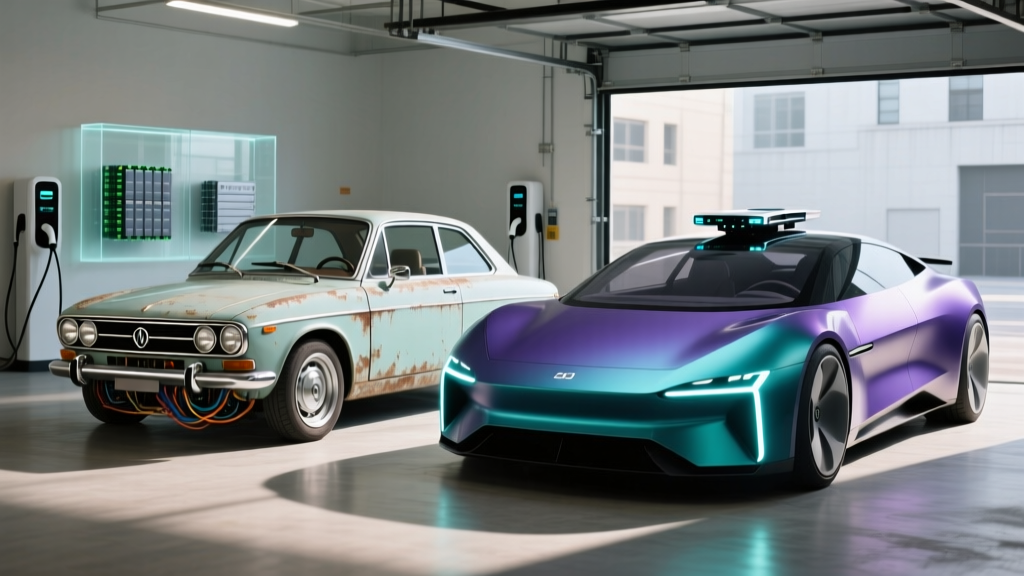
If you've stumbled across a 70's electric car in a museum, forum, or auction listing and wondered how those early battery-electric vehicles stack up against today's EVs, here's the direct answer: 1970s electric cars typically delivered 30–60 miles of range on heavy lead-acid batteries, topped out around 45–60 mph, and required 8–12 hours to recharge on a standard 120V outlet. A 2026 EV like the Chevrolet Equinox EV or Hyundai Ioniq 5 delivers 250–310+ EPA-rated miles, charges from 10–80% in 18–30 minutes on a DC fast charger, and accelerates to 60 mph in 5–7 seconds. The gap is enormous — but understanding why the 70's electric car failed is one of the best ways to evaluate whether a modern EV fits your life today.
Quick Answer: 70's Electric Car vs. 2026 EV
A typical 1970s EV (e.g., AMC Amitron concept, CitiCar, or converted lead-acid commuter) offered 30–60 miles of range, 40–60 mph top speed, and 8+ hour charge times. A 2026 mass-market EV delivers 250–350 EPA miles, 100+ mph cruising, and 10–80% DC fast charging in under 30 minutes. Battery chemistry has shifted from lead-acid (30–40 Wh/kg) to NMC lithium-ion (200–260 Wh/kg) and LFP (160–180 Wh/kg), a roughly 5–7× energy-density improvement.
The 1970s EV Landscape: What Buyers Actually Drove
The 1973 oil embargo triggered genuine interest in electric vehicles, but the production reality was grim. The Sebring-Vanguard CitiCar (1974–1977), one of the few mass-produced 70's electric cars, used eight 6-volt lead-acid batteries, produced roughly 2.5 horsepower, and topped out near 38 mph with about 40 miles of range. It sold around 2,600 units before the company folded.
Other efforts — the AMC Amitron (a concept that never reached production), converted Renault Dauphines, and various neighborhood electric vehicles (NEVs) — shared the same fundamental problem: lead-acid batteries are heavy, energy-poor, and slow to charge. A typical lead-acid pack weighed 800–1,200 lbs and stored 8–15 kWh of usable energy. For context, a single modern LFP module in a 2026 Tesla Model 3 stores roughly that much energy in a fraction of the weight.
The 70's electric car was also hamstrung by infrastructure. There were no public charging networks, no standardized connectors, and no power electronics capable of managing charge rates safely. Owners charged on standard 120V household outlets at roughly 1.2 kW — meaning a full recharge took overnight, sometimes longer.
Battery Chemistry: The Core Reason Modern EVs Work
The single biggest difference between a 70's electric car and a 2026 EV is battery chemistry. Here's how the technologies compare:
| Attribute | Lead-Acid (1970s EVs) | NMC Lithium-Ion (2026) | LFP Lithium-Ion (2026) |
|---|---|---|---|
| Energy Density | 30–40 Wh/kg | 200–260 Wh/kg | 160–180 Wh/kg |
| Cycle Life | 300–500 cycles | 1,000–2,000 cycles | 3,000–5,000+ cycles |
| Usable Pack Size (typical) | 8–15 kWh | 60–100 kWh | 50–82 kWh |
| Pack Weight | 800–1,200 lbs | 700–1,100 lbs | 900–1,300 lbs |
| Thermal Management | None (passive) | Active liquid cooling/heating | Active liquid cooling/heating |
| Cost per kWh (approx.) | $150–200 (but poor lifespan) | $100–130 | $70–95 |
Modern NMC (nickel manganese cobalt) and LFP (lithium iron phosphate) chemistries don't just store more energy — they accept charge faster, last longer, and integrate with thermal management systems that precondition the battery for optimal DC fast charging. A 70's electric car had none of this. Batteries degraded rapidly, especially in heat, and replacement costs were significant relative to the vehicle's value.
If you're shopping for a 2026 EV, the chemistry choice matters: LFP batteries (found in the Tesla Model 3 RWD, standard-range Ford Mustang Mach-E, and several BYD models) tolerate daily 100% charging and offer longer cycle life but sacrifice some range in cold weather. NMC packs (used in higher-trim Ioniq 5, BMW iX, Rivian R1S) deliver higher energy density and better cold-weather performance but benefit from 80% daily charge limits for longevity. Source: IRS §30D battery sourcing rules now also tie the $7,500 federal credit to critical-mineral and battery-component requirements, which directly affect which chemistry and supply chain your vehicle uses.
Range, Charging, and Performance: Then vs. Now
Let's put concrete 2026 numbers against the 70's electric car baseline:
| Metric | 1974 CitiCar (70's EV) | 2026 Chevy Equinox EV 3RS | 2026 Hyundai Ioniq 5 SEL | 2026 Tesla Model 3 LR |
|---|---|---|---|---|
| EPA Range | ~40 mi (estimated) | 319 mi | 310 mi | 363 mi |
| Battery (usable kWh) | ~9.6 kWh (lead-acid) | 85 kWh (NMC) | 77.4 kWh (NMC) | 79 kWh (NMC) |
| Top Speed | ~38 mph | 130 mph (electronically limited) | 115 mph | 125 mph |
| 0–60 mph | Did not reach 60 mph | ~7.9 sec | ~7.2 sec (RWD) | ~4.2 sec (AWD) |
| Max DC Charge Rate | N/A (no DC charging) | ~150 kW | ~240 kW (peak) | ~250 kW (V3 Supercharger) |
| 10–80% DC Time | N/A | ~32 min | ~18 min | ~25 min |
| Level 2 Charge Rate | ~1.2 kW (120V wall outlet) | 11.5 kW | 10.9 kW | 11.5 kW |
| Base MSRP | $2,700 (~$17,000 adj.) | $43,400 | $46,650 | $47,740 |
Real-World Range Reality (2026 EVs)
EPA range is measured under controlled lab conditions. In real-world highway driving at 70–80 mph, expect to use roughly 85–90% of the EPA sticker. In freezing temperatures (below 32°F), range can drop 20–35% due to battery resistance and cabin heating demands — even with a heat pump. A 310-mile Ioniq 5 may deliver ~240–260 miles on a cold winter highway trip. The 70's electric car had no thermal management at all, making winter range even more dismal.
Cost of Ownership: 70's Electric Car Economics vs. 2026
The CitiCar's $2,700 price tag in 1974 sounds cheap, but adjusted for inflation that's roughly $17,000 — and you got a vehicle that couldn't leave a 10-mile radius of your home. Today's EV economics are more nuanced. Here's a realistic 5-year cost breakdown for a 2026 EV versus a comparable gas vehicle:
| Cost Category | 2026 EV (e.g., Equinox EV ~$43K) | 2026 Gas Crossover (~$35K) |
|---|---|---|
| Purchase Price (after potential §30D credit) | $35,900 (if eligible for full $7,500 point-of-sale credit) | $35,000 |
| Energy/Fuel (5 yr, 75,000 mi) | $3,750 (home charging at $0.13/kWh, ~3.5 mi/kWh) | $9,375 (28 MPG avg, $3.50/gal) |
| Maintenance (5 yr) | $1,200 (cabin filter, wipers, tire rotation, brake fluid) | $4,500 (oil changes, filters, brakes, spark plugs) |
| Insurance (5 yr avg) | $9,500 (EVs typically 15–25% higher premiums) | $7,500 |
| Depreciation (est. 5 yr) | $18,000 (~50%) | $15,000 (~43%) |
| 5-Year Total Cost | $68,350 | $71,375 |
The EV wins on energy and maintenance — but higher insurance premiums and steeper depreciation (driven partly by Tesla price cuts and rapid tech obsolescence) narrow the gap. Your actual numbers depend heavily on electricity rates, annual mileage, state incentives, and whether you can charge at home on a Level 2 circuit.
For the 70's electric car owner, "fuel" costs were minimal (pennies per charge on residential electricity), but battery replacement every 2–3 years at $800–$1,500 (1970s dollars) wiped out any savings. Modern EV batteries carry 8-year/100,000-mile federal warranty mandates with capacity-retention thresholds (typically 70%), and real-world data from Tesla's impact reports and fleet operators show NMC packs retaining 85–90% capacity at 150,000 miles. Source: fueleconomy.gov EV technology overview.
Home Charging: The Make-or-Break Factor
One thing the 70's electric car and a 2026 EV share: home charging access determines whether ownership is practical or painful. The difference is that modern Level 2 charging actually works for daily needs.
| Item | Typical Cost Range | Notes |
|---|---|---|
| Level 2 EVSE (charger hardware) | $300–$700 | ChargePoint Home Flex, Emporia, Wallbox Pulsar Plus |
| 240V/50A circuit installation | $800–$2,500 | Depends on panel proximity, conduit run length |
| Electrical panel upgrade (if needed) | $1,500–$4,000 | Required if existing panel is 100A or maxed out |
| Permit & inspection | $100–$400 | Varies by municipality |
| Total (no panel upgrade) | $1,200–$3,600 | Most common scenario |
| Total (with panel upgrade) | $2,700–$7,100 | Older homes with 100A service |
At 11.5 kW (48A), a Level 2 home charger adds roughly 35–45 miles of range per hour. Most EV owners charge overnight and start every morning with a full battery — something the 70's electric car owner could only dream of at 1.2 kW. If you lack home charging access (apartment dwellers, street parking), public DC fast charging becomes your lifeline, and that changes the economics: DC fast charging costs $0.30–$0.50/kWh on networks like Electrify America and EVgo, roughly doubling the per-mile energy cost versus home charging.
Common Misconceptions About EVs (Lessons from the 70's)
| Myth (Held Over from the 70's Electric Car Era) | 2026 Fact |
|---|---|
| "EVs don't have enough range for real driving." | Most 2026 EVs deliver 250–360 EPA miles. The average American drives 37 miles/day (FHWA data). A 310-mile EV covers a week of commuting with room to spare. |
| "Batteries wear out quickly and cost a fortune to replace." | Modern NMC and LFP batteries are warrantied for 8 yr/100,000 mi at ≥70% capacity. Fleet data shows 85–90% retention at 150K mi. Full replacement: $8,000–$18,000 depending on pack size, but rarely needed within typical ownership. |
| "Charging takes too long." | At home on Level 2, you charge while sleeping (6–8 hours for full). On a road trip, a 240 kW-capable EV adds 150–200 miles in 15–20 minutes. Peak kW is not sustained — expect tapering above 80% SoC. |
| "EVs are worse in cold weather." | Range drops 20–35% in freezing temps — real and worth planning for. But preconditioning (warming the battery while plugged in) mitigates charging slowdowns, and heat pumps (standard on many 2026 models) reduce cabin-heating energy draw by 40–60%. |
| "EVs are worse for the environment because of electricity generation." | Even on coal-heavy grids, EVs produce fewer lifetime emissions than ICE vehicles (Union of Concerned Scientists analysis). On grids with 50%+ renewables, the advantage is massive. The 70's electric car ran on far dirtier grids and still had lower tailpipe emissions — zero. |
Decision Framework: Is a 2026 EV Right for You?
Choose a 2026 BEV (full electric) if:
- You have access to home Level 2 charging (garage, driveway, or workplace)
- Your daily driving is under 80 miles round-trip
- You want minimal maintenance and lower per-mile fuel cost
- You qualify for the §30D federal tax credit (income ≤$150K single / $300K joint; vehicle MSRP ≤$55K sedans / $80K SUVs/trucks; battery sourcing compliant)
- You take occasional road trips under 300 miles or are comfortable planning DC fast-charge stops
Choose a PHEV (plug-in hybrid) if:
- You lack reliable home charging but want some electric-only driving (20–45 mi EPA electric range on models like the Toyota RAV4 Prime or Jeep Wrangler 4xe)
- You frequently drive 400+ miles where charging infrastructure is sparse
- You want one vehicle for city commuting and long rural trips without route-planning anxiety
Stick with a hybrid (HEV) or gas vehicle if:
- You live in an apartment with zero charging access and no workplace charging
- Your budget is under $30,000 and you need a used vehicle (used EV credit capped at $4,000 under §25E with strict price and income limits)
- You regularly tow heavy loads over long distances (EV towing range drops 40–60%)
Frequently Asked Questions
Were there any production 70's electric cars people actually bought?
Yes. The Sebring-Vanguard CitiCar (1974–1977) was the most notable, with roughly 2,600 units sold. The Elcar (1974–1976) was another small-run option. Most were neighborhood-speed vehicles with lead-acid batteries, 30–40 mile range, and top speeds under 45 mph. They were more like modern NEVs (neighborhood electric vehicles) than highway-capable cars.
Why did 70's electric cars disappear?
Three factors: lead-acid batteries were too heavy and energy-poor for practical range; the oil crisis eased by the late 1970s, reducing urgency; and there was zero charging infrastructure. Without lithium-ion chemistry (commercially viable only from the 1990s onward), EVs simply couldn't compete with gasoline vehicles on range, speed, or convenience.
Can I still buy or drive a 70's electric car today?
You can find CitiCars and similar vehicles at classic-car auctions and EV-history museums. They're collectibles, not daily drivers. Parts availability is extremely limited, lead-acid battery packs need regular replacement, and these vehicles lack any modern safety equipment (airbags, crumple zones, ABS). Treat them as historical artifacts, not transportation.
What's the cheapest way to get into a modern EV in 2026?
The Chevrolet Equinox EV LT starts around $33,600 (before incentives) and qualifies for up to $7,500 in §30D federal credit if you meet income and sourcing requirements — potentially bringing the effective price below $27,000 via point-of-sale transfer. The Nissan Leaf S starts around $29,000 but uses the aging CHAdeMO DC charging standard, which limits road-trip practicality. Always verify current IRS eligibility at irs.gov before purchasing, as battery-sourcing rules change annually.
How does the 2026 EV charging network compare to what existed in the 1970s?
In the 1970s, there was effectively no public EV charging infrastructure — owners relied on standard 120V household outlets. In 2026, the U.S. has over 200,000 public charging ports across networks like Tesla Supercharger (now open to NACS-equipped non-Tesla EVs), Electrify America, EVgo, and ChargePoint. DC fast chargers up to 350 kW are common along interstate corridors. That said, rural charging deserts remain a real limitation, and charger reliability on non-Tesla networks still averages 75–85% uptime — a frustration the 70's EV owner never faced, because there was nothing to be unreliable.
The journey from a 70's electric car to a 2026 EV isn't just incremental improvement — it's a fundamental technology shift driven by lithium-ion chemistry, power electronics, and thermal management. The CitiCar proved that electric propulsion worked; it just couldn't work well enough with the tools available. Today's EVs solve every core limitation of their 1970s ancestors: range, speed, charging time, battery longevity, and safety. The remaining questions — charging access, cold-weather planning, upfront cost, and insurance — are real but solvable with the right information and the right vehicle choice for your specific driving pattern.