The Short Answer: 1900 Electric Cars vs. Today's EVs
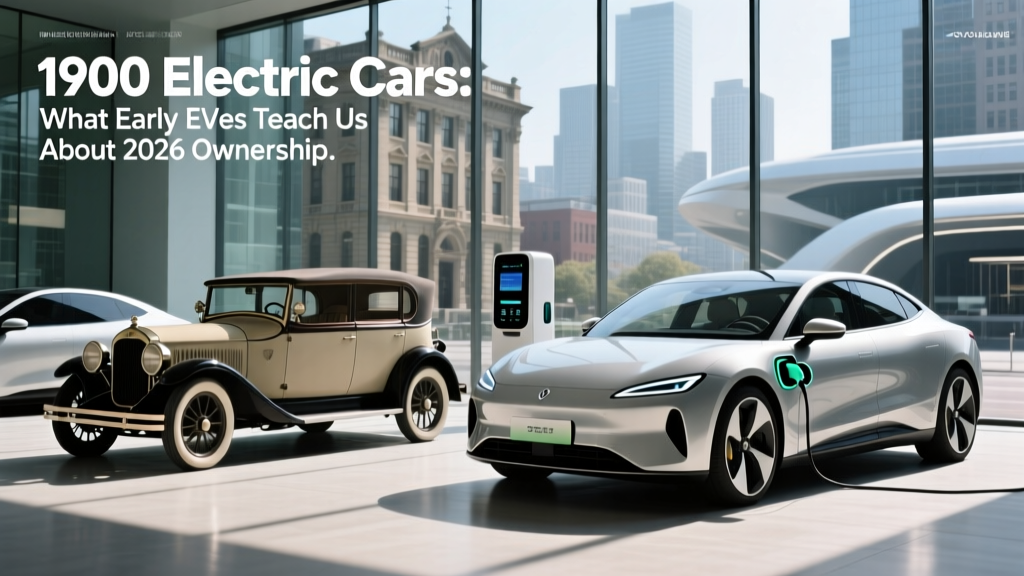
In 1900, electric cars like the Baker Electric and Columbia Phaeton offered roughly 20–40 miles of range, topped out near 15–20 mph, and cost $1,500–$3,000 (equivalent to $55,000–$110,000 today). They dominated urban transport before gasoline infrastructure displaced them. In 2026, a base Chevrolet Equinox EV delivers 315 miles of EPA range, charges at 150 kW DC, and starts at $33,600 — often dropping below $26,100 after the §30D federal tax credit. The core EV value proposition — quiet, efficient, zero tailpipe emissions — hasn't changed in 126 years. What changed is battery chemistry, charging infrastructure, and economies of scale.
Why 1900 Electric Cars Mattered — And Why They Disappeared
At the turn of the 20th century, electric vehicles outsold gasoline and steam-powered cars in the United States. In 1900, approximately 38% of automobiles were electric, 40% were steam, and only 22% ran on gasoline. Brands like Baker Electric, Columbia, and Detroit Electric marketed to urban professionals who valued silent operation, no hand-cranking, and adequate range for city errands.
The typical 1900 electric car used lead-acid batteries weighing 800–1,200 pounds, delivering 2–5 kWh of usable energy. That gave roughly 30 miles at 12–15 mph before requiring an 8–10 hour recharge from a 110V household outlet — essentially Level 1 charging, a century before the term existed.
Three factors killed the early EV market by 1920:
- Range limitation: Lead-acid energy density (~30 Wh/kg) couldn't compete with gasoline's ~12,000 Wh/kg
- Infrastructure gap: Texas oil discoveries and expanding gas stations made refueling ubiquitous
- Electric starter: Cadillac's 1912 electric starter eliminated hand-cranking, removing a key EV advantage
The parallel to 2026 is instructive: range, infrastructure, and convenience still determine EV adoption curves.
Range and Efficiency: Then vs. Now
| Specification | 1900 Baker Electric | 2026 Chevy Equinox EV 2LT | 2026 Toyota Camry (Gas) |
|---|---|---|---|
| Energy Storage | ~3 kWh (lead-acid) | 85 kWh (NMC lithium-ion) | 13.2 gal gasoline (~430 kWh) |
| Range | ~30 miles | 315 miles (EPA) | ~510 miles |
| Top Speed | ~14 mph | 130 mph (governed) | 135 mph |
| "Refuel" Time | 8–10 hours | ~25 min (10–80% at 150 kW DC) | ~3 minutes |
| Efficiency | ~100 Wh/mile | 3.4 miles/kWh (~294 Wh/mile) | 32 MPG combined |
| Weight | ~2,500 lbs | ~4,300 lbs | ~3,400 lbs |
Real-World Range Note: The Equinox EV's 315-mile EPA figure assumes moderate temperatures and mixed driving. Expect ~260–280 miles on sustained 75-mph highway runs, and 200–230 miles in sub-30°F winter conditions. Cold weather increases battery internal resistance and demands cabin heating — issues that 1900 EV owners knew well when winter cut their range in half.
The energy-density revolution is staggering. Modern NMC (nickel-manganese-cobalt) lithium-ion cells achieve ~250 Wh/kg at the cell level — roughly 8× the energy density of 1900-era lead-acid. LFP (lithium iron phosphate) chemistry, used in the base Tesla Model 3 and many 2026 affordable EVs, trades some energy density (~170 Wh/kg) for longer cycle life, lower cost, and reduced fire risk.
Cost of Ownership: 1900 vs. 2026 in Real Dollars
A 1900 Baker Electric cost approximately $2,000 — about $74,000 in 2026 dollars adjusted for inflation. Battery replacement (every 2–3 years) ran $300–$600 ($11,000–$22,000 today). Charging cost roughly $0.05/kWh at early 20th-century electricity rates, making per-mile fuel costs competitive with horse-drawn carriages but not with cheap gasoline.
| Cost Factor | 1900 Electric Car | 2026 Equinox EV | 2026 Gas Sedan (Camry) |
|---|---|---|---|
| Purchase Price (inflation-adj.) | ~$74,000 | $33,600 (~$26,100 after §30D) | $29,500 |
| Fuel/Energy per Mile | ~$0.03 | $0.04 (home) / $0.14 (DC fast) | $0.11 (at $3.50/gal, 32 MPG) |
| Annual "Fuel" (12,000 mi) | ~$360 ($13,300 adj.) | $480 (home) / $1,680 (DC only) | $1,313 |
| Maintenance/Year | Battery repl. every 2–3 yr | ~$400 (tires, cabin filter, fluid top-offs) | ~$900 (oil, filters, brakes, belts) |
| Battery Warranty | None | 8 yr / 100,000 mi (≥70% capacity) | N/A |
The 5-year total cost of ownership for a 2026 Equinox EV with home charging, after the §30D credit, typically undercuts a comparable gas sedan by $3,000–$7,000, according to fueleconomy.gov comparisons. The breakeven point depends heavily on home charging access and local electricity rates.
What 1900 EV Owners Would Recognize in 2026
Despite 126 years of progress, several ownership realities remain unchanged:
Home Charging Is the Cornerstone
In 1900, EV owners charged from household Edison-base outlets overnight — the equivalent of today's Level 1 (1.4 kW, ~4 miles of range per hour). In 2026, a Level 2 home charger (7.2–11.5 kW, ~25–40 miles/hour) remains the backbone of practical EV ownership. Installation costs $500–$2,500 depending on panel capacity and run length, with potential panel upgrades adding $1,500–$3,500 for older homes with 100A service.
Roughly 25–30% of US households lack reliable off-street parking, making home charging difficult. This is the modern equivalent of the 1905 infrastructure gap that killed early EVs — except today's public DC fast-charging networks (Electrify America, EVgo, Tesla Supercharger) partially fill the void.
Cold Weather Still Cuts Range
Lead-acid batteries lost 40–50% capacity below freezing. Modern lithium-ion cells, managed by active thermal systems and heat pumps, lose 15–30% in extreme cold — better, but still a real planning factor. The 2026 Hyundai Ioniq 5's heat pump and battery preconditioning minimize this penalty, but physics remains undefeated.
Charging Speed Defines Road-Trip Viability
A 1900 EV owner needed 8+ hours to recharge. A 2026 Hyundai Ioniq 5 peaks at 240 kW on a 350 kW DC fast charger, adding 10–80% in roughly 18 minutes — but only when the battery is preconditioned and ambient temperatures are moderate. The charge curve tapers sharply above 80%, meaning that last 20% can take as long as the first 80%. Smart road-trippers charge to 80% and hop to the next station rather than waiting for a full fill.
Federal Tax Credits: The 2026 Rules You Need to Know
The IRS §30D clean vehicle credit offers up to $7,500 for qualifying new EVs, but eligibility is anything but universal. Key requirements for 2026:
- MSRP cap: Vans/SUVs/pickups ≤ $80,000; sedans ≤ $55,000
- Income cap: Modified AGI ≤ $300,000 (joint) / $225,000 (head of household) / $150,000 (single)
- Battery sourcing: Increasing percentages of critical minerals and battery components must be sourced from the US or FTA-partner nations — many popular models lose partial or full credit eligibility year to year
- Point-of-sale transfer: Buyers can transfer the credit to the dealer at purchase, reducing the sale price directly rather than waiting for a tax refund
- Final assembly: Vehicle must be assembled in North America
Always verify current eligibility on the IRS website and consult a tax professional — sourcing rules shift annually, and a model that qualifies in January may not in July.
Decision Framework: Should You Buy an EV in 2026?
Choose an EV If:
- You have access to Level 2 home or workplace charging (covers ~80% of daily driving)
- Your daily commute is under 80 miles round-trip (well within any modern EV's range)
- You qualify for the §30D credit (effective price drops by $7,500)
- You drive 10,000+ miles/year (fuel savings compound faster)
- You live in a region with moderate winters or have access to DC fast charging for road trips
Choose a PHEV (Plug-In Hybrid) If:
- You lack reliable home charging but want some electric-only driving
- You regularly take 300+ mile road trips through charging-sparse areas
- You want EV-like daily commuting with gas-car range security
Stick With Gas or Hybrid If:
- You have no home or workplace charging and public infrastructure is sparse in your area
- You tow heavy loads frequently (towing can cut EV range by 40–60%)
- Your budget can't absorb higher upfront cost even with tax credits
- You live in extreme-cold climates and can't accommodate 25–30% winter range loss
Common Misconceptions — 1900 to Now
| Myth | Fact |
|---|---|
| "EV batteries need replacing every few years" | Modern lithium-ion packs are warrantied for 8 years/100,000 miles at ≥70% capacity. Most retain 85–90% after 100,000 miles. Replacement costs $8,000–$18,000 if needed out of warranty. |
| "EVs are worse in winter" | Range drops 15–30%, but EVs start reliably in any cold (no engine cranking), and preconditioning while plugged in preserves range. AWD EVs like the Ioniq 5 excel in snow with instant torque. |
| "Charging takes too long" | Home charging happens while you sleep (8–10 hours for a full charge on Level 2). Road-trip DC fast charging adds 150–200 miles in 15–20 minutes at modern stations. |
| "The grid can't handle EVs" | Most EV charging occurs overnight during off-peak hours. A single EV adds roughly the same load as a central AC unit. Utilities are upgrading distribution transformers proactively. |
| "EVs produce more emissions than gas cars" | Even on coal-heavy grids, lifetime emissions are 50–70% lower per EPA lifecycle analysis. On clean grids, the advantage exceeds 80%. |
What a First-Time EV Buyer Must Know in 2026
1. kW vs. kWh — Know the Difference
This is the single most common confusion. kW (kilowatts) measures power — how fast energy flows, like water pressure in a hose. kWh (kilowatt-hours) measures energy — the total amount stored or consumed, like gallons in a tank. A 85 kWh battery charged at 11.5 kW takes roughly 7.5 hours from empty. A 150 kW DC fast charger delivers that same 85 kWh in about 35 minutes (real-world, accounting for taper).
2. EPA Range ≠ Real-World Range
EPA testing includes city and highway cycles with climate control on, but sustained 75-mph highway driving, cold weather, hilly terrain, and aggressive acceleration all reduce range. Budget 15–25% below the EPA sticker for trip planning.
3. Charging Connector Matters
As of 2026, the industry is consolidating around NACS (North American Charging Standard, used by Tesla and adopted by Ford, GM, Rivian, Hyundai/Kia, and most others). CCS1 is still supported at most public stations but is being phased out on new vehicles. CHAdeMO is effectively legacy. Verify your vehicle's connector and carry the appropriate adapter.
4. Insurance Costs More
EV insurance premiums run 15–25% higher than comparable gas vehicles due to higher repair costs and total-loss thresholds. Shop quotes before purchasing.
5. Maintenance Is Minimal — But Tires Aren't
No oil changes, no spark plugs, no transmission fluid. Regenerative braking extends brake pad life to 100,000+ miles. However, EVs are heavier and deliver instant torque, wearing tires 20–30% faster. Budget for tire replacement every 25,000–40,000 miles.
How long do modern EV batteries actually last?
Most lithium-ion EV batteries retain 85–92% capacity after 100,000 miles based on fleet data. Federal warranty requirements mandate 8 years/100,000 miles with at least 70% capacity retention. LFP chemistry batteries (in base Tesla Model 3, some BYD models) often exceed 3,000 charge cycles with minimal degradation — potentially outlasting the vehicle itself.
Can I install a Level 2 charger in any home?
Most homes with a 200A electrical panel and a nearby 240V outlet (or the ability to run one) can support Level 2 charging. Homes with older 100A panels may need a panel upgrade ($1,500–$3,500) or a smart charger with load management. Always consult a licensed electrician for final specifications — your panel's available amperage determines your maximum charge rate.
Are 1900 electric cars related to modern EVs?
Only philosophically. The core concept — electric motor, battery storage, plug-in charging — is identical. But modern lithium-ion chemistry, power electronics, thermal management, and regenerative braking represent over a century of materials science and engineering progress. A 2026 EV is roughly 10× more energy-dense, 5× faster, and 10× longer-ranged than a 1900 Baker Electric, at a third of the inflation-adjusted cost.
What's the cheapest new EV I can buy in 2026?
The Nissan LEAF S starts at $28,140 with 149 miles of EPA range and uses the older CHAdeMO DC connector — functional but increasingly unsupported. The Chevrolet Equinox EV 2LT at $33,600 (potentially ~$26,100 after the §30D credit) offers 315 miles, NACS compatibility, and 150 kW DC fast charging — a far more practical choice for most buyers.
Do EVs hold their resale value?
EV depreciation has been steeper than gas vehicles in recent years, driven by rapid technology improvements, price cuts from Tesla, and battery-health uncertainty in used models. Expect 45–55% depreciation over 5 years versus 35–45% for comparable gas vehicles. This gap is narrowing as the market matures and battery longevity data becomes more established.
The arc from 1900 electric cars to 2026 EVs is a story of chemistry, infrastructure, and economics converging. The early EV didn't fail because the concept was wrong — it failed because battery technology and energy infrastructure hadn't caught up. In 2026, they have. The question is no longer whether EVs work, but whether your specific driving patterns, charging access, and budget make one the right choice for you.