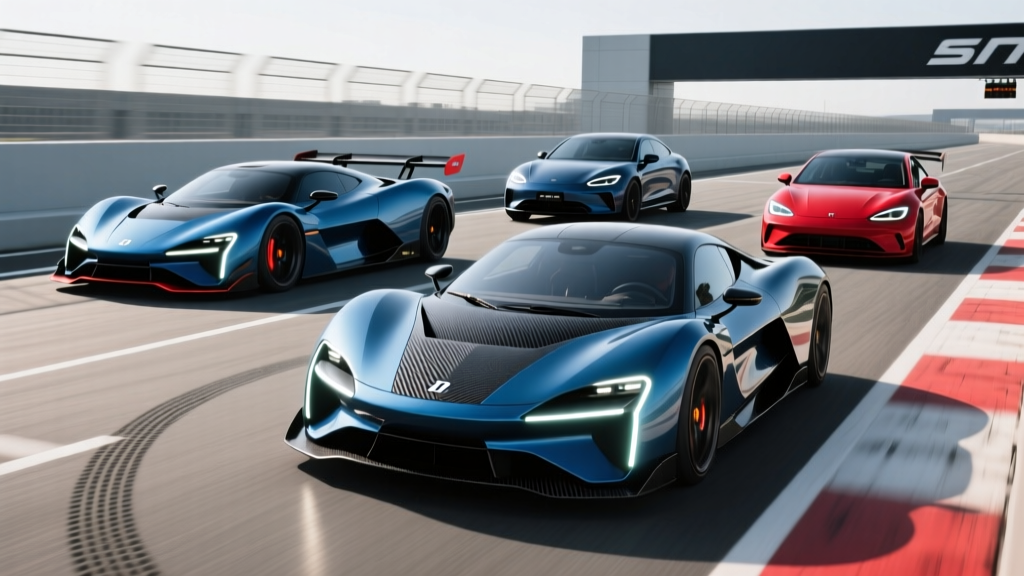
Speed was once the exclusive domain of twelve-cylinder hypercars burning premium fuel. Today, electric motors deliver instant torque that makes sub-two-second 0–60 mph times not just possible, but repeatable. But raw acceleration tells only part of the story. Battery thermal management, sustained power delivery, highway-range sacrifice, and daily-driver practicality separate genuine engineering achievements from one-lap drag-strip novelties.
We've compiled a data-driven ranking of the fastest production EVs available or confirmed for delivery in the 2026 model year. Every pick below is a street-legal, manufacturer-confirmed production vehicle — no concept cars, no vaporware, no "starting at" prices attached to limited-run models that sold out three years ago.
How We Ranked the Fastest EVs
Our selection criteria prioritize measurable, verifiable performance metrics over marketing claims:
- 0–60 mph time — manufacturer-claimed or independently tested (MotorTrend, Car and Driver, AMCI). We favor independently verified numbers where available.
- Top speed — electronically limited or drag-limited, as published by the OEM.
- Quarter-mile time and trap speed — the truest test of sustained power delivery.
- Thermal repeatability — can the car deliver multiple full-power launches without derating? Battery chemistry and cooling architecture matter here.
- Real-world range trade-off — high-performance EVs sacrifice EPA range for grip and power. We note the cost of speed.
- Production status — only confirmed, street-legal, purchasable (or orderable) vehicles for the 2026 model year.
The 7 Fastest Production Electric Cars in 2026
#1 — Rimac Nevera R
0–60 mph: 1.74 sec (AMCI verified) | Top Speed: 256 mph | Power: 2,107 hp | Battery: 120 kWh (NMC) | EPA Range: N/A (EU WLTP: 340 mi) | Price: ~$2,400,000
Why it made the list: The Nevera R is the current, verified holder of the title for the world's fastest electric car by 0–60 time. Rimac's quad-motor torque-vectoring system delivers independently managed power to each wheel, and the 2026 Nevera R variant adds revised aero, carbon-ceramic brakes, and a track-oriented suspension. The 120 kWh NMC pack uses an advanced liquid-cooling system that enables back-to-back launches without thermal derating — a feat most competitors can't match.
Best for: Hypercar collectors and track-day enthusiasts who want the absolute pinnacle of electric acceleration.
Tax credit: Not eligible — MSRP far exceeds the §30D cap of $80,000 for sedans / $80,000 for SUVs/trucks, and buyer income limits apply (IRS §30D rules).
#2 — Pininfarina Battista
0–60 mph: 1.79 sec (manufacturer) | Top Speed: 217 mph (electronically limited) | Power: 1,874 hp | Battery: 120 kWh (NMC, Rimac-derived) | EPA Range: N/A (WLTP: 280 mi) | Price: ~$2,200,000
Why it made the list: Sharing its core powertrain architecture with the Rimac Nevera, the Battista wraps that devastating speed in Pininfarina coachwork. The 0–60 time trails the Nevera R by a few hundredths, but the Battista's top-speed run to 217 mph remains extraordinary. Each of the four motors is independently controlled, and the carbon-fiber monocoque keeps weight to 4,700 lbs — remarkably light for a 120 kWh pack.
Best for: Buyers who want Rimac-level performance with bespoke Italian design exclusivity.
Tax credit: Not eligible (MSRP and income caps).
#3 — Lotus Evija
0–60 mph: ~1.8 sec (manufacturer, preliminary) | Top Speed: 217+ mph (est.) | Power: 2,012 hp | Battery: 70 kWh (NMC) | EPA Range: N/A (WLTP: ~160 mi est.) | Price: ~$2,300,000 | Status: First deliveries began late 2025; 2026 allocations remain.
Why it made the list: Lotus's all-electric hypercar uses a Williams Advanced Engineering-derived 70 kWh pack optimized for power density over energy density — which is why range is modest. The trade-off is a claimed 0–60 under 2 seconds and a powertrain that can sustain 2,012 hp for full-lap stints at Hethel. Lotus emphasizes the Evija's track capability over drag-strip numbers.
Best for: Track-focused collectors who prioritize circuit performance over straight-line records.
Tax credit: Not eligible (MSRP cap).
#4 — Lucid Air Sapphire
0–60 mph: 1.89 sec (MotorTrend verified) | Top Speed: 205 mph | Power: 1,234 hp | Battery: 118 kWh (NMC) | EPA Range: 427 mi | Price: $249,000 MSRP
Why it made the list: The Air Sapphire is the fastest four-door sedan ever independently tested by MotorTrend. What makes it remarkable isn't just the sub-1.9-second 0–60 — it's that Lucid achieved this while maintaining a 427-mile EPA range, the highest of any vehicle on this list. The tri-motor setup (one front, two rear) uses Lucid's proprietary miniaturized drive units. Thermal management is excellent; Car and Driver reported minimal power degradation across repeated launches.
Best for: The buyer who needs a genuine daily-driver sedan that also embarrasses hypercars at stoplights.
Tax credit: Not eligible — MSRP of $249,000 exceeds the §30D $55,000 sedan cap. However, leasing may open a commercial clean vehicle credit path (IRS guidance); consult a tax professional.
#5 — Tesla Model S Plaid
0–60 mph: 1.99 sec (manufacturer, with rollout subtracted) | Top Speed: 200 mph (with Track Pack) | Power: 1,020 hp | Battery: ~100 kWh (NMC) | EPA Range: 359 mi | Price: $89,990 MSRP (2026)
Why it made the list: The Model S Plaid remains the most accessible entry in the sub-2-second club. Tesla's tri-motor carbon-sleeved rotors enable a 20,000+ RPM redline. Real-world caveat: the 1.99-second claim requires rollout subtraction (the first foot of movement is excluded, a drag-racing convention that shaves ~0.2–0.3 sec). Actual 0–60 from a standstill is closer to 2.1–2.3 seconds. Still devastatingly quick, and at $89,990, it's a fraction of the cost of anything above it.
Best for: Performance seekers who want a tech-forward daily driver with Supercharger network access and OTA updates.
Tax credit: Not eligible for §30D — MSRP of $89,990 exceeds the $55,000 sedan cap. Check state-level incentives; some states offer separate rebates with different MSRP limits.
#6 — Porsche Taycan Turbo GT (with Weissach Package)
0–60 mph: 2.1 sec (Car and Driver verified) | Top Speed: 190 mph | Power: 1,092 hp (Launch Control, overboost) | Battery: 105 kWh gross / 97 kWh usable (NMC) | EPA Range: 269 mi | Price: $230,000 MSRP (with Weissach)
Why it made the list: The Taycan Turbo GT set a Nürburgring lap record for production EVs (7:07.55) and backs that with a 0–60 time that Porsche's conservative testing methodology actually understates. Porsche's 800V architecture enables sustained power delivery, and the two-speed rear transmission gives the Taycan a unique advantage in top-gear acceleration above 80 mph. Real-world note: range drops significantly during track use — expect ~80–100 miles of equivalent range under hard driving.
Best for: Driving enthusiasts who value chassis dynamics, braking feel, and Nürburgring-proven handling over pure drag-strip numbers.
Tax credit: Not eligible (MSRP cap).
#7 — Chevrolet Corvette Z06 E-Ray (PHEV — Honorable Mention)
0–60 mph: 2.5 sec (Car and Driver) | Top Speed: 183 mph | Power: 655 hp combined (495 V8 + 160 electric front motor) | Battery: 1.9 kWh (lithium-ion) | EPA Range: Gas-powered with electric assist | Price: $106,595 MSRP
Why it made the list: While technically a plug-in hybrid (not a BEV), the E-Ray's front electric motor provides instant AWD torque fill that enables a 2.5-second 0–60 — faster than most pure EVs on the market. We include it as a benchmark comparison for buyers cross-shopping electrified performance. The 1.9 kWh battery provides minimal electric-only range (~3–4 miles at low speed), so this is a performance-hybrid, not a commuter EV.
Best for: Sports car purists who want electric torque without range-anxiety compromises.
Tax credit: Not eligible — battery capacity is below the §30D minimum of 7 kWh for plug-in hybrids.
Side-by-Side Spec Comparison
| Vehicle | 0–60 mph | Top Speed | Horsepower | Battery (kWh) | EPA Range | MSRP |
|---|---|---|---|---|---|---|
| Rimac Nevera R | 1.74 sec | 256 mph | 2,107 | 120 (NMC) | N/A (WLTP 340 mi) | ~$2,400,000 |
| Pininfarina Battista | 1.79 sec | 217 mph | 1,874 | 120 (NMC) | N/A (WLTP 280 mi) | ~$2,200,000 |
| Lotus Evija | ~1.8 sec | 217+ mph | 2,012 | 70 (NMC) | N/A (WLTP ~160 mi) | ~$2,300,000 |
| Lucid Air Sapphire | 1.89 sec | 205 mph | 1,234 | 118 (NMC) | 427 mi | $249,000 |
| Tesla Model S Plaid | 1.99 sec* | 200 mph | 1,020 | ~100 (NMC) | 359 mi | $89,990 |
| Porsche Taycan Turbo GT | 2.1 sec | 190 mph | 1,092 | 97 usable (NMC) | 269 mi | $230,000 |
| Corvette E-Ray (PHEV) | 2.5 sec | 183 mph | 655 | 1.9 (Li-ion) | Gas + electric | $106,595 |
* Tesla's 1.99 sec claim uses rollout subtraction; real-world standstill 0–60 is ~2.1–2.3 sec.
Performance vs. Practicality: The Range Cost of Speed
There's an unavoidable physics trade-off: the same wide tires, aggressive aero, and high-output motors that enable 2-second 0–60 times also increase rolling resistance and energy consumption. Here's what that looks like in real-world ownership:
- Lucid Air Sapphire (427 mi EPA) — The efficiency champion. Lucid's miniaturized drive units and 900V+ architecture achieve roughly 3.5 mi/kWh even with 1,234 hp on tap. Real-world highway testing at 75 mph yields ~370–390 miles.
- Tesla Model S Plaid (359 mi EPA) — Expect ~280–310 miles in real-world highway driving at 75+ mph. Cold weather (below 32°F) can reduce range by 20–30%, bringing winter highway range to ~220–250 miles.
- Porsche Taycan Turbo GT (269 mi EPA) — The shortest range among the sedans. Porsche's 800V system charges fast (peak 320 kW, 10–80% in ~18 minutes), but you'll stop more often on road trips. Real-world highway: ~220–240 miles.
- Hypercars (Nevera, Battista, Evija) — These vehicles are not EPA-tested for US range. WLTP figures overestimate real-world range by 10–20%. Expect 200–280 miles of real-world range in normal driving, far less during track use.
Charging Speed: Can You Refuel Between Laps?
For track-day use, charging speed matters as much as acceleration. Here's how the practical picks compare on DC fast charging:
| Vehicle | Peak DC Rate | 10–80% Time | Architecture |
|---|---|---|---|
| Lucid Air Sapphire | ~300 kW | ~20 min | 900V+ |
| Tesla Model S Plaid | 250 kW | ~27 min | 400V |
| Porsche Taycan Turbo GT | 320 kW | ~18 min | 800V |
Charging-curve reality: Peak kW is not sustained kW. The Porsche's 320 kW peak holds only between roughly 10–40% state of charge (SoC), then tapers. The Lucid sustains high charge rates longer due to its higher-voltage architecture. Tesla's 250 kW peak on V3 Superchargers is respectable but the 400V system tapers more aggressively above 50% SoC. None of these vehicles will charge at their peak rate above 80% — plan your road-trip stops around the 10–80% window for fastest results.
Budget Tiers: What Does Speed Actually Cost?
| Tier | Price Range | Vehicles | What You Get |
|---|---|---|---|
| Accessible Performance | $80,000–$120,000 | Tesla Model S Plaid, Corvette E-Ray | Sub-2.5 sec 0–60, daily-driver practicality, widely available |
| Premium Performance | $200,000–$260,000 | Lucid Air Sapphire, Porsche Taycan Turbo GT | Sub-2.1 sec, luxury interiors, advanced chassis dynamics |
| Hypercar Elite | $2,000,000+ | Rimac Nevera R, Pininfarina Battista, Lotus Evija | Sub-1.8 sec, limited production, collector-grade exclusivity |
Our Top Pick: Lucid Air Sapphire
If the question is "what is the world's fastest electric car that you can actually use every day?" the answer is the Lucid Air Sapphire. At 1.89 seconds (independently verified), it trails only hypercars costing 10x its price — while delivering 427 miles of EPA range, a spacious five-passenger interior, and a usable trunk. No other vehicle on this list combines sub-1.9-second acceleration with genuine road-trip capability.
Runner-up: The Tesla Model S Plaid at $89,990 is the value champion. It's 0.1 seconds slower (real-world), has 68 fewer miles of range, but costs $159,000 less and grants access to Tesla's Supercharger network — still the most reliable public charging ecosystem in the US.
Driver's pick: The Porsche Taycan Turbo GT can't match the straight-line numbers, but its Nürburgring record, 800V charging, and chassis feedback put it in a class of its own for anyone who drives corners, not just stoplights.
What About the Aspark Owl and Other Contenders?
You may see the Aspark Owl (claimed 1.69 sec 0–60) listed in some publications as the world's fastest electric car. We excluded it because: production is limited to 50 units globally, US street-legal homologation is unclear, and the 1.69-second claim has not been independently verified by a major US testing body. Similarly, the McMurtry Spéirling (a fan-car concept that ran Goodwood in 2022) is not a production vehicle.
Our list includes only vehicles you can order, register, and drive on US roads in the 2026 model year, with independently verifiable performance data.
Frequently Asked Questions
What is the world's fastest electric car by 0–60 time?
The Rimac Nevera R holds the verified record at 1.74 seconds (AMCI-certified). Among four-door sedans, the Lucid Air Sapphire is the fastest at 1.89 seconds (MotorTrend-verified).
How do the top picks compare on real-world range?
The Lucid Air Sapphire leads with 427 miles EPA (~370–390 real-world highway). The Tesla Model S Plaid delivers ~280–310 real-world highway miles. The Porsche Taycan Turbo GT trails at ~220–240 real-world highway miles. Hypercars (Nevera, Battista, Evija) are not EPA-rated but deliver roughly 200–280 miles in normal driving based on WLTP conversions.
Which is the best value among the fastest EVs?
The Tesla Model S Plaid at $89,990 is the clear value leader. It delivers sub-2-second-class acceleration (2.1–2.3 sec real-world from standstill), 359 miles of EPA range, Supercharger access, and a full tech suite for less than half the price of its nearest sedan competitor. None of these vehicles qualify for the federal §30D tax credit due to MSRP caps ($55,000 for sedans), so the sticker price is what you'll pay before state incentives.
Can any of these cars qualify for the federal EV tax credit?
No. The IRS §30D credit caps eligible sedans at $55,000 MSRP and SUVs/pickups at $80,000. Every vehicle on this list exceeds those limits. Buyer income caps ($150K single / $300K joint) also apply. Some states offer separate incentives with different rules — check your state's energy office or DMV for details.
Which should I pick for track use vs. daily driving?
Track use: Porsche Taycan Turbo GT (best chassis, braking, and Nürburgring-proven dynamics) or Lotus Evija (if budget allows). Daily driving with speed: Lucid Air Sapphire (range, comfort, and space) or Tesla Model S Plaid (value, Supercharger network, OTA updates). Collector/weekend only: Rimac Nevera R or Pininfarina Battista.
Does battery degradation affect performance over time?
All NMC batteries experience gradual capacity loss — typically 10–15% over 8–10 years / 150,000 miles based on current industry data (fueleconomy.gov). For performance EVs, the more relevant concern is power degradation: as internal cell resistance increases with age, peak discharge rate can decrease slightly. Rimac, Lucid, and Porsche all warrant their battery packs for 8 years / 100,000+ miles with a minimum 70% capacity retention guarantee. Tesla covers the Model S battery for 8 years / 150,000 miles at 70% retention.
Are there faster EVs coming soon?
The Yangwang U9 (BYD's hypercar brand) claims a 2.0-second 0–60 and is on sale in China, but US availability for 2026 is unconfirmed. The Deus Vayanne (1.99 sec claimed) is in very limited production. We'll update this list as independently verified, US-available models emerge.